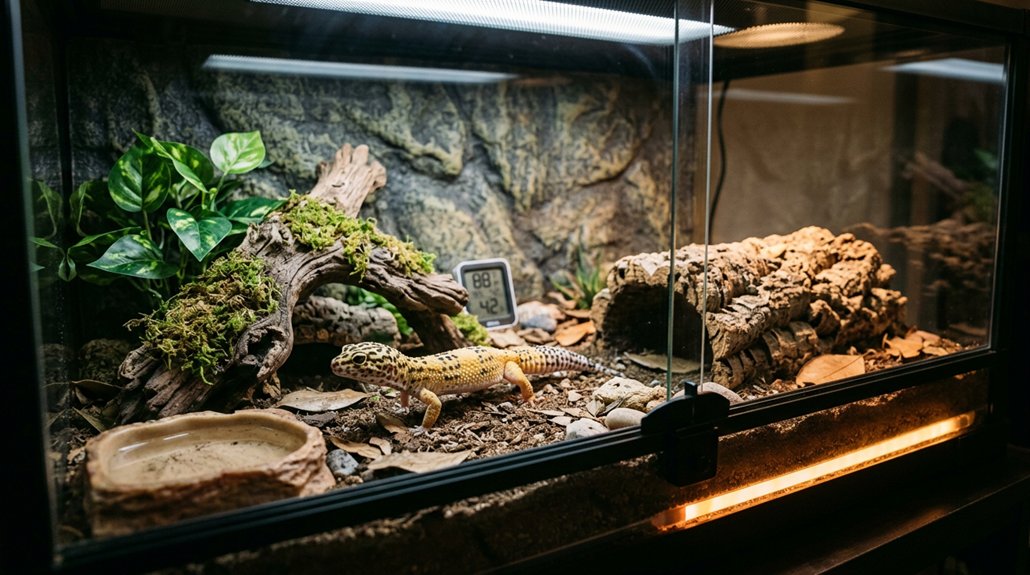
To create the perfect leopard gecko tank, guarantee you use a bioactive substrate mix of 60% organic topsoil and 40% play sand, maintaining a depth of at least 4 inches for natural behaviors. Schedule overhead heat sources like halogen bulbs for basking temperatures of 94-97°F and use heat mats for consistent warmth. Provide 12-14 hours of light with UVB bulbs like Arcadia ShadeDweller 7% to mimic daylight. More insights await to refine your approach.
Key Takeaways
- Maintain basking area at 94-97°F, warm hides at 90-92°F, and cool zones at 70-77°F using halogen bulbs and heat mats.
- Ensure daylight cycle of 12-14 hours with UVB lights like Arcadia ShadeDweller 7% or Zoo Med T5 HO.
- Use a bioactive substrate mix of 60% organic topsoil and 40% play sand, at least 4 inches deep.
- Maintain humidity levels at 70-80% with a digital hygrometer and moist hides in the tank.
- Avoid substrates like calcium sand to prevent impaction; opt for materials that mimic natural environments.
How to Create the Perfect Leopard Gecko Environment
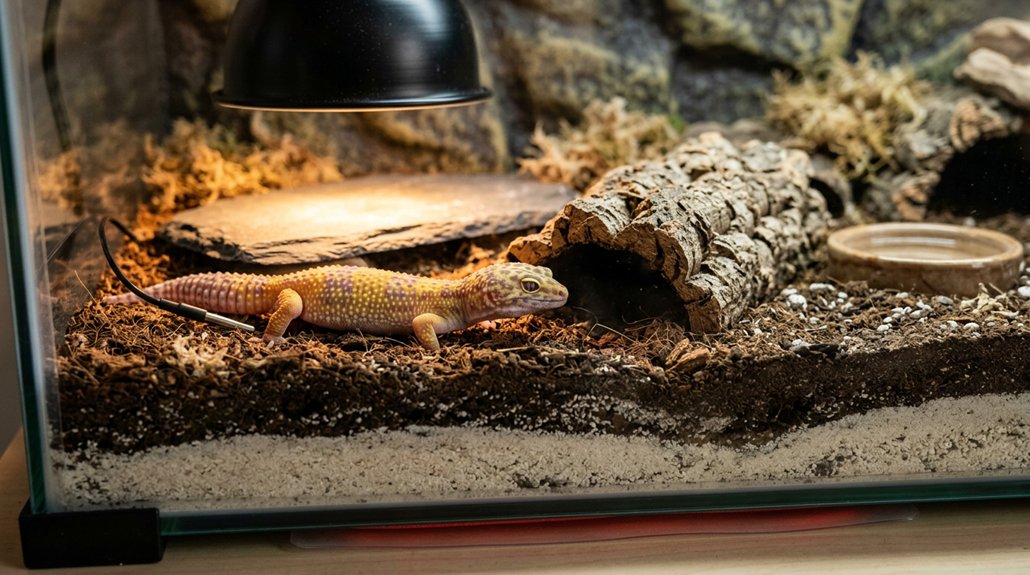
Creating the perfect leopard gecko environment involves understanding and replicating their natural habitat with precise temperature and humidity conditions. Implement a temperature gradient with basking spots at 94-97°F, guaranteeing optimal basking behavior. Maintain a warm hide at 90-92°F to support nocturnal habits and a cool zone between 70-77°F for stress reduction. Use overhead heating like halogen bulbs for consistent ambient heat without belly heat. Establish humidity control with a moist hide at 70-80%, using a digital hygrometer for accuracy. Provide a 4-inch deep bioactive substrate, combining 60% organic topsoil and 40% play sand for burrowing instincts. Arrange smooth-edged rocks and logs, creating feeding zones and enrichment opportunities, enhancing habitat preferences, while health monitoring through visual assessments ensures environmental suitability.
Choosing the Right Tank Size
When selecting a tank for your leopard gecko, it’s important to evaluate dimensions that cater to their adult size and behavioral needs, with a minimum volume of 10 gallons ensuring sufficient space. Look for a long and shallow tank design, which accommodates their terrestrial habits, alongside proper ventilation through strategically placed air holes. Accessibility should also be assessed, allowing for easy maintenance and interaction while preventing escape.
Recommended Tank Dimensions
A minimum of a 36”L x 18”W x 18”H tank is recommended for Leopard Geckos, offering sufficient space for their comfort and mobility. These tank dimensions align with their habitat preferences, enabling them to exhibit natural behaviors. Juveniles can initially occupy a 10-gallon (38 liters) tank, but remember they’ll outgrow this space quickly. For longer-term housing, prioritize enclosures that mimic their terrestrial lifestyle by focusing on ground area rather than height.
- Juvenile tank: Suitable for starting, not for adult permanence.
- Terrestrial behavior: Geckos prefer horizontal space to vertical.
- Multiple occupants: Double space and add hides to minimize stress.
- Growth accommodations: Prepare for their permanent tank proactively.
These considerations guarantee your geckos thrive in a well-structured and spacious habitat.
Ventilation and Accessibility
After considering the ideal dimensions for a Leopard Gecko’s habitat, attention turns to ventilation and accessibility, two critical factors in selecting the right tank size. Understanding ventilation importance is essential, as it prevents humidity buildup, ensuring your gecko’s health. Choose a tank with screen tops or wall vents for effective air exchange. Accessibility benefits arise from front-opening designs, reducing handling stress and simplifying maintenance. When housing multiple geckos, double the tank size and add hides to alleviate territorial stress.
Here’s a quick overview:
| Factor | Emotional Impact |
|---|---|
| Ventilation | Fresh air, health |
| Accessibility | Stress-free handling |
| Tank Size | Freedom to explore |
| Gecko Comfort | Happiness and well-being |
| Territorial Space | Peaceful coexistence |
Prioritize your Leopard Gecko’s wellness by balancing these elements in your enclosure design.
Creating an Effective Heating Setup
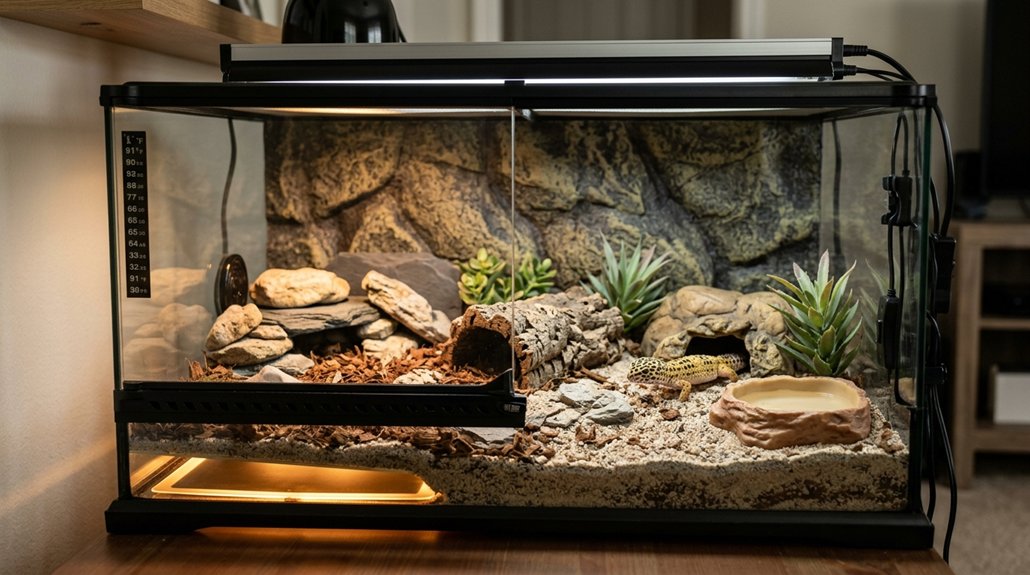
To guarantee the health and well-being of your Leopard Gecko, you’ll need to maintain specific thermal conditions, including a basking surface temperature of 94-97°F and a warm hide temperature of 90-92°F. Utilizing overhead heat sources like halogen bulbs or deep heat projectors will mimic the gecko’s natural environment, while achieving a proper temperature gradient across the tank. Use a digital thermometer and place a thermostat probe inside the warm hide for precise temperature monitoring and control, making necessary adjustments to your heat sources to maintain the ideal range.
Optimal Temperature Range
Ensuring your Leopard Gecko’s habitat is correctly heated is essential for facilitating ideal thermoregulation, which in turn influences their overall health. Maintaining a basking surface temperature between 94-97°F (34-36°C) is vital, as this helps with digestion and activity. Use digital thermometers for precise temperature monitoring to keep basking spots within this range. The warm hide area should be slightly cooler, targeting 90-92°F (32-33°C), while the enclosure’s cool side should remain at 70-77°F (21-25°C). Nighttime temperatures can drop to 60°F (16°C), but shouldn’t go below this threshold. Prefer overhead heat sources like halogen bulbs over belly heat for a natural warmth distribution.
- Basking surface: 94-97°F (34-36°C)
- Warm hide: 90-92°F (32-33°C)
- Cool side: 70-77°F (21-25°C)
- Nighttime: 60°F (16°C) minimum
Adjusting Heat Sources
Creating an effective heating setup for your Leopard Gecko involves utilizing overhead heat sources, such as halogen bulbs and deep heat projectors, which are essential for achieving ideal basking surface temperatures of 94-97°F (34-36°C). These heat source options must be well-controlled to establish a proper gradient within the enclosure—ensuring warm hide temperatures of 90-92°F (32-33°C) and cool zones at 70-77°F (21-25°C). Precise temperature control is crucial; employ a thermostat-regulated heat mat, placing its probe securely inside the warm hide for accurate readings. To prevent overheating, utilize lamp dimmers or select lower wattage bulbs strategically. Regularly monitor temperatures with a digital thermometer, making necessary adjustments to maintain a stable environment that meets your gecko’s thermoregulatory needs.
Selecting Lighting for Healthy Geckos
When setting up lighting for your leopard gecko’s habitat, it’s crucial to contemplate the specifics that support their health and well-being. Reptile lighting must mimic their natural environment to maintain ideal photoperiod importance and enhance UVB benefits. You should provide 12-14 hours of daylight duration using appropriate lighting types like Arcadia ShadeDweller 7% or Zoo Med T5 HO. These guarantee UV exposure, aiding metabolic functions. Incorporate light timers to stabilize the photoperiod, which minimizes stress and supports circadian rhythms.
Use a Solarmeter 6.5 to confirm the UVB bulb’s distance offers accurate exposure.
- UVB benefits: Vital for metabolic support
- Light timers: Maintain consistent daily light cycles
- Daylight duration: 12-14 hours for natural rhythms
- Habitat mimicry: Proper light intensities replicate wild conditions
Choosing the Best Substrate for Leopard Geckos
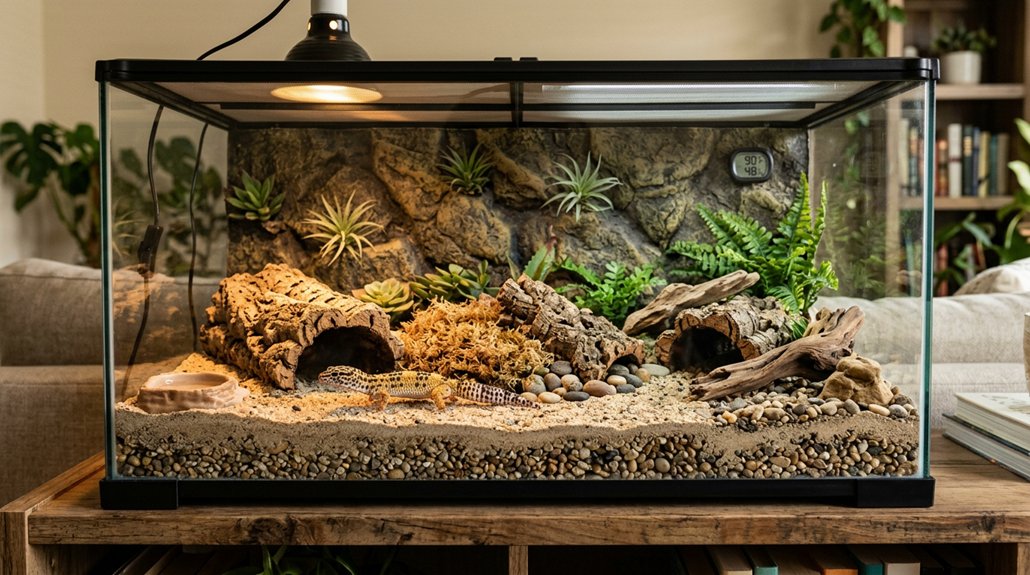
As you’ve perfected the lighting setup for your leopard gecko, the choice of substrate is the next critical step in replicating their natural environment within the terrarium. Opt for bioactive-compatible substrate types, composed of 60% organic topsoil and 40% play sand, providing an ideal environment for burrowing. Avoid calcium carbonate-based substrates due to ingestion risks. Enhance moisture retention by integrating materials like bark chips and sphagnum moss, which aid drainage. Introduce a thriving clean-up crew such as isopods and springtails to sustain ecological balance.
| Substrate Types | Composition | Purpose |
|---|---|---|
| Bioactive Mix | 60% topsoil, 40% play sand | Burrowing, safety |
| Alternative Mix | Bark chips, sphagnum moss | Moisture retention, drainage |
| Clean-Up Crew (CUC) | Isopods, springtails | Ecological balance |
Monitor substrate humidity to maintain peak gecko health.
Keeping Your Gecko’s Home Pleasant
To guarantee a leopard gecko’s habitat promotes health and happiness, the environment must closely emulate their natural surroundings. Achieve ideal humidity control by creating a bioactive setup with a substrate blend of 60% organic topsoil and 40% play sand, ensuring a depth of at least 4 inches. Maintain an appropriate temperature gradient using a digital thermometer for precision in monitoring. Implement overhead heat sources like halogen bulbs to simulate natural solar radiation, avoiding belly heat tactics. For effective environmental enrichment, it’s essential to provide:
- A basking area with temperatures of 94-97°F (34-36°C).
- A cooler zone ranging from 70-77°F (21-25°C).
- Various hiding spots offered by strategically placed caves and logs.
- Natural behaviors encouraged through rocks and burrowing opportunities.
Enriching the Environment With Decor
Creating a comfortable home doesn’t stop at replicating basic environmental conditions; it’s equally important to enhance your leopard gecko’s habitat with thoughtfully chosen decor. By integrating a mix of live and artificial plants, you can establish hiding spots and sustain ideal humidity levels that contribute to your gecko’s overall well-being. Smooth, rounded rocks and natural logs are essential components, offering climbing opportunities that promote natural behaviors while preventing injuries. Arranging caves, cork flats, and logs in a cluttered manner reduces stress and increases security for your gecko. Make sure all decor lacks sharp edges or fragile parts to maintain safety. Providing a substrate depth of at least 4 inches allows burrowing, facilitating instincts and supporting behavioral enrichment in a complex microhabitat.
Solving Leopard Gecko Setup Problems
When setting up a leopard gecko tank, solving potential setup problems early on can save you time and guarantee your pet’s health and comfort. Pay attention to heat distribution by confirming the basking spot reaches 94-97°F (34-36°C) and the cooler side remains at 70-77°F (21-25°C). Utilize digital thermometers to monitor tank temperatures effectively.
For humidity maintenance, adopt a bioactive substrate mix of 60% organic topsoil and 40% play sand, promoting adequate moisture levels.
To tackle common issues, consider:
- Utilizing thermostat-regulated heat mats beneath hides.
- Ensuring full-spectrum UVB lighting exposure for peak health.
- Preventing thermal gradients that exceed ideal thresholds.
- Achieving consistent daylight cycles with 12-14 hours lighting setups.
Adhering to these guidelines guarantees a stable environment conducive to your gecko’s well-being.
Understanding How Substrates Impact Gecko Health
Although often overlooked, the substrate in a leopard gecko’s enclosure plays a crucial role in their overall health. Proper substrate composition, ideally 60% organic topsoil and 40% play sand, is essential. This mix supports fundamental moisture retention, facilitating hydration and mimicking natural conditions. A depth of at least 4 inches encourages burrowing behavior, important for mental stimulation and physical welfare. Incorrect substrates, such as calcium sand, pose health implications like impaction. A suitable substrate supports ecosystem balance, allowing isopods and springtails to thrive, enhancing waste management and habitat maintenance. Monitoring humidity, particularly in a moist hide, guarantees 70-80% levels on the cool side, aligning with a gecko’s natural hydration needs and promoting overall well-being.
Frequently Asked Questions
What Is the Best Light and Heat Source for Leopard Geckos?
You’ll find halogen bulbs and heat mats as top heat sources. For lighting, opt for UVB full-spectrum bulbs like Arcadia Shade Dweller. Make certain basking temps reach 94-97°F with appropriate substrate for thorough thermoregulation and health.
Does My Leopard Gecko Need a Heat Lamp and a Heat Mat?
Think of a leopard gecko’s tank as an orchestra needing both a heat lamp and a heat mat to create a harmonious temperature gradient. This setup mirrors their natural habitat, supporting thermoregulation and healthy behavior.
Can Geckos Hear You?
Yes, leopard geckos can hear you. Their sound perception is attuned to low-frequency vibrations, which influence gecko behavior. These vibrations help them detect environmental changes and communicate, though they’re less responsive to high-frequency sounds.
How Much Substrate Should Be in a Leopard Gecko Tank?
Picture the desert beneath your feet; that’s how your gecko’s tank should feel. Aim for a 4-inch substrate depth with a mix of substrate types like 60% organic topsoil and 40% play sand, ensuring best comfort.
Conclusion
You’ve now laid the groundwork for a thriving leopard gecko environment, where every detail dances in harmony. The tank size sets the stage, while the heating setup mimics their sun-kissed origins. Lighting casts its essential glow, and the substrate forms a supportive canvas. As you weave these elements together, your gecko will flourish, exploring a world enriched with decor and care. Remember, attentive observation is your guiding star, ensuring your scaled companion enjoys a healthy, vibrant habitat.