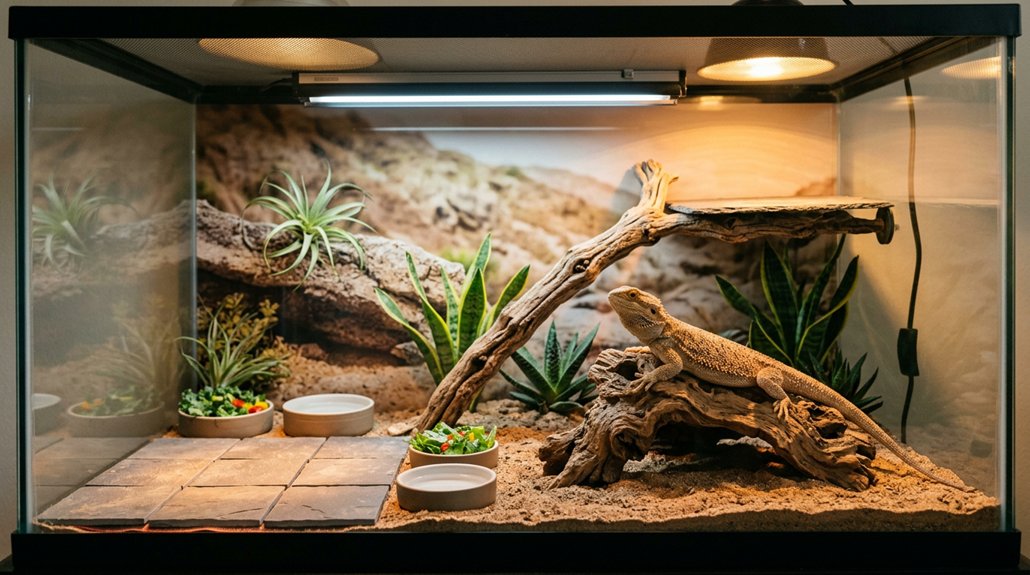
For a bearded dragon tank, guarantee a space of at least 120 x 60 x 60 cm. Position UVB lamps 7-11 inches above the basking spot, replacing every 6-12 months, and regulate a thermogradient with basking temperatures between 40-46°C. Night cooling to around 10°C mimics natural habitats. Choose non-loose substrates to prevent impaction and enrich with caves and climbing surfaces. Monitoring these elements fosters your dragon’s health, with further insights guiding successful habitat management.
Key Takeaways
- Use UVB lamps positioned 7-11 inches above basking spots, replacing them every 6-12 months.
- Ensure basking temperatures of 40-46°C (105-115°F) and cooler zones between 21-29°C (70-85°F).
- Maintain humidity levels between 30%-60% using a digital hygrometer for optimal habitat conditions.
- Utilize T5 HO linear UVB bulbs within 12-16 inches of basking surfaces for consistent lighting.
- Choose non-loose substrates like slate or tiles to prevent impaction and simplify cleaning.
Essential Habitats for Bearded Dragons: Space, Light, and Temperature
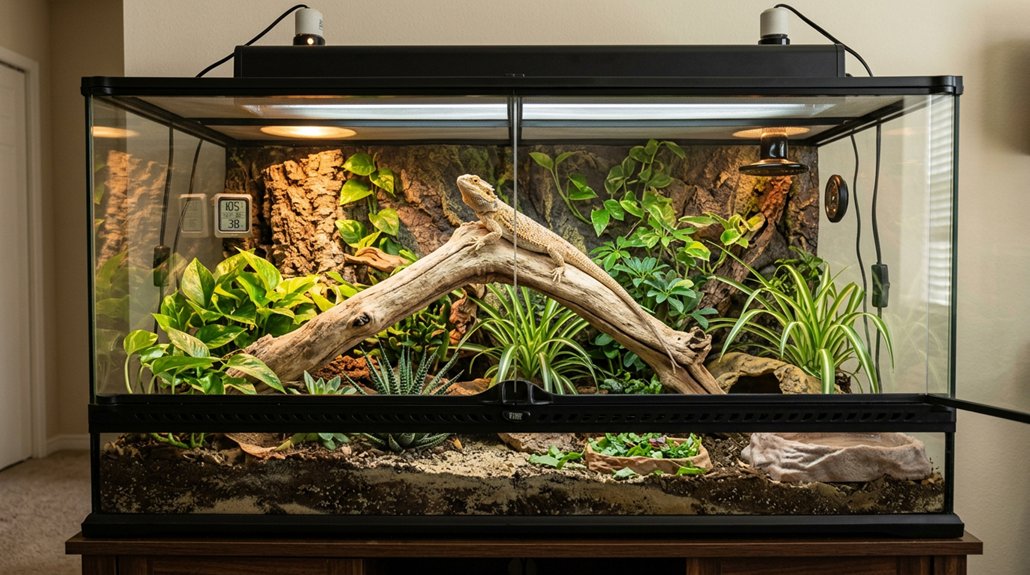
When setting up a habitat for bearded dragons, ensuring adequate space, proper lighting, and ideal temperature regulation is essential for their well-being. Space exploration allows your dragon to engage in natural behavior, requiring minimum dimensions of 120 x 60 x 60 cm to facilitate this need for movement. Lighting plays an important role, particularly UVA and UVB lamps simulating sunlight for vitamin D3 synthesis, necessary for calcium absorption. Position UVB bulbs 7-11 inches above the basking spot, replacing them every 6-12 months for maximum efficacy. Temperature precision is critical; the basking area should maintain 40°C to 46°C, while cooler zones should be between 21°C and 29°C. Use a digital hygrometer to maintain humidity levels between 30%-60%, preventing potential health issues.
Choosing the Right Tank Size for Growth and Comfort
When selecting a tank for your bearded dragon, it’s essential to guarantee the enclosure meets ideal dimensions, starting with a 20-gallon tank for hatchlings and expanding to at least 120 x 60 x 60 cm for adults. This space is critical for facilitating growth and accommodating natural behaviors like walking and basking, consequently minimizing stress. Additionally, the tank should feature adequate ventilation to foster a healthy environment, combined with structural materials like a metal mesh top for both security and air circulation.
Optimal Enclosure Dimensions
Selecting the right tank size is essential for the healthy growth and comfort of your bearded dragon. For adults, the enclosure should measure at least 120 x 60 x 60 cm (4 x 2 x 2 ft) to accommodate their need for movement. Initially, young dragons can start in a 20-gallon tank but must shift to larger spaces as they grow. Proper enclosure design involves considering tank materials; wooden vivariums are recommended for their superior insulation and heat retention, unlike glass. Guarantee your design includes adequate ventilation and room for essential heating and lighting fixtures to maintain necessary temperature gradients. Avoid housing multiple dragons together since they exhibit territorial instincts, potentially leading to stress and aggression, compromising the animal’s welfare.
Growth and Habitat Needs
One essential aspect of optimizing a bearded dragon’s habitat involves selecting an appropriately sized tank that accommodates their growth and behavioral needs. During early growth stages, a 20-gallon setup might suffice, but as your bearded dragon matures, shifting to a tank sized 120 x 60 x 60 cm (4 x 2 x 2 ft) is vital. This not only supports physical growth but also fosters habitat enrichment by allowing space for climbing, basking, and hiding, important for natural behaviors. Wooden vivariums provide superior insulation and heat retention compared to glass tanks, ensuring a stable microenvironment. Remember, housing multiple dragons together can result in stress due to their territorial nature, so individual tanks are best for psychological comfort and development.
Selecting Proper Lighting Fixtures for Optimal Health
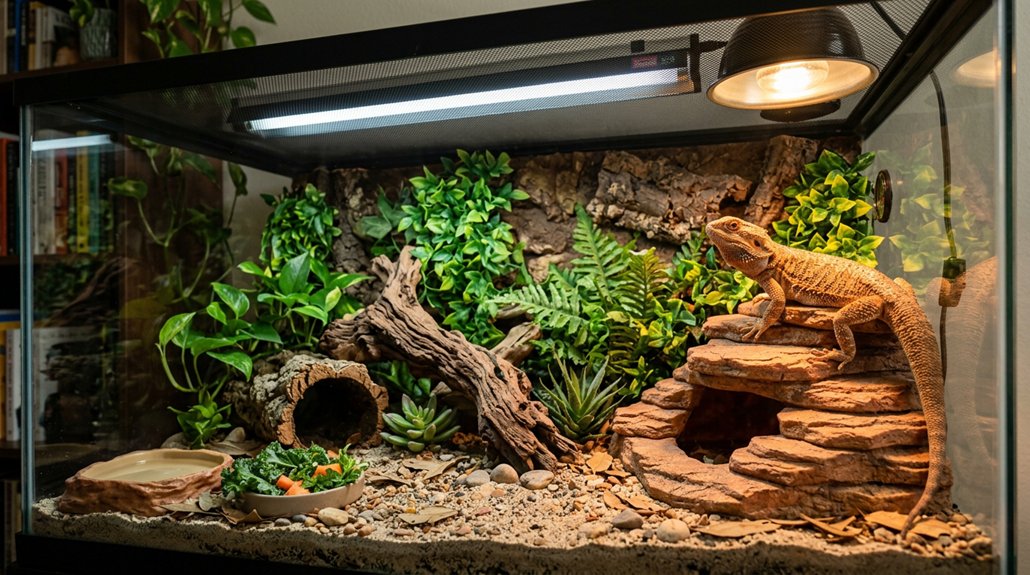
Although proper lighting is vital for the ideal health of your bearded dragon, the selection of appropriate fixtures can be challenging without a clear understanding of their specific requirements. Lighting considerations start with choosing T5 HO linear UVB bulbs, favored over T8 or compact variants due to their superior and consistent UVB output. Position these within 12-16 inches of the enclosure to achieve peak UVI levels at the basking spot. It’s recommended to invest in a double light hood that accommodates both UVB and basking bulbs to emulate natural sunlight. Consistency in light cycles is essential; using timers guarantees a steady 10-12 hour pattern. Remember, bulb longevity varies, so replace UVB bulbs every 6-12 months to maintain effectiveness.
The Importance of UVB: Light for Bearded Dragon Health
Understanding the essential role of UVB lighting in a bearded dragon’s health reveals why it’s vital for their survival and wellbeing in captivity. UVB benefits include enabling vitamin D₃ synthesis, which is key for calcium absorption, thereby preventing metabolic bone disease. You should aim for a UV Index (UVI) level between 4.0-6.0 at the basking spot using a 14% Arcadia Dragon bulb. Among bulb types, T5 HO UVB bulbs outperform T8s due to consistent, robust output. Quality fixtures and reflectors prevent significant UVB reduction from screening materials. Regularly test your setup with a Solarmeter 6.5 to guarantee proper exposure. Change UVB bulbs every 6-12 months to maintain ideal health for your bearded dragon.
Create Dynamic Temperature Zones for Healthy Basking
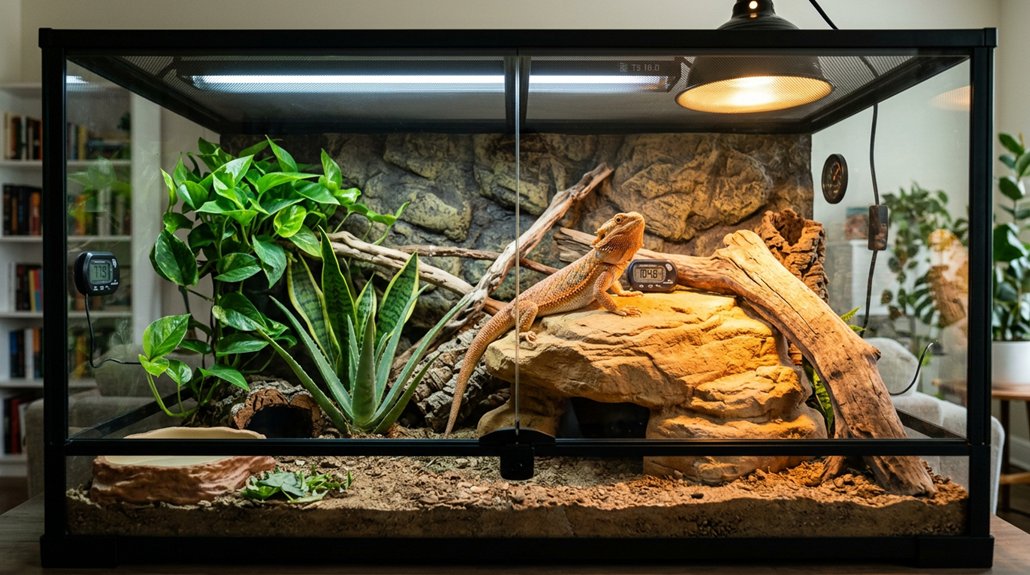
You should establish a well-defined thermogradient in your bearded dragon’s tank to facilitate natural behavior and physiological regulation, guaranteeing basking temperatures remain between 105-115°F (40-46°C) while cooler zone temperatures stay within 70-85°F (21-29°C). To achieve effective basking conditions, use a combination of basking lights and heat-retaining accessories like rocks, continually monitoring surface temperatures with an infrared thermometer to prevent stress-inducing fluctuations. Nighttime management requires consistent observation to guarantee cooler areas remain near 70°F, allowing your dragon to maintain optimum body temperature throughout the day and night.
Optimal Temperature Gradient
To guarantee a bearded dragon’s health and vigor, establishing a well-defined temperature gradient within its enclosure is fundamental. This guarantees behavioral enrichment and facilitates temperature monitoring. A gradient from 40°C (104°F) on the hot side to 25°C (77°F) on the cool side is ideal, allowing the bearded dragon to thermoregulate effectively.
| Temperature Zones | Hot Side | Cool Side |
|---|---|---|
| Ideal Range | 40°C-46°C | 21°C-29°C |
| Daytime Range | 40°C | 25°C |
| Nighttime Minimum | 10°C | 10°C |
| Activity Temperature | 105-115°F | 70-85°F |
Accurate measurement is fundamental, so use infrared thermometers to monitor basking temperatures. Nighttime can drop to 10°C, benefiting the dragon’s natural rhythm. Proper zoning supports overall health and well-being.
Effective Basking Setup
Establishing an effective basking setup requires careful design and precise control of temperature zones to support the thermoregulatory behavior of bearded dragons. You should aim for a basking area between 105-115°F (40-46°C) using a halogen heat lamp or a high-wattage basking bulb, ideally positioned 7-11 inches from the basking surface. Basking accessories like rocks or platforms help retain heat, providing a comfortable spot without rapid heat loss. Additionally, guarantee cooler ambient zones in the enclosure range from 70-85°F (21-29°C) to allow your bearded dragon to cool down when needed. Heat monitoring with an infrared thermometer is essential to maintaining these precise conditions, promoting ideal health and digestion, and allowing your dragon to properly thermoregulate.
Nighttime Temperature Management
While managing nighttime temperatures for bearded dragons, it’s imperative to establish a natural thermal fluctuation that mirrors their wild environment. Allowing temperatures to safely drop to as low as 50°F (10°C) enables nighttime cooling, which is essential for boosting their metabolism. During nighttime cooling, most dragons don’t require supplemental heat unless temperatures fall below 55°F (13°C). Avoid disrupting the natural day/night cycle by using red infrared lights or ceramic heat emitters only if absolutely necessary. Consistent warm temperatures disrupt natural behaviors, potentially leading to brumation issues. Establish a thermogradient with cooler zones at 70-85°F (21-29°C) during the day, shifting to nighttime cool down. Observe basking behavior, as it promotes important morning basking activity that enhances health and supports metabolic function.
How to Keep Humidity Levels in Check
Maintaining ideal humidity levels is essential for your bearded dragon’s well-being, with the target range lying between 30-60%. For effective humidity control, use a digital probe hygrometer. It’s an important humidity tool for accurate humidity monitoring. Make sure ventilation strategies are in place; avoid sealed tanks that trap moisture. Effective airflow mitigates humidity sources like misting or a water dish, preventing the environment from becoming overly wet. Be vigilant with humidity fluctuations, particularly during seasonal shifts, and modify your methods accordingly. Keeping levels below 60% is critical to prevent respiratory issues and skin complications. Regular checks of these humidity factors will help you maintain a stable, healthy habitat for your bearded dragon, promoting ideal health and well-being.
When Nighttime Heating Becomes Necessary
As you guarantee your bearded dragon’s habitat maintains appropriate humidity levels, understanding the intricacies of nighttime heating becomes equally significant for their overall well-being. While temperatures dropping as low as 50°F don’t usually require supplemental heat, colder climates necessitate vigilance. Employ ceramic heat emitters (CHE) or red infrared heat lights if temperatures dip below 55°F. These tools provide essential warmth without disrupting the natural day/night cycle, vital for maintaining your pet’s circadian rhythm. Verify continuous heat isn’t applied, avoiding any spur towards brumation. Precision in temperature monitoring is key; utilize a digital probe thermometer to regularly check nighttime temperatures. This detailed tracking aids in preserving an ideal range of 50°F to 60°F, reinforcing your bearded dragon’s health and comfort.
Safe Substrate Choices for Simplicity and Cleanliness
When selecting a substrate for your bearded dragon tank, it’s essential to prioritize ease of maintenance while avoiding impaction risks. Non-loose options like slate or tiles eliminate the dangers associated with sand ingestion and simplify cleaning, thereby fostering a hygienic environment. Though sandy desert substrates promote natural behaviors, they must be specifically tailored to reptile use to minimize health hazards effectively.
Avoid Impaction Risks
Though it might seem convenient, using sand as a substrate for bearded dragons is inadvisable due to its high impaction risk when ingested, which can cause serious health complications. When considering substrate selection, prioritize non-loose options like slate, tiles, or reptile carpets. These substrates eliminate the ingestion risk while offering stable footing, minimizing potential health implications. A bare bottom tank also serves as an effective hazard-free alternative, simplifying your pet’s habitat. If you’re still keen on replicating natural environments, use sand specially designed for reptiles, reducing impaction chances. Whichever substrate you choose, guarantee regular cleaning; this helps prevent bacterial proliferation, safeguarding your reptile’s health. Thorough analysis reveals that thoughtful substrate choices yield safer, health-optimized environments for your dragon.
Ease of Maintenance
In the pursuit of a clean and easily maintainable environment for your bearded dragon, non-loose substrates like slate or tiles emerge as ideal choices. They’re easy to clean, reducing hassle in your regular cleaning routines, and importantly eliminate the risk of impaction. Slate or tiles don’t fragment, making them safe if accidentally ingested. In contrast, options like reptile carpet can harbor debris and encourage bacteria growth, complicating cleaning and increasing potential for injury. Sand, while natural, demands vigilant monitoring of eating behaviors to preempt impaction issues. Opting for a bare tank streamlines maintenance, ensuring best hygiene conditions. By integrating these substrate choices, you can create a robust setup that supports health, prevents respiratory infections, and minimizes your maintenance efforts.
Encouraging Natural Behaviors Through Tank Accessories
Creating a habitat that encourages natural behaviors through tank accessories is essential for the well-being of bearded dragons. Effective enrichment strategies include heat-retaining caves and hammocks, which mimic basking zones and enable thermal regulation, promoting comfort and security. Incorporating branches and ledges encourages climbing, when monitored through behavioral observation, reveals activity levels that contribute to their quality of life. Rough surfaces like rocks and logs support physical activity and claw health while providing hiding spots that reduce stress. Additionally, strategically placed food bowls designed for greens encourage foraging, aligning with natural feeding habits. Regularly observe for stress indicators, such as glass surfing, which may require adjusting accessories to better support these behaviors, ensuring a thriving habitat for your bearded dragon.
Troubleshoot Bearded Dragon Enclosure Challenges
Even the most meticulously designed bearded dragon tank can present challenges that require attention and troubleshooting. Begin by ensuring UVB lighting is set appropriately, keeping it 7-11 inches above basking areas to facilitate essential vitamin D3 production and calcium absorption. Regularly monitor temperature gradients; maintain basking surfaces at 105-115°F and cooler zones at 70-85°F. Enclosure decor and basking hides should be arranged to provide safe, effective heat retention. Use a digital probe hygrometer to keep humidity levels between 30-60%, as excess moisture might lead to respiratory issues. Check UVB bulbs regularly and replace them every 6-12 months, as they lose effectiveness over time. Adjust basking accessories as needed to maintain comfort and safety for your bearded dragon.
Frequently Asked Questions
What Kind of Lighting and Heating Do Bearded Dragons Need?
Bearded dragons need UVA and UVB lighting for vitamin D metabolism—UVB requirements are UVI 4-6. Basking zones should be 105-115°F. Use T5 HO bulbs for UVB and overhead heating to mimic natural conditions effectively.
How to Place Lights in Bearded Dragon Tank?
Hit the nail on the head by placing lights above the basking area for ideal heat, ensuring UVB fixtures provide maximum coverage. Position lights to maintain a consistent temperature, using precise measurements to fine-tune your arrangement.
What Should the Light Cycle Be for a Bearded Dragon?
You’ll need to adjust the light cycle, providing 14 hours of daylight duration in summer, and 10 hours in winter. Adjusting this mimics seasonal changes, guarantees appropriate UVB exposure, supports a proper heat gradient, and aids health.
Do You Leave a Heat Lamp on All Night for Bearded Dragons?
Think of your bearded dragon’s tank as a miniature planet where stable nighttime temperature is essential for its health. Don’t leave the heat lamp on all night—it disrupts natural cycles and jeopardizes the dragon’s well-being.
Conclusion
Imagine your bearded dragon’s habitat as a miniature ecosystem, much like a coral reef. Just as corals rely on precise conditions to thrive, your dragon needs the right balance of space, light, and temperature. Ensuring ideal UVB exposure can greatly reduce metabolic bone disease, much like sunlight nurtures coral growth. By meticulously adjusting these elements, you’re not just housing a pet; you’re fostering a healthy, thriving ecosystem, where each detail plays a critical role in your dragon’s well-being.