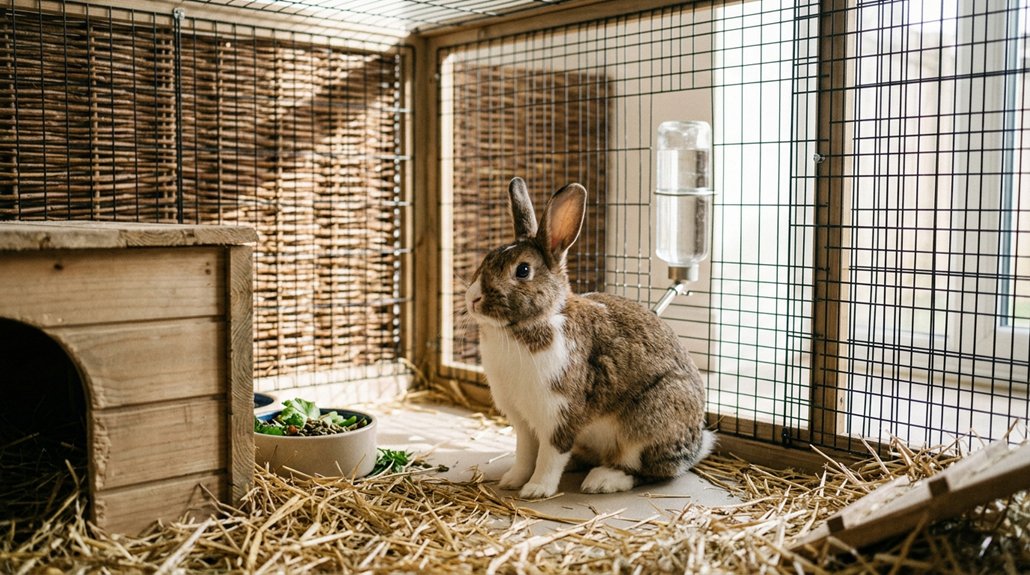
To guarantee your rabbit’s health and happiness, select a cage that offers ample space. At minimum, provide 12-15 square feet of floor space for average-sized pairs, with larger breeds like Flemish Giants requiring at least 20 square feet. The cage should be twice your rabbit’s stretched length and at least 24-36 inches wide for comfort. Indoor and outdoor setups must also allow proper height for hopping. There’s more to discover about optimizing your rabbit’s habitat for their wellbeing.
Key Takeaways
- A rabbit cage should ideally have a minimum floor space of 12-15 square feet to ensure comfort and prevent muscle atrophy.
- Larger breeds like Flemish Giants require at least 20 square feet of floor space for proper physical and mental well-being.
- The cage length must be double the rabbit’s stretched length, with width of 24-36 inches for comfortable lying down.
- Indoor cages should meet a minimum of 12 square feet; outdoor hutches must provide protection and ample living space.
- Adequate height is crucial, ranging from 2 to 3 feet, depending on the rabbit’s size, to allow hopping and stretching.
Why Cage Size Matters for Your Rabbit’s Health and Happiness
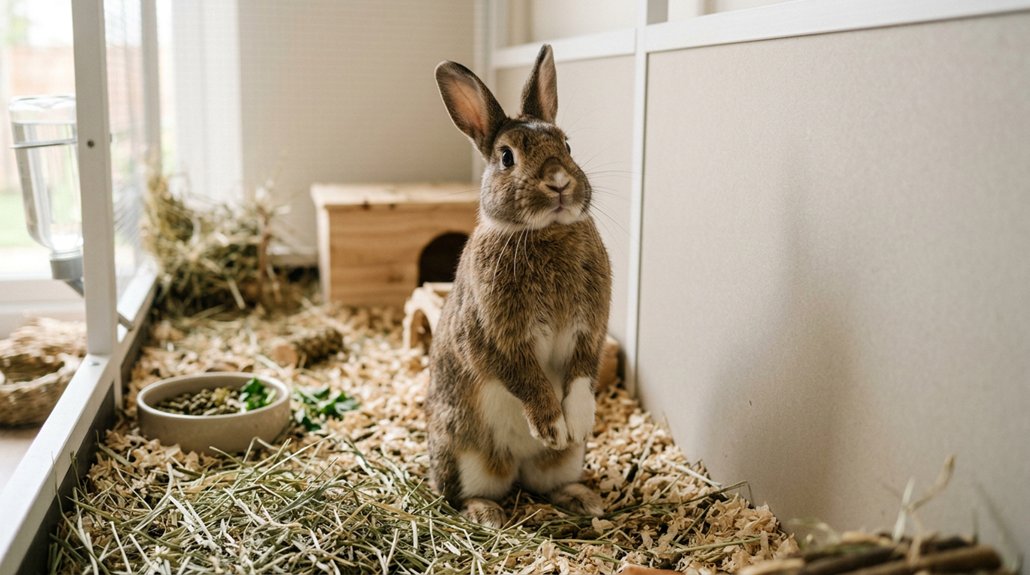
Although it may seem trivial, the size of your rabbit’s cage is essential to its health and happiness. Proper cage size prevents muscle atrophy and obesity by enabling vital physical movement. A spacious environment not only promotes physical well-being but also enhances mental health through cage enrichment, allowing rabbits to engage in natural behaviors like exploring and foraging. It fosters social interaction, important for their psychological stability, while mitigating stress-related behaviors. Larger enclosures contribute to overall happiness, reducing depression and anxiety, as rabbits indulge in their instincts with ease. Make sure their living space offers at least 12 square feet, facilitating freedom to hop, stretch, and live actively without confinement. These components underscore the importance of a well-sized habitat to support your rabbit’s well-being.
Essential Measurements: How Big Should Your Rabbit’s Cage Be?
When determining the ideal cage size for your rabbit, accurate measurement of your rabbit’s full length is essential, as they need a cage at least twice that length. Aim for a minimum floor space of 12 to 15 square feet, based on the rabbit’s size and whether you’re housing pairs or larger breeds. Verify the cage height satisfies natural behaviors, allowing smaller rabbits to stand on their hind legs with at least 2 feet of clearance, and closer to 3 feet for larger breeds.
Measuring Bunny Length Correctly
How can you guarantee your rabbit has enough space in its cage? Start by using effective measuring techniques to understand their true size. Measure your rabbit’s length from the tip of the nose to the base of the tail when it’s fully stretched. This typically ranges from 30 to 36 inches for adult rabbits. To secure the cage meets the essential measurements required for comfort and natural behavior, consider the following:
- Cage Length: Minimum twice your rabbit’s stretched length (60-72 inches).
- Cage Width: At least 24 to 36 inches for unrestricted lying down.
- Cage Height: Ensure room to stand on hind legs—minimum 24 inches.
- Movement Space: Adequate area for hopping and stretching fully.
Accurate measurements secure ample space for movement and well-being.
Ideal Floor Space Requirements
In guaranteeing your rabbit’s habitat meets its needs, it’s important to grasp the specifics of suitable floor space. A pair of average-sized rabbits requires a minimum of 12 square feet to move freely and exhibit natural behaviors. Ideal space utilization involves cage dimensions that provide at least 24-36 inches in width and a length of 6 feet, enabling 3-4 unobstructed hops. Larger breeds, such as Flemish Giants, necessitate approximately 20+ square feet for optimal well-being. Cage enrichment should be considered, with larger enclosures considerably enhancing both mental and physical health. Prioritize expanding the cage to support running, hopping, and exploring, promoting a stimulating and comfortable environment. Remember, a more spacious habitat guarantees your rabbit thrives effectively.
Height for Natural Behaviors
Although floor space is vital, the height of a rabbit’s cage plays an equally important role in facilitating natural behaviors. Height requirements are significant; for small to medium rabbits, a minimum height of 2 feet (60 cm) is vital. Larger breeds may need up to 3 feet (90 cm). This allows them to comfortably stand on their hind legs, stretch, and survey their environment without head collisions.
- Guarantees enough vertical space for stretching and surveying.
- Supports play structures or levels for increased activity.
- Maintains rabbit well-being by preventing confinement stress.
- Allows room for rabbits to express natural behaviors efficiently.
While some hutch areas can be shorter, prioritizing height in most of the interior meets these requirements, ultimately preventing issues linked to inadequate space.
Adjusting Cage Size for Different Rabbit Breeds and Needs
When selecting the appropriate cage size for different rabbit breeds, it’s vital to take into account the unique needs of each rabbit to guarantee their health and well-being. Small to medium rabbits require a minimum cage space of 12 square feet, whereas larger breeds, like Flemish Giants, need around 20 square feet. Always make sure cages are at least four times the rabbit’s size to accommodate stretching and movement. Important cage accessories should support breed-specific needs, making sure comfort and activity are provided. A medium-sized rabbit’s hutch should measure at least 2 feet wide by 6 feet long, with a height of 2 to 3 feet, facilitating natural behaviors. Regardless of breed, access to a 24-square-foot exercise area is vital for health.
Creating Happy Spaces: Ideal Areas for Living and Play
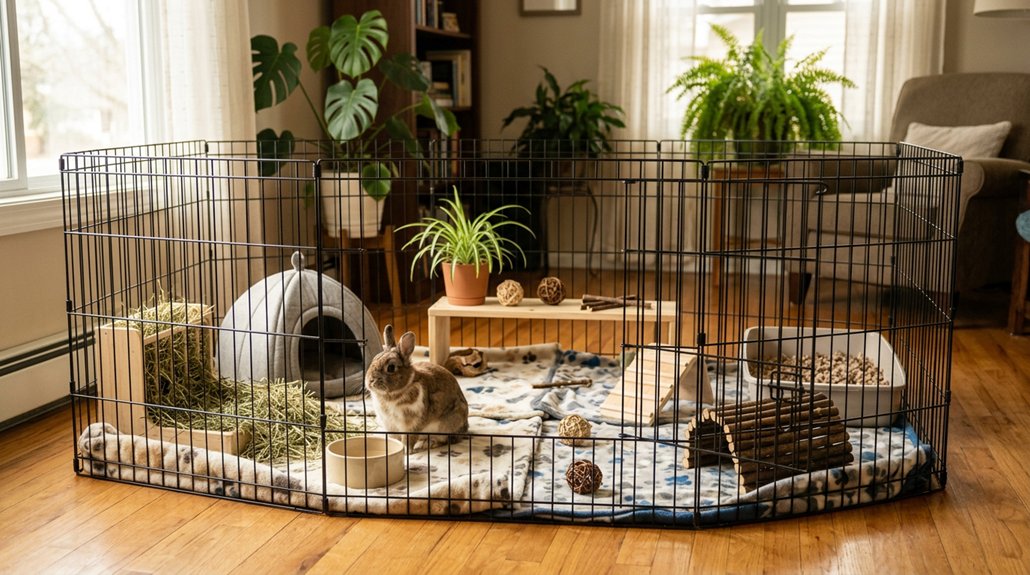
Many rabbit owners overlook the importance of creating spacious environments that support both living and play areas. A minimum of 12 square feet is vital for a pair of average-sized rabbits. Larger breeds, including Flemish Giants, need up to 20+ square feet. To provide for natural behaviors, access to an exercise area of at least 24 square feet is critical. Remember, it’s not just about the size of the habitat, but the quality of the environment.
Creating spacious habitats ensures rabbits can express natural behaviors and thrive, underscoring the importance of environment quality over mere space size.
- Enrichment activities: Incorporate tunnels and chew toys.
- Safe hideouts: Guarantee cozy nooks for stress relief.
- Vertical space: Height of 2-3 feet permits upright posture.
- Essentials: Include space for litter boxes and food dishes.
Providing these elements guarantees rabbits can thrive mentally and physically.
Choosing Between Different Types of Rabbit Cages
While selecting the right rabbit cage is crucial for their health and well-being, you must prioritize spacious options such as dog kennels or roomy outdoor hutches. Smaller, commercially available rabbit cages often fall short, leading to potential health and behavioral issues. Indoor vs outdoor decisions should consider cage materials, guaranteeing durability and safety. For indoor settings, custom-built cages seamlessly integrate, meeting minimum size requirements of 12 square feet for average-sized rabbits. Outdoor hutches, ideally larger, provide protection from elements. Avoid multi-level cages due to limited floor space and increased injury risks. Your rabbit’s breed influences specific dimensions; consequently, always focus on providing ample room for comfort, essential for overall welfare. Prioritize cage features aligned with your rabbit’s needs.
Arranging an Ideal Rabbit Habitat for Comfort
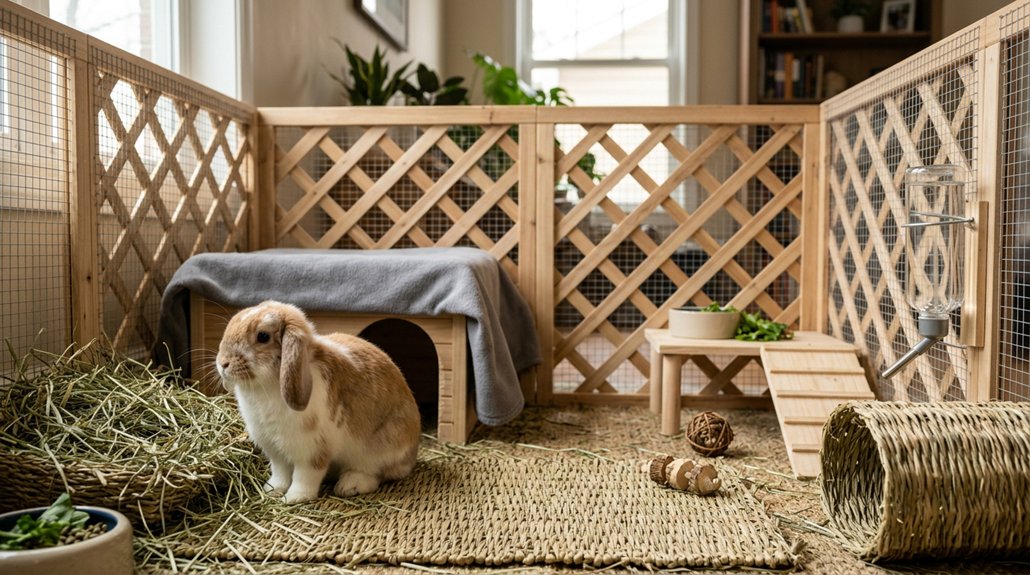
An ideal rabbit habitat guarantees both comfort and health, with a minimum of 12 square feet of living space. This space requirement guarantees adequate room for essential items like a litter tray, food, and water bowls. Consider cage dimensions of at least 24 inches wide by 42 inches long and 24 inches high, which allow your rabbit to stretch, hop, and stand comfortably on its hind legs. Incorporate cozy corners with hideaways, and explore multi-level setups to maximize vertical space, enhancing both comfort and mental stimulation. Including safe enrichment items like tunnels and wooden toys supports natural behaviors and prevents health issues.
- Provide spacious outdoor hutches with access to exercise areas.
- Incorporate cozy hideaways.
- Use multi-level designs for added space.
- Guarantee safe, stimulating enrichment.
Increasing Space Gradually: Expanding Rabbit’s Habitat Over Time
When expanding a rabbit’s living space, ensuring you’ve established consistent potty training habits is essential. Begin with a base of at least 12 square feet, sufficient for two average-sized rabbits, and gradually expand as their litter habits become reliable. Gradual expansion not only accommodates their comfort but also encourages improved movement and exploration. As the rabbits adapt to the increased area, add an additional few feet strategically. Include essentials like a litter tray, food and water bowls, and safe enrichment items in any new space. Regular monitoring of cleanliness aids in reinforcing positive potty training, which enhances their freedom within the expanded habitat. This methodical growth supports healthier and more engaged rabbits while maintaining hygiene and comfort in their environment.
Frequently Asked Questions
What Is the 3-3-3 Rule for Bunnies?
The 3-3-3 Rule guarantees your rabbit’s cage is at least three times their length and width when stretched, promoting ideal rabbit behavior and cage enrichment by reducing obesity, muscle atrophy, and enhancing mental and physical health.
What Is the Ideal Size for a Rabbit Cage?
For ideal rabbit comfort, a cage should measure at least 6 feet long, allowing them to hop thrice. Meeting these cage dimensions minimizes stress and promotes natural behaviors, ensuring your rabbit’s well-being and preventing health issues.
How Do You Say “I Love You” in Rabbit Language?
To say “I love you” in rabbit language, observe bunny behavior and rabbit communication. Your rabbit gently nibbles, nudges, purrs softly, performs binkies, and relaxes close to you, indicating trust, affection, and a strong emotional bond.
How Do Rabbits Say Goodbye?
In rabbit behavior, farewell signs include reduced activity and appetite, isolation, and altered vocalizations. Rabbits’ bonding rituals and emotional responses involve seeking solitude or comfort, reflecting their way of processing grief and saying goodbye.
Conclusion
Understanding the nuances of rabbit habitat is essential for their well-being. A spacious environment is not merely a luxury—it’s fundamental for their vitality. Consider the unique needs of different breeds, ensuring their home isn’t just a cage, but a sanctuary that evolves with them. Gradual expansion mirrors natural growth and exploration instincts, offering comfort and engagement. By embracing these considerations, you’re not just housing a rabbit; you’re crafting a thriving environment that upholds their quality of life.