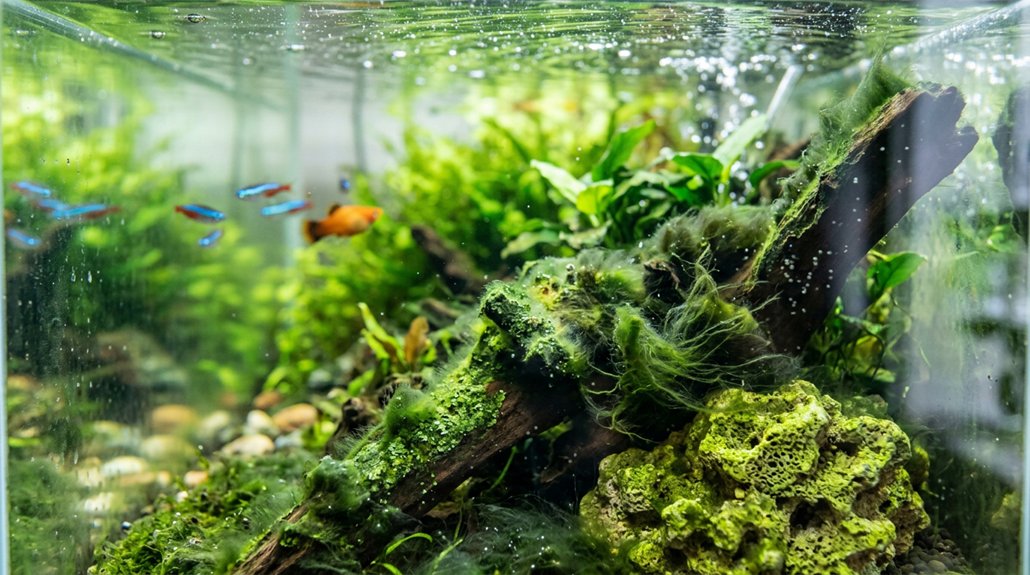
Algae in your aquarium usually appears when excess nitrate and phosphate, overfeeding, waste buildup, strong light, and poor circulation favor rapid photosynthesis. You can control it by keeping nitrate below about 10 ppm and phosphate below about 0.5 ppm, using RO/DI water, limiting light to 6–8 hours, and improving flow, filtration, and weekly water changes. Remove visible growth manually, vacuum detritus, and use targeted treatments or grazers when needed, so each control step becomes clearer from here.
Key Takeaways
- Excess nitrate and phosphate from overfeeding, waste, and tap water fuel algae; keep nitrate under 10 ppm and phosphate under 0.5 ppm.
- Too much light, direct sunlight, or photoperiods over 8–10 hours promote algae; use 6–8 hours daily on a timer.
- Strong circulation, surface agitation, and regular filter cleaning prevent dead zones where detritus and algae-forming nutrients build up.
- Control algae by removing it manually, siphoning debris, and using grazers like Amano shrimp, nerite snails, or otocinclus.
- For severe blooms, use RO/DI water, phosphate media, UV for green water, or peroxide spot treatment as last-resort options.
What Causes Aquarium Algae?
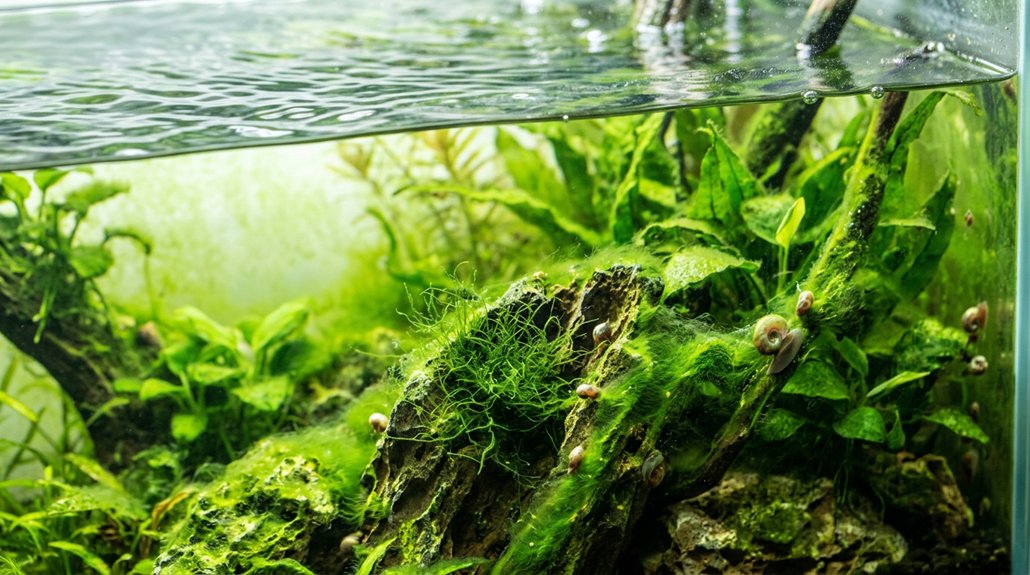
Aquarium algae are usually driven by excess nutrients, especially nitrate and phosphate, so keeping nitrate below about 10 ppm and phosphate below about 0.5 ppm helps limit blooms. You should identify nutrient sources such as overfeeding, fish waste, decaying plant tissue, and nutrient-rich tap water, because they add ammonia, nitrate, and phosphate that algae can exploit. In algal ecology, these inputs shift competitive balance toward opportunistic species when your tank’s biological demand is exceeded. Poor circulation can create dead zones where organics accumulate and cyanobacteria proliferate. Excessive light, unstable CO2, inconsistent fertilization, aging bulbs, and sparse live plant mass also weaken higher-plant competition. When those variables drift, algae gain a physiological advantage and colonize surfaces, substrate, and slow-flow zones more readily.
How Do Lighting and Nutrients Fuel Algae?
Light fuels algae because it powers photosynthesis, and when your tank runs more than about 8–10 hours of light per day, receives direct sunlight, or uses very high-intensity lighting, you’re effectively giving algal cells the energy they need to outgrow slower competitors. In practice, your light duration should match plant demand, because excess photons accelerate algal biomass accumulation. Nutrient thresholds matter too: nitrate above roughly 10 ppm and phosphate above 0.5 ppm can supply algae with fertilizer-like substrates. When lighting is strong but plant uptake is limited, algae exploit the surplus. Sudden increases in brightness or dosing can destabilize the system and trigger blooms. To suppress this, you should keep photoperiods controlled, maintain steady inputs, and aim for balanced light and nutrient availability so desirable plants stay competitive.
Why Do Water Flow and Maintenance Matter?
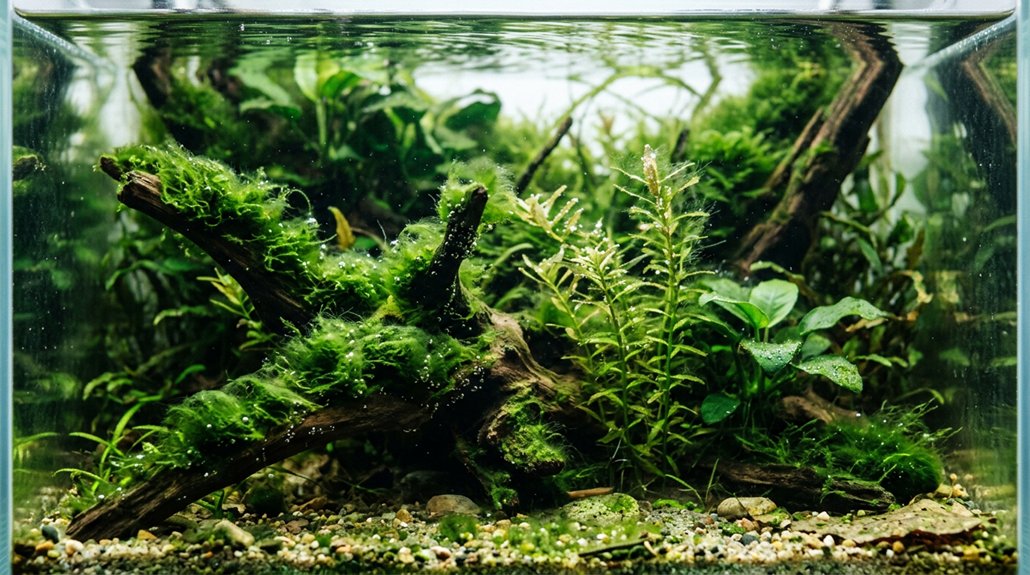
You need strong, directed water flow to prevent dead zones, improve oxygenation, and keep detritus suspended so filtration can remove it before it breaks down into nitrate and phosphate. If you let flow stagnate or maintenance lapse, trapped organics and clogged media can release nutrients back into the water column, which favors cyanobacteria, filamentous algae, and black beard algae. Keep up with weekly water changes, regular filter cleaning, and media rinsing to maintain low nutrient levels and stable conditions that suppress algal growth.
Maintain Strong Water Flow
Strong, well-distributed water movement is essential because stagnant areas create dead zones where detritus accumulates, oxygen drops, and cyanobacteria or filamentous algae can establish. You should use careful pump placement and flow mapping to eliminate low-velocity pockets and create even circulation across the tank. Redirect filter outlets or add powerheads so particles stay suspended long enough for mechanical filtration and skimming to remove them before they decompose into nitrate and phosphate. Increase surface agitation with return nozzles or air stones to raise dissolved oxygen and suppress algal expansion. Aim for turbulent, multi-directional currents, especially in cyanobacteria-prone systems, rather than relying on chemicals alone. When flow reaches all water volumes regularly, you reduce nutrient-rich microhabitats and limit conditions that favor algae growth.
Keep Up With Maintenance
Even with well-distributed circulation, algae control depends on consistent maintenance because flow only works when the system stays free of accumulated waste. You should perform weekly water changes of 20–30% to dilute nitrate, phosphate, and dissolved organics that build up in low-flow zones. Regular weekly vacuuming of the substrate removes detritus before it decomposes and fuels cyanobacteria, hair algae, and black beard algae. Inspect filter media monthly; trapped debris can mineralize into nutrients, so cleaning and timely media replacement are essential, especially after chemical treatments. Adequate circulation still matters, but maintenance keeps mechanical filtration effective by suspending particles for removal. By combining stable flow, substrate cleaning, and media replacement, you’ll minimize localized nutrient hotspots and prevent algal establishment in dead zones.
How Do You Remove Hair Algae and Brown Algae?
You can remove hair algae by manually twirling the filaments around a toothbrush or gloved finger, siphoning the strands during water changes, and trimming heavily affected leaves. Brown algae usually respond to scraping with a glass scraper or soft toothbrush, plus diatom grazers such as Amano shrimp or nerite snails while you reduce silicates and phosphates. To prevent recurrence, you’ll need to stabilize lighting, CO2, circulation, and routine maintenance so plant growth outcompetes algae.
Hair Algae Removal
Hair algae can be removed by physically extracting the filaments and correcting the conditions that let them take hold. You should use manual removal techniques: twirl strands onto a toothbrush, or pinch them with gloved fingers, then siphon debris during water changes.
| Control factor | Target |
|---|---|
| Lighting | 6–8 h/day |
| Nutrients | Avoid excess iron, nitrates, phosphates |
Weekly 20–30% water changes, stable photoperiods, and strong circulation reduce reattachment. If you keep algae eating fish, select species that graze selectively, but they won’t replace direct extraction. Persistent growth usually indicates excess light or over-fertilization, so adjust dosing and filtration first. For dense mats, repeat removal before spores disperse. Chemical algaecides can suppress symptoms, yet they don’t correct the underlying imbalance that drives recurrence.
Brown Algae Cleanup
Brown algae cleanup differs from hair algae control because diatoms usually present as a dusty brown film on glass, substrate, and plant surfaces, especially in newly established aquariums. You can remove brown algae by mechanically scrubbing affected surfaces with a toothbrush or glass scraper, then siphoning loosened debris during water changes. Grazers such as Amano shrimp, otocinclus, and nerite snails can reduce residual film. Because diatoms exploit silicate sources and excess phosphates, their diatom lifecycle often slows as your tank matures and plant biomass increases. Avoid routine chemical treatments unless an infestation is severe and you’ve identified the cause. In most cases, brown algae is transient, and precise manual removal plus biological grazing is the most effective cleanup strategy for your aquarium.
Preventing Recurrence
Preventing recurrence depends on controlling the conditions that favor each algae type: hair algae proliferates under excessive light and nutrient imbalance, especially elevated iron and nitrates, while brown algae (diatoms) typically persists in new systems with available silicates and phosphates. You should keep the photoperiod at 6–8 hours, test fertilizer inputs, and maintain nitrate below 10 ppm and phosphate below 0.5 ppm. During water changes, manually extract remaining strands with a toothbrush or siphon, and trim infested leaves. For diatoms, use RODI water, phosphate-adsorbing media, and allow tank maturation. Stable filtration, weekly 20–30% changes, and targeted grazers like Amano shrimp or nerite snails help suppress regrowth. Apply seasonal adjustments and substrate management to limit nutrient release and keep plants competitive.
How Do You Treat Cyanobacteria and BBA?
To treat cyanobacteria, you should first physically remove as much biomass as possible by siphoning visible mats and vacuuming affected substrate, since this eliminates both the organism and the excess organics and phosphates it’s feeding on. Then use targeted treatments, after removing carbon, and pair them with substrate vacuuming and aeration.
| Organism | Primary action | Follow-up |
|---|---|---|
| Cyanobacteria | Siphon mats | Diluted peroxide |
| Cyanobacteria | Vacuum substrate | Small water changes |
| BBA | Trim infested leaves | Stabilize CO2 |
| BBA | Spot-treat hardscape | Add grazers |
For BBA, stabilize CO2, keep light and nutrients consistent, and remove affected leaves outside the tank. Apply 3% hydrogen peroxide only to hardscape, then rinse briefly. If needed, add Siamese algae eaters or select plecos, but don’t expect full eradication.
How Do You Control Green Water?
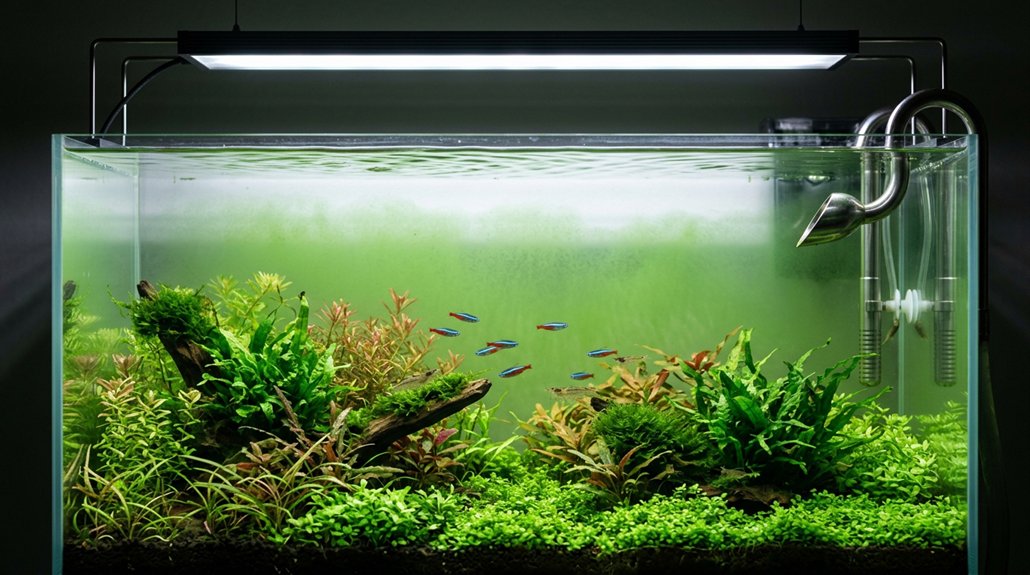
Green water usually clears fastest when you cut off the bloom’s resources: reduce light intensity and photoperiod to about 6–8 hours, and if the bloom is severe, use a blackout to starve the suspended algae. You should also deploy UV sterilizers; they’re highly effective because circulating water exposes free-floating cells to germicidal UV, typically clearing the bloom within 7–10 days. During treatment, perform small, regular water changes to dilute nitrate and phosphate, and reduce feeding to limit new nutrient inputs. If your source water contains nutrients, use RO/DI water, and consider phosphate-adsorbing media in the filter. Fast-growing plants or a refugium can further compete for nutrients. Grazers won’t solve planktonic algae, so don’t rely on them for this problem.
How Do You Prevent Aquarium Algae Long Term?
Long-term algae control depends on keeping the aquarium’s light, nutrients, and flow in stable balance. You’ll get the best results by making your aquarium landscaping and stocking strategy support plant growth, not waste accumulation.
Stable light, nutrients, and flow are the foundation of long-term algae control.
- Run lights 6–8 hours daily on a timer.
- Keep nitrate ≲10 ppm and phosphate ≲0.5 ppm with 20–30% weekly water changes.
- Use fast-growing plants and stable CO2 so they outcompete algae.
- Maintain circulation, clean filters monthly, and add grazers if needed.
Avoid direct sunlight, overfeeding, and nutrient-rich tap water; RO/DI helps when source water is problematic. Increase surface agitation to limit organic buildup. If green water persists, UV sterilization can help. Reserve chemical algaecides for last-resort intervention, since they can disrupt biological stability and’t solve the underlying imbalance.
Frequently Asked Questions
What Is the Fastest Way to Get Rid of Algae in a Fish Tank?
Reduce light to 6–8 hours, remove visible algae, and change 30–50% water immediately; that’s the fastest route. You’ll speed fast algae removal by improving nitrate management, vacuuming substrate, and using appropriate grazers or targeted treatments.
What Can I Put in My Fish Tank to Prevent Algae?
Like a nutrient sponge, you can add floating plants, fast-growing stems, natural substrates, and algae grazers; they’ll outcompete algae for nitrate and phosphate. You’ll also need RO/DI water and phosphate-removing media.
What Kills Algae Without Killing Fish?
You can use diluted 3% hydrogen peroxide, a UV sterilizer, or algae grazers; manual removal’s safest. Add an algae skimmer and phosphate remover to limit regrowth. You’ll protect fish if you dose correctly.
Why Is My Aquarium Growing so Much Algae?
It’s likely because you’ve got excess light, nutrient buildup, and insufficient filtration creating ideal growth conditions. You’re also seeing possible circulation dead zones, unstable CO2, or a new tank’s immature biofilter, all fueling rapid algae expansion.
Conclusion
In your aquarium, algae bloom when light, nutrients, and stagnant flow align like a chemical surge. If you trim excess feeding, regulate photoperiod, maintain filtration, and remove waste with disciplined water changes, you can restore balance before green films and filamentous strands spread. Think of control as precision, not force: you’re tuning a living system so water stays clear, plants stay efficient, and algae remain a faint, manageable trace rather than a dominant canopy.