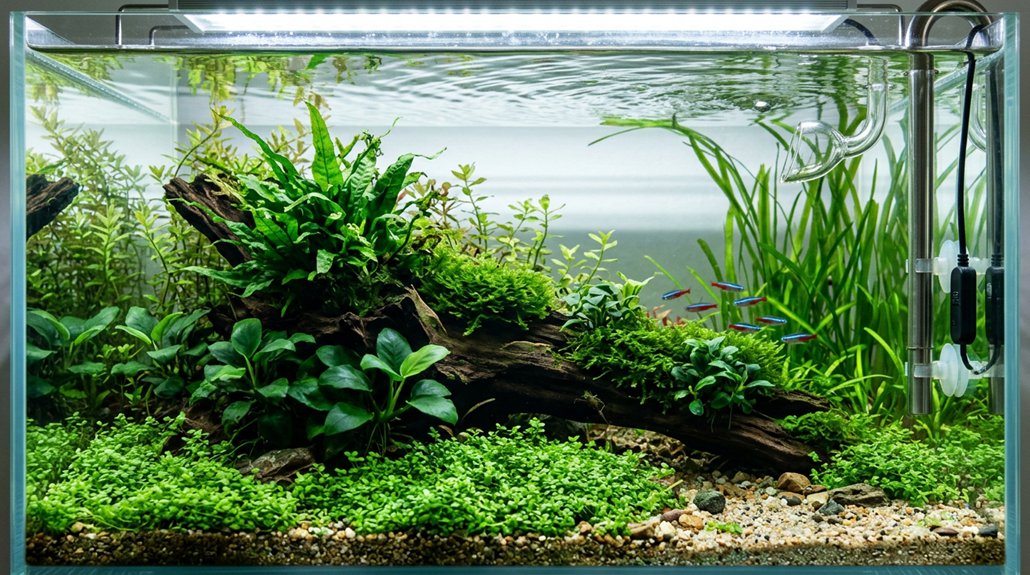
For a freshwater aquarium, you’ll want a properly sized tank, a level stand, and a reliable filter. Aim for 20–55 gallons, with a longer tank shape for stability and swimming room. Add a submersible heater, digital thermometer, secure lid, LED lighting, water conditioner, and a liquid test kit for ammonia, nitrite, and pH. Use rinsed substrate, basic décor, and maintenance tools. Get these right, and you’ll see how each piece works together.
Key Takeaways
- Choose a 20–55 gallon long tank with a sturdy, level stand and leak-test any used aquarium before setup.
- Install filtration rated for 3–5 times tank volume per hour, with mechanical and biological media for stable water quality.
- Use a properly sized heater and accurate thermometer to maintain tropical temperatures around 74–77°F.
- Treat tap water with dechlorinator and test ammonia, nitrite, and pH regularly with a reliable liquid kit.
- Add rinsed substrate, safe décor, and maintenance tools like a gravel vacuum, algae scraper, and spare net.
What Size Freshwater Aquarium Should You Start With?
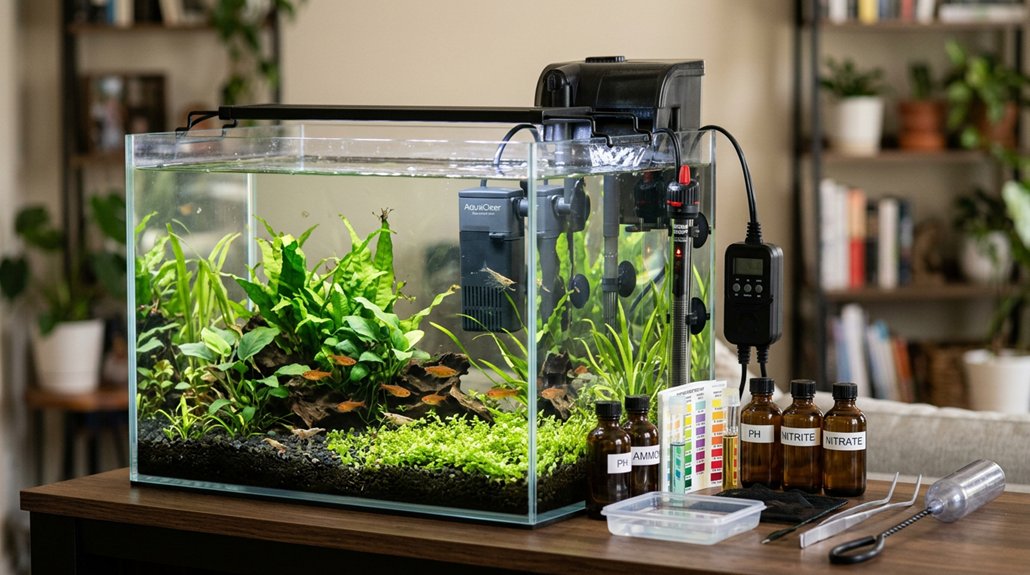
A 20-gallon freshwater aquarium is the minimum sensible starting point for most beginners, with 20–55 gallons being the ideal range because larger volumes are more chemically stable and easier to maintain. You’ll usually find a 20-gallon tank fits most rooms while giving you far more margin for error than anything under 10 gallons. Avoid 1-gallon bowls and other undersized setups for most fish; they’re unsuitable for stable water quality. For a small community or betta alternatives, a longer, low-profile tank is preferable to a tall, narrow one because it offers better swimming space and more surface area for gas exchange. If your space and budget allow, 55 gallons is excellent, but 20–30 gallons is often the most practical compromise for you.
Choose a Tank Material and Stand
Once you’ve settled on a tank size, the next decision is material and support: glass tanks are usually cheaper per gallon and resist scratching, while acrylic tanks are lighter and more impact-resistant but scratch more easily and need full-bottom support. When comparing glass vs. acrylic, weigh maintenance and handling. A tank should sit on a level surface, with a 1/4″ foam pad between stand and tank to spread load. Use a purpose-built stand or a custom built stand rated for the filled weight; a 55-gallon setup can exceed 550 lbs before décor.
- Choose 20 gallons or larger for stability.
- Favor shorter, longer footprints over tall narrow designs.
- Inspect used tanks for cracks and leak-test before placement.
Pick the Right Aquarium Filter
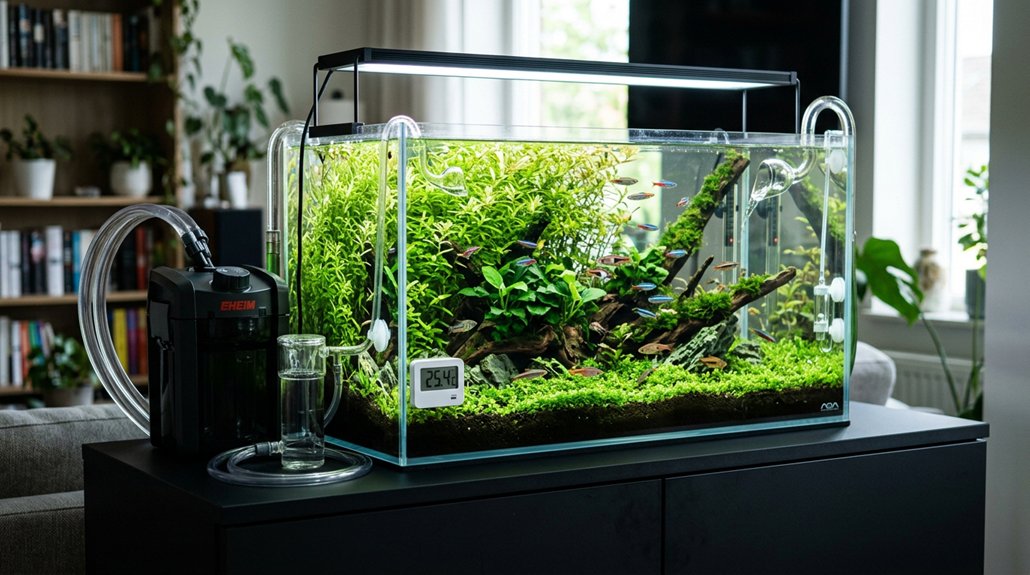
To keep your aquarium stable, choose a filter rated to turn over the tank’s full volume about 3–5 times per hour; for a 20-gallon tank, that means roughly 60–100 GPH. Use a three-stage setup: mechanical pre-filter captures debris, biological media supports nitrifying bacteria, and optional activated carbon removes dissolved contaminants. For beginners, a hang-on-back filter with a bio-wheel is reliable; canister filters suit larger systems, and sponge filters work well in small tanks or fry tanks. If your tank is borderline, choose the higher GPH rating, but avoid excessive water movement that disrupts flow patterns and stresses fish. Check noise levels before buying. Clean mechanical media regularly, and rinse biological media in used tank water, not tap water, so you don’t kill beneficial bacteria or trigger ammonia spikes.
Size the Heater and Thermometer
Dial in your heater by matching wattage to tank size: aim for about 3–5 watts per gallon, using closer to 5 W/gal for small tanks or when your room runs much cooler than the aquarium, and closer to 3 W/gal for larger tanks. For a precise check, use gallons × W/gal, or compare desired temperature minus room temperature against the heater’s rating.
Match heater wattage to tank size: aim for 3–5 watts per gallon for reliable aquarium temperatures.
- For tanks over 40 gallons, split output between two smaller units for heater redundancy.
- Choose a submersible heater with a numerical dial; its control isn’t always exact.
- Place a digital thermometer or probe in the water, not just an adhesive strip; thermometer placement affects accuracy.
Target about 74–77°F for most tropical fish, and verify it regularly.
Choose Lighting and a Secure Lid
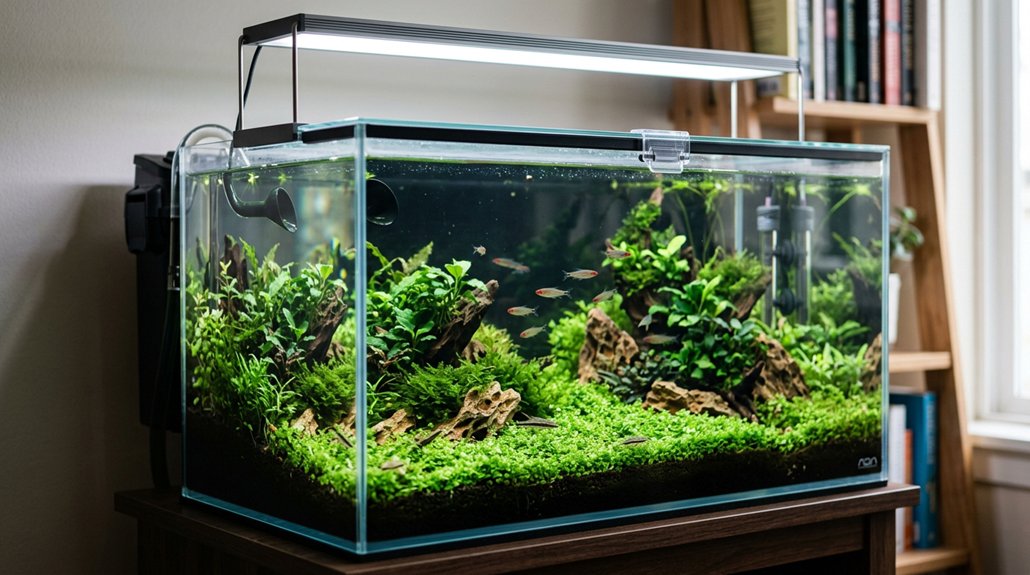
Choose lighting by the animals you keep: fish-only community tanks usually do well with about 1–2 watts per gallon, while planted tanks typically need 2–5 watts per gallon, so a 30-watt fixture can cover roughly 15–30 gallons depending on the setup. For freshwater tanks, LED or fluorescent lights are preferred because they run cool, use less energy, and deliver suitable LED spectra for display or plant growth. Pair the fixture with a secure lid or hood to prevent jumping and limit evaporation. A glass hood seals tightly, while plastic hoods are lighter and often include built-in lighting. Make sure the canopy matches your tank dimensions, leaves access for feeding and equipment, and uses replaceable bulbs, tubes, or LED modules for future upgrades.
Condition and Test the Water
Conditioning the water before it enters the aquarium is essential for fish health and biological stability. You should treat every batch of tap water with a water dechlorinator that neutralizes chlorine and chloramine, so you don’t damage beneficial bacteria or stress fish. Keep a strict testing schedule for ammonia, nitrite, and pH with a reliable liquid kit or multi-parameter strips, especially during cycling or after adding livestock.
- Match temperature with an in-water thermometer before use; most tropical species need 74–77°F.
- In a cycled tank, target zero ammonia and zero nitrite, then use about 25% weekly water changes to limit spikes and nitrate buildup.
- If hardness or pH needs adjustment, change it only from test results, then retest frequently to avoid abrupt swings.
Add Substrate, Decor, and Maintenance Tools
Once the water is conditioned, you can set up the tank’s base layer with 1–2 inches of rinsed substrate, using about 1 lb per gallon for a 1-inch bed or 2 lbs per gallon for a 2-inch bed; dark, smooth gravel or aquarium sand works best for most freshwater community tanks. Use careful substrate layering to support roots and prevent anaerobic zones. Rinse all decor thoroughly, or boil unknown-origin rock for 15 minutes, so dust and residues won’t cloud water or leach chemicals. Add non-reactive driftwood, rockwork, and caves with smooth edges to create hiding places and a naturalistic aquascape. Include live plants when you can, matching depth and lighting to species needs; plastic plants are easier. Keep a gravel vacuum, algae scraper, and spare net ready for weekly 25% maintenance.
Frequently Asked Questions
What Is the Necessary Equipment for the Aquarium?
You’ll need a filter, water heater, aquarium lid, lighting, dechlorinator, test kit, substrate, and safe decorations. Choose equipment sized to your tank and livestock, and keep everything maintained for stable water quality.
What Mistakes Do Beginner Fish Owners Make?
You often create a domino effect: overfeeding consequences, improper cycling, underpowered filtration, skipped dechlorination, and no water testing. You’ll also miss heater checks, add fish too soon, and neglect weekly maintenance, risking ammonia spikes and disease.
What Is the Main Important When Keeping a Freshwater Aquarium?
The main priority is stable water chemistry; you’ve got to monitor ammonia, nitrite, and pH, while keeping appropriate stocking density. You’ll also need reliable filtration and regular maintenance to prevent toxic buildup and stress.
How Long Should a New Fish Tank Sit Before Adding Fish?
You should let it sit 24–48 hours first, then wait through full cycle time—usually 4–8 weeks—for bacterial colonization. You’ll know it’s ready when ammonia and nitrite read 0 ppm and nitrate appears.
Conclusion
With the right tank, filter, heater, light, and water-testing tools, you’re ready to build a stable freshwater habitat. When you’ve conditioned the water, added substrate, and arranged decor, your aquarium should feel like a clear underwater landscape, with gentle currents and steady warmth supporting life. Keep your maintenance tools close, monitor water quality often, and your setup’ll stay balanced, healthy, and ready for your fish to thrive.