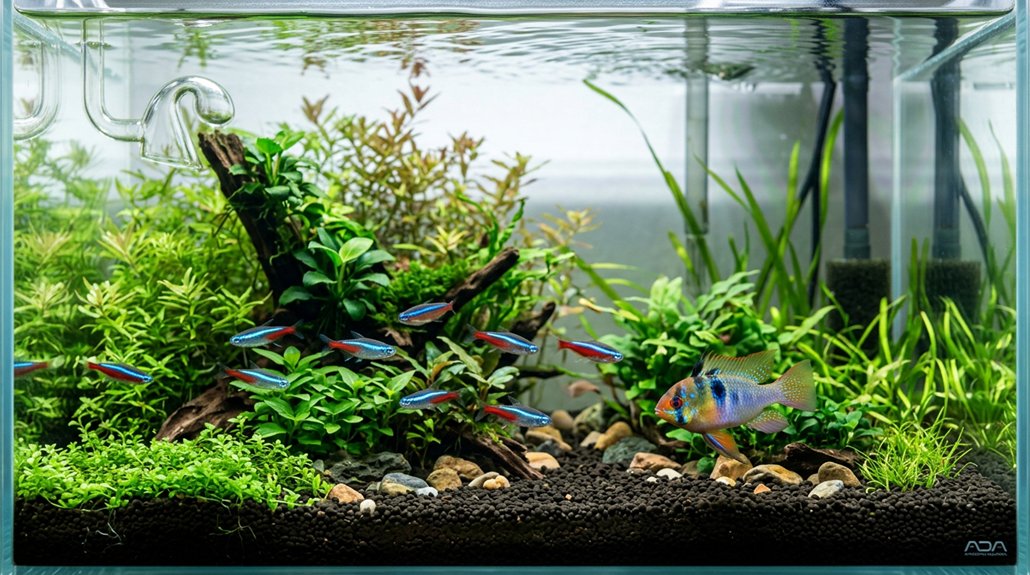
Keep your aquarium water clear by controlling waste, cycling the tank fully, and running proper filtration. You should remove uneaten food, vacuum the substrate, and change 10–25% of the water regularly. If the tank is new, test ammonia and nitrite until both stay at 0 ppm. Use mechanical media to trap particles, activated carbon or Purigen to cut discoloration, and reduce light if green water appears. There’s more to fine-tune for consistently clean water.
Key Takeaways
- Cycle the aquarium fully and test ammonia, nitrite, and nitrate regularly before adding fish.
- Avoid overfeeding and overstocking, since excess waste quickly clouds water.
- Use proper filtration with mechanical, biological, and chemical media to trap debris and remove dissolved organics.
- Vacuum the substrate and perform regular partial water changes to remove waste, silt, and nitrates.
- Control algae and tannins with proper lighting, driftwood preparation, and UV or carbon when needed.
What Causes Cloudy Aquarium Water?
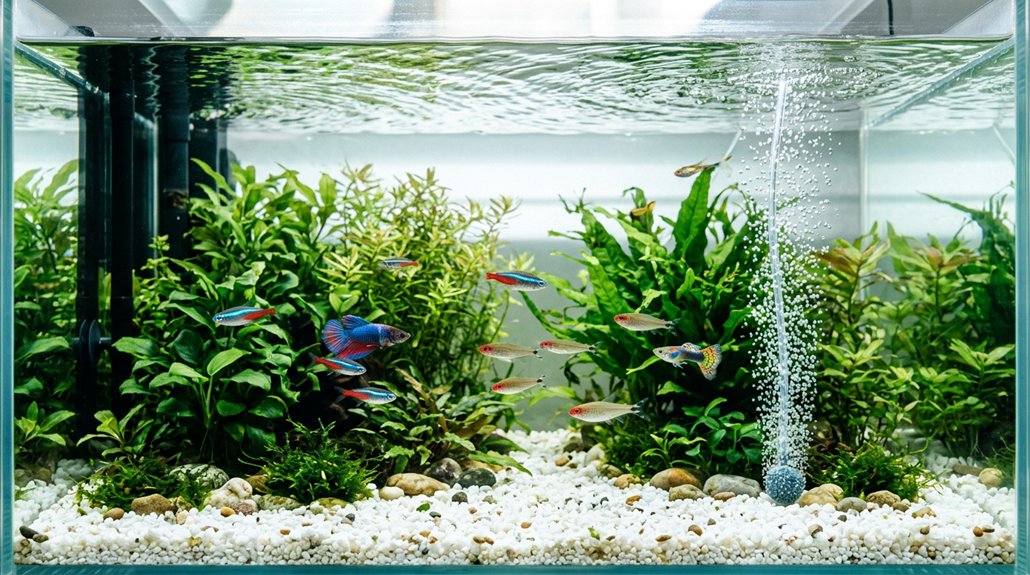
Cloudy aquarium water usually points to an imbalance in the tank’s waste load, filtration, or lighting. You’ll often see it when uneaten food, fish waste, and decaying plants increase ammonia and dissolved organics, shifting microbial interactions toward bacterial growth and algae. A milky-white haze with few particles is typically a bacterial bloom, common during cycling or after sudden nutrient spikes or filter media cleaning. If the water looks green and pea-soupy, you’re likely dealing with free-floating algae fueled by excess light plus nitrates and phosphates from overfeeding or fertilizers. Fine silt from new setups or disturbed substrate creates particulate cloudiness that should settle or be filtered out. Brown-yellow tint from driftwood tannins isn’t true turbidity and can be reduced with carbon or water changes.
Start With Proper Tank Cycling
Before you add most fish, you should cycle your new aquarium for 4–8 weeks so nitrifying bacteria can establish on the biofilter and convert ammonia to nitrite, then nitrate. Test the water weekly during this period, and don’t stock fish until ammonia and nitrite both read 0 ppm and nitrate stays in a safe range. If you seed the filter with established media or a bacterial starter, you can support the cycle, but you still need to add stock slowly so you don’t overwhelm the filtration.
Cycle Before Adding Fish
Cycling your tank before adding fish is essential because it establishes the nitrogen cycle, allowing beneficial bacteria to convert toxic ammonia into nitrite and then nitrate. Use fishless cycling by dosing pure ammonia or letting food decay to about 2–4 ppm. Seeded media from a mature tank, plus porous ceramic rings or lava rock, speeds colonization. Keep temperature near 20–30°C and pH above 6.5, with strong filter flow for oxygen. Test with reliable liquid kits every 2–3 days. Wait until ammonia and nitrite both read 0 and nitrate rises; this usually takes 4–8 weeks. Once stable for a week, add fish slowly, starting with 10–20% of your planned stock, then pause several days or weeks before adding more.
Monitor Ammonia And Nitrite
Once your tank is cycled, test ammonia and nitrite at least twice a week with a liquid kit, because both should stay at 0 ppm in a stable aquarium. During the first 4–8 weeks, ammonia testing confirms that nitrifying bacteria are converting toxic ammonia to nitrite, then nitrate. Keep nitrite monitoring consistent after cycling, too; any detectable reading means your biological filter isn’t fully handling the load. If either value rises above 0 ppm, do a 25–50% partial water change right away and cut back feeding and stocking. Preserve bacterial colonies by keeping plenty of spongy prefilters, ceramic rings, or lava rock in place, and rinse media only in removed tank water. Add fish slowly so the biofilter can expand.
Remove Cloudy Water Caused by Particles
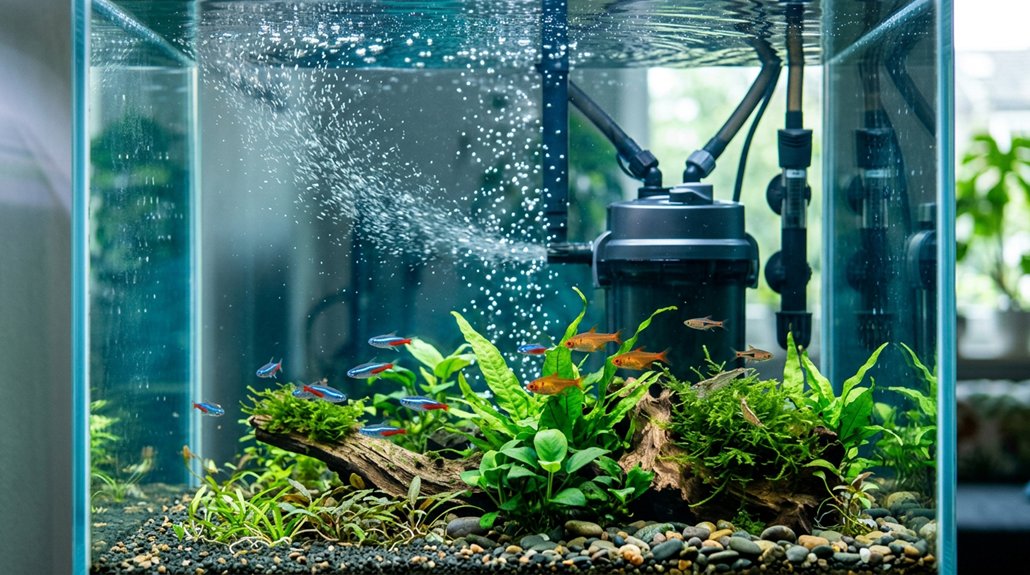
To clear cloudy water caused by particles, vacuum the substrate with an aquarium siphon on a weekly schedule, or more often if needed, to remove uneaten food, fish waste, and silt before they keep circulating. Pair substrate vacuuming with mechanical filtration sized to your tank’s flow: use a prefilter sponge, coarse or fine filter pads, or a sponge filter to trap suspended debris. If new substrate dust still clouds the water after a week, do multiple 25–50% water changes and rinse the substrate thoroughly outside the tank. Rinse filter media monthly in old tank water, not tap water, so you preserve beneficial bacteria while restoring trapping efficiency. For microscopic particles, add temporary water-polishing pad or filter floss, and replace disposable media when it clogs.
Wait Out a Bacterial Bloom
A bacterial bloom usually appears as milky, diluted-milk cloudiness with few visible particles, often during tank cycling or after a sudden nutrient spike when beneficial bacteria haven’t yet caught up. You should usually wait it out rather than intervene aggressively. Don’t use large water changes, heavy filter cleaning, or UV sterilizers, because they can slow natural succession and disrupt microbial balance. Feed normally, or slightly less, and keep routine 10–25% water changes only if water quality needs it. When you rinse biological media, use old tank water so nitrifying bacteria survive. Monitor ammonia, nitrite, and nitrate frequently. If fish stress appears or ammonia or nitrite rises, do targeted partial changes and maintain strong aeration and filtration. The bloom should clear in 7–14 days.
Clear Green Water With Less Light
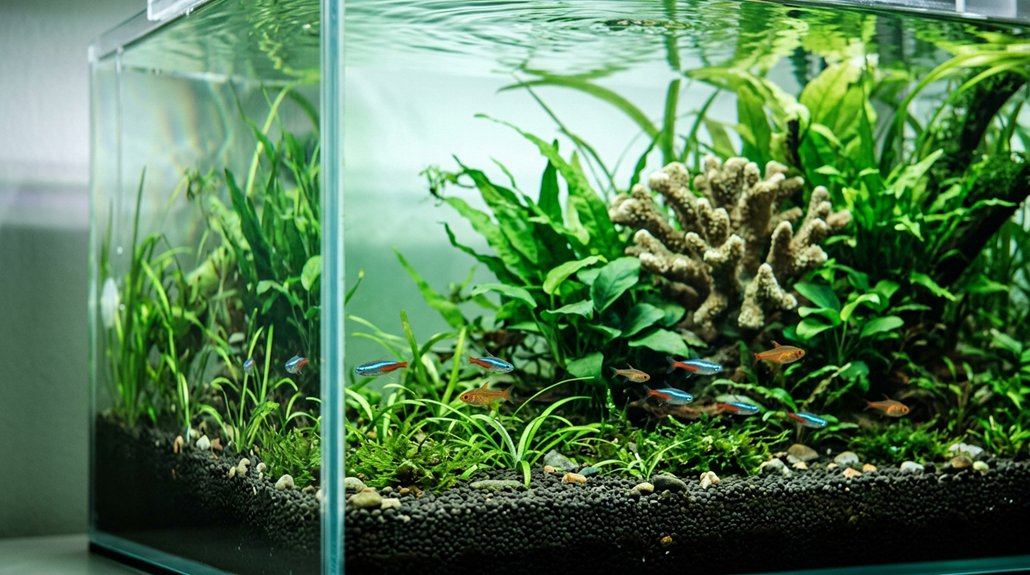
If the cloudiness is green instead of milky, you’re likely dealing with free-floating algae rather than a bacterial bloom, and light control is the fastest way to break it. Start with a 30–50% water change to export suspended algae and excess nutrients. Then reduce daily lighting to 6–8 hours; if needed, use a blackout treatment for 7–10 days, but watch plants and ammonia closely. For faster results, add UV sterilization matched to your tank’s flow rate, since it kills algae cells as water passes through. Also cut feeding, vacuum substrate, and remove decaying leaves to limit nutrient input. After the water clears, restore light gradually to 8–10 hours and keep fast-growing plants, like floating frogbit, competing with algae.
Remove Brown Tannins From Aquarium Water
Brown tannins usually come from driftwood, catappa leaves, and other botanicals leaching humic compounds, and the fastest way to clear them is to step up water changes to 30–60% until the tint fades.
| Action | Purpose | Frequency |
|---|---|---|
| Water changes | Dilute tannins | Daily to weekly |
| Activated carbon | Adsorb dissolved color | Replace as needed |
| Purigen | Ion-exchange removal | Recharge per label |
| Boil/soak wood | Pre-leach tannins | Several hours |
| Stop new sources | Limit staining | Ongoing |
For persistent staining, combine media with mechanical filtration and detritus vacuuming. Pre-soak or boil new wood, change soak water, and use careful botanical selection for tannin prevention. If you keep blackwater species, skip chemical removal; otherwise, keep changing water and media until the wood’s color stabilizes.
Clean Cloudy Aquarium Walls
Crystal-clear walls usually come back with consistent mechanical cleaning and tighter husbandry: use an algae scrubber or magnetic cleaner on the inside panels daily to remove biofilm before it builds up, and choose a soft scrubber on acrylic to avoid micro-scratches. For effective algae removal, wipe the viewing panes before deposits harden. Vacuum the substrate and change 25–50% of the water weekly so suspended debris doesn’t settle and stick to the glass. Rinse or replace mechanical media monthly to keep particles trapped. Wipe the outside weekly with an aquarium-safe cleaner or microfiber cloth to remove grease and haze. Reduce light to 8–10 hours and feed less to limit new film. Good acrylic care keeps surfaces clear, and removing decaying plant matter further cuts nutrient buildup and clouding.
Use Better Filtration Media
Upgrade the media inside your canister or HOB filter so it does more than just move water: combine coarse mechanical media like sponge or filter floss to trap debris, porous biological media like ceramic rings or bioballs to support nitrifying bacteria, and chemical media like activated carbon or Seachem Purigen to remove dissolved organics that can tint or haze the tank. Add advanced sponges and magnetic media for better contact and easier servicing.
Upgrade your filter media to combine mechanical, biological, and chemical stages for cleaner water and easier maintenance.
- You’ll see fewer floating particles.
- You’ll feel confident your fish breathe cleaner water.
- You’ll avoid the frustration of recurring haze.
- You’ll get clearer viewing without overcomplicating the system.
Use a water-polishing pad or microfibers as the last stage, and choose higher-capacity layered media for more surface area and steadier ammonia and nitrite conversion.
Prevent Cloudy Water With Routine Maintenance
You’ll keep cloudy water in check by changing 30–60% of the water each week and vacuuming the substrate to remove waste and uneaten food. Rinse mechanical filter media in old tank water about once a month so you restore particle capture without killing beneficial bacteria. Keep feeding and stocking under control, because excess organic load quickly drives haze and nutrient buildup.
Weekly Water Changes
Weekly water changes are one of the most reliable ways to prevent cloudy aquarium water, because they remove dissolved organics, nitrates, and suspended particles before they build up. Aim for a 25–50% change each week; 30% is often the best balance for stability and clarity. Use ideal timing by changing water on the same day every week, so waste doesn’t accumulate unpredictably. Before refilling, dechlorinate tap water or use RO water, and practice temperature matching to avoid shocking fish or harming beneficial bacteria. During the change, siphon 10–20% of the substrate with a gravel vacuum to lift uneaten food and waste.
- Relief when the haze fades
- Confidence in a steadier tank
- Less stress from sudden cloudiness
- Pride in consistent care
Clean Filters Regularly
Clean filters regularly to keep water clear, because a clogged filter can’t trap particles effectively and may start recirculating debris back into the tank. You should rinse sponges, floss, and pads monthly in aquarium water removed during a water change, never tap water, so you preserve beneficial bacteria and particle capture. Clean prefilter sponges on intake pipes weekly, or sooner if flow drops, using siphoned tank water. Replace disposable polishing pads every 2–6 weeks, based on load, before they clog and slow flow. Every 4–8 weeks, deep-clean canister or HOB filters: disassemble, rinse media in tank water, and brush impellers and housings. Check sponge placement and watch filter noise; after maintenance, verify flow and cloudiness so you don’t overclean or replace all media at once.
Best Products for Clear Aquarium Water
For the clearest water, pair the right media with the problem you’re trying to solve: mechanical media such as prefilter sponges, coarse sponge pads, and fine water-polishing pads trap suspended particles; disposable fine pads should be replaced weekly, while reusable sponges can be rinsed monthly in tank water to preserve flow. Use aquarium clarifiers and phosphate removers only when testing shows particles or nutrients are driving haze.
- You’ll see sharper visibility.
- You’ll cut down on tannins and discoloration.
- You’ll protect beneficial bacteria.
- You’ll feel in control of the tank.
Activated carbon or Seachem Purigen handle dissolved organics; Purigen’s reusable after bleach regeneration. For green water, size a UV sterilizer to your flow, then change water. Add porous bio-media for bacteria.
Frequently Asked Questions
What Can I Put in My Fish Tank to Keep the Water Clear?
You can put activated carbon and live plants in your tank to keep water clear. Use mechanical filter media, plus biological media, and run a properly sized filter; they’ll reduce particles, organics, and algae.
How to Make Aquarium Water Always Clear?
You can’t keep it always clear, but you’ll get close: use live plants, efficient filtration, weekly water changes, light feeding, and UV sterilizers for blooms. Think of your tank as a city—every waste stream needs a drain.
How Do I Stop My Aquarium Water From Getting Dirty?
Feed only what your fish’ll eat in two minutes, do weekly 25–50% water changes, vacuum substrate, and keep filtration sized right. Test ammonia, nitrite, nitrate, and phosphate; this supports algae prevention and substrate maintenance.
Conclusion
Keeping your aquarium water clear is like tuning a delicate engine: every part must work in sync. If you cycle your tank properly, control light, clean surfaces, and maintain strong filtration, you stop problems before they cloud the view. Stay consistent with water changes and routine care, and your tank will run clean and stable. With the right habits, you’ll keep murky water at bay and give your fish a healthier, brighter home.