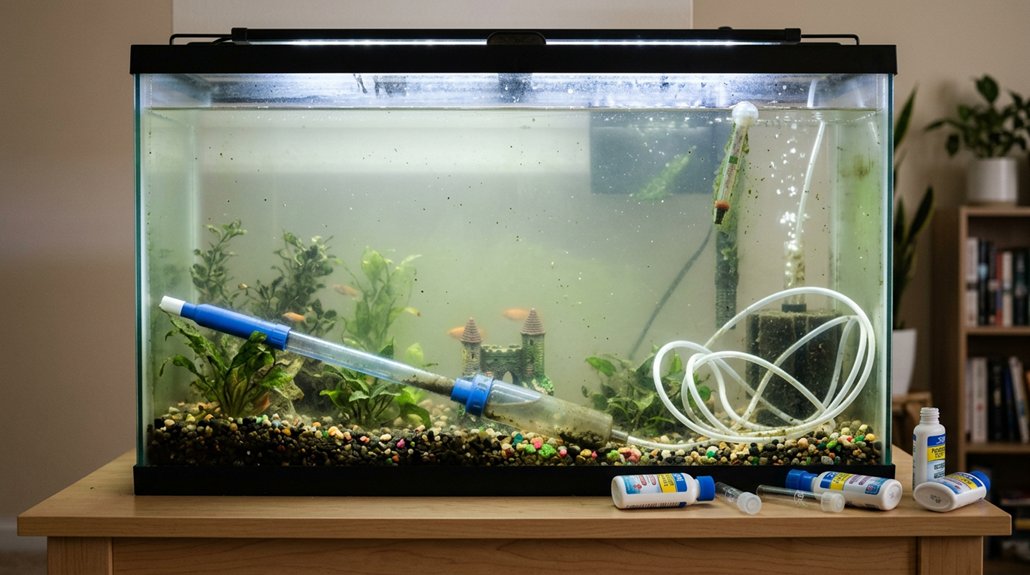
The biggest mistakes when cycling a fish tank are adding fish too soon, overstocking early, and skipping reliable ammonia, nitrite, and pH testing. You can also run into trouble if you rely on bottled bacteria alone, misread test results, or use conditioners that mask toxins instead of fixing them. A new filter needs time for nitrifying bacteria to establish, so patience and consistent testing are essential if you want a stable, safe tank.
Key Takeaways
- Adding fish too early before nitrifying bacteria establish can cause dangerous ammonia spikes.
- Overstocking or feeding normally during cycling can overload the unfinished biofilter.
- Skipping accurate ammonia, nitrite, and pH testing hides rising toxin levels.
- Relying blindly on bottled bacteria or conditioners does not replace proper cycling.
- Changing water care incorrectly can slow nitrifier growth or fail to remove extreme toxins.
What Fish Tank Cycling Does
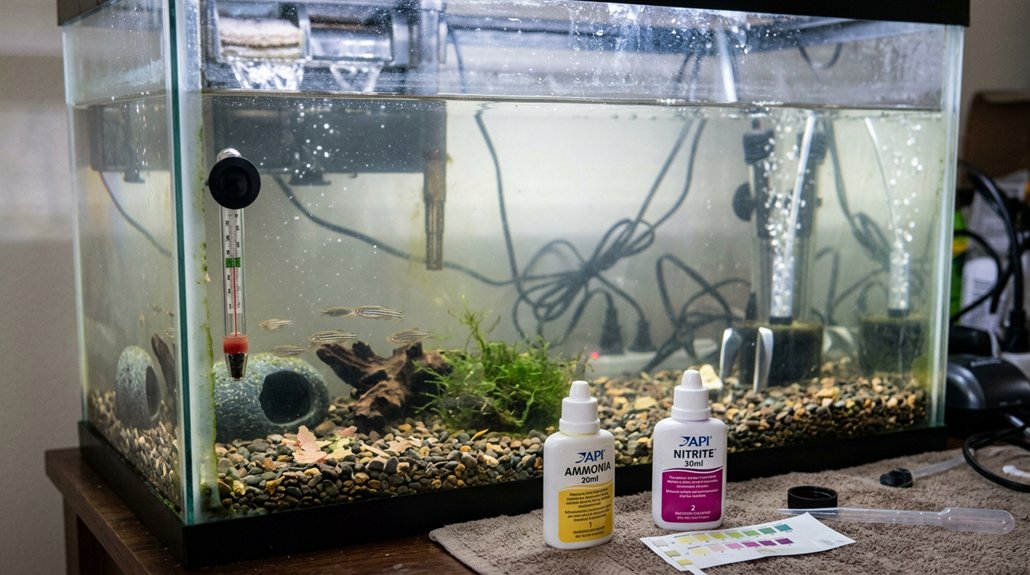
Cycling builds a tank’s nitrifying bacterial community so it can convert toxic ammonia (NH3/NH4+) first into nitrite (NO2−) and then into nitrate (NO3−), allowing the system to handle a steady daily ammonia load. You’re cultivating nitrifier ecology on every available surface, mainly autotrophic bacteria such as Nitrosomonas, Nitrosospira, Nitrospira, or Nitrobacter. Their growth takes weeks to months, so the goal isn’t instant filtration; it’s stable capacity. Ammonia speciation matters because higher pH shifts more total ammonia into toxic NH3, while very low pH can slow nitrification. You can verify completion by dosing ammonia and checking that, within 24 hours, ammonia and nitrite read 0 ppm while nitrate is present. Fishless cycling builds this capacity without exposing livestock to spikes.
Why New Tanks Fail With Fish Too Soon
When you add fish within days of setting up a new tank, the biofilter usually hasn’t had time to establish enough nitrifying bacteria to process the waste, so ammonia can rise to lethal levels before the system catches up. Your overstocking timing matters because the colony grows over weeks, not hours, and even a few fish can outpace it.
Adding fish too soon can overwhelm a new tank before the biofilter is ready, sending ammonia to dangerous levels.
- Stock slowly: early crowding overloads the unfinished filter.
- Test frequently: without ammonia, nitrite, and pH checks, you can’t verify safety.
- Feed lightly: normal feeding boosts waste faster than bacteria can convert it.
If you skip water changes, trust unverified bottled bacteria, or use improper acclimation, toxins build quickly. Low pH can stall nitrification; high pH increases ammonia toxicity.
Common Fish Tank Cycling Mistakes
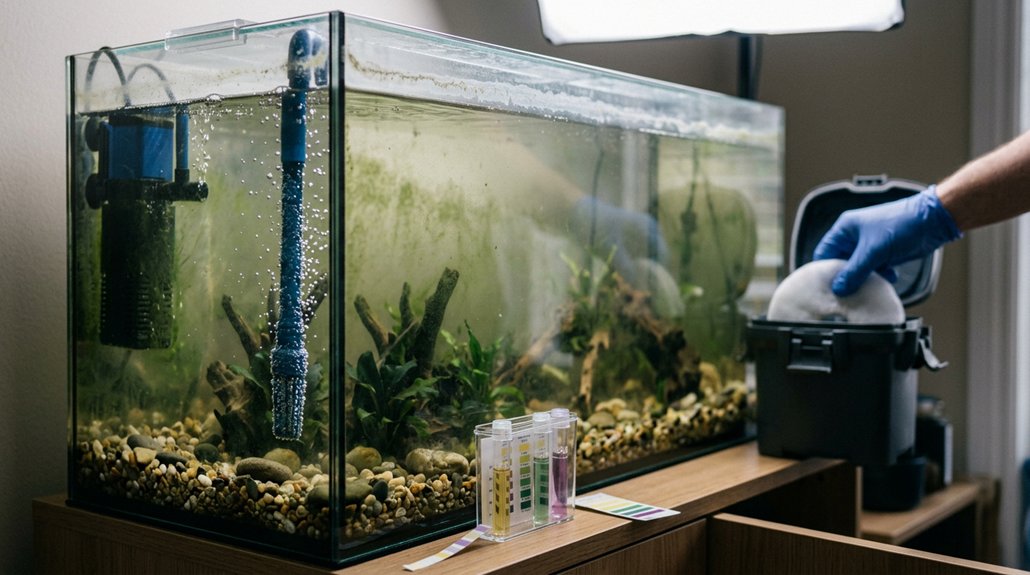
Common mistakes can throw a tank’s nitrogen cycle off track before the biofilter has a chance to mature. You shouldn’t add fish within days of setup, because nitrifier populations usually need weeks to establish and can’t prevent lethal ammonia spikes. Don’t skip reliable ammonia and nitrite tests, and if readings are very high, use the API 1:10 dilution so you don’t misread progress. Be skeptical of starter myths and inconsistent bottled bacteria; many products won’t build enough biomass without seeding from established filter media. Avoid overdosing conditioners, which can mask problems without fixing them. You also need to balance water changes: none when toxins are extreme, but not so many that you keep stripping conditions needed for nitrifiers. Finally, keep pH buffered and stable, since a crashed pH can stall cycling.
How to Cycle a Fish Tank Step by Step
Once you’ve avoided the common cycling mistakes, the process itself becomes straightforward: choose a target ammonia level for fishless cycling, usually 1 ppm for most aquariums or 2–4 ppm for tanks that’ll be heavily stocked, then dose pure ammonium chloride or a measured fishless-cycle product and verify the concentration with an ammonia test kit.
- Add seed media: established filter media, a sponge, or bottled nitrifiers.
- Do daily ammonia dosing, then test ammonia, nitrite, and nitrate every 24 hours.
- Re-dose only when ammonia and nitrite both read 0.
Keep pH stable near your tank’s long-term target, dechlorinate any top-off water, and avoid unnecessary water changes unless nitrate climbs too high. If the cycle stalls for over a week, add more seed media, check pH, or use a proven nitrifier product.
How to Tell Your Tank Is Fully Cycled
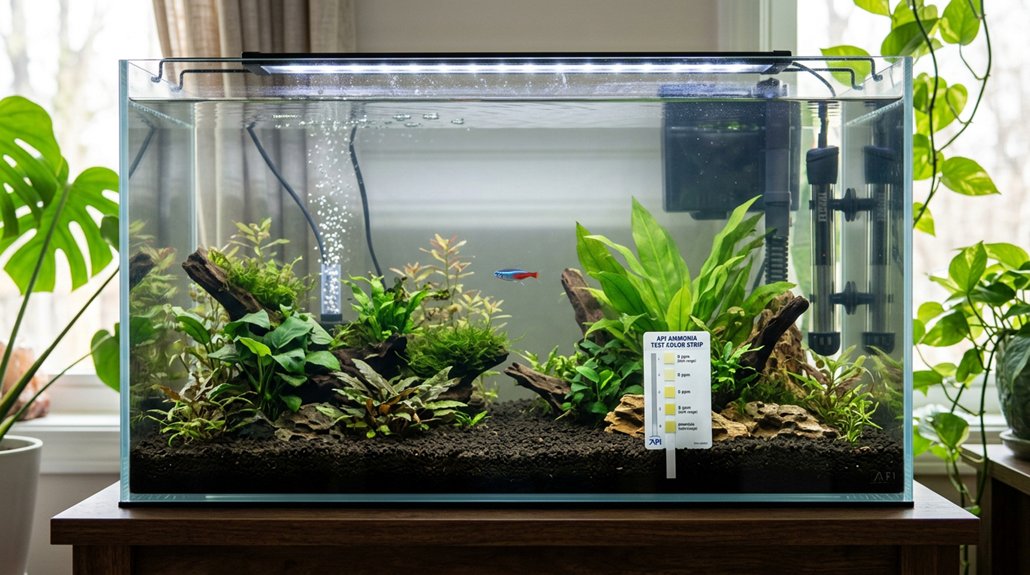
A tank is fully cycled when a measured ammonia dose, typically 1 ppm, is processed to 0 ppm ammonia and 0 ppm nitrite within 24 hours, while nitrate remains detectable, usually above 5–10 ppm. You should verify this with an accurate liquid test kit, not strips, and use API’s dilution method if ammonia reads above range. Repeat the 1 ppm challenge several days apart; consistent 24-hour clearance shows the biofilter can handle daily waste loads. Watch for ammonia masking from conditioners such as Seachem Prime, which can hide true ammonia levels. Test raw water when safe. Also check pH, since pH dependency can stall nitrifiers at low values, and a zero reading at one pH may fail after a shift.
Frequently Asked Questions
How Do You Know When a Fish Tank Is Properly Cycled?
You know it’s properly cycled when a measured ammonia dose drops to 0 ppm, nitrite also reads 0 ppm within 24 hours, and nitrate testing shows nitrate present; stable pH and clear water support confirmation.
How Long Should a Fish Tank Be Cycled For?
You should cycle your tank for 2–8 weeks; the ideal duration depends on starter bacteria, temperature, pH, and filtration. With seeded media, you might finish in 2–4 weeks, but test ammonia, not days.
How Often Do You Add Ammonia When Cycling?
You add ammonia only when your test shows it’s been fully processed, so your ammonia schedule is based on results, not time. Early on, check daily; once stable, your dosing frequency is typically every 24 hours.
How Often Should I Feed Fish When Cycling in the Tank?
Like balancing a lab scale, you should feed sparingly: one small pinch or pellet per fish every 24–48 hours. Adjust feeding frequency to ammonia tests; don’t overfeed. For fry feeding, offer tiny meals more often.
Conclusion
By avoiding common cycling mistakes, you give your tank the stable biological foundation it needs. Cycling is not a shortcut; it is the slow build of nitrifying bacteria that keeps ammonia and nitrite under control. When you monitor water parameters, add fish gradually, and wait for clear signs of completion, you reduce stress and losses. Think of cycling like laying a road before traffic arrives: without that groundwork, your fish can’t travel safely.