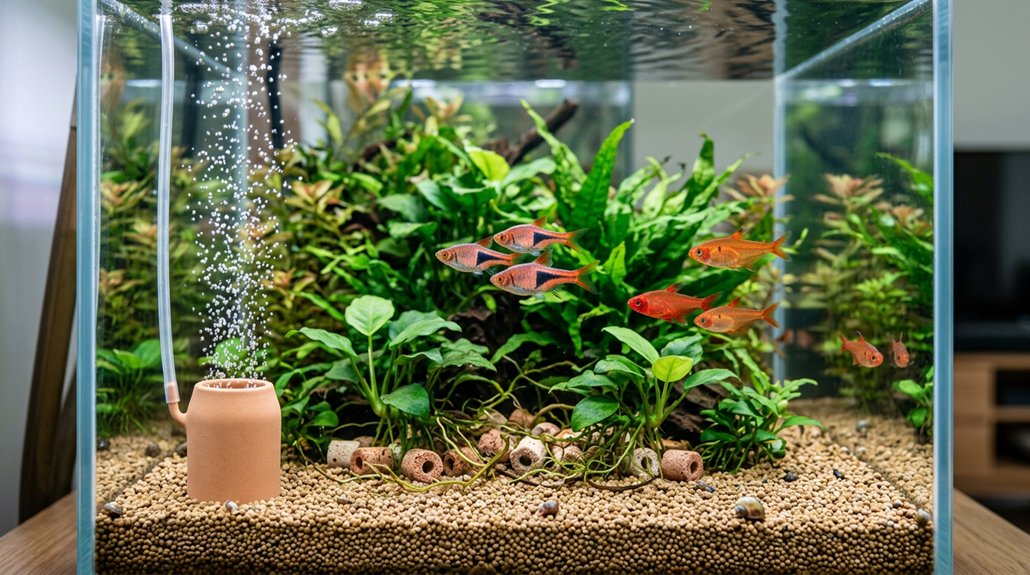
The nitrogen cycle in your fish tank is the biological process that turns toxic ammonia from fish waste, uneaten food, and decay into nitrite, then nitrate. Beneficial nitrifying bacteria in the filter, gravel, and decorations do this work, and they need oxygen, stable temperature, and time to establish. You’ll know a tank is cycled when ammonia and nitrite read 0 ppm and nitrate is measurable, but keeping them there still takes monitoring and maintenance if you want the full picture.
Key Takeaways
- The nitrogen cycle converts toxic fish waste into less harmful nitrate through beneficial bacteria in the aquarium.
- Fish waste and leftover food release ammonia, which is the first toxic compound in the cycle.
- Nitrifying bacteria convert ammonia into nitrite, then nitrite into nitrate over several weeks.
- A tank is cycled when ammonia and nitrite read 0 ppm, while nitrate is measurable and kept low.
- Cycling needs time, oxygen, and maintenance like partial water changes, careful stocking, and avoiding chlorine.
What Is the Aquarium Nitrogen Cycle?
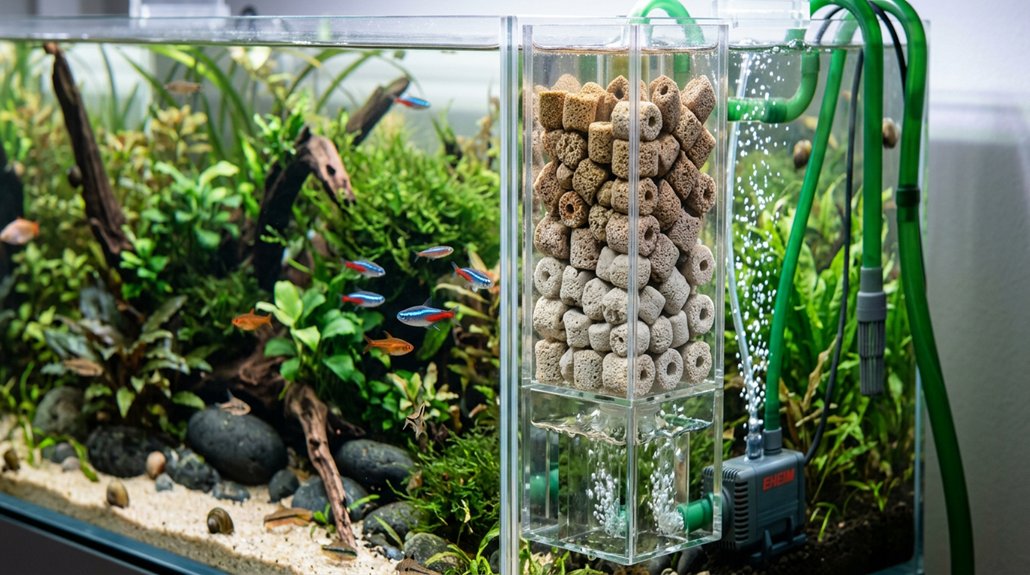
The aquarium nitrogen cycle is the biological process that converts toxic waste into less harmful compounds in a fish tank. You’re managing a microbial system in which fish waste and decaying organics generate ammonia, then specialized nitrifiers in the aquarium microbiome transform it into nitrite and nitrate. This isn’t just chemistry; it’s a biological filtration capacity defined by colonized surfaces such as filter media, gravel, and decorations. When your tank is cycled, you’ll measure 0 ppm ammonia and 0 ppm nitrite, with detectable nitrate present, showing the bacteria can process waste as it’s produced. Hobbyist misconceptions often treat “cycled” as permanent, but it depends on current bioload versus bacterial capacity. Nitrate accumulates over time, so you’ll still need removal through water changes or plant uptake.
How Does the Nitrogen Cycle Work?
In your tank, fish waste, uneaten food, and decaying plants release ammonia, which beneficial Nitrosomonas bacteria oxidize into nitrite. Nitrite is then converted by Nitrobacter and related bacteria into nitrate, so a properly cycled system shows 0 ppm ammonia and 0 ppm nitrite while nitrate accumulates. You’ll reduce nitrate through partial water changes or live plants, and you should act when levels approach about 40 ppm.
Ammonia To Nitrate Path
Ammonia enters the tank from fish waste, uneaten food, and decaying organic matter, with un-ionized NH3 being highly toxic, especially at pH ≥ 7.0. You also get ammonia from fish metabolism, and its form depends on substrate chemistry and water pH. In the next oxidation step, Nitrosomonas bacteria convert NH3/NH4+ into nitrite (NO2-), so an initial ammonia spike is often followed by a nitrite spike. Nitrite remains toxic. Then Nitrobacter, or similar nitrite-oxidizers, transform NO2- into nitrate (NO3-), a much less toxic terminal product. Nitrate keeps accumulating as long as waste is produced, so you’ll need water changes or live plants to limit buildup. In a fully cycled aquarium, ammonia and nitrite read 0 ppm, while nitrate is measurable but low.
Beneficial Bacteria Roles
Nitrosomonas and Nitrobacter drive the aquarium nitrogen cycle by sequentially oxidizing nitrogenous waste into less toxic forms. You rely on Nitrosomonas to convert fish-derived ammonia into nitrite, then Nitrobacter oxidizes nitrite into nitrate. Both groups are obligate chemolithotrophs and aerobes, so your tank’s oxygen requirements must stay high enough to support their metabolism. They colonize filter media, gravel, decorations, and plant roots, where biofilm formation creates stable, sticky communities. Because they grow slowly, with doubling times often near 15–20 hours, population increases lag behind waste input. Their activity is also constrained by pH and temperature; performance is usually strongest near 25–30°C, with Nitrosomonas favoring about pH 7.8–8.0 and Nitrobacter about 7.3–7.5.
Cycling And Water Changes
As fish waste and uneaten food decompose, they release ammonia (NH3/NH4+), the most toxic early-stage nitrogen compound in your tank, so you should test for it every 2–3 days during cycling. Nitrosomonas then oxidize ammonia to nitrite (NO2−), which usually peaks in week two and remains highly toxic. Next, Nitrobacter convert nitrite to nitrate (NO3−), a less toxic end product that accumulates as cycling advances. Your tank is cycled when ammonia and nitrite both read 0 ppm and nitrate is measurable, often 20–25 ppm. At that point, you can add fish more safely. Control nitrate with regular partial water changes, about 10% weekly or larger changes at ≥40 ppm, plus live plants. Automated dosing can help stabilize nutrients during this shift.
What Does It Mean to Cycle a Tank?
To cycle a tank means you’re establishing sufficient nitrifying bacteria on the filter, substrate, and other surfaces so ammonia and nitrite are rapidly oxidized. You’re aiming for stable test results of 0 ppm ammonia and 0 ppm nitrite, with detectable nitrate indicating active biological filtration. This process usually takes several weeks and can be accelerated by seeded media, live plants, or bottled bacteria, but the bacterial load still has to match your tank’s eventual bioload.
Cycle Definition
Cycling a tank means building a sufficient population of beneficial nitrifying bacteria on the tank’s surfaces and filter media so added ammonia and nitrite are converted as soon as they appear, keeping both at 0 ppm. In practice, you’re completing tank maturation through bacterial succession on all available colonization surfaces. A cycled aquarium shows 0 ppm ammonia, 0 ppm nitrite, and measurable nitrate, which confirms active nitrification. This process usually takes 2–8 weeks, though the timeline varies with surface area, temperature, and eventual bioload. You can accelerate colonization with live nitrifying bacteria, established media or gravel, and live plants. Even then, the resulting filtration capacity is load-dependent, so a tank cycled for a few small fish may still be overwhelmed by a sudden increase in waste output.
Beneficial Bacteria Setup
What tank cycling actually means is building a large enough population of beneficial nitrifying bacteria, mainly *Nitrosomonas* and *Nitrobacter*, on the filter media, gravel, and other surfaces so ammonia and nitrite are oxidized to nitrate as soon as they appear. You’re promoting biofilm formation on every oxygen-exposed surface, because these organisms are slow-growing obligate aerobes. Keep the system warm, near 77–86°F (25–30°C), with near-neutral to slightly alkaline pH, and use strong oxygenation strategies to support nitrification. You can seed colonies faster with used media, substrate, live plants, or bottled cultures. Don’t rinse media in tap water, since chlorine can kill cells. In practice, the bacterial load must match fish waste, so you’ll need to add livestock gradually and let colonies expand between additions.
Target Water Readings
A tank is considered cycled when ammonia tests at 0 ppm, nitrite tests at 0 ppm, and nitrate is measurable, showing that toxic nitrogen compounds are being fully converted. You should confirm the expected sequence: ammonia rises first, nitrite spikes as ammonia declines, then nitrate accumulates as nitrite returns to zero. After cycling, keep nitrate measurable but low, ideally under 20–40 ppm; if it reaches 40 ppm or higher, perform a water change. Your testing frequency should be every 2–3 days early in cycling, then weekly once readings stabilize, using a master kit for ammonia, nitrite, nitrate, and pH. Plant uptake can help suppress nitrate, but it won’t replace biological filtration. Even a cycled tank can be overloaded if you add fish too quickly.
How Long Does It Take to Cycle an Aquarium?
Timing an aquarium cycle depends on how quickly nitrifying bacteria colonize the filter and substrate; in most tanks, this process takes about 2 weeks to 2 months, with 3–8 weeks being the typical range. You’ll usually see ammonia rise within 3 days, then nitrite in week 2. A tank is cycled when both test 0 ppm and nitrate is measurable, often around 4–6 weeks.
- Fish acclimation affects initial ammonia input.
- Substrate sterilization can remove resident microbes.
- Bio-load changes can outpace bacterial capacity.
- Test kits verify completion, not guesswork.
If your stocking is light, cycling may finish sooner; if it’s dense, it can lag. Even a cycled system isn’t permanent—its bacterial population adjusts to waste production, so sudden load increases can disrupt balance.
How Can You Speed Up the Nitrogen Cycle?
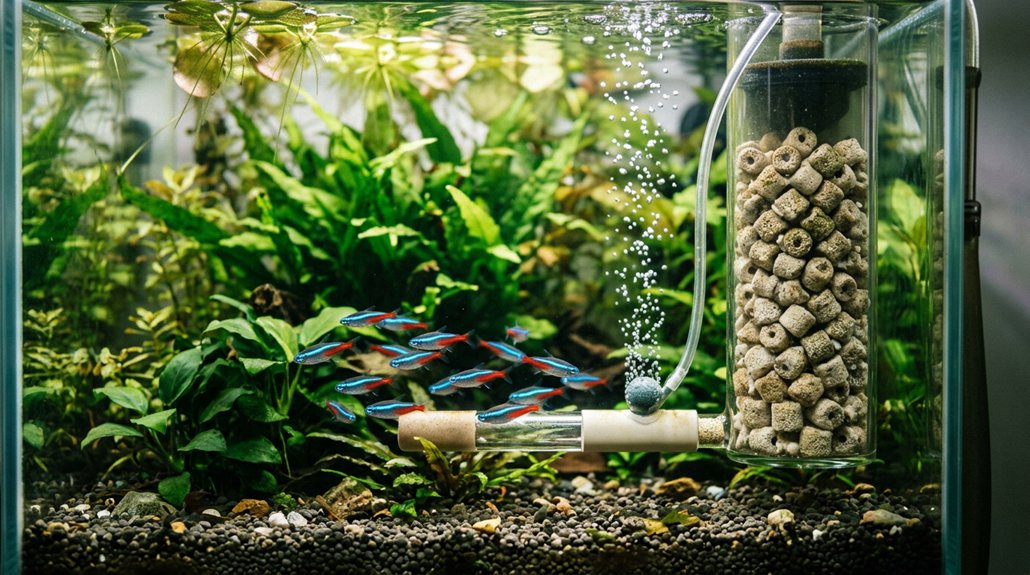
You can speed up the nitrogen cycle by increasing nitrifying bacterial activity and giving those microbes an immediate source of surface area and ammonia. Use temperature control to hold the tank near 80–82°F (27–28°C), which raises metabolic rates and can shorten cycling time. Seed the aquarium with used filter media or gravel from an established tank to import active nitrifiers and expand colonization fast. You can also add bottled bacteria, such as Tetra SafeStart or Dr. Tim’s One & Only, to inoculate the system, though outcomes vary by product and storage. Live plants in freshwater, or live rock in saltwater, add surface area and help assimilate dissolved nitrogen. In fishless cycling, dose pure ammonia or ammonium chloride until nitrates appear, then complete with a 30% water change.
How Do You Keep Ammonia and Nitrite at Zero?
- Test ammonia and nitrite every 2–3 days during cycling, then weekly.
- Control stocking density; add one or two fish, then wait two weeks.
- Match fish diet to consumption, so uneaten food doesn’t elevate waste output.
- Perform 10–30% water changes and rinse media only in tank water.
Avoid chlorine, chloramine, and other bactericidal chemicals, because they can suppress nitrifiers. Consistent monitoring keeps the biofilter stable, minimizes stress, and maintains safe, toxicant-free conditions for your fish.
Frequently Asked Questions
How Long Does the Nitrogen Cycle Take in a Fish Tank?
Usually, your cycling duration is 2–8 weeks; aquarium bacteria establish in stages. You’ll often see ammonia first, nitrite by week two, then nitrate last. Heavy bioloads can lengthen it.
Can Fish Survive the Nitrogen Cycle?
Yes, you can keep fish alive, but about 0 ppm ammonia and nitrite is ideal; during cycling, most deaths come from fish stress and low ammonia tolerance. You’ll need testing, water changes, and detoxifiers.
How to Fix Nitrogen Cycle in Fish Tank?
You fix it by testing water parameters, then lowering ammonia and nitrite with 10–30% changes, adding bacterial supplements, and reducing feeding. Keep the filter running, avoid tap-rinsing media, and wait until readings’re 0 ppm.
How Do I Tell When My Fish Tank Is Fully Cycled?
You’ll know it’s fully cycled when water testing shows 0 ppm ammonia, 0 ppm nitrite, and measurable nitrate, often 20–25 ppm. Beneficial bacteria have established, and you’ll keep those readings stable despite bio-load changes.
Conclusion
In your aquarium, the nitrogen cycle is the quiet chemical choreography that protects fish health. You seed beneficial bacteria, and they sequentially convert toxic ammonia into nitrite, then nitrate. During cycling, you monitor water quality until ammonia and nitrite read zero. To keep your tank stable, you maintain filtration, avoid overfeeding, and perform regular water changes. With steady science and careful control, you can support a balanced, biologically mature aquatic environment.