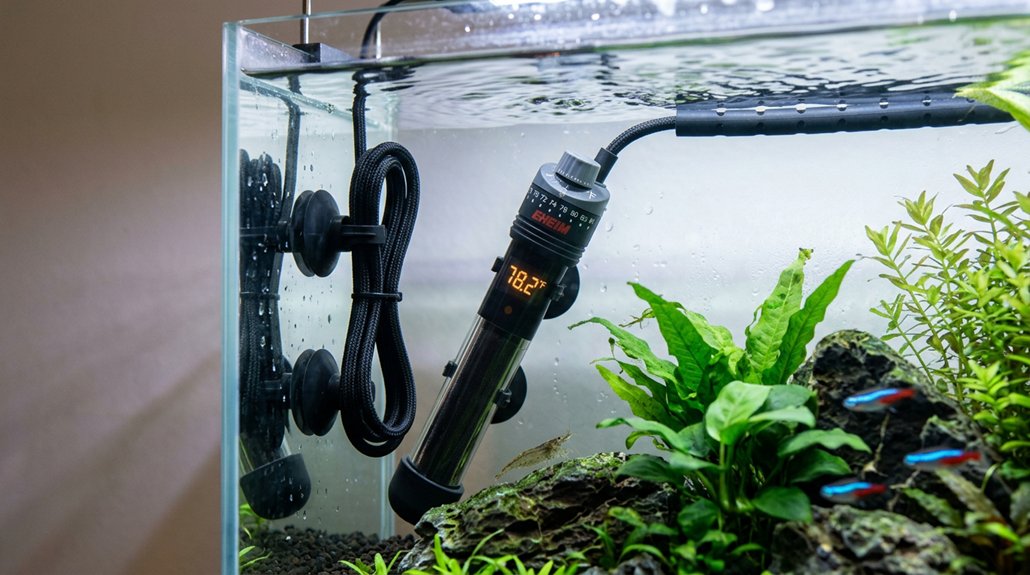
Choose a heater by matching wattage to your tank and room. A good rule is about 5 watts per gallon for a roughly 10°F rise, or closer to 3 watts per gallon for larger tanks or warmer rooms. Use two smaller heaters for tanks over 55 gallons, colder spaces, or needs above 200 watts. Pick titanium, PTC, or a quality glass model, and place it near filter flow for even heat. There’s more to optimize.
Key Takeaways
- Size the heater by tank volume: about 5 watts per gallon for a 10°F rise, less for larger tanks or warmer rooms.
- Use multiple heaters for tanks over 55 gallons, colder rooms, or temperature rises above 10–15°F for better redundancy.
- Choose heater type by setup: titanium or PTC for reefs and high-value tanks, glass for budget freshwater tanks.
- Place the heater near filter output or a pump, and mount it vertically unless the manufacturer says otherwise.
- Check temperature with a thermometer in the opposite corner to confirm even heating and adjust if needed.
What Size Aquarium Heater Do You Need?
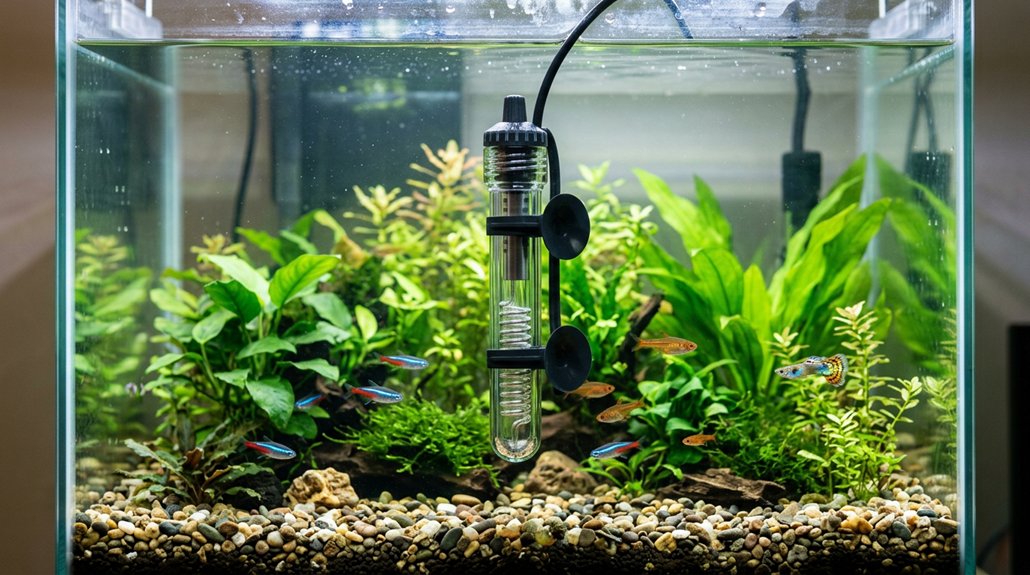
To size an aquarium heater, start with the common rule of thumb of about 5 watts per gallon for tanks that only need to run roughly 10°F above room temperature; for example, a 29-gallon tank usually lands around 145 watts, though it’s often rounded to a 100- to 150-watt heater based on available sizes. That gives you a practical starting point for heater wattage, but you should adjust for ambient compensation. If your tank is large, or your room runs cooler than normal, drop toward 3 watts per gallon and consider two heaters. A 15°F rise can push one unit past its duty cycle. For tanks needing 200 watts or more, use multiple heaters for steadier heat, better distribution, and redundancy.
What Aquarium Heater Type Is Best?
Once you’ve sized the heater, the next choice is type, and the best option depends on the tank’s value, livestock, and failure tolerance. For high-value or saltwater systems, titanium-element heaters are best: they resist cracking and corrosion, and with a quality controller, they can hold temperature within ≤0.5°F. For most freshwater community tanks, glass submersible heaters such as the Eheim Jager offer recalibratable control to ±0.5°F and strong value, but they’re more prone to impact damage from large or aggressive fish. PTC-based systems add chip-controlled safety features, low overload risk, and long warranties, making them ideal for sensitive reefs. Plastic-encased or guard-protected heater materials suit moderate-risk tanks. Use two smaller heaters instead of one large unit for redundancy.
Where Should You Place an Aquarium Heater?
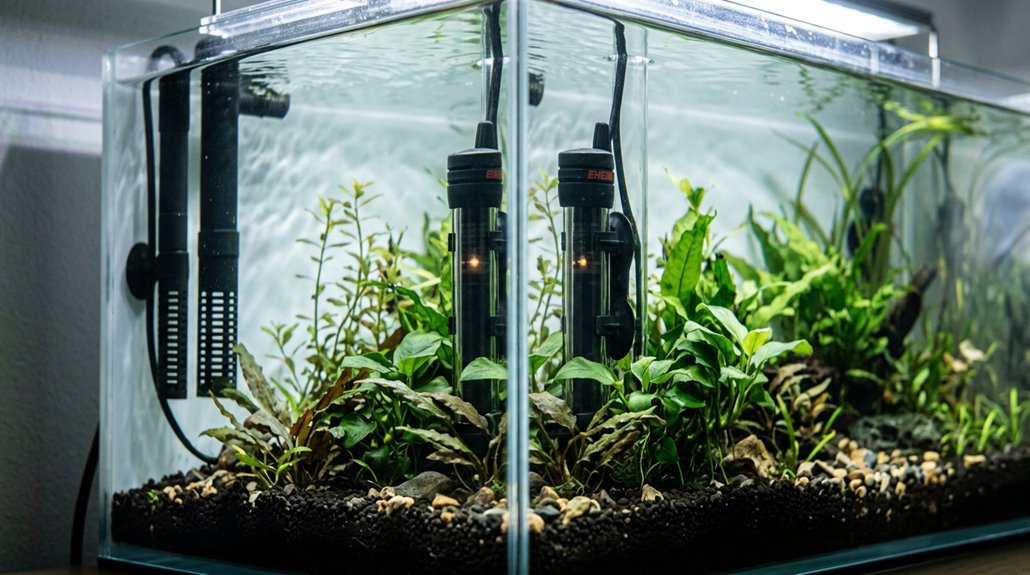
Place the heater next to the filter output or pump so the current distributes warmed water quickly and evenly throughout the tank. That placement minimizes temperature zoning and helps you read stable flow patterns across the aquarium.
- Mount submersible heaters vertically unless the manufacturer says otherwise.
- Put the thermometer in the opposite corner to check heat reach.
- For long-tube units, a 45° angle can improve circulation across the element.
- In sumps, use the high-flow section for faster transfer.
- Keep the heater fully submerged and unplug it during water changes.
If you’ve got a larger tank, positioning heaters at opposite ends can improve uniformity and add redundancy. Always follow the minimum water level mark to avoid damage.
How Many Aquarium Heaters Do You Need?
How many heaters you need depends on tank size, the temperature rise you’re trying to achieve, and how much redundancy you want. For tanks under about 55 gallons, one correctly sized heater is often enough; use roughly 5 W per gallon for modest room-to-target increases. If your livestock are valuable or room temperature swings, add redundant heaters. For tanks over 55 gallons, or when you need more than a 10–15°F rise, use two or more smaller units instead of one large one. This improves heat distribution and backup capacity. Place them at opposite ends or near filter outputs, and put thermometers opposite each heater to verify even temperatures. Account for specialty heater duty cycles and upsizing recommendations when planning total wattage.
Which Aquarium Heater Should You Buy?
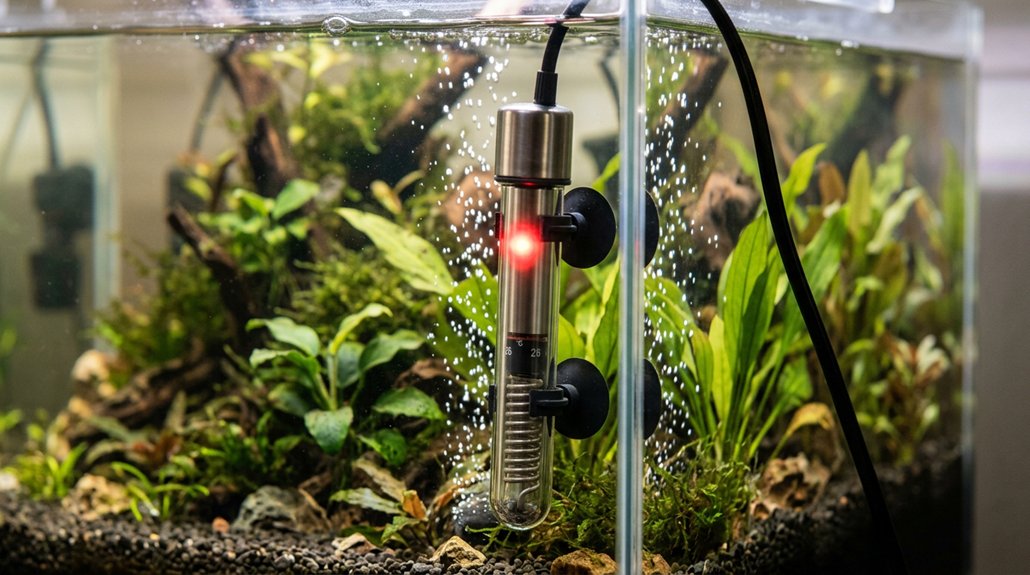
Now that you know how much heater capacity your tank needs, the next step is choosing the right type. For most tanks, use the wattage rule: about 5 W per gallon in typical rooms, or 3 W/gal for larger aquariums. Upsize if your room’s colder or you need more than a 10–15°F rise.
- Titanium or PTC heaters suit reef tanks
- Glass heaters fit budget community tanks
- Multiple small heaters add redundancy
- Check placement near filter outflow
- Verify temperature with a second thermometer
For high-value systems, titanium or PTC models offer durability, corrosion resistance, and better energy efficiency. For a lower-cost setup, an Eheim Jager gives accurate control and recalibration. Match the heater’s duty cycle, warranty, and electrical load to your risk tolerance, and consider aesthetic integration when choosing display hardware.
Frequently Asked Questions
Is a 50W Heater Too Big for a 5 Gallon Tank?
Yes, a 50W heater’s usually too big for your 5-gallon tank; 25W is safer. Don’t trust wattage myths—check heater placement, use a thermometer, and add an external controller if you must run 50W.
What Size Tank Is a 200W Heater Good For?
You can usually heat about a 40–80 gallon tank with a 200W heater, depending on room temperature, tank depth, and species tolerance. In colder rooms or larger setups, you’ll need less volume or dual heaters.
What Is the Rule of Thumb for Aquarium Heaters?
You’ll typically use about 5 watts per gallon to raise water roughly 10°F above room temperature; for example, your 29-gallon tank needs around 100 watts. Adjust for setpoint variance and ambient influence, though.
Is a 100W Heater Too Much for a 5 Gallon Tank?
Yes—100W’s too much for your 5-gallon tank. You’d want about 25W, or two smaller heaters, with careful heater placement and heater guards; otherwise, you’d risk overheating. Use a thermometer and an external controller.
Conclusion
Now you can choose the right aquarium heater with confidence. Match heater wattage to your tank size, pick the heater type that fits your setup, and place it where water flow spreads heat evenly. For larger tanks, use two heaters for better stability and redundancy. Before you buy, check reliability, controls, and safety features. Do that, and you’ll keep your fish comfortable without any knight-errant guesswork.