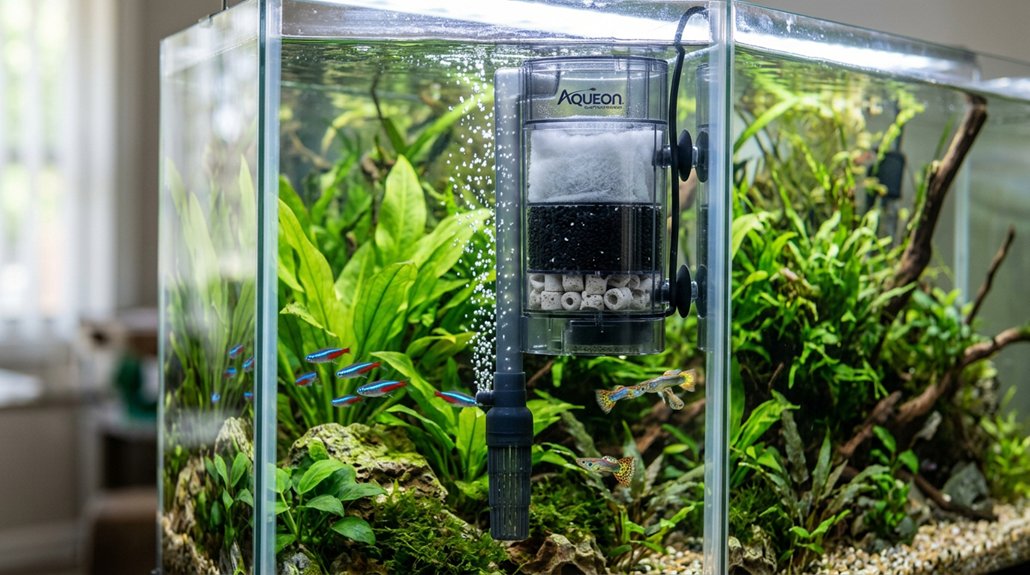
The best aquarium filter for your tank matches your fish, tank size, and layout while delivering mechanical, biological, and, when needed, chemical filtration. Aim for about 4–6× tank turnover per hour, but adjust for head height, bends, and livestock. Sponge filters suit fry, shrimp, and bettas; HOBs fit small to medium tanks; canisters work well for larger or heavily stocked setups. Choose media that fits your goals, and you’ll see why maintenance and flow matter.
Key Takeaways
- Choose a filter type that matches your tank: sponge for small or breeding tanks, HOB for most displays, canister for larger systems.
- Aim for 4–6× tank volume per hour in turnover, adjusting for head height and bends that reduce rated flow.
- Use layered media: mechanical first, then biological, and chemical media only when needed for polishing or removing medications.
- Match flow to livestock and aquascape; gentle current suits shrimp and bettas, while active fish and heavy stocking need stronger circulation.
- Maintain filters regularly by rinsing mechanical media in tank water, cleaning parts monthly, and protecting biological media from tap water.
What Does an Aquarium Filter Do?
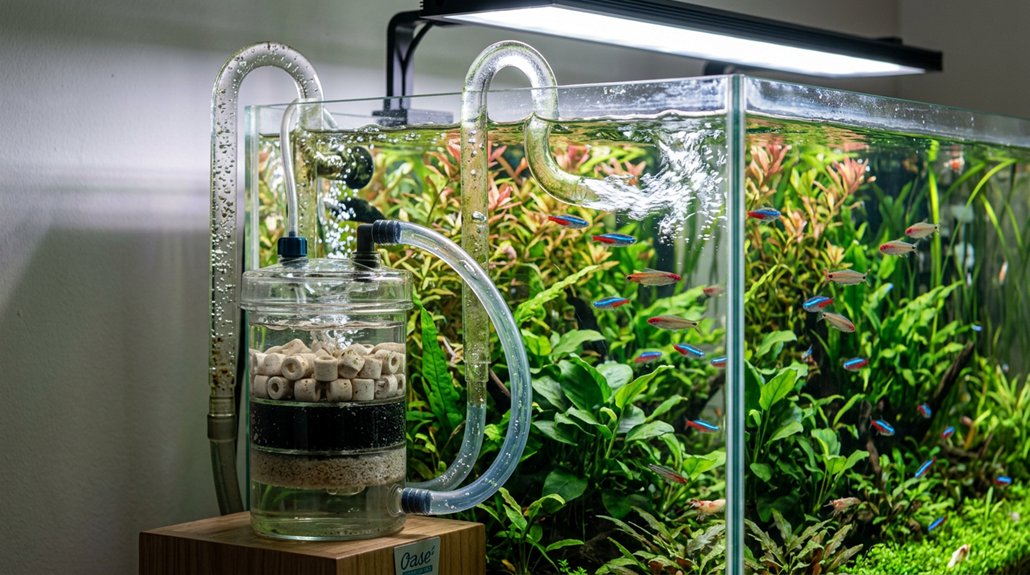
An aquarium filter does three essential jobs: it mechanically traps solid waste like uneaten food, fish poop, and plant debris so particles don’t cloud the water; it supports biological filtration by giving nitrifying bacteria a home on porous media such as sponges, ceramic rings, or bio-balls, where they convert toxic ammonia into nitrite and then into less-toxic nitrate; and, when used, it provides chemical filtration through media like activated carbon or zeolite to remove dissolved organics, tannins, medications, and discoloration, though these media need regular replacement every 4–6 weeks. You also need proper flow, ideally circulating the tank 4–6 times per hour, to avoid dead zones and maintain gas exchange. Good filter placement improves circulation, and noise reduction matters when you mount or insulate the unit. Different designs combine these functions differently.
Which Aquarium Filter Fits Your Tank?
To choose the right filter, you should target about 4–6× your tank volume per hour, so a 20-gallon tank needs roughly 80–120 GPH without creating excessive current. For tanks under about 20 gallons, sponge or HOB/internal power filters usually give you the best balance of gentle flow and simple maintenance, while larger tanks often benefit from canisters with greater capacity and customizable media. You should also match the filter type to your livestock and aquascape, using adjustable outlets, spray bars, or multiple filters when you need lower turbulence, redundancy, or more biological capacity.
Tank Size And Flow
Tank size sets the baseline for filter selection, but flow rate has to match the livestock too. Aim for about 4–6x your tank volume per hour; a 20-gal aquarium typically needs 80–120 GPH.
| Tank size | Guidance |
|---|---|
| 2.5–5 gal | Use low-flow options for small tanks and gentle circulation. |
| 10 gal | Moderate flow is usually enough. |
| 20 gal | Target 80–120 GPH. |
| >20 gal | Consider higher-capacity units. |
| Large setups | Use multi filtering or multiple outlets for flow distribution. |
Delicate fry, bettas, and shrimp need reduced current, while active fish can handle stronger turnover. For tanks over 20 gallons or heavy bioloads, higher-flow filters give better circulation and more media capacity. Spread outlets to prevent dead zones and keep backup filtration online during maintenance or failure.
Filter Types And Media
Once you’ve matched flow to tank volume, the next step is choosing the filter type and media that fit your system’s livestock and maintenance goals. For small, breeding, or shrimp tanks, a sponge filter gives gentle mechanical and biological filtration, but you’ll need to plan sponge placement so it won’t displace space or current-sensitive animals. For most small to medium display aquaria, a hang-on-back filter is the most flexible choice because you can mix mechanical, biological, and chemical media easily. If your tank is over 30 L or heavily stocked, a canister filter offers stronger, customizable multistage performance, though it’s more complex. Use media layering deliberately: coarse sponge or floss traps debris, ceramic rings provide surface area, and activated carbon or zeolite can polish water intermittently.
Why Your Tank Needs a Filter
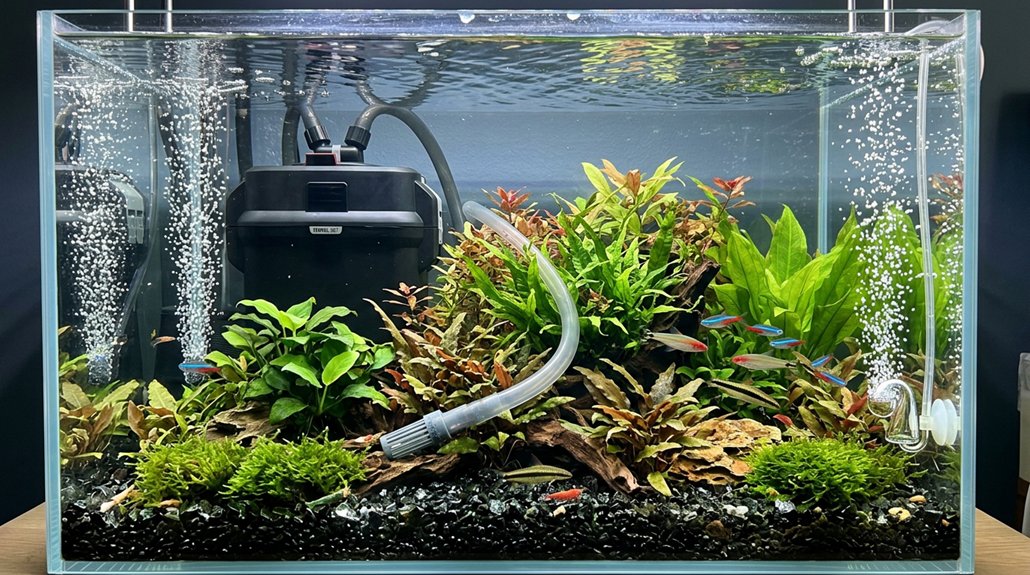
You need a filter to maintain steady water flow, improve oxygen exchange, and prevent stagnant dead zones where ammonia can build up. It also removes solid waste and debris, which keeps the water clearer and slows decomposition. By combining biological, mechanical, and chemical filtration, you can support the nitrogen cycle and maintain stable water quality.
Water Flow And Oxygen
Keeping water in motion is one of a filter’s most important jobs, because circulation prevents stagnant “dead zones” where ammonia can build up and harm fish, shrimp, and plants. You should target roughly 4–6× tank volume per hour; a 20-gallon aquarium needs about 80–120 GPH for reliable turnover.
| Tank Size | Target GPH | Effect |
|---|---|---|
| 10 gal | 40–60 | Basic circulation |
| 20 gal | 80–120 | Stable gas exchange |
| 40 gal | 160–240 | Better coverage |
| 55 gal | 220–330 | Reduced dead zones |
| 75 gal | 300–450 | Stronger mixing |
Surface agitation improves oxygen diffusion, letting atmospheric oxygen enter the water and supporting aerobic nitrifying bacteria. Don’t overdo it, though: strong flow can stress delicate species and plants. Use flow modifiers or multiple filters for broader, gentler circulation.
Waste Removal And Clarity
A good aquarium filter does more than just push water around—it continuously pulls out waste, keeps particles from clouding the tank, and supports stable water chemistry. You need circulation to prevent stagnant dead zones, because those pockets reduce oxygen exchange and let ammonia accumulate. Mechanical media like sponges and filter floss trap uneaten food and feces; when they clog, cleaning or replacement restores waste removal. Biological media carry nitrifying bacteria that turn ammonia into nitrite and nitrate, so your filter can’t be intermittent. Chemical media, such as activated carbon, can reduce dissolved organics and tint, but they lose efficiency in about 4–6 weeks. For effective clarity maintenance and algae control, target 4–6× tank volume per hour without creating harsh current.
Filtration Types And Benefits
Beyond removing visible waste and keeping water clear, filtration is what keeps an aquarium biologically stable and oxygenated. You need proper flow patterns, usually 4–6× tank volume per hour, to prevent dead zones and ammonia buildup. It also drives microbial succession on filter media, establishing the nitrogen cycle.
| Filter type | Benefit |
|---|---|
| Mechanical | Traps solids |
| Biological | Converts ammonia |
| Chemical | Removes dissolved contaminants |
| Sponge/HOB/Canister | Match tank needs |
Mechanical media like sponges and floss catch debris before it decays. Biological media such as ceramic rings and bio-balls house nitrifying bacteria. Chemical media, including activated carbon, adsorb tannins and medications, but you’ll replace it every 4–6 weeks. Sponge filters suit shrimp tanks; HOBs fit small systems; canisters handle heavy loads.
The 3 Types of Aquarium Filtration
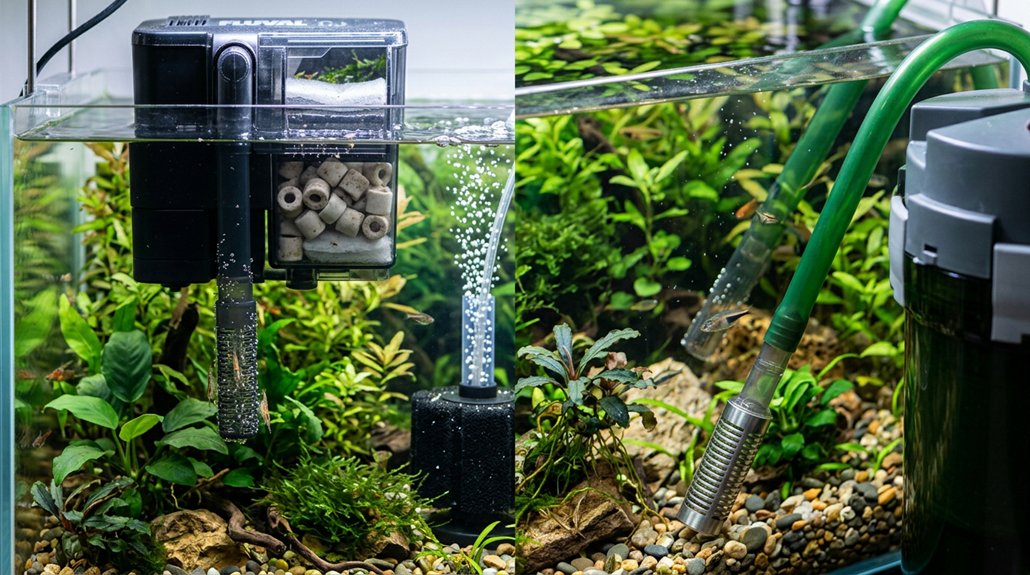
Aquarium filtration works best when you understand its three functions: mechanical, biological, and chemical. Mechanical filtration physically traps uneaten food, fish waste, and plant debris in sponges, pads, or floss, so you’ll need to clean it often to avoid clogging and reduced flow. Biological filtration depends on biological colonies of nitrifying bacteria on porous media such as ceramic rings, bio-balls, and sponges; these bacteria convert toxic ammonia to nitrite, then nitrate, so rinse media only in tank water. Chemical filtration uses activated carbon or zeolite for chemical adsorption of dissolved organics, tannins, medications, and odors, but carbon exhausts after about 4–6 weeks and must be replaced. Most filters combine all three stages.
How to Match Filter Flow to Fish
To match filter flow to your fish, aim for a turnover rate of about 4–6 times the tank volume per hour, so a 20-gallon aquarium should run roughly 80–120 GPH. Use current mapping to identify dead zones and strong jets, then make species specific adjustments. If you keep delicate or slow-moving fish, reduce effective flow with spray bars, flow deflectors, sponge prefilters, or a lower setting so they aren’t stressed or fin damaged. For danios, barbs, or other high-oxygen swimmers, increase flow, and in planted tanks raise surface agitation. Heavily stocked or messy tanks need higher turnover, so choose a higher-GPH unit or dual filters. With canisters or HOBs, account for head height and bends because rated flow drops, so pick extra capacity.
What Media Should Your Aquarium Filter Use?
Once you’ve matched flow to your fish, the next decision is media, because the right filter only performs well when its stages are arranged correctly. Use media layering: start with coarse sponge or filter floss to catch visible debris and protect later stages from clogging. Next, install porous biological media such as ceramic rings, bio-balls, or sintered glass, since their surface area supports nitrifying bacteria that convert ammonia to nitrite, then nitrate. Add chemical media, like activated carbon or zeolite, in a separate chamber or bag to adsorb tannins, organics, and medications. Choose media volume and contact time for your bio-load; heavily stocked tanks need larger chambers. For planted or CO2 systems, limit carbon use because it removes additives, and prioritize biome compatibility.
Aquarium Filter Maintenance Tips
Regular maintenance keeps your filter efficient and your nitrogen cycle stable. During weekly service, rinse sponges, pads, and floss in removed tank water, not tap water, so you don’t kill beneficial bacteria; replace floss when it won’t rinse clean. Swish biological media gently in aquarium water only, and never fully replace it unless necessary. Change activated carbon or similar chemical media every 4–6 weeks because saturation reduces adsorption of tannins, medications, and dissolved organics. Monthly, or sooner if flow drops, clean intake tubes, impellers, and housings to preserve target flow of 4–6× tank volume per hour. For larger systems, use redundant filtration and test ammonia and nitrite after major media changes. A seasonal deepclean and selective DIY upgrades can improve reliability.
Frequently Asked Questions
How Do I Reduce Filter Noise in My Aquarium?
You can reduce filter noise by adding foam baffles, securing loose tubing clamps, lowering water turbulence, and ensuring the filter stays level. Also, clean impellers regularly; worn parts’ll rattle and amplify vibration.
Can I Use Two Filters on One Tank?
Yes, you can use two filters on one tank; dual filtration provides redundancy benefits, improves flow balancing, and lets you stagger maintenance scheduling, so you’re less likely to disrupt biological filtration or oxygenation.
How Often Should I Replace Filter Media?
You shouldn’t replace filter media on a fixed schedule; the theory that “regular swaps improve water” is false. You’ll extend media lifespan by cleaning gently and replacing only when replacement indicators show clogging, damage, or exhaustion.
Do Air-Driven Filters Need Special Air Pumps?
No, you don’t need a special air pump, but you do need one with enough output and pressure. Add a check valve, bubble trap, and flow control to protect against backflow and tune performance.
What’s the Best Filter for a Planted Aquarium?
You’ll usually do best with plant-safe filtration: a gentle sponge or low flow canisters filter preserves roots, minimizes CO2 loss, and keeps debris moving; as they say, slow and steady wins the race.
Conclusion
So, after all that, your aquarium’s “optional” filter turns out to be the thing quietly keeping your fish alive—how inconvenient. You’ve seen that choosing the right filter isn’t about buying the biggest box; it’s about matching flow, media, and maintenance to your tank’s needs. If you want clear water and healthy fish, don’t let filtration be an afterthought. Pick wisely, clean it regularly, and let the filter do the boring work.