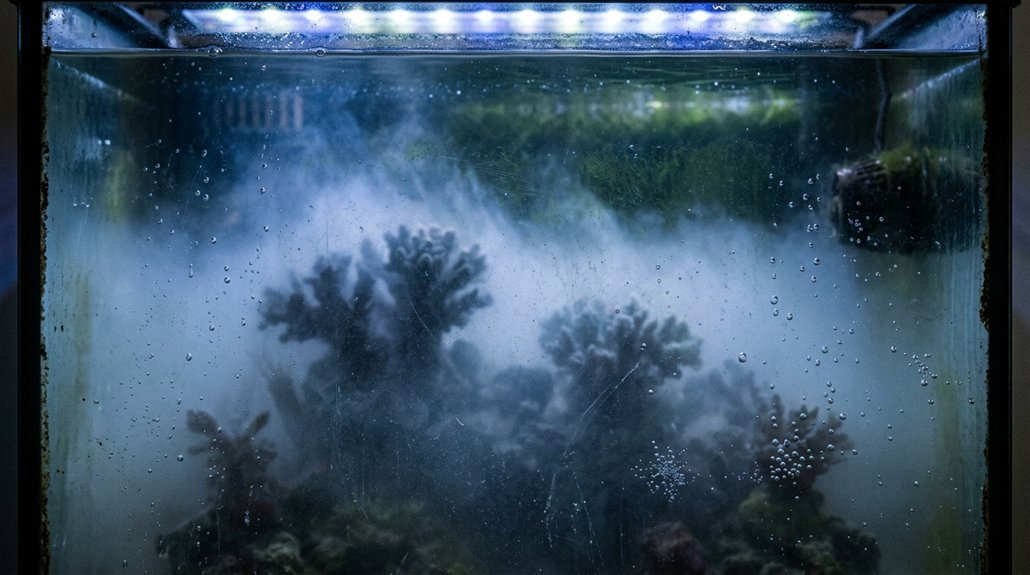
Cloudy saltwater usually comes from suspended debris, a bacterial bloom, algae, or dissolved organics. If your substrate or filter media was disturbed, use a 100–200 micron sock, fine floss, or polishing media, and run carbon. For milky water, reduce feeding, boost surface agitation, and test ammonia and nitrite; UV can help. For yellow-brown water, remove decaying material and change water. The exact cause matters, and the best fix depends on what you’re seeing.
Key Takeaways
- Cloudy saltwater often comes from stirred-up substrate or filter debris, which can be removed with fine mechanical filtration.
- Milky-white water usually signals a bacterial bloom, especially in new tanks or after excess nutrients.
- Green cloudiness is typically caused by algae or phytoplankton, often linked to strong light and elevated nutrients.
- Yellow-brown water usually comes from tannins or decaying organics, and activated carbon plus water changes help clear it.
- Fix cloudiness by reducing feeding, testing water, improving oxygenation, and using filter socks, carbon, or UV sterilization.
What’s Causing Cloudy Saltwater?
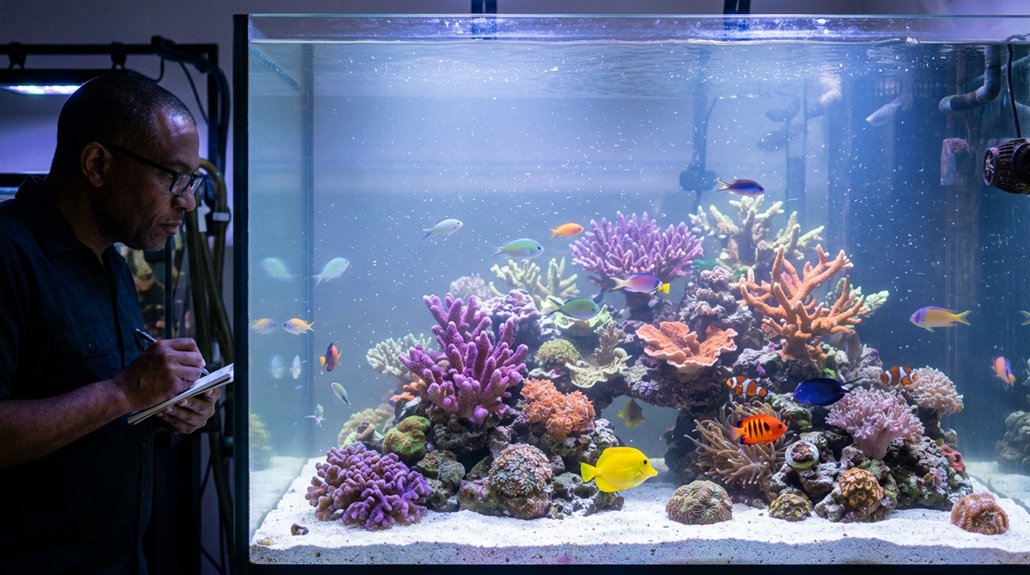
Cloudy saltwater usually comes from one of a few distinct causes, and the color and tank history can help narrow it down quickly. If you’ve recently disturbed substrate or filter media, fine particulate debris may be suspended and scattering light; it often settles with finer mechanical filtration. A milky-white haze usually signals a bacterial bloom, especially in new tanks or after nutrient spikes, while green water points to phytoplankton or algae driven by excess light, including an intense lighting spectrum, and elevated nutrients. Yellow-brown cloudiness often reflects tannins or decaying organics. A salinity fluctuation won’t usually create cloudiness directly, but it can stress biology and worsen instability. You should test ammonia and nitrite, then match treatment to the observed color, recent stocking changes, feeding, or dead matter.
Clear Cloudy Saltwater Fast
To clear cloudy saltwater fast, you need to target the suspended material or bloom that’s reducing water clarity while minimizing further disruption to the system. Use instant filtration with a 100–200 micron filter sock, fine floss, or a 1–5 micron polishing cartridge for rapid clarification.
| Intervention | Expected effect |
|---|---|
| Filter sock/floss | Removes particulates |
| UV sterilizer | Lowers free-floating cells |
| Carbon + agitation | Reduces organics, improves oxygen |
Run the chosen media continuously and replace or rinse it daily. Add a properly sized UV sterilizer for visible change within 24–72 hours. Perform 10–15% water changes every 1–2 days, vacuuming only small substrate areas. Activated carbon can further adsorb dissolved organics, while increased surface agitation helps maintain oxygen and system stability.
Fix a Bacterial Bloom in Saltwater
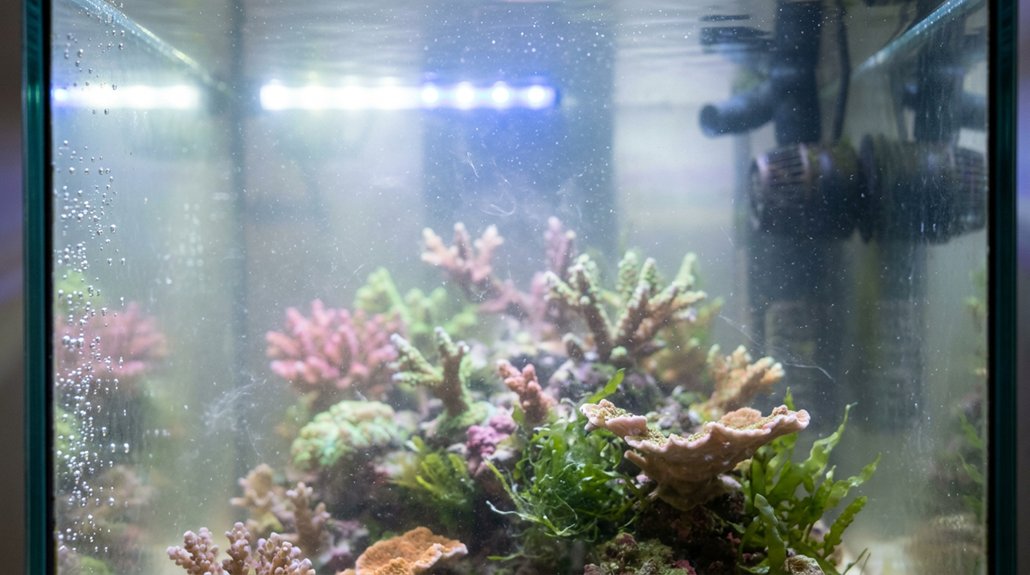
A bacterial bloom is a rapid surge of heterotrophic bacteria that turns saltwater milky-white, usually in new tanks or after a nutrient spike from overfeeding, decaying matter, or disturbed bio-media. You should stop feeding for 1–2 days, remove dead material, and increase surface agitation to limit oxygen depletion. If ammonia or nitrite rise, perform 10–15% water changes every 1–2 days. Add fine mechanical filtration, such as a 100–200 μm sock or 1–5 μm polishing media, plus activated carbon, replacing only one medium at a time. UV sterilization can accelerate clearing, but it’s a stopgap. Avoid unnecessary probiotic dosing unless you’re correcting a specific biological imbalance. In most cases, the bloom resolves in 3–7 days once excess nutrients are removed and nitrifying bacteria recover.
Clear Yellow or Brown Saltwater
If the water’s haze shifts toward yellow or brown rather than milky white, the likely cause is dissolved organics, most often tannins leaching from driftwood or decaying plant material, dead livestock, or uneaten food. This tannic staining can lower pH and should be evaluated promptly. Test ammonia and nitrite immediately if the tint appears.
| Cause | Response |
|---|---|
| Driftwood leaching | Run activated carbon |
| Decay or waste | Perform 25–50% water change |
Activated carbon, or chemically rated granular carbon, typically clears dissolved organics within 24–72 hours at proper flow. Large partial water changes with mixed RO/DI saltwater rapidly dilute the discoloration. If you add wood, pre-soak or boil it first to reduce future tannin release. Remove decaying material fast, and keep gravel and filtration clean to limit recurrence.
Prevent Cloudy Saltwater From Returning
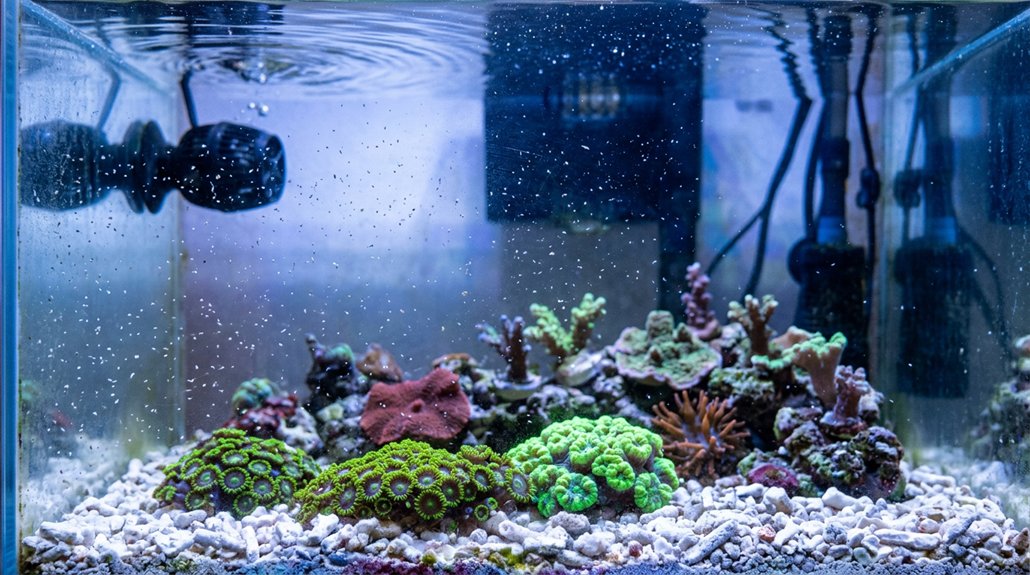
Preventing recurrence requires controlling the particulate, organic, and biological drivers of cloudiness. You should apply strict regular maintenance and nutrient control to keep the system stable and optically clear.
Preventing recurrence means controlling particulates, organics, and biological imbalance to keep water stable and clear.
- Rinse or replace floss, cartridges, and filter socks every 1–3 days during recovery, then follow a routine schedule; trapped debris can re-enter the water if neglected.
- Feed only what fish eat in about 2 minutes, and remove leftovers immediately. Overfeeding elevates dissolved organics and can trigger repeat bacterial or algal blooms.
- Protect bio-filtration by rinsing media in tank water only, never all at once. Use activated carbon or fine polishing media, test nitrate and phosphate, and perform 10–25% water changes to suppress recurrent haze.
Frequently Asked Questions
How to Clear Cloudy Saltwater Aquarium Water?
Use fine filter floss, a 100–200 micron sock, and activated carbon; if needed, add UV or a polishing filter. For a diatom bloom, reduce nutrients, rinse substrate, and keep live rock well-aerated.
How to Clear up Cloudy Water Fast?
To clear cloudy water fast, you’d trap debris like a net in fog: add fine filter floss, run live bacteria support, use a chemical flocculant, boost aeration, and change 10–15% of water.
How to Fix Cloudy Water in a Tank?
You’ll fix cloudy tank water by filtering fine particles, boosting aeration, using carbon, and doing small water changes. If it’s a bacterial bloom or silica buildup, add UV or polishing filtration and remove nutrients.
Will Cloudy Aquarium Water Clear on Its Own?
Yes, your cloudy aquarium water can clear on its own, though nature’s little prank may be a bacterial bloom or mineral precipitation. If ammonia and nitrite stay low, you’ll often see clarity return within days.
Conclusion
Your saltwater tank should be a window, not a fogged glass. When the water turns cloudy, it’s usually a signal: excess bacteria, suspended debris, or dissolved organics are disrupting the system’s balance. If you correct the source quickly, clarity returns. Think of the tank like a pulse monitor for your reef—when the water clears, you’re seeing stability restored. Keep testing, filter consistently, and you’ll prevent the haze from coming back.