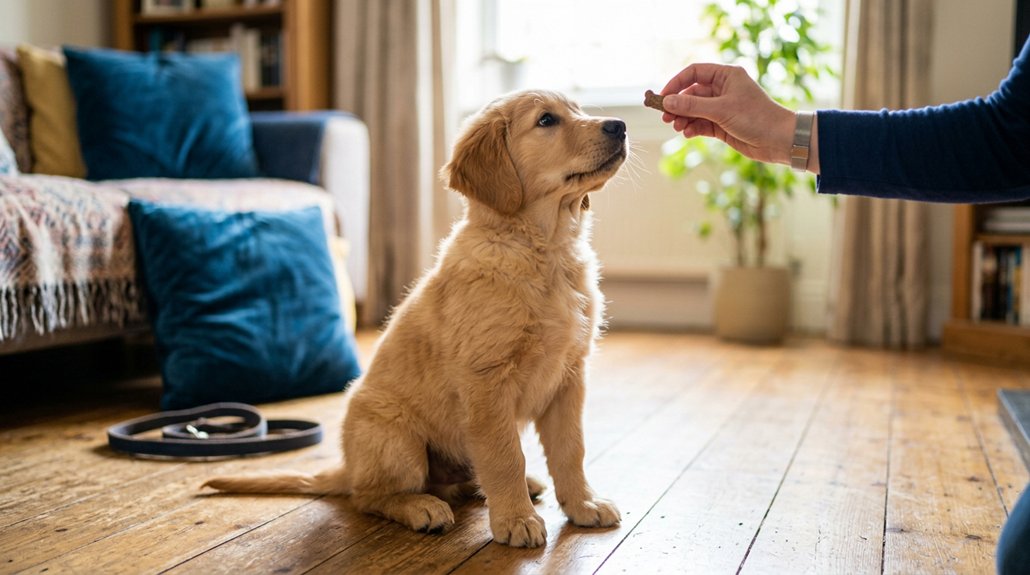
Training your puppy to sit and stay requires patience, consistency, and positive reinforcement. Start by capturing their attention with a treat, using it to guide them into a sitting position with a verbal cue like “sit.” For “stay,” begin with the puppy lying down, rewarding them as they maintain the position and gradually increase duration and distance. Consistency with release words guarantees clarity. Begin in quiet settings and progressively incorporate distractions. Continued practice will enhance their skills.
Key Takeaways
- Use treats to capture the puppy’s attention and guide them into a natural sit position with a verbal cue “sit.”
- Introduce the “stay” command by having the puppy lie down, rewarding focus during the stay position.
- Gradually increase the duration and distance of the “stay” command, monitoring for comfort and adjusting as needed.
- Practice commands in varied environments to improve reliability and adaptability in real-world settings.
- Employ consistent release words with excitement cues to signal the end of a command or session.
Master the Basics: Teach Your Puppy to Sit
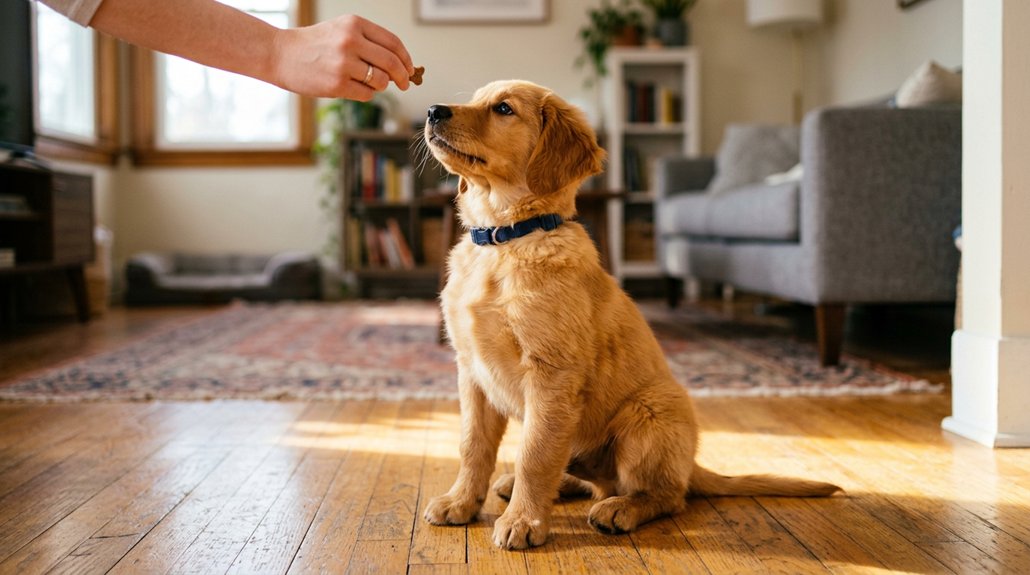
Begin by capturing your puppy’s attention with a treat held right in front of their nose, then slowly move it over their head; this encourages them to sit naturally. Use a verbal cue like “sit” and a consistent hand signal to reinforce the association between the command and the action. Immediate rewards, be it a treat or verbal praise, are essential for puppy motivation. A well-structured training schedule should start in a quiet setting to keep distractions to a minimum. As your puppy’s proficiency grows, gradually phase out food rewards, placing more emphasis on verbal praise to maintain their responsiveness. This effective approach guarantees a solid foundation in obedience and sets the stage for more advanced training commands.
Teach Your Puppy to Stay and Build Their Duration
Establishing a reliable “stay” command is integral to your puppy’s obedience training, building both their self-control and your confidence in managing their behavior. Start by having your puppy lie down, using a hand signal and the verbal command “stay”. Reward them only while they remain focused in position. Initially, reward after a few seconds, gradually extending the duration to reinforce the stay command. Practice in various environments like the yard or park to enhance your puppy’s focus amidst distractions. Always use a consistent release word, like “okay,” to signal when they can break the position.
Here’s a quick guide:
| Step | Action | Reward |
|---|---|---|
| 1. Lie Down | Use hand signal & stay | While in position |
| 2. Increase Time | Gradual duration | Progressive increments |
| 3. Environment | Introduce distractions | On maintaining focus |
Increasing Distance in Stay Training
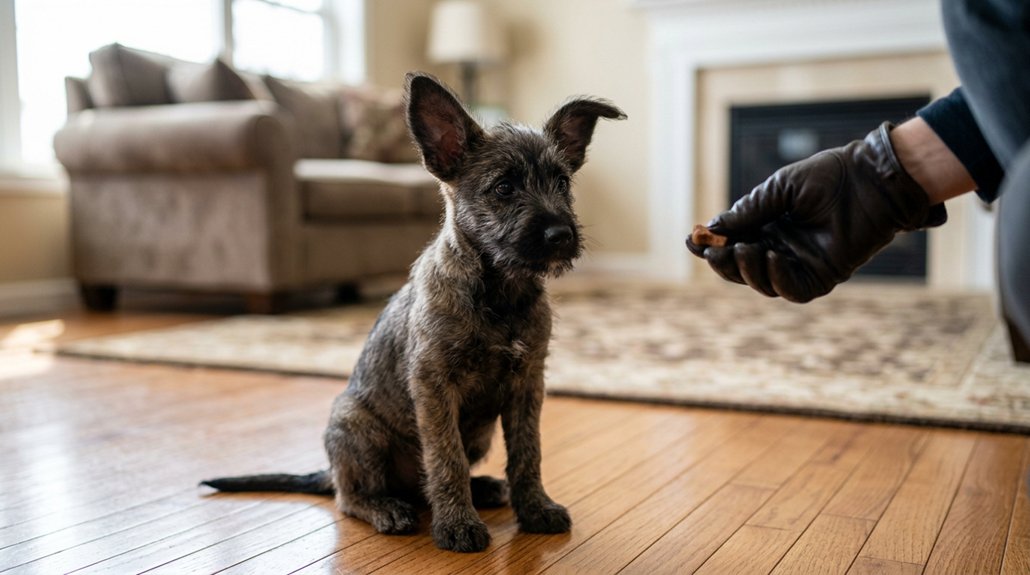
Start by taking a single step back as you command your puppy to stay, promptly returning to reward them for their successful attempt. Gradually increase the distance over time, making sure you consistently reward your puppy each time they hold their position. Keep your pup’s comfort in mind; if they show signs of anxiety, reduce the distance and work back up gradually.
Gradual Distance Expansion
As you begin expanding the distance in your puppy’s stay training, it’s crucial to guarantee your furry friend feels secure and confident. Start with positive reinforcement, rewarding your puppy immediately after they successfully remain in position when you step back. Gradual progression is key; slowly increase the distance in multiple training sessions, watching closely for your puppy’s comfort. Avoid overwhelming them by recognizing signs of unease or breaking the stay. If your puppy struggles, adjust by returning to a closer point until they’re comfortable again. Consistently reward them only while they maintain the stay, reinforcing desired behavior. Practice in varied environments to help them generalize the stay command, making it applicable in different settings and enhancing reliability.
Consistent Reward Timing
To effectively increase the distance in your puppy’s stay training, consistent reward timing is fundamental. Start by stepping back just one step while maintaining eye contact. If your puppy remains in the “stay” position, immediately return and use positive reinforcement by rewarding them with a treat. This training timing guarantees your puppy knows they’ll earn a reward for staying put. Gradually increase the distance by a few feet each time, making sure your puppy stays focused and comfortable. Constantly monitor their body language for anxiety and remain adaptable. Practice in different environments—home, yard, public spaces—to reinforce the command amidst distractions. This variety enhances their confidence, making certain they’re attentive and obedient, regardless of distance or surroundings.
Adapting Training to Varied Environments
To effectively train your puppy, it is crucial to practice commands like “sit” and “stay” in diverse locations to build their adaptability. Start with familiar environments at home, then progressively introduce more distracting settings like gardens or local parks. Consistent training across varied environments will strengthen your puppy’s ability to maintain focus and follow commands reliably in any situation.
Training in Different Locations
When training your puppy, adapting to different locations is fundamental for developing a well-rounded and obedient dog. Practicing the “sit” and “stay” commands in various locations, like different rooms in your home, helps puppies understand that these commands are universally applicable. Introducing outdoor training in environments such as your garden or local parks presents distraction challenges that are both rewarding and vital for your puppy’s growth. Training in diverse locations, such as at friends’ houses, exposes your puppy to unfamiliar scents and surroundings.
Key steps include:
- Practice commands in every room of the house.
- Use outdoor spaces for real-world distractions.
- Visit new places to introduce unfamiliar sights and smells.
- Gradually increase environment complexity to test command reliability.
These approaches guarantee your puppy is adaptable and attentive.
Managing Environmental Distractions
Take them to friends’ houses or public spaces, like parks, to prepare them for real-world stimuli, including people and other dogs. This exposure strengthens their ability to stay attentive and reinforces their command reliability. Consistent reinforcement in these diverse settings guarantees your puppy learns to manage and maintain focus despite increasing distractions.
Building Command Consistency Everywhere
Achieving command consistency with your puppy requires training in varied environments. Start by applying generalization techniques at home, practicing “sit” and “stay” in different rooms. Then, gradually move outdoors to the garden and other unfamiliar settings to expand your puppy’s understanding. Consistency is essential, so reinforce commands frequently both in familiar places and new environments to build their confidence and reliability.
Observe your puppy for distraction identification—knowing what diverts their attention helps tailor your approach. Consider these methods:
- Practice at local parks to acclimate them to new stimuli and people.
- Visit friends’ homes for varied social settings.
- Identify specific distractions and adjust your training techniques.
- Guarantee command exercises include both simple and complex environments to solidify their training.
Reinforce With Regular Practice for Lasting Success
Although training a puppy might seem challenging, reinforcing commands with regular practice is essential for lasting success. Short, 5 to 10-minute sessions are effective for maintaining your puppy’s focus and training motivation. Using positive reinforcement, consistently reward your puppy when they hold the sit or stay position. This not only encourages their understanding but also builds patience and reliability over time.
Gradually increase the duration and distance of the stay command to boost their confidence and resilience. Practice in varied environments with distractions to help your puppy generalize these commands, ensuring they respond well in any setting. Keeping sessions enjoyable fosters a strong bond and enhances their enthusiasm to learn, making training both effective and rewarding for you and your puppy.
Using Release Words to Indicate Freedom
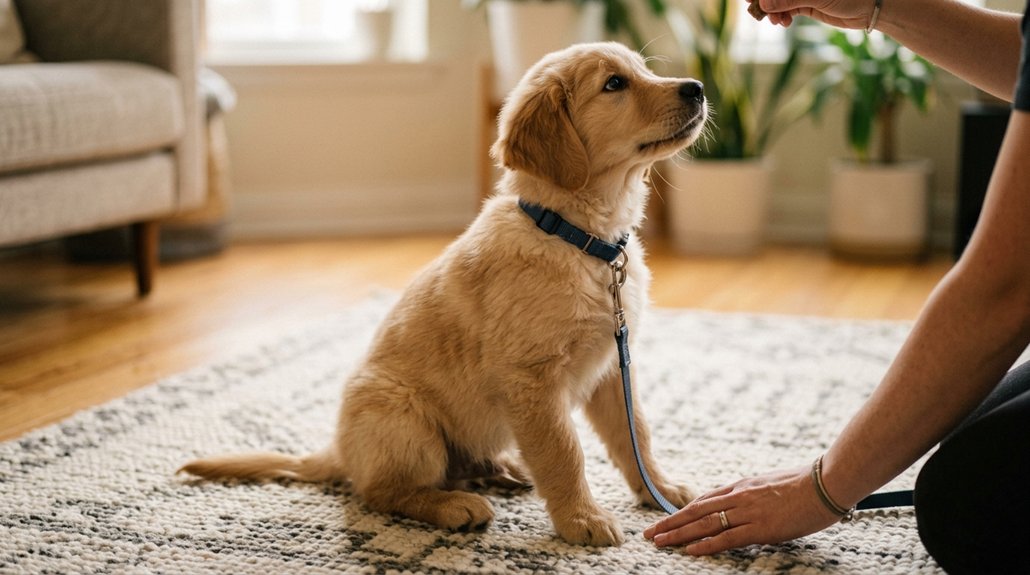
Release words are pivotal tools in training your puppy, signaling them when they’re free to move from a commanded position. Recognizing the release word importance dramatically enhances your puppy’s understanding and obedience. Use excitement cues, like a lively tone, to make the release word unmistakable. Choose words like “okay,” “break,” or “free” and remain consistent to avoid confusion. Reinforce this cue with practice—every time you say the release word, toss a treat to strengthen the connection.
- Choose a consistent release word to prevent confusion.
- Use excitement cues to help the puppy associate the word with fun.
- Toss a treat as you say the cue to connect the word with movement.
- Integrate release words regularly for improved engagement and enthusiasm.
Frequently Asked Questions
At What Age Should You Teach a Puppy to Sit?
Start training your puppy to sit around 7 to 8 weeks old. Early training taps into their puppy development stage, enhancing obedience and bonding. Short, consistent sessions guarantee effective learning, aligning with their natural attention span limits.
What Is the 7 7 7 Rule for Dogs?
The 7 7 7 Rule for dogs involves balancing training tips: seven minutes of focused learning, seven minutes of joyful play, seven minutes of social interactions daily. It nurtures puppy behavior through mental stimulation, physical action, and varied exposure.
What Is the Hardest Command to Teach a Dog?
The hardest command to teach a dog is “stay,” due to advanced obedience requirements and behavioral challenges. It demands high impulse control, making it complex to master. Patience, consistent practice, and positive reinforcement improve learning outcomes considerably.
What Is the Best Way to Get a Puppy to Sit and Stay?
Imagine a puppy named Max. You’ll use positive reinforcement and clicker training. Maintain consistent cues with short sessions, ensuring precise reward timing. Gradually introduce distraction techniques, ensuring Max learns to sit and stay effectively in varied environments.
Conclusion
Now that you’ve transformed your energetic furball into a model of patience, remember to keep practicing—after all, your puppy isn’t a mind reader, even if they often seem to know what you’re thinking. With consistency, your canine will gracefully master the art of sitting and staying, possibly better than most toddlers. So go ahead, bask in the glory of your newly trained companion while subtly reminding your friends of your superior dog-training prowess. You’re now the dog whisperer they can only dream to be!