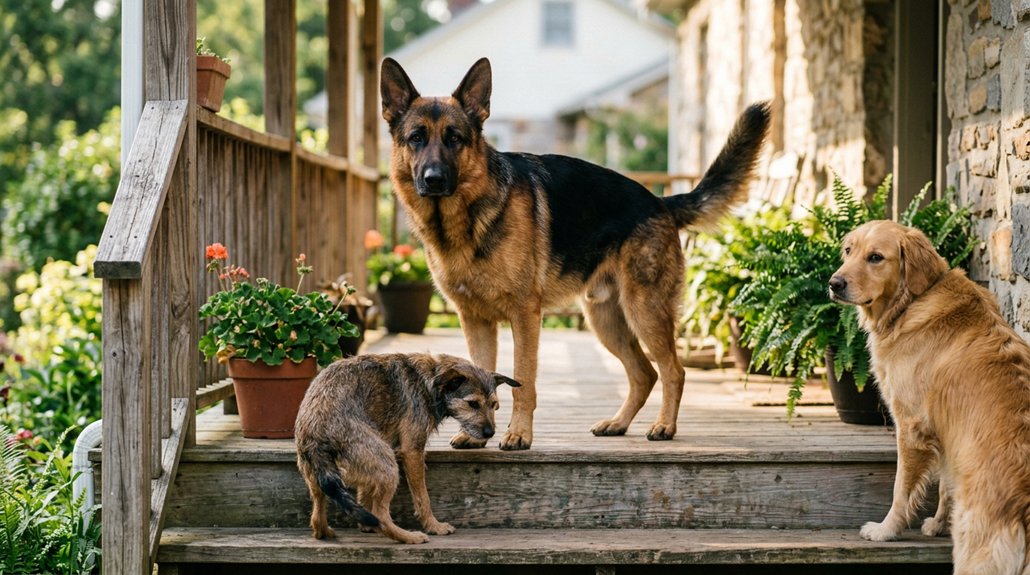
Your dog may exhibit dominance through persistent eye contact, guarding food or toys, and assertive physical postures like placing a paw on others or standing over them. Aggressive behaviors, such as growling or resource guarding, suggest attempts to control. Environmental factors can exacerbate dominance if rules aren’t enforced consistently. Health issues might also influence such behavior. To fully understand and address these behaviors, consider exploring further strategies and insights.
Key Takeaways
- Dogs displaying persistent eye contact or proud walking often indicate an assertion of dominance.
- Guarding food or toys aggressively highlights dominance-related possessiveness in dogs.
- Herding family members is a sign that your dog is exhibiting controlling behavior.
- Growling during interactions often signifies attempts by the dog to assert dominance.
- Physical dominance in dogs can be observed when they place a paw on others or stand over them.
Spotting Signs of Dominance
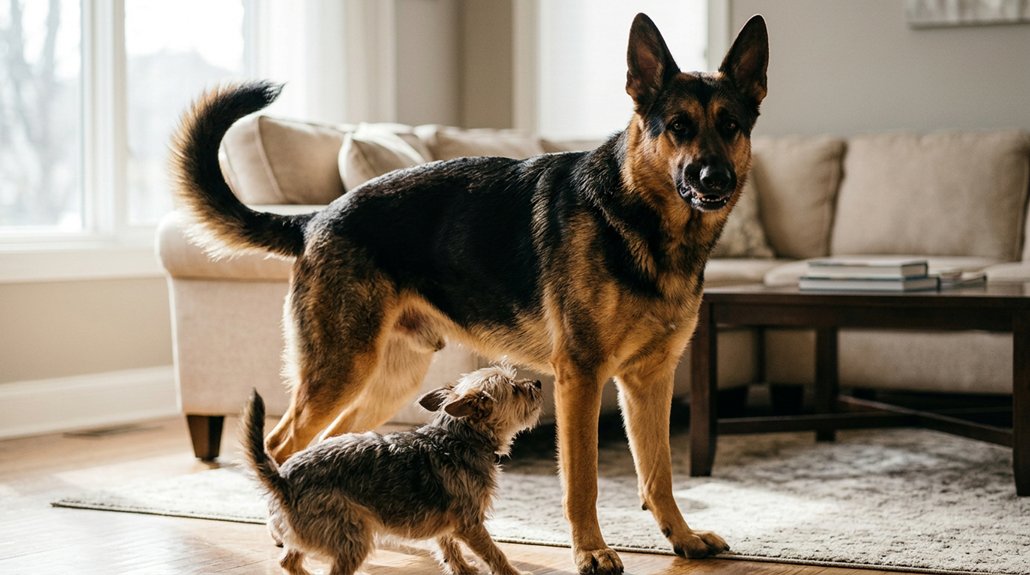
When observing canine behavior, it’s vital to distinguish between dominance and mere confidence. Dog playfulness shouldn’t be mistaken for dominance, as misconceptions often lead to incorrect training methods grounded in dominance myths. A dominant dog may frequently show aggressive behavior towards small children or pets, signaling a need for control. Recognize dominance through possessiveness, like guarding food or toys, and aggressive games with intimidating growls. Notice a proud walk with persistent eye contact, indicative of authority assertion. Physical dominance displays include placing a paw on others or standing over them. These actions, combined with hostile responses to authority, reveal a challenge to the household’s hierarchy. Understanding these signs helps you manage behavior effectively and foster a healthier dynamic.
Identifying Family-Directed Aggression
Family-directed aggression in dogs often manifests through explicit behaviors aimed at asserting dominance within the household. Notable signs include growling or snapping during certain interaction patterns, like when family members approach their territory. This behavior, linked to resource guarding, signals your dog’s intent to control family dynamics. Hostility towards small children, potentially caused by awkward handling, reveals underlying dominance issues. Dogs might attempt to herd within the family environment, an indication of controlling behavior resembling sibling rivalry. Aggressive responses when defending food or toys point to dominance-related possessiveness. Additionally, persistent eye contact, combined with a stiff posture, challenges family authority. Addressing these behavioral triggers requires consistent training to realign your dog’s role within the household, preserving harmony.
Understanding Your Dog’s Rebelliousness
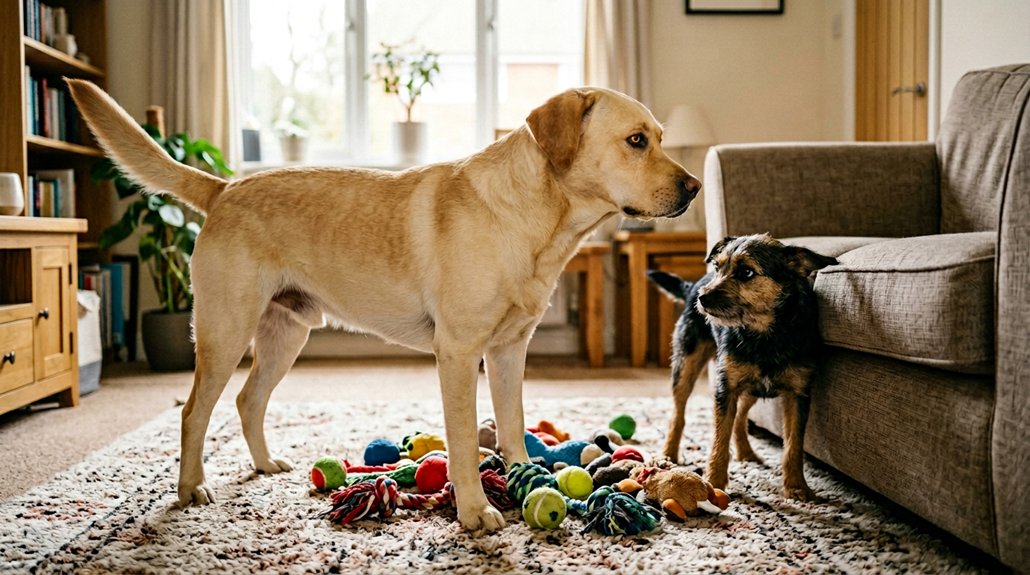
Understanding the root causes of your dog’s rebelliousness is critical for effective behavioral management. In dog psychology, what appears as rebellious behavior often arises from a lack of clearly enforced rules and structure at home. Misinterpreting these actions as dominance can lead to misguided training methods, even increasing aggression. Here’s how you can better manage rebellious behavior:
Understanding your dog’s rebelliousness often stems from inconsistent rules and misinterpretations, not dominance.
- Establish a Hierarchy: Dogs need a clear understanding of their place within the family unit. Consistent rule enforcement creates boundaries and reduces confusion.
- Identify Undisciplined Behaviors: Early recognition of misbehavior lets you implement corrective measures promptly, preventing escalation.
- Implement Consistent Training: Regular, structured training fosters respect and curtails rebellion, helping your dog become well-behaved and responsive.
Spotting Environmental Influences on Your Dog’s Behavior
Now that you’ve addressed rebelliousness within your dog, it’s important to assess how environmental factors might be shaping its behavior. Environmental triggers, like inconsistent training and corrections, play significant roles. A dog’s exposure to poorly structured settings can exacerbate dominance issues.
| Factor | Impact on Behavior |
|---|---|
| Excessive Leeway | Dogs may set their own rules |
| Inconsistent Training | Reinforces dominance tendencies |
| Poor Peer Exposure | Impairs social cue recognition |
| Lack of Routine Stability | Increases frustration and aggression |
Routine stability is essential, as it fosters a sense of security and diminishes the potential for territorial aggression. Overindulgence in unwanted behaviors, coupled with inadequate exposure to calm peers, can distort a dog’s social framework. By maintaining structure, you mitigate these environmental triggers and guide your dog’s behavior towards balance.
Health Check: Medical Influences on Dog Dominance
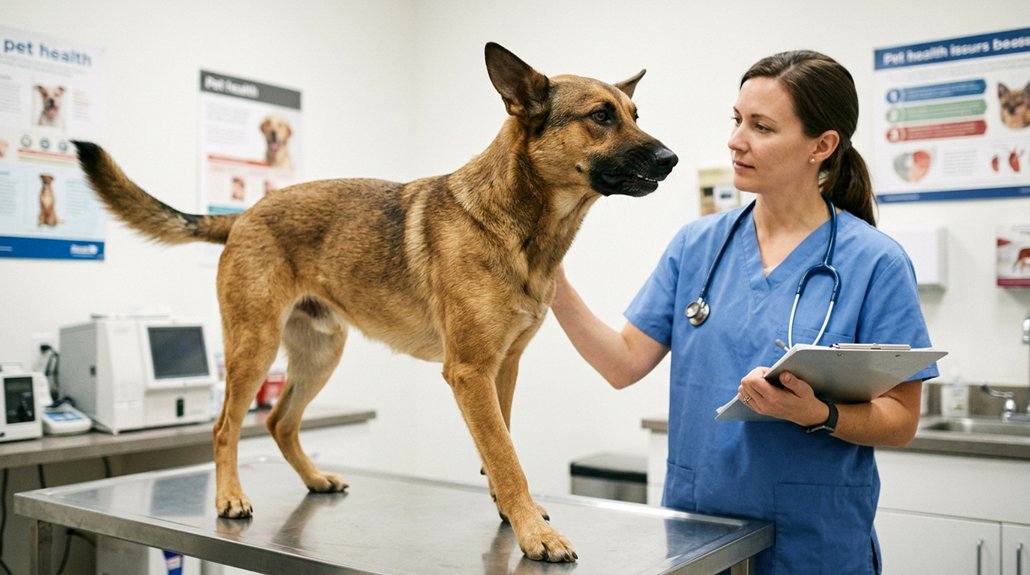
A sudden shift in your dog’s behavior can be akin to an alarm bell, signaling an underlying medical issue that might be influencing dominance tendencies. It’s vital to take health screenings and veterinary consultations into account if you notice unexpected aggression or dominance. Medical conditions, such as thyroid disorders, hormonal imbalances, or pain, can contribute to these behaviors. Addressing these issues is significant for effective management. Here’s how specific medical factors can affect dominance:
- Thyroid Disorders: These can lead to aggression, suggesting a thorough examination is necessary.
- Hormonal Imbalances: Particularly high testosterone in males elevates dominance tendencies.
- Pain or Irritability: Discomfort from physiological disorders may be misinterpreted as dominance.
Consulting your veterinarian guarantees any medical causes of dominance are accurately addressed.
Understanding Body Language for Dominance
When analyzing a dog’s body language for signs of dominance, you’ll want to pay close attention to specific postures and signals. Raised hackles, a stiff stance, and persistent eye contact indicate a dog asserting control. Recognizing these behaviors helps you understand social hierarchies and anticipate potential conflicts in canine interactions.
Recognizing Dominant Postures
In canine body language, recognizing dominant postures is essential for understanding your dog’s interactions with others. Dominance displays in dogs can often manifest through assertive postures which signal authority and command. To spot these behaviors, consider:
- Raised Hackles: When your dog’s fur stands on end, it signifies feelings of threat or agitation and can indicate dominance display. They’re asserting their position or responding to perceived challenges.
- Confident Stance: A dog walking proudly with its head held high demonstrates assertive posture, often reflecting dominant behavior. Such postures convey confidence and an air of authority.
- Eye Contact and Pawing: Direct, persistent eye contact can be a dominance display, while pawing at another dog indicates an assertive posture to control interactions. These clear signals of dominance should be closely monitored.
Interpreting Dominant Signals
Recognizing dominant postures provides a foundation, but understanding more nuanced signals is vital in interpreting canine body language for dominance. Raised hackles combined with a proud gait suggest a dog asserting dominance within its environment. When growling accompanies a tense stance or direct eye contact, it warns of a potential challenge. Such behaviors indicate a desire to assert control within the dominance hierarchy. Additionally, physical acts like standing over another dog or placing a paw on them during playful interaction highlight social rank assertion. Consistent, prolonged eye contact may further denote a challenge or intent to establish authority. Finally, guarding resources like food or toys reveals possessiveness and indicates dominant tendencies, essential for evaluating inter-dog dynamics and hierarchy establishment.
Dealing With Aggression Towards Authority Figures
When you encounter aggression from your dog towards authority figures, it’s often a result of inconsistent rule enforcement, which can embolden dominant behavior. Misinterpreting signals of assertiveness, such as subtle growls or disobedience, without addressing them appropriately, may lead your pet to believe it can challenge leadership. You need to understand that consistent, clear boundary-setting and accurately reading your dog’s behavioral cues are essential in mitigating these dominance behaviors.
Lack of Rule Enforcement
Inadequate rule enforcement in dog training can lead to aggressive behaviors toward authority figures. Without rule clarity, your dog may misinterpret its role in the pack hierarchy, resulting in challenges to authority. Implementing consistent obedience training promotes structure and reduces aggression by helping your dog understand who’s in charge. Consider these strategies:
- Rule Consistency: Enforce commands consistently to solidify boundaries and limit misinterpretation of your leadership.
- Resource Management: Prevent possessive behaviors by controlling and supervising access to resources, reinforcing your authoritative role.
- Hierarchical Clarity: Establish your position as the leader by setting structured routines and clear, enforceable rules that your dog must follow.
Such measures not only minimize aggressive responses but also encourage a harmonious relationship with authority figures.
Misinterpretation of Dog Signals
How often do we misunderstand our dogs’ signals, especially when they seem aggressive towards authority figures? Misreading signals often arises from developmental misunderstandings. Dogs can display aggression when there’s a lack of established rules and consistent training, creating confusion about hierarchy. When you misinterpret behaviors like growling or snapping, it might actually be your dog trying to assert dominance, not necessarily a sign of inherent aggression. Recognizing persistent eye contact or hostility towards commands is key; these are indicators of a dog’s need to challenge authority. Without rule-based training, dogs may perceive themselves as leaders, setting their own rules. Understanding cues like raised hackles or tense stances is essential to preventing further escalation of dominant behavior.
Implementing Consistent Training to Overcome Dog Dominance
Establishing a consistent training regimen is vital for tackling dog dominance behavior effectively. You need to employ positive reinforcement and behavior modification techniques to guarantee your dog understands acceptable behaviors. Here’s how to approach it:
- Positive Reinforcement: Reward your dog with treats or praise immediately after it displays desirable behavior, reinforcing what’s expected.
- Behavior Modification: Implement clear rules and enforce them consistently. Use immediate and predictable consequences to discourage unwanted behaviors.
- Structure and Leadership: As the owner, take on the role of pack leader. Manage your dog’s environment with a predictable routine to diminish signs of dominance.
Initiating these training methods early is vital; puppies respond faster to behavioral corrections, laying a solid foundation for reducing dominance tendencies.
Curbing Your Dog’s Dominant Tendencies
To effectively curb your dog’s dominant tendencies, establish clear household rules and guarantee these are consistently integrated into their daily routine. Consistency in training techniques is paramount, aiding your dog in recognizing the structured expectations and reducing behavioral challenges. Employ positive reinforcement alongside firm boundaries to effectively manage interactions and maintain a balanced hierarchy within your home.
Establish Clear Household Rules
When addressing your dog’s dominant tendencies, establishing a consistent set of household rules is essential. This not only creates a structured environment but also helps your dog understand expectations. Use training rewards to reinforce positive behavior and maintain behavioral consistency to minimize dominance. Consider these key strategies:
- Prohibit Demanding Behaviors: Discourage jumping or biting by applying appropriate consequences. Consistent enforcement of rules reinforces that dominance won’t be tolerated.
- Restrict Furniture Access: Allow your dog on furniture only upon invitation, reinforcing the owner as the pack leader.
- Control Resources: Treat all toys and food as your property. This discourages possessiveness, a hallmark of dominance, by establishing respect for ownership.
Consistency in Training Techniques
Successful management of a dog’s dominant tendencies hinges on the unwavering application of consistent training techniques. Establishing clear training routines and applying behavior reinforcement consistently is essential in defining boundaries and hierarchy. Misinterpretation often arises from inconsistency, so guaranteeing every family member enforces rules is imperative. If you’re unsure about leading training routines, consulting a professional trainer guarantees structured guidance, especially for dogs displaying dominance. Early intervention is most effective when behavior modification can easily take root in puppies.
| Element | Inconsistent Approach | Consistent Approach |
|---|---|---|
| Rule Enforcement | Confuses the dog | Clarifies expectations |
| Behavior Reinforcement | Weakens learning | Strengthens responses |
| Ownership Hierarchy | Blurs boundaries | Establishes hierarchy |
Implement these techniques consistently to reinforce desired behaviors.
When Professional Help Is Needed
If your dog exhibits behaviors that are persistently aggressive or domineering, it’s crucial to recognize the limit of at-home training and consider professional intervention. Persistent issues such as growling, snapping, or resource guarding indicate a need for expert behavior modification and advanced training techniques. Professional intervention becomes critical under the following conditions:
- Consistency Failures: Inconsistent training can reinforce negative behaviors leading to escalation. A certified dog trainer can provide guidance.
- Resistance to Authority: Hostile responses to commands or control attempts, particularly with children or other pets, require professional evaluation to guarantee safety.
- Sudden Aggression: If aggression develops rapidly, consult a veterinarian to explore medical causes before seeking an animal behaviorist.
Early professional engagement, especially in the puppy stage, facilitates effective long-term behavior modification.
Frequently Asked Questions
How Do You Know if Your Dog Is Asserting Dominance?
You’ll notice dominance signals in your dog’s canine body language, like growling when challenged, paw placement over others, guarding food or toys, and a high-headed, assertive stance. Resistance to commands indicates they’re asserting control over their environment.
What Is the 7 Second Rule for Dogs?
The 7 Second Rule for dogs means swiftly addressing dominance signals within a seven-second window. Utilize expert training techniques to redirect focus, fostering a secure environment. Avoid punishment, aiming for positive reinforcement to manage assertive behaviors effectively.
Can Thyroid Issues Cause Aggression in Dogs?
Yes, thyroid issues can cause aggression in dogs. Thyroid dysfunction leads to hormonal imbalances, which might alter behavior. Recognizing sudden aggression as a symptom is essential, necessitating a veterinary assessment to diagnose and manage potential hypothyroidism effectively.
What Is a Red Flag Puppy’s Behavior?
When a puppy’s playfulness suddenly shifts to persistent, focused eye contact or refusal to adopt a submissive stance, it’s a red flag. You’re observing potential dominance behavior, which might require early corrective intervention from you.
Conclusion
In the journey to curbing your dog’s dominance, you’re the captain steering the ship. Consistent training, understanding the environmental triggers, and addressing medical influences can transform chaos into calm. Remember, spotting signs like family-directed aggression early is vital, yet professional help might be your lifeline when waters get rough. With persistence and love, the rebellious nature of your pup can be managed, ensuring a harmonious relationship. You’re their guide to becoming the best version of themselves.