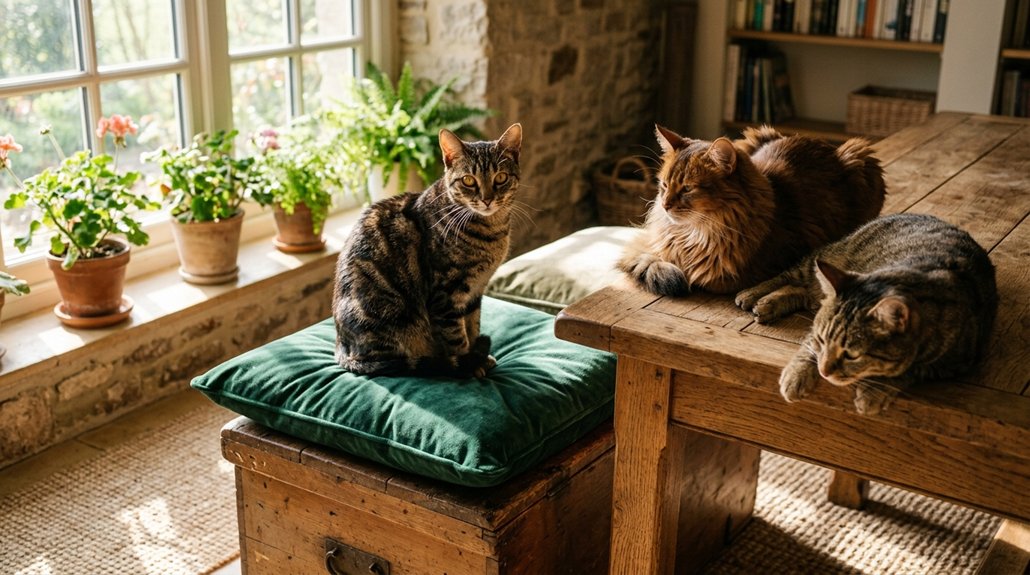
Discover the allure of rare cat breeds, each with unique traits and intriguing origins. The Sokoke from Kenya is an agile climber, while the Peterbald from Russia forms strong bonds with owners. Kurilian Bobtails boast distinctive pom-pom tails, and Egyptian Maus are ancient runners. Minskins blend Sphynx and Munchkin features, while Chartreux and Korats are historical and cultural treasures. Explore deeper to uncover the fascinating characteristics and histories of these extraordinary felines.
Key Takeaways
- Sokoke from Kenya features a uniquely marbled coat and thrives in energetic, stimulating environments due to its strong climbing instincts.
- The Peterbald, originating from Russia, varies from hairless to a suede-like coat, emphasizing the importance of specialized grooming and care.
- Minskin combines short legs and sparse fur, showcasing a playful and social nature that enjoys human interaction.
- Kurilian Bobtail is recognizable by its short pom-pom tail, enhancing balance and agility thanks to natural mutations.
- Egyptian Mau, known for its historical significance, boasts exceptional speed and distinct natural spots, making it a prized, but expensive breed.
Sokoke: A Rare and Energetic Climber
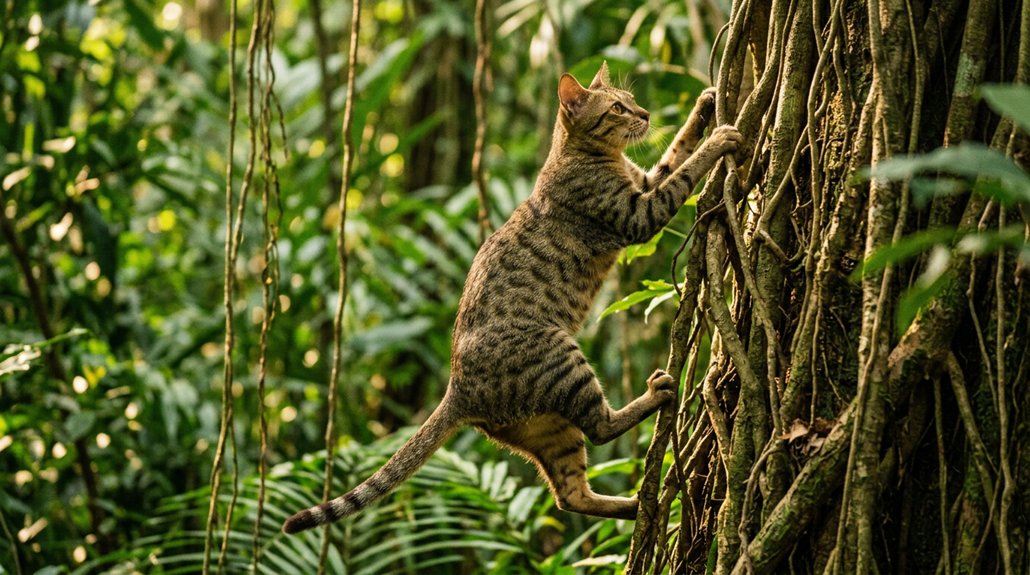
Though you might not often encounter the Sokoke cat, this rare breed hailing from Kenya captivates with its uniquely marbled coat, echoing a hand-painted masterpiece. Renowned for its energetic playfulness, this feline demonstrates an unyielding spirit, making it an ideal companion for interactive and engaging activities. It’s essential to recognize the Sokoke’s climbing instincts, a key trait that highlights its affinity for exploration and its ancestral ties to nature. These cats thrive in environments that stimulate their natural urges, often exhibiting remarkable agility and curiosity. Originally thought to be connected to wild hybrids, the Sokoke’s lineage is firmly rooted in domestic ancestry. Their rarity and limited breeding outside Kenya contribute to their mystique and allure among cat enthusiasts.
Peterbald: Exploring Its Affectionate Nature
While the Peterbald is a relatively new breed, originating in Russia in 1993, it quickly gains recognition for its distinctive traits and affectionate disposition. Their genetic diversity means they can range from completely hairless to having a fine layer of suede. Their unique coat requires specific Peterbald Grooming; regular gentle wiping keeps their skin healthy, minimizing oil build-up.
You’ll find their personalities equally alluring. Known for their social nature, Peterbalds thrive on human interaction, forming strong bonds with their owners. They love being the center of attention, often following people around the house. Given their lean, athletic build, incorporating interactive play is essential in their lifestyle, alongside a nutrient-rich Peterbald Diet to maintain their energy and health.
Kurilian Bobtail: Understanding Unique Tail Traits
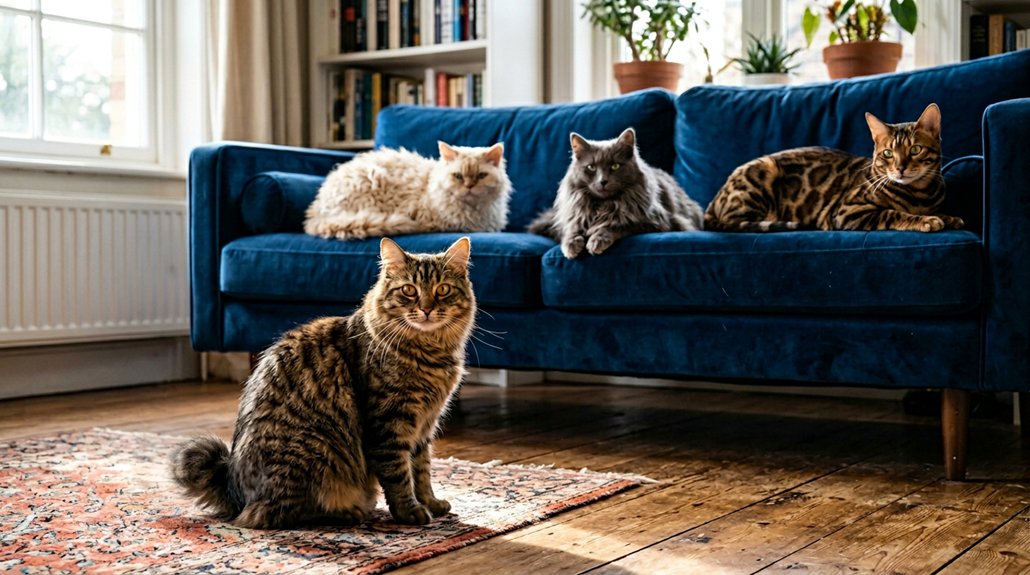
The Kurilian Bobtail frequently enchants feline enthusiasts with its distinctive short, pom-pom tail. This unusual feature, not longer than 3-4 inches, is a result of fascinating tail mutations. These natural mutations contribute to the breed’s unique appearance while also enhancing balance. You might be surprised to learn that the Kurilian Bobtail originated from the Kuril Islands over 200 years ago, bringing a rich history that sets it apart from other cats.
Consider the following enchanting attributes of the Kurilian Bobtail:
- Distinctive Tail: Its short, fluffy tail is a natural mutation.
- Balance Enhancement: Its tail aids in agility and impressive jumping.
- Rare and Intelligent: Despite its rarity, it’s known for its intelligence.
- Playful Disposition: Makes a friendly and interactive companion.
Egyptian Mau: Meet the Ancient Agility
An ancient marvel of the feline world, the Egyptian Mau enchants with its extraordinary agility and storied history. Tracing back to Egyptian history, this breed’s natural elegance is often depicted in ancient art. Known today as agile hunters, Egyptian Maus can sprint up to 30 mph, showcasing unmatched speed among domestic cats. Their striking appearance—marked by natural spots, arched backs, and large, green almond-shaped eyes—enhances their majestic presence.
| Trait | Description | Emotion Evoked |
|---|---|---|
| Appearance | Striking, spotted, graceful | Wonder and Fascination |
| Speed | Nearly 30 mph | Amazement |
| Temperament | Loyal, affectionate | Warmth and Connection |
These enchanting cats form strong bonds with owners, but their rarity carries a price: $500 to $3,500.
Minskin: A Modern Blend of Sphynx and Munchkin
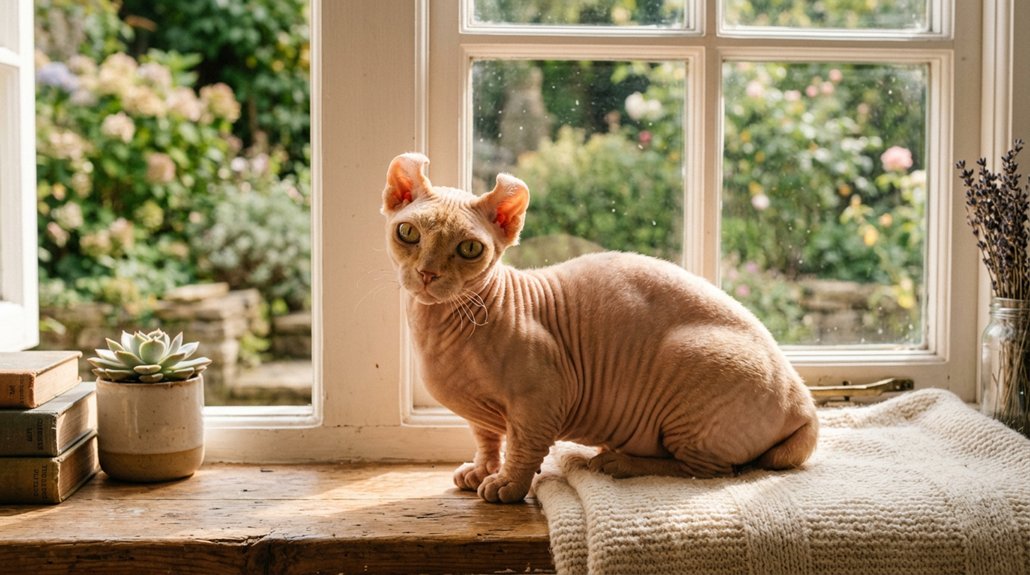
You’ll find the Minskin fascinating due to its unique combination of short legs and sparse fur, characteristics that make it stand out from other breeds. Known for their playful and social nature, these compact cats enjoy human interaction, making them great companions. Since their recognition as a breed in 2008, Minskins have captivated enthusiasts with their distinctive appearance and engaging personality.
Unique Physical Features
Imagine a cat that combines the playful essence of the Munchkin with the unique, hairless appeal of the Sphynx—such a breed exists in the form of the Minskin. This breed, recognized in 2008, possesses distinctive characteristics that arise from its hybrid breed traits. Physically, Minskins showcase a rare combination of sparse fur on their face, ears, and legs, alongside the notable short legs characteristic of Munchkins.
The average Minskin stands 7-9 inches tall and weighs 4-6 pounds. Its unique blend captivates with:
- Endearing small stature
- Striking hairless sections
- Charming short legs
- Distinctive lineage
Minskins are quite the sight, representing a fascinating blend of form and function. You’ll surely find their distinct appearance unforgettable.
Playful and Social Nature
How do Minskins enchant with their playful and social nature? This alluring breed, born from a mix of Sphynx and Munchkin cats, showcases lively, playful interactions and deep social bonding. Minskins inherit their spirited playfulness from the Munchkin lineage, delighting in games that engage both mind and body. Meanwhile, the Sphynx’s influence is evident in their love for companionship, often forming strong bonds with their human counterparts. You’ll find these cats keen to partake in any activity, enhancing their appeal as family pets. Their minimal fur doesn’t only give them a unique appearance; it seems to empower their energetic and personable character, drawing in more people intrigued by this endearing combination. Fundamentally, Minskins thrive in interactive, social environments.
Breeding and Recognition
Though relatively new to the feline world, the Minskin breed intriguingly blends the genetic traits of its Sphynx and Munchkin ancestors. Developed through meticulous breeding techniques, Minskins combine the Sphynx’s distinctive coat characteristics with the Munchkin’s hallmark short legs. These unique features have captivated enthusiasts and led to growing interest in the breed.
Despite the Minskin being officially recognized in 2008, it’s still maneuvering the recognition process within various cat registries. This process depends on:
- Unique appearance: Short legs, sparse fur.
- Health and robustness: Lifespan of 12 to 15 years.
- Affectionate demeanor: Inherited from its parent breeds.
- Popularity surge: Among cat lovers and breeders.
Each step furthers the Minskin’s journey towards becoming a staple among rare cat breeds.
Norwegian Forest Cat: A Rare Giant of Norway
The Norwegian Forest Cat, known as a rare giant of Norway, is a robust and resilient feline well-suited to the demanding Scandinavian climate. It displays superb winter adaptation with a thick, water-resistant coat, allowing survival in harsh conditions. This sizeable breed typically weighs between 12 to 16 pounds, boasting a beautiful triangular head, tufted ears, and bushy tail. Despite its imposing size, it’s famed for a gentle temperament, proving to be both social and playful. Nearly lost during WWII, breeding programs restored this elegant feline’s population. Its strong hunting instincts enhance its agility as a climber, while its regal presence continues to garner admiration. Lifespan averages 14 to 16 years, emphasizing its durability and companionship.
Serengeti: a Domestic Beauty With Exotic Flair
While the Norwegian Forest Cat commands attention with its impressive size and adaptability, the Serengeti presents a differing allure with its exotic aesthetic. This breed, resembling a serval due to its long legs, large ears, and striking spotted coat, embodies domestic beauty with no wild ancestry. Developed by crossing Bengal cats with Oriental Shorthairs, the Serengeti boasts unique traits that capture interest. You’ll find their high energy and innate curiosity perfect for interactive play and exploration, offering distinctive playful companionship.
Despite limited breeding efforts, the Serengeti’s charms foster a dedicated following. Emotionally connect with this rare feline through:
- Their serval-like appearance.
- High energy, playful nature.
- Limited availability among cat breeds.
- Engaging personality that captivates enthusiasts.
Explore the rare beauty of Serengeti cats.
Chartreux: France’s Calm and Historic Blue Cat
Known for its serene demeanor and charming appearance, the Chartreux stands out as a distinctive feline breed. Originating from France, the Chartreux has historical roots linked to monastic communities, contributing to its quiet and gentle disposition. This breed’s striking physical features include a dense, water-resistant coat of slate-blue and unique copper-colored eyes, earning it the nickname “smiling blue cat” due to its rounded head and full cheeks. The Chartreux temperament is calm and adaptive, making it a suitable companion for diverse living environments. Despite their reduced numbers during wartime, careful breeding efforts have preserved the lineage. These cats are intelligent, capable of learning tricks, providing engaging companionship for families or individuals. The Chartreux is a treasure among rare breeds.
Korat: Thailand’s Lucky Silvery-Blue Feline
Celebrated in Thai culture, the Korat cat symbolizes good fortune and is often gifted rather than sold. With its striking silvery-blue coat and luminous green eyes, the Korat is not just a visual marvel but also a cultural icon. It’s an energetic, playful companion, known for its intelligence and problem-solving skills, such as opening cabinets. If you’re considering a Korat adoption, note their rarity outside Thailand, due to strict breeding practices.
- Cherished symbol – Represents prosperity and good luck.
- Unique appearance – Shimmering coat and mesmerizing eyes captivate owners.
- Intelligent nature – Problem-solving abilities enhance interaction.
- Proper care longevity – Lives 12-15 years with attentive care.
Korat symbolism extends beyond aesthetics, embodying hope and happiness in your home.
Frequently Asked Questions
What Are the Origins of the Lykoi, Also Known as the “Werewolf Cat”?
You’re curious about the Lykoi’s origins. The Lykoi history traces back to Tennessee and Virginia, where their unique genetics emerged naturally. These cats have a partially hairless coat due to a spontaneous genetic mutation affecting their hair follicles.
How Does the Highlander Breed Demonstrate Its Affinity for Water?
You’ll be amazed when you see the Highlander breed’s unique bond with water. This cat’s playful nature embraces aquatic environments, exhibiting distinctive feline behavior. They’re known for water play, showcasing an unusual affinity for splashing and swimming activities.
What Makes the Tennessee Rex’s Ginger Coat Unique Compared to Other Breeds?
The Tennessee Rex’s ginger coat is unique due to its curly, soft texture, often exhibiting a shimmery, metallic sheen. It’s distinct from other breeds because of genetic traits affecting hair structure and light reflection properties.
Are There Any Special Care Requirements for the Aphrodite Breed’s Long-Legged Physique?
The Aphrodite breed’s long-legged physique requires regular exercise to maintain muscle health and avoid joint issues. You’ll need to focus on grooming, which includes frequent brushing to prevent matting and maintain their luxurious coat’s condition.
How Do the Patterns of the Cheetoh Differ From Its Bengal and Ocicat Ancestors?
Cheetoh patterns blend Bengal’s rosettes and Ocicat’s spots, offering a unique mix due to Cheetoh genetics. Cheetoh characteristics feature larger, more dynamic markings, maintaining a wild aesthetic but with distinct, rich variations in spotting not seen in ancestors.
Conclusion
As you explore these rare feline wonders, you’re starting a journey through a living tapestry of history and nature. Each breed is a unique brushstroke, from the Sokoke’s energetic climbs to the Chartreux’s calming blue serenity. They’re not just pets; they’re echoes of ancient lands and traditions crafted by evolution’s deft hand. Embrace their uniqueness, and you’ll find that each rare breed is a living tribute to the rich, diverse world of domesticated cats.