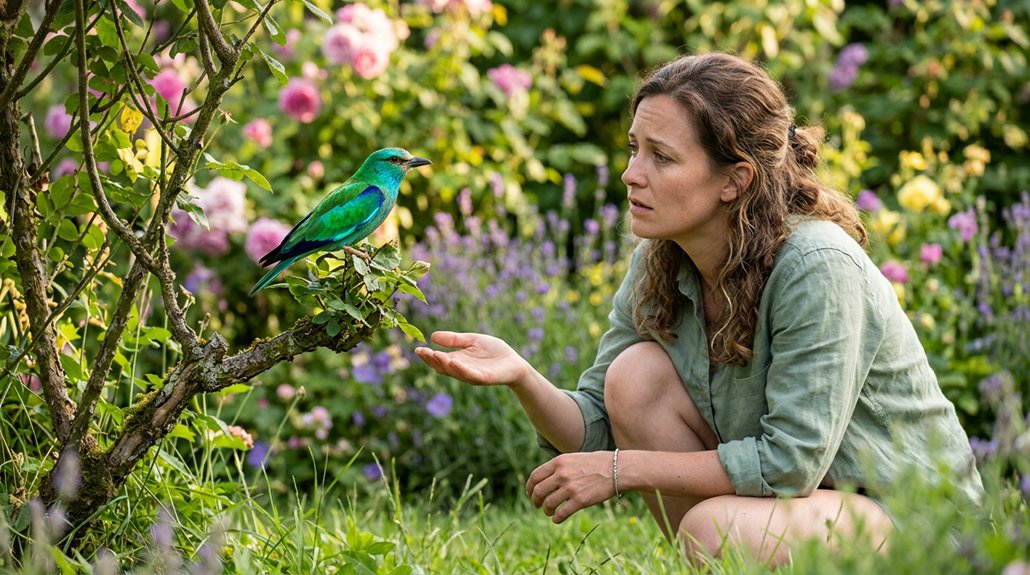
Stop chasing your bird and work at the edge of its flight distance. Watch for early stress cues like leaning back, crouching, stepping aside, stiffening, or feather compression, and stop at the first sign. Hold still until it relaxes, then walk away to reward calm. Use brief, daily treat sessions at the cage, moving from bowl to hand only when it stays relaxed. If you keep going, you’ll see how to rebuild trust step by step.
Key Takeaways
- Stop approaching at the first sign of discomfort, like leaning back, crouching, or sidestepping, and give the bird space.
- Work at the bird’s flight distance, hold still until it relaxes, then calmly walk away to reward calm behavior.
- Use high-value treats to build trust, starting by dropping them in the cage and gradually offering them closer by hand.
- Keep sessions brief, daily, and consistent, advancing only in small steps and ending after a calm success.
- Avoid forcing, grabbing, or towel handling unless necessary; after forced handling, give the bird quiet time to recover.
Get Your Bird Back in the Cage
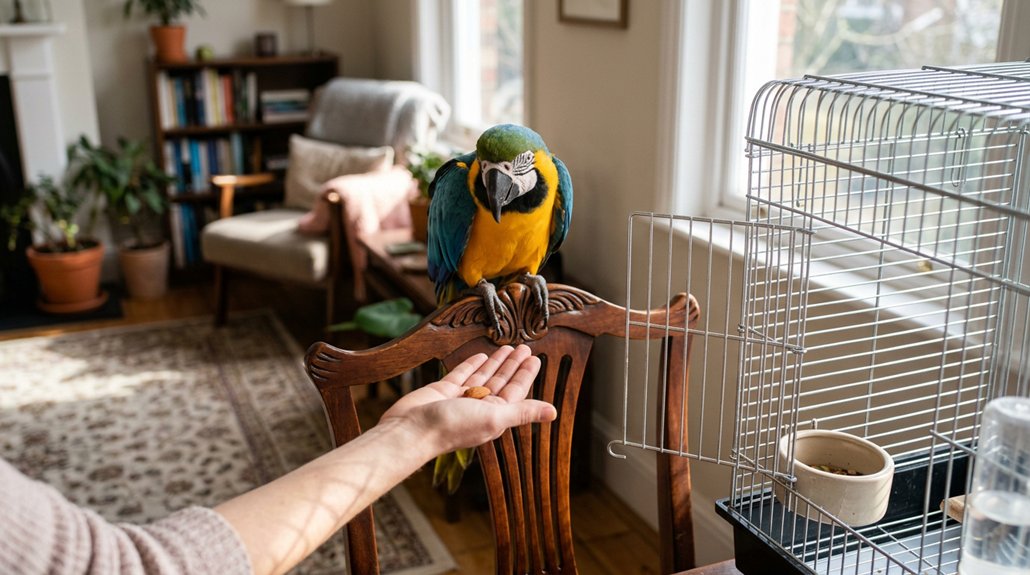
To get your bird back in the cage, don’t keep advancing the moment it shows discomfort; if it leans back, crouches, or steps aside, stop immediately and wait for it to calm before trying again. Use short, frequent sessions and reduce distance in small steps, rewarding calm approaches with high-value treats only when it enters. Start by dropping treats inside, then offer them from your hand. Teach choice by approaching slowly, pausing, then walking away so it learns reduced flight distance without force. Avoid towel-forcing except in emergencies; repeated coercion damages trust and worsens escape or biting. Optimize perch placement, lighting adjustments, cage enrichment, and exit prevention so the cage feels predictable and safe. Continue until it willingly returns and steps up inside.
Read Your Bird’s Body Language
You need to watch for early discomfort cues such as leaning back, crouching, stepping aside, or compressing feathers; when you see them, stop your approach. When your bird returns to a normal posture, fluffs slightly, or shifts weight out of a ready-to-fly stance, you can continue because it’s tolerating your presence. Use its flight distance as your boundary, and reward calm behavior by keeping sessions brief and backing away when the bird relaxes.
Spot Discomfort Signs
Watch carefully for early discomfort signals: a bird may lean back on the perch, crouch, step one foot aside, or compress its feathers just before it tries to move or fly away. You should treat these changes as a clear warning that your approach is too close. If you notice stiffening, fixed eye contact, or wings lifting slightly, stop immediately; those signs indicate stress, not curiosity. Also monitor perch pressure: a bird that grips harder or shifts its weight to brace for escape is preparing to leave. Respect its flight distance and don’t push past it. Wait until you see relaxed posture, softer feathers, and weight shifting out of the ready-to-flee stance. When you remove pressure at the first sign of discomfort, you teach safety and gradually reduce avoidance.
Reward Calm Approach
Reward calm behavior immediately: when your bird shows a relaxed posture, slight feather-fluffing, or a weight shift away from a ready-to-fly stance, offer a small, highly valued treat so it learns that staying calm brings good outcomes. If you see leaning back, crouching, a foot stepping aside, or feather compression, stop approaching and hold position until calm returns. Then reward. Use brief, frequent sessions and prefer Nutriberries or a nut.
- Reinforce calm during your approach.
- Pause at discomfort, then resume only after recovery.
- Advance from distant treats to hand-delivered rewards and stepping up.
This social conditioning works best alongside environmental enrichment, which lowers baseline stress and supports consistent, precise learning.
Stop Approaching at First Discomfort
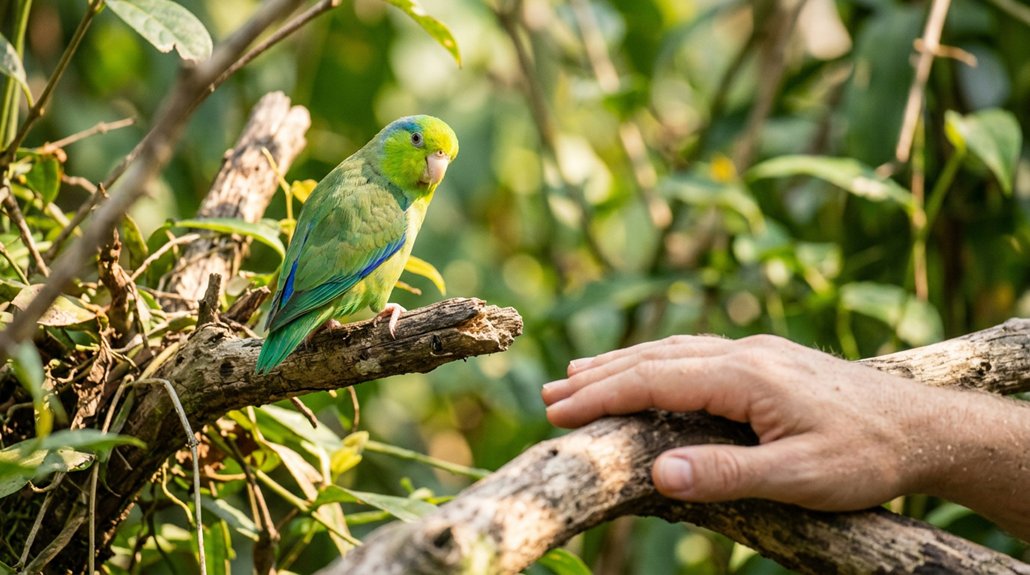
At the first sign of discomfort—leaning back, crouching, stepping a foot aside, or compressing the feathers—stop approaching immediately to avoid triggering flight. You’re reading its threshold, not testing it. Maintain gentle eye contact and slow arm extension only while posture stays neutral.
| Cue | Response |
|---|---|
| Leans back | Stop |
| Crouches | Stop |
| Steps aside | Stop |
| Feathers compress | Stop |
| Relaxes | Hold still |
Note the distance where it moves away; that’s its flight distance. Stay just outside it, then hold position quietly until you see normal posture, slight feather fluffing, or weight shifting away from readiness to flee. When calm appears, turn and walk away to reinforce control. Repeat in short sessions, narrowing the gap gradually—1.0 m, then 0.9 m, then 0.8 m—without forcing or flooding.
Use Distance to Build Cage Trust
Use your bird’s flight distance as the boundary for building cage trust: approach slowly in short daily sessions, and stop just before it moves away. Your slow approach should be repeatable, calm, and measurable. Use visual barriers if needed to reduce alertness.
Approach slowly, stop before your bird moves away, and make each calm visit predictable and measurable.
- Observe the closest point that triggers movement, then halt there.
- Wait for relaxed posture or slight feather fluffing, then end the session.
- Over many 5–10 minute trials, reduce distance by about 10 cm when calm signals persist.
When close proximity is tolerated, drop a high-value treat into the cage without forcing entry. This teaches your bird that your presence predicts safety and reward. Don’t grab, towel, or push it inside; coercion strengthens fear and raises flight distance.
Reward Calm With a Walk Away
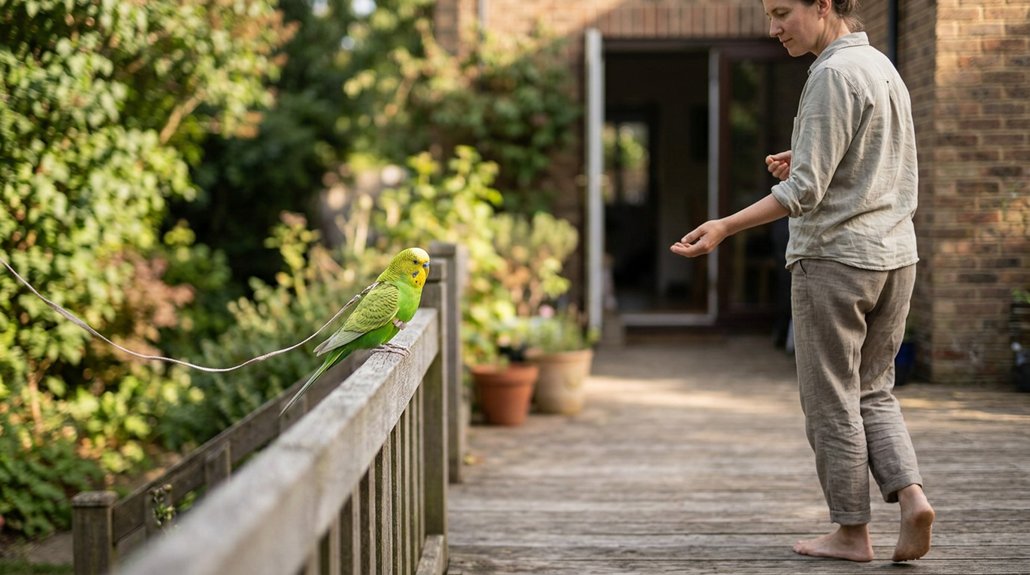
When your bird shows calm posture, slight fluffing, and no retreat, you should step away immediately so calm is rewarded with distance. If you notice leaning back, crouching, or weight shifting, stop advancing at once and only return after the bird relaxes. Repeating these brief walk-away cycles teaches that quiet acceptance prevents pressure, and you can later pair that calm with treats.
Calm Rewards Distance
Reward calm by stopping your approach at the first subtle sign of discomfort—such as a slight lean back or a weight shift ready to flee—and only move away once the bird shows clear settling, like a normal posture or mild fluffing. This supports gradual desensitization and pairs well with environmental enrichment. Use a brief, consistent pause so the bird can learn that calm behavior ends pressure.
- Hold position for 3–5 seconds of calm.
- Walk away immediately once calm is maintained.
- Reduce flight distance by about 0.1 m every few sessions.
When tolerance improves, drop a low-value treat into the bowl, then shift toward hand-delivered rewards. Track each session’s distance. Don’t force contact or grab, because that can undo learning and increase stress.
Walk Away Timing
As soon as your bird shows mild discomfort—leaning back, crouching, or stepping aside—stop advancing and hold still until it relaxes; then, the moment it returns to a calm posture with a normal stance or slight feather fluff, turn and walk away. This timing matters because your timed departures teach that calmness changes the interaction. Watch its visual cues closely, and don’t wait for full surrender; act at the first stable relaxation. Use several 1–3 minute sessions daily so the bird can repeatedly experience calm-return→walk-away pairings without overload. Over time, reduce the stopping distance only when it stays settled consistently. This precise pattern lowers flight distance, prevents escape behavior, and builds tolerance through predictable removal of pressure.
Reinforce Quiet Acceptance
Once your bird can stay relaxed as you approach, use that calm response as the cue to remove yourself. This is positive reinforcement: your departure confirms that quiet acceptance ends pressure. Do it within seconds, not after a delay, so the bird links calm behavior with relief. 1. Approach only to the current tolerated distance. 2. If the bird remains still, turn away and leave immediately. 3. Move closer in small increments only after repeated calm responses. If you see leaning back, weight shifting, or tiny sidesteps, stop advancing and wait. You can also drop occasional high-value treats into the bowl, but the walk-away should do most of the teaching. Over time, this builds voluntary tolerance and lowers flight-distance reactivity.
Start Treat Training at the Cage
Start treat training at the cage door with short, repeated sessions so your bird learns that the cage area predicts good things. Offer a highly preferred treat 3–5 times daily, but only when your bird is calm inside the cage; wait for relaxed posture or brief stillness before rewarding. Use a consistent cue, such as “treat” or a soft whistle, so your bird begins to respond to the signal, not just your presence. This is targeted desensitization: you’re pairing the cage with safety and reward, not pressure. Through steady hand feeding routines, you’ll strengthen trust without forcing contact. Over days, shift the reward from the bowl to the doorway and then just outside it. If your bird backs away, stop advancing, reduce distance, and step away to preserve progress.
Move Treats From Bowl to Hand
Shift the treat from the bowl to your hand in small, deliberate steps so your bird can learn that your hand predicts safety and reward. Begin with high-value treats in the bowl, then move the bowl closer to the door over repeated brief sessions. When your bird eats calmly with the door open, use this sequence:
- Present a closed fist trust cue at the same location.
- Open to an open palm just inside the cage.
- Advance to palm near the perch, then at the edge.
Give the treat only when your bird approaches without crouching, leaning back, or fleeing. Keep each session 3–5 minutes and repeat daily. This controlled progression supports hand targeting and reduces fear. Avoid rushing; consistency matters more than speed.
Teach Step-Up Training Slowly
Gauge your bird’s flight distance first, then approach just inside that boundary so it learns you won’t suddenly crowd it. Use gradual desensitization: advance slowly, stop at leaning back, crouching, or weight shifts, and wait for calm before continuing. Perch shaping works well here because you can offer a stable target before using your finger.
| Signal | Action | Result |
|---|---|---|
| Tense | Hold still | Trust begins |
| Calm | Offer treat | Positive association |
| Step up | Reward immediately | Learning strengthens |
Once it tolerates close contact, place a Nutriberry or favored nut near the toes or perch edge. Then present a flat finger or perch under the lower chest/fulcrum and let the bird step up voluntarily. Keep sessions brief, frequent, and precise, ending only after a calm success.
Recover After a Bad Cage Attempt
If a step-up session ended with a towel grab or a forced return to the cage, stop handling your bird immediately and give it 20–30 minutes of quiet, non-threatening space to recover. During this post handling calm, you’re watching for normal posture, slight fluffing, and stable weight distribution before you re-enter. If you see leaning back, crouching, or sidestepping, back off at once. 1. Offer calm presence only when the bird’s relaxed. 2. Place high-value treats, such as Nutriberries, in the cage only when it goes in voluntarily. 3. Use brief, predictable routines, then withdraw. Avoid repeating towel trauma; forced returns teach the cage is unsafe. Rebuild trust with slow, repeated approach steps over days or weeks, not with pressure.
Frequently Asked Questions
What Is the 3 3 3 Rule for Birds?
The 3-3-3 rule means you watch body language cues, stop after 3 seconds of discomfort, move back 3 steps, then wait 3 minutes before trying again; you’re building trust and later flight recall.
How to Tell if a Bird Hates You?
You can’t know if your bird “hates” you; you’re seeing fear or mistrust. Watch body language cues, vocal tone, biting, lunging, eye pinning, retreating, and whether it calms only when you leave.
How Long Does It Take for a Bird to Get Used to You?
Usually, you’ll see progress in 1–3 weeks, but full comfort can take months. With building trust and gradual exposure, some birds respond in days; fearful birds may need 4–12+ weeks of consistent, calm handling.
How to Train Your Bird to Come Back to You?
Train your bird with positive reinforcement and target training: use high-value treats, reward every voluntary step toward you, and stop before discomfort. You’ll build recall through brief, frequent sessions, not a marathon of pressure.
Conclusion
If your bird still won’t come to you, don’t push harder—pause, observe, and let the cage become safe again. Each retreat, each calm reward, each small hand-fed treat is a clue that trust is rebuilding. Step-up training can wait until your bird’s body says yes. For now, the next move matters: approach less, wait more, and watch for the moment your bird finally chooses you first.