To manage your cat’s nighttime overactivity, implement a structured play schedule involving 15-20 minutes of interactive play before sleep using engaging toys. Maintain a consistent feeding regimen to align with their natural rhythms, and provide a stimulating daytime environment with puzzle toys and climbing structures. Establish a cozy sleep area to encourage rest. Consider a feline companion for increased social interaction. Persistent disturbances may require veterinary evaluation. Discover the nuanced strategies for effective energy management.
Key Takeaways
- Engage your cat in active play sessions for 15-20 minutes before bedtime to manage nighttime energy levels.
- Establish structured feeding routines, avoiding nighttime meals, to align your cat’s energy patterns with natural circadian rhythms.
- Diversify daytime activities using engaging toys, puzzle feeders, and climbing structures to enhance daytime mental and physical stimulation.
- Create a cozy, quiet sleep environment with minimal distractions to encourage restful nighttime sleep for your cat.
- Consider adopting a companion cat for social interaction and increased daytime engagement to reduce nighttime hyperactivity.
Immediate Solutions for Cats’ Nighttime Hyperactivity
If nighttime hyperactivity is leaving you sleep-deprived, deploying immediate strategies can help manage your cat’s energy levels more effectively. Addressing nocturnal behavior involves systematic sleep training. Initiate a pre-sleep regimen through 15-20 minutes of active play with toys like fishing poles or laser pointers to mitigate excess energy. Enhance daytime engagement using puzzle toys or treat balls, promoting mental stimulation. Implement a regimented feeding schedule to discourage night-time restlessness by focusing feedings during daylight hours. Construct a conducive sleep environment, strategically distant from your bedroom, offering essential amenities such as a litter box, food, and a scratching post. For persistent nocturnal antics, confine your feline to a secure, enriched space, facilitating controlled nocturnal interaction while promoting ideal sleep patterns.
Why Cats Are Nighttime Hunters
Your cat’s nocturnal hyperactivity is rooted in crepuscular activity patterns, a behavior that stems from their natural proclivity for hunting during twilight hours when their prey, like rodents, are most active. This evolutionary trait is driven by instincts inherited from their wild ancestors who optimized nighttime hunting for survival. A combination of these inherent instincts and insufficient daytime stimulation can exacerbate active nocturnal behaviors in domestic cats.
Natural Instincts Behind Hunting
Recognizing that cats are naturally crepuscular provides insight into their nighttime hunting behavior, which is deeply rooted in evolutionary adaptations. This inclination arises from their ancestry as wild hunters where the hunting evolution tailored their instinctual behavior to hunt small prey like rodents. Millions of years of evolutionary pressure have honed these instincts, enabling them to maximize predatory efficiency.
- Evolutionary Adaptations: Domesticated cats retain vestiges of these hunting instincts.
- Pent-Up Energy: Reduced daytime stimuli often lead to nocturnal hyperactivity.
- Solitary Predators: Cats increase activity post prolonged solitude, aligning with their solitary nature.
- Prey Activity: Prey is most active during dawn and dusk, matching cats’ hunting times.
Crepuscular Activity Patterns
Understanding cats’ crepuscular activity patterns demands scrutiny of their evolutionary development as proficient hunters of the twilight hours. Cats’ inclination towards twilight activity is genetically entrenched, derived from their predatory lineage targeting dusk-and-dawn-dwelling prey such as rodents. Crepuscular behavior aligns seamlessly with these natural predators’ need to exploit their prey’s vulnerabilities during shifts between daylight and darkness. During daytime stasis, your cat conserves energy, manifesting in heightened nighttime dynamism. While these innate tendencies are ingrained, your presence and routine inadvertently reinforce them, especially when your cat capitalizes on increased interaction when you’re home in the evening. Insufficient daytime stimulation compounds energy accumulation, catalyzing crepuscular activity. Strategically engaging your cat in daylight enrichment may mitigate nocturnal disturbances effectively.
Recognizing Common Signs of Nighttime Hyperactivity
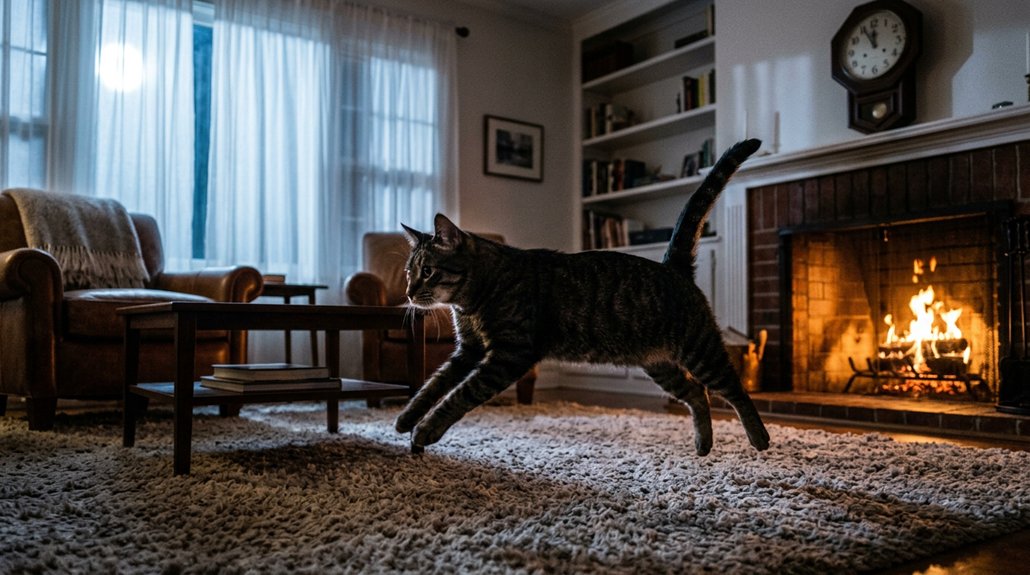
To effectively manage your cat’s nighttime hyperactivity, it’s crucial to identify specific behavioral cues like frenetic play or vocalizations, which may indicate excess energy or attention-seeking. Distinguishing between normal crepuscular activity and excessive restlessness involves evaluating frequency, intensity, and any changes in your cat’s routine or environment. While such behaviors are often benign, consistent nocturnal disturbances could point to underlying health issues, necessitating a veterinary evaluation.
Identifying Behavioral Cues
When your feline companion spends the night darting across furniture or persistently vocalizing, these behaviors are hallmark indicators of nighttime hyperactivity. Recognizing these cues is critical to understanding feline socialization and nighttime communication. This hyperactivity often signals an internal drive to expel pent-up energy. Such behaviors include:
- Vocalization: Crying or yowling manifests nocturnal communication and an attempt to solicit attention.
- Playful aggression: Nibbling on toes or playful attacks may be linked to socialization deficits during the day.
- Restlessness: Zooming around furniture reflects a need to engage active senses.
- Pre-Bite Indicators: Dilated pupils and excessive purring can precede more aggressive actions.
These cues are integral for identifying behavioral patterns, thereby guiding you in managing your cat’s activity levels effectively.
Distinguishing Normal vs. Excessive
Many behaviors, such as an occasional late-night dash or curious exploration, fall within the spectrum of normal feline nighttime activities. Normal behaviors typically include brief playing, exploring, or vocalizing. However, distinguishing between normal and excessive behaviors is essential for managing nocturnal hyperactivity. Excessive behaviors encompass wild, destructive play, persistent vocalization, or rapid, chaotic sprints around your home, which disrupt household peace. If your cat repeatedly nibbles toes or walks across you in an overly energetic manner, these actions may signal a need for attention surpassing normal activities. To discern excess, scrutinize your cat’s play habits. Evaluate if nighttime activity results from inadequate daily enrichment or overstimulation, which may indicate a requirement for modified interaction strategies or environmental adjustments.
Addressing Potential Health Concerns
Recognizing when your cat’s nighttime behavior strays beyond the norm can be essential for pinpointing potential health concerns. Observe any changes meticulously, especially if linked to chronic pain, hyperthyroidism, or anxiety management. Identifying overstimulation signs such as dilated pupils or aggressive tendencies is vital to prevent escalation into feline distress. Use the following to guide your behavior observation:
- Look for excessive vocalization, which may indicate anxiety or discomfort.
- Monitor destructive behavior and its frequency, hinting at underlying distress.
- Note any changes in eating/sleeping patterns to aid health investigations.
- Regularly consult your veterinarian for insight on medical factors versus behavioral issues.
Persistent hyperactivity demands significant analysis to mitigate potential health concerns, ensuring your pet’s well-being.
Creating a Daytime Environment to Reduce Night Activity
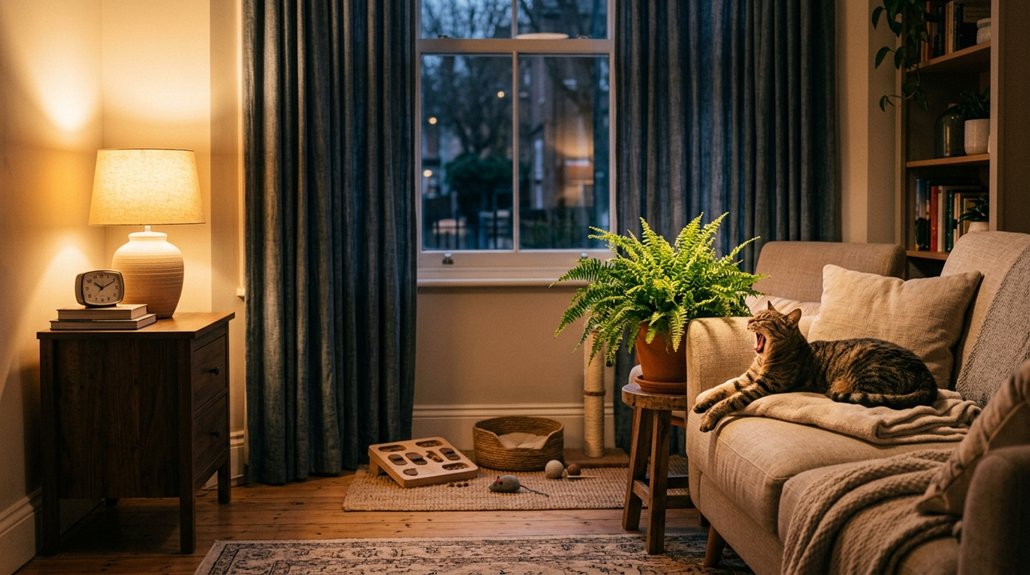
Although cats are naturally nocturnal, creating a stimulating and structured daytime environment can mitigate their nighttime activity. Implement daytime stimulation by incorporating interactive play sessions. Utilize tools like fishing pole toys and laser pointers to effectively expend feline energy during daylight hours. Establish feeding schedules aligned with your family’s daily routine to enhance consistent daytime activity.
Environmental enrichment is essential. Introduce and rotate diverse toys to sustain mental engagement and circumvent boredom-induced nocturnal behaviors. Scratching posts, climbing structures, and puzzle toys fortify physical and cognitive stimulation. Actively engage your cat in evening play to limit prolonged naps and bolster daytime wakefulness. This multifaceted approach, grounded in evidence-based practice, effectively addresses overactive nighttime behavior in felines, ensuring a peaceful household at night.
Best Toys for Interactive Play
In the domain of feline enrichment, certain toys are pivotal in facilitating interactive play by tapping into a cat’s innate predatory instincts. These toys offer significant interactive toy benefits and are instrumental in promoting engaging playtime.
Toys crucially engage a cat’s predatory instincts, enhancing interactive play and boosting their natural behaviors.
- Fishing pole toys: Highly effective, these toys simulate hunting, activating natural behaviors and maximizing feline engagement through kinetic stimuli.
- Laser pointers: These devices are esteemed for promoting exercise and cognitive stimulation, encouraging pursuit behavior.
- Interactive puzzle toys: They challenge problem-solving faculties, rewarding cats with treats, and maintaining interest through continuous cognitive engagement.
- Treat-dispensing toys: Providing dual benefits of mental stimulation and physical activity, they guarantee energy expenditure and sensory stimulation.
Rotating toys consistently keeps the play environment dynamic, preventing boredom and maintaining continuous interaction.
Routine Building: Feeding and Playtime Schedules
Establishing consistent feeding times, synchronized with your household schedule, plays a critical role in regulating your cat’s circadian rhythm and mitigating nocturnal overactivity. Incorporating structured interactive play sessions, totaling 15-20 minutes in the afternoon and evening, strategically harnesses and exhausts your cat’s energy reserves, thereby curtailing hyperactive behavior at night. Reinforcing this regimen by periodically rotating toys guarantees sustained cognitive engagement and reduces boredom-induced behavioral issues.
Consistent Feeding Times
Implementing consistent feeding times is essential for synchronizing your cat’s energy levels with your household’s daily schedule, thereby enhancing daytime alertness and nighttime restfulness. Enhancing feeding frequency by scheduling meals at regular intervals prevents pent-up energy from long fasting periods. You should also prioritize meal timing in the evening to mitigate nighttime hunger, curbing nocturnal activity and fostering a peaceful environment. Avoid nighttime feedings to respect your cat’s natural nocturnal instincts, ensuring meal plans align with daytime activities.
- Larger evening meals reduce hunger-driven nocturnal activity.
- Regular feeding intervals prevent buildup of excessive energy.
- Avoiding nighttime feeding supports the cat’s natural rhythm.
- Align meal times with daytime activities for effective energy management.
Structured feeding times, integrated with play, effectively reduce nighttime hyperactivity.
Scheduled Interactive Play
Although many cats exhibit increased nocturnal activity, strategically scheduled interactive play can effectively mitigate this behavior. Deploying structured playtime routines using interactive toys for 15-20 minutes pre-bedtime can facilitate feline relaxation and promote sleep. By integrating diversified toys and implementing a rotational schema, you’ll maintain an engaging stimulus threshold, promoting diurnal activity. Aligning these sessions with the cat’s natural energy peaks—afternoon and evening—harnesses their intrinsic activity cycles, yielding tranquil nights. Empirical evidence underscores avoiding nocturnal feeding, as it inadvertently reinforces hyperkinetic nighttime tendencies. Maintain a regimented schedule congruent with your own, optimizing the cat’s circadian rhythm and improving household sleep quality.
| Factor | Strategy |
|---|---|
| Duration | 15-20 minutes pre-bedtime |
| Toy Variability | Diverse, rotate regularly |
| Natural Activity | Engage in evening and afternoon |
| Feeding Schedule | Avoid feeding at night |
| Family Integration | Align with household routines |
How to Create a Cozy Sleep Spot for Your Cat
Creating a cozy sleep spot for your cat involves several key elements that can greatly enhance its nighttime rest. Optimizing the sleep environment by choosing a quiet, low-traffic area in your home is fundamental. Comfort factors such as a warm, supportive bed or blanket are essential, as cats inherently seek soft surfaces. Integrating essentials like a litter box, food, and water nearby reduces the need for nocturnal wandering, optimizing rest. To manage energy while safeguarding comfort, add a scratching post or safe toys to the area. Keep distractions such as noisy items and clutter away to maintain a tranquil atmosphere. Here are critical components:
- Quiet, low-traffic location
- Soft, warm bedding
- Easy access to essentials
- Safe toys for appropriate engagement
Adding a Companion to Manage Energy Levels
Introducing a companion cat can be an effective strategy to curtail your primary cat’s nighttime hyperactivity. This addition can offer constant play and social interaction, greatly reducing nocturnal mischief. Dual cats naturally engage in more daytime activity, mitigating excess energy. However, verify cat compatibility and sufficient resource allocation: you’ll need extra food, litter boxes, and space to prevent conflicts. Proper introductions and compatible personalities enhance household harmony.
| Emotions | Impact |
|---|---|
| Boredom | Reduced with companionship |
| Loneliness | Minimized through interaction |
| Conflict | Avoided via proper resource allocation |
Strategies to Redirect Attention-Seeking Behavior
To effectively manage your cat’s nighttime attention-seeking behavior, it’s essential you employ evidence-based techniques that focus on ignoring the cat’s vocalizations and disruptive actions. Responding reinforces these behaviors, encouraging further disruptions. Implement cat behavior interventions to mitigate nocturnal activities through structured nighttime routines.
Incorporate these strategies:
- Daytime Engagement: Provide diverse toys and activities, reducing nighttime boredom.
- Routine Establishment: Create consistent play and feeding schedules, ensuring your cat is both stimulated and satiated during the day.
- Deterrents Utilization: Use items like upside-down carpet runners by doors to discourage undesirable scratching.
- Interactive Play: Leverage toys that trigger hunting instincts during play sessions, facilitating exhaustion pre-bedtime.
Integrating these methods can noticeably diminish your cat’s nocturnal mischief and enhance your peace.
When to Seek Veterinary Advice for Persistent Behavior
Wondering when it’s crucial to consult a veterinarian for your cat’s persistent nighttime behavior issues? If your feline’s after-hours antics are coupled with excessive vocalization or disruptive behaviors, it might indicate underlying health problems necessitating a veterinary evaluation. Keep an eye on any shifts in eating or sleeping patterns, as they can signal issues requiring medical intervention. Persistent destructive conduct, elevated by stress or anxiety, underscores the need for expert advice.
| Symptom | Action Required |
|---|---|
| Excessive Vocalization | Veterinary evaluation |
| Increased/Decreased Appetite | Immediate consultation |
| Insomnia | Professional assessment |
| Destructive Behaviors | Evaluate for stress |
| Frequent Hyperactivity | Rule out health issues |
If hyperactive episodes become intensified, seeking a veterinary opinion is prudent to exclude conditions like hyperthyroidism or chronic pain.
Frequently Asked Questions
How Do I Get My Cat to Stop Being Hyper at Night?
Initiate a playtime routine of 15-20 minutes with interactive toys before bedtime to mitigate your cat’s nighttime distraction. Regular scheduled feedings and a tranquil sleep setting further promote stability. Persistent issues? Consult your veterinarian for guidance.
What Is the 3-3-3 Rule for Cats?
The 3-3-3 rule highlights acclimation stages: three days of cat anxiety, three weeks of exploration, three months for routine establishment. Understanding cat behavior during night activities aids adaptation, fostering stability and minimizing nocturnal hyperactivity through adherence to this framework.
Why Does My Cat Randomly Go Crazy at Night?
Your cat goes crazy at night due to nocturnal instincts and disrupted playtime patterns. Evidence suggests engaging them in daytime activities reduces nighttime hyperactivity by aligning play with their natural crepuscular schedule, diminishing pent-up energy and boredom.
Why Is My Cat Suddenly so Energetic at Night?
Your cat’s sudden nocturnal behavior could result from insufficient daytime feline exercise. Cats sleep when you’re busy, conserving energy for night activity. Guarantee consistent playtimes and mental stimulation during the day to mitigate nocturnal energy spikes.
Conclusion
Steering nighttime hyperactivity in cats is akin to orchestrating a symphony where all elements must harmonize. Recognize your feline’s nocturnal instincts, akin to nature’s programmed cacophony. Implement multifaceted interventions: interactive toys as the conductor, daytime engagement as the melody, and a calming sleep oasis as the finale. Introducing a companion can modulate the tempo while redirecting behavior acts as a skilled soloist. Persistent discord warrants veterinary consultation, ensuring your feline’s health doesn’t hit any discordant notes.