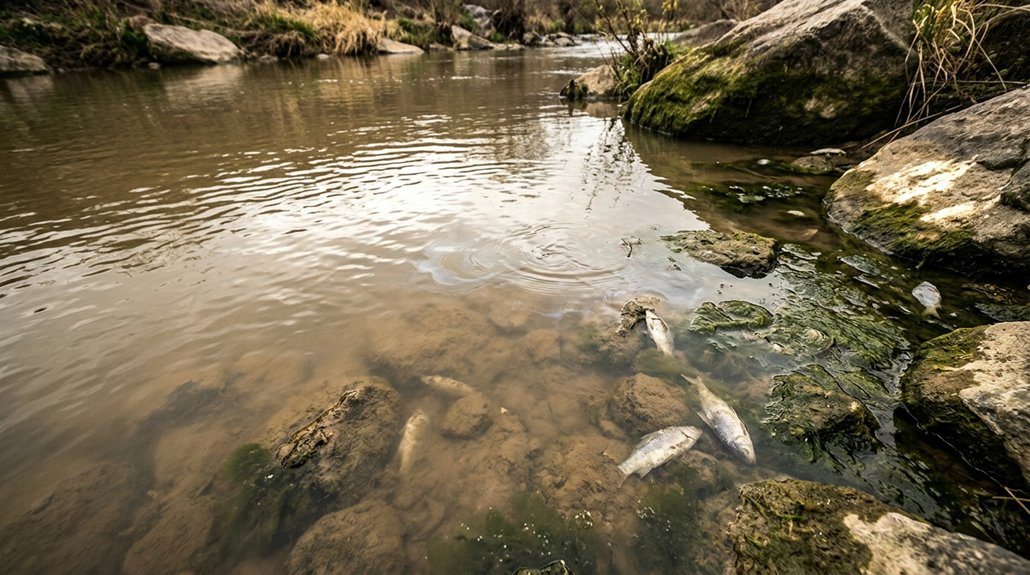
Water quality is the #1 cause of fish death because you can lose dissolved oxygen, stable pH, and safe chemistry faster than fish can adapt. When oxygen drops, your fish suffocate first, often before dawn, especially in warm, crowded, or polluted water. Ammonia, chlorine, metals, algal toxins, and runoff can damage gills and metabolism within hours. Heat, rain, and turnover can worsen it quickly, and the mechanisms become clearer from there.
Key Takeaways
- Poor water quality kills fish by depriving them of oxygen, especially when dissolved oxygen drops below species-specific survival thresholds.
- Warm, crowded, stagnant, or eutrophic water holds less oxygen and can trigger rapid hypoxia before dawn.
- Algal blooms and decaying organic matter consume oxygen and may also release toxins that damage gills and organs.
- Pollution, runoff, and chemical spills can directly injure fish gills, disrupt respiration, and increase toxic ammonia or low pH stress.
- Sudden mixing, rain, or turnover can spread anoxic bottom water and sulfur compounds, causing mass fish kills quickly.
Why Fish Die in Low-Oxygen Water
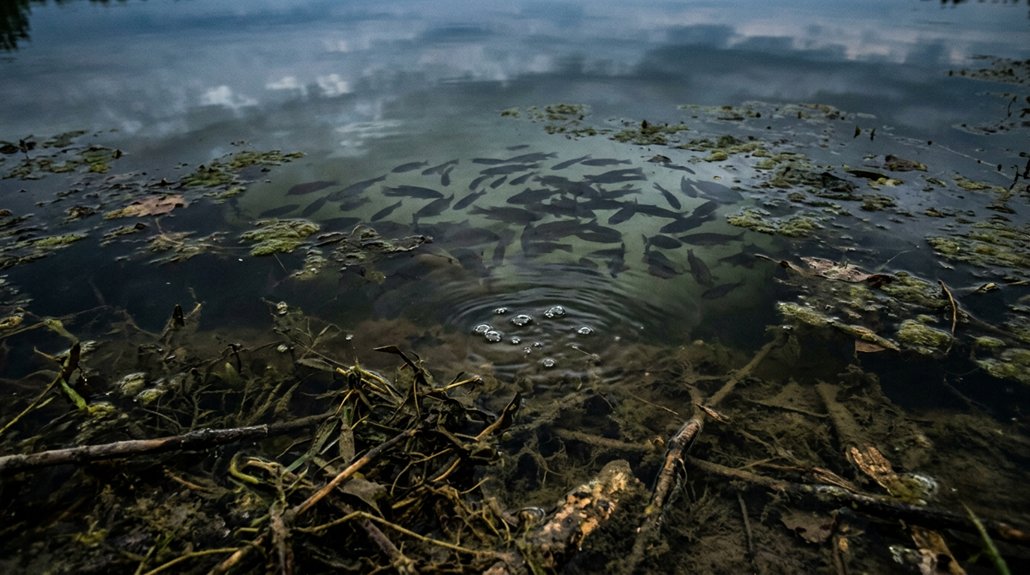
Fish die in low-oxygen water because dissolved oxygen (DO) falls below the level required for respiration, and that deficit can develop quickly in warm, crowded, or biologically active waters. You’re seeing oxygen supply fail against respiratory demand: at 20 °C, fresh water holds only about 9 mg/L, and solubility declines as temperature rises. When DO drops below species thresholds, your fish can’t extract enough oxygen across the gills, and gill collapse may follow as stress intensifies. In eutrophic systems, nighttime respiration and bacterial decomposition can drain DO before dawn. Stratification can trap anoxic bottom water, and turnover can suddenly distribute it through the water column. The result is metabolic suffocation, not poisoning. Point inputs such as sewage, bloom decay, or runoff accelerate the oxygen debt and trigger mass mortality.
Why Low Oxygen Causes Fish Kills First
Low dissolved oxygen is often the first factor to trigger fish kills because it’s the most immediate constraint on aerobic metabolism: fish must extract O2 directly from water, and when DO drops below species-specific thresholds, their tissues are starved before most other stressors become lethal. You’ll see stress first as behavioral hypoxia: fish crowd the surface, ventilate faster, and avoid low-DO zones. As oxygen falls further, gill collapse and reduced diffusion across the lamellae sharply limit uptake. Because water holds only finite O2, even modest microbial respiration, algal decay, or organic loading can push concentrations below the margin of safety. In warm or saline water, that margin’s smaller, so you’ll reach critical hypoxia sooner, and mortality follows when demand exceeds supply, often within minutes to hours.
How Heat, Rain, and Turnover Cut Oxygen
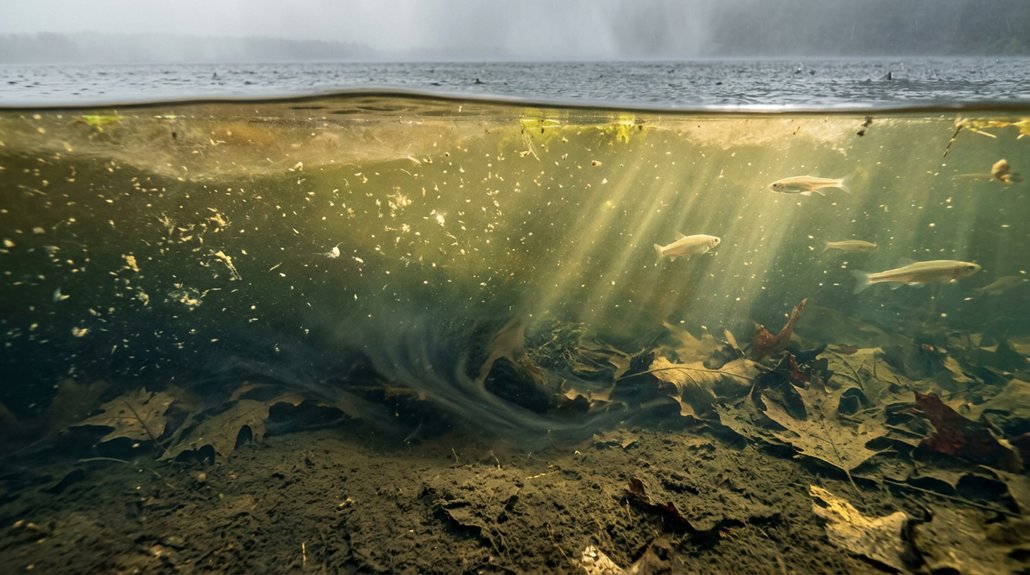
Warm water holds less dissolved oxygen, so when summer heating raises surface temperatures, the oxygen available to fish can fall below their metabolic needs; at about 20 °C, fresh water holds roughly 9 mg/L DO, and that declines by about 1 mg/L for each 10 °C increase. You can also see thermal stratification trap oxygen-poor bottom water, so mixing events matter.
- Wind or heavy rain can trigger turnover dynamics.
- Cold rain can densify the surface and force mixing.
- Deep water may contain anoxic water and hydrogen sulfide.
- Rapid mixing can collapse DO through the whole column.
- Fish can’t compensate fast enough for abrupt hypoxia.
After storms, extra organic matter also increases microbial oxygen demand. Then you may see sudden mortality when the water column re-equilibrates, especially in shallow ponds and lakes.
Algae Blooms, Toxins, and Eutrophication
When you have excess nitrogen and phosphorus from runoff or sewage, phytoplankton can bloom rapidly and then collapse, causing sharp dissolved oxygen loss as bacteria decompose the biomass. Some bloom-forming taxa release hepatotoxins, neurotoxins, or brevetoxins that can directly impair or kill fish. In eutrophic water, you’ll also see strong day–night oxygen swings, with the highest fish-kill risk often occurring before dawn.
Harmful Bloom Toxins
Nutrient enrichment from nitrogen and phosphorus—often delivered by agricultural runoff, sewage, and fertilizers—can drive phytoplankton populations to double in biomass in about 24 hours, creating the conditions for harmful algal blooms. You’re then exposed to species-specific toxins, not just low oxygen.
- *Microcystis* releases hepatotoxins.
- *Anabaena/Aphanizomenon* can produce neurotoxins.
- *Karenia brevis* causes red tides and ichthyotoxins.
- *Pfiesteria* and *Alexandrium* also injure gills and blood.
- Toxin pathways and toxin persistence explain why impacts can continue after cells decline.
These compounds can trigger gill paralysis, bleeding lesions, rapid mortality, and shellfish contamination. You shouldn’t treat blooms abruptly; staggered control, nutrient reduction, and aeration reduce the chance of collapse-driven die-offs and secondary fish kills.
Nutrient-Driven Oxygen Loss
Beyond the direct toxicity of harmful blooms, excess nitrogen and phosphorus can also trigger a separate kill mechanism: eutrophication-driven oxygen loss. You’ll see sewage, fertilizer, and stormwater inputs accelerate phytoplankton growth; biomass can nearly double daily, producing dense blooms. When they collapse, bacteria decompose the cells and consume dissolved oxygen, so nighttime or post-crash DO can fall below 5 mg/L for warm-water fish and below 8 mg/L for cold-water species. Turbidity and shading suppress submerged plants, shifting nutrient spiraling toward detrital processing and raising oxygen demand. Some taxa, including Microcystis and Karenia brevis, add toxins or mucilage that worsen stress. In stratified waters, poor sediment oxygenation intensifies hypoxia, creating dead zones. Cutting nutrient loads and using aeration can prevent fish kills.
Pollution and Toxic Spills
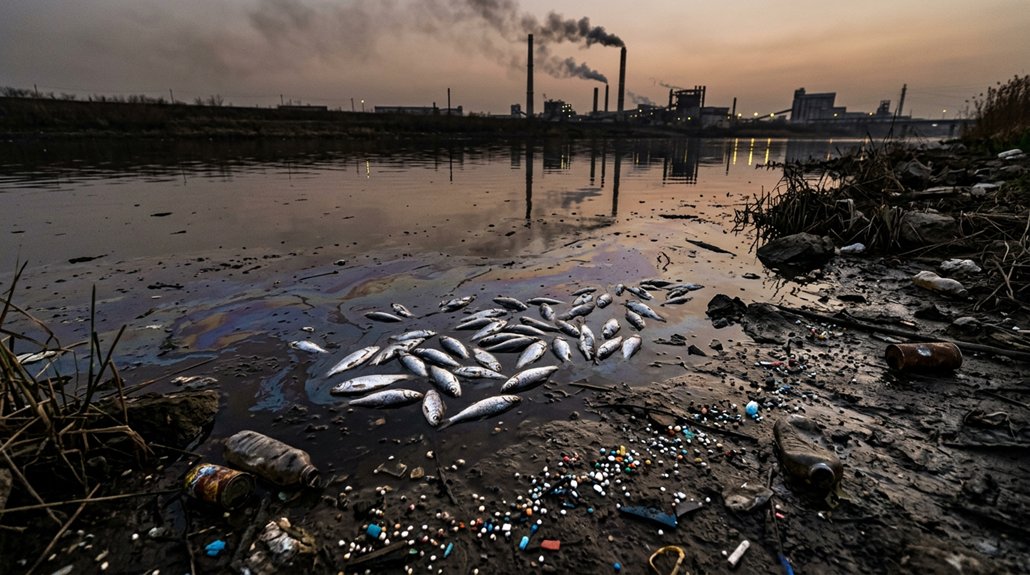
Pollution and toxic spills can kill fish rapidly by introducing contaminants at concentrations that exceed the water’s assimilative capacity. In your system, chemical spills and industrial runoff may deliver pesticides, chlorine, heavy metals, or cyanide that damage gills, disrupt respiration, and cause acute mortality.
- Large organic discharges raise biochemical oxygen demand.
- Bacterial decomposition depletes dissolved oxygen.
- Hypoxia can suffocate fish even without direct toxicity.
- Acid mine drainage can drop pH below 4.
- Low flow reduces dilution, amplifying risk.
You’ll also see characteristic injury patterns, such as cherry-red gills from cyanide or pale, mucilaginous gills from chlorine. Sewage, whey, and hydraulic fracturing wastewater can trigger similar kills by changing chemistry, oxygen, and metal availability.
How to Test and Prevent Fish Kills
To identify and prevent fish kills, you need to monitor water chemistry and oxygen dynamics before fish begin to show stress. Measure dissolved oxygen at dawn and mid-afternoon with a calibrated probe; verify meter calibration routinely, because nighttime lows drive mortality. Test pH, total ammonia, nitrite, and temperature, since higher pH and warmth increase toxic non-ionized ammonia, while nitrite disrupts oxygen transport. Inspect for eutrophication: dense algal blooms, green or brown water, and daytime supersaturation followed by nocturnal crashes. Quantify total phosphorus and nitrate/nitrite to trace nutrient loading. Reduce fertilizer, septic, and runoff inputs, preserve shoreline vegetation, and install alarmed backup aeration sized for summer demand. After a die-off, stop feeding, remove carcasses, aerate or flush, and perform fish sampling if diagnosis remains unclear.
Frequently Asked Questions
What Is the Biggest Cause of Fish Death?
The biggest cause of fish death is oxygen depletion, often worsened by temperature stress. You’ll see hypoxia when warm water holds less oxygen, and decomposition, eutrophication, or stratification can drive lethal dissolved-oxygen crashes.
Why Do Fish Die in Polluted Water?
You’ll see fish die because polluted water can trigger algae blooms, which decompose and cause oxygen depletion. Low dissolved oxygen stresses gills, while toxins, ammonia, nitrite, and pH shifts can’t sustain aquatic respiration.
Can Poor Water Quality Kill Fish?
Yes—poor water quality can kill fish by reducing dissolved oxygen, increasing ammonia or nitrite toxicity, and stressing them with temperature swings or low water hardness. You’ll see gasping, lethargy, then mortality.
Why Are My Fish Dying if the Water Is Good?
Your fish may be dying from hidden stressors like tank cycling failure, temperature shock, low dissolved oxygen, ammonia, nitrite, or pH swings. You can’t judge water by appearance alone; test parameters and stabilize conditions.
Conclusion
You can see it plainly: when water quality collapses, fish die fast, and low oxygen is usually the first killer. Heat, rain-driven runoff, turnover, algae blooms, toxins, and spills can strip dissolved oxygen or poison gills in hours. If you monitor temperature, oxygen, pH, and contaminants, you’ll catch trouble before it becomes a catastrophic fish kill. In aquatic systems, water quality isn’t just important—it’s the invisible switch between life and a silent, floating graveyard.