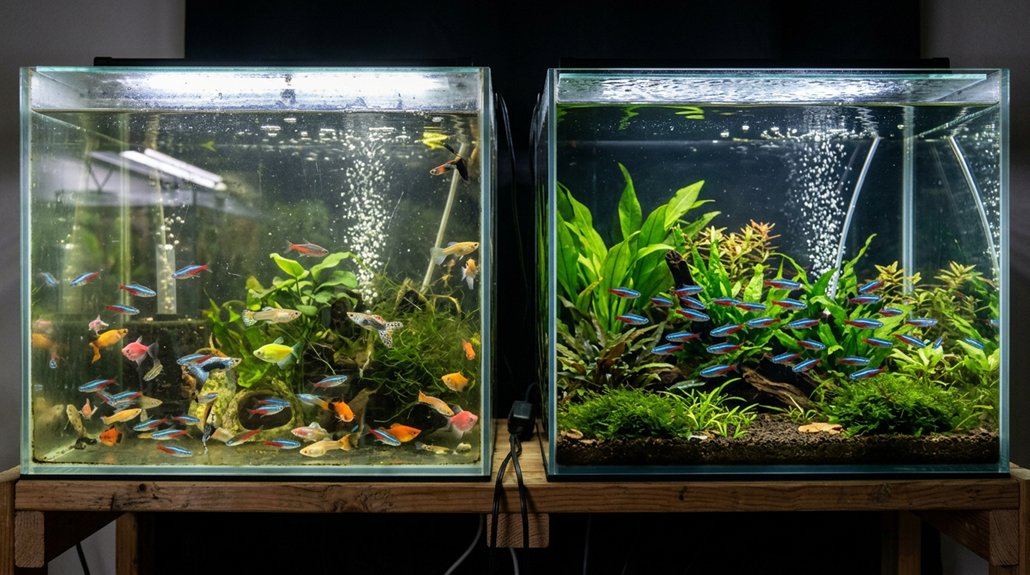
You’ll avoid most fish compatibility problems by matching temperament, adult size, water chemistry, and social needs, not just colors or juveniles. Don’t mix aggressive or territorial fish, like Oscars, African cichlids, or male bettas, with small peaceful schoolers. Keep species in proper groups, and use the adult size, not the baby size, when planning tank space. Match temperature, pH, and hardness closely, add hiding spots, and stock slowly so conflicts stay low and stability can build, with more useful detail ahead.
Key Takeaways
- Don’t mix aggressive territorial fish with small peaceful schoolers; adult temperament matters more than juvenile behavior.
- Match water temperature, pH, and hardness across species; incompatible chemistry causes chronic stress and illness.
- Stock for adult size, swimming space, and bioload, not juvenile size; many fish outgrow small tanks.
- Keep social fish in proper groups and check feeding needs; weak or slow fish can be bullied or eaten.
- Add fish slowly with hiding places, and monitor ammonia, nitrite, and nitrate during cycling and early stocking.
Fish Compatibility Basics
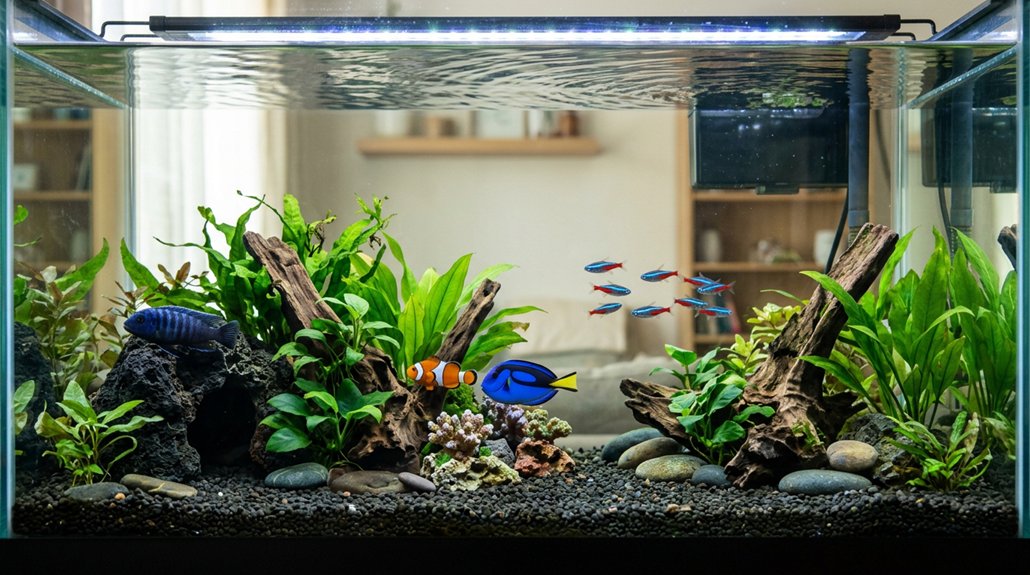
Before you add any fish to the same tank, check whether their temperaments, water needs, adult sizes, diets, and social behaviors actually line up. You’ll get better species compatibility when you compare aggression levels first: territorial or highly aggressive fish can’t safely share space with peaceful schoolers. Next, match temperature and pH ranges; many tropical community species do best around 24–27°C and pH 6.8–7.5, and mismatches can cause chronic stress. You also need to plan for adult size, because active fish outgrow tight setups quickly. Feeding compatibility matters too: specialist herbivores, predators, and generalists don’t always compete fairly. Finally, check whether each species needs a group or prefers solitude, since social structure affects behavior, feeding, and long-term health in captivity.
Avoid Mixing Incompatible Fish
Even a well-planned aquarium can fail if you mix species that don’t belong together, so you need to screen for temperament, water chemistry, size, diet, and social behavior as a single compatibility check. You shouldn’t place territorial fish like Oscars, African cichlids, or male bettas with small, passive schoolers, because juvenile aggression can escalate into injury, starvation, or death. Match temperature and pH closely; Neons and African cichlids, for example, need different ranges. Check feeding habits too, since strict carnivores may treat slow fish as food. Keep social species in proper groups of six or more, or they’ll stress and become targets. Behavioral enrichment helps, but it won’t compensate for a bad pairing.
Match Adult Size and Temperament
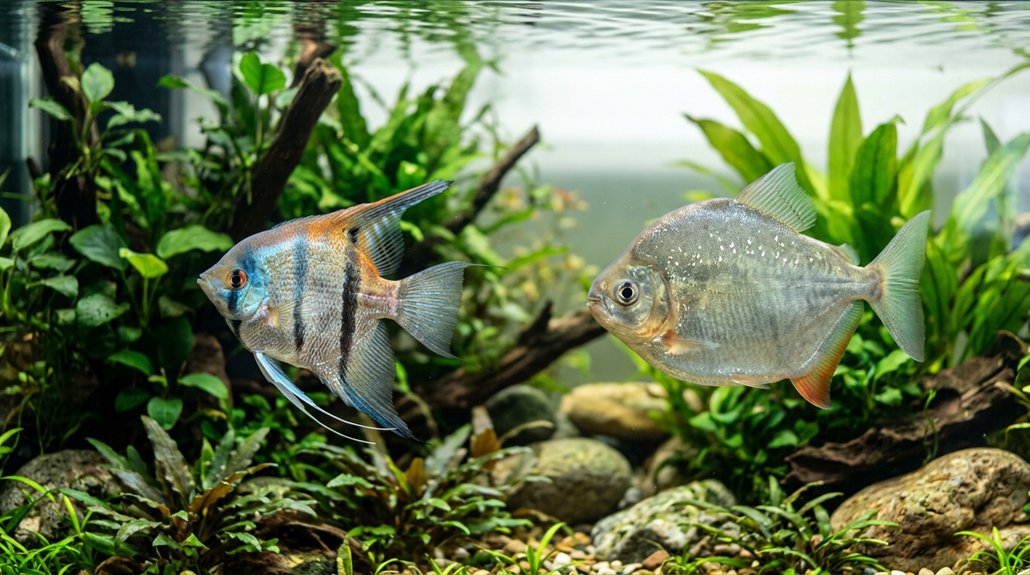
Another compatibility trap is assuming a fish’s juvenile size tells you how it will behave long term; you need to plan around its adult size and temperament, not its current one. You should research adult behavior before buying, because a common pleco may grow 30–60 cm and outpace a small tank quickly. In long term planning, pair only species whose temperaments stay compatible at maturity; territorial or semi-aggressive fish, such as many African cichlids, often become more assertive and can intimidate peaceful schoolers. Use adult-length space rules, starting around 60 litres minimum and scaling up with size and activity. Also consider whether fish occupy the surface, midwater, or bottom, since overlapping niches can trigger feeding competition and conflict. When unsure, choose the largest expected adult size or keep conspecific groups.
Get Water Conditions and Tank Size Right
Tank size and water chemistry have to match the fish you’re actually keeping, not just the ones you like the look of. You need to check adult length, not juvenile size: a 30 cm Silver Shark or Common Pleco can’t live properly in a small aquarium. Use the stocking guideline as a starting point, then adjust for bioload, activity, and body size. Keep temperature ranges stable and species-appropriate; many community fish do best at 22–27°C, while discus need 28–31°C. Also match pH and hardness across all inhabitants: soft, slightly acidic water suits many tetras and rasboras, whereas African cichlids need harder, alkaline conditions. Finally, size the tank for swimming zones, because schooling fish need horizontal space and bottom dwellers need enough substrate area to occupy.
Add Hiding Places and Stock Slowly
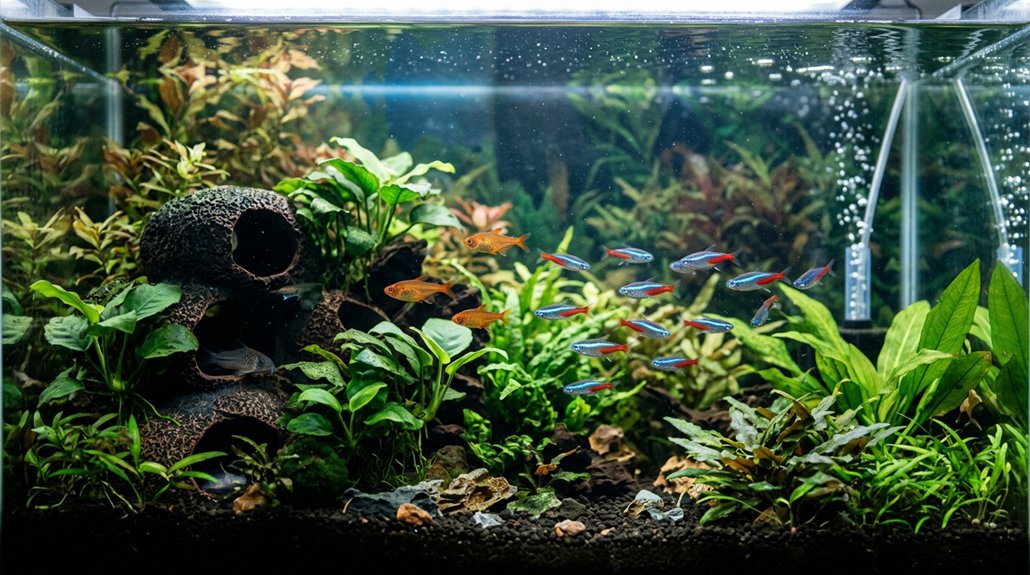
Adding cover is one of the simplest ways to reduce compatibility problems: give each shy or territorial species multiple retreats, such as caves, dense plants, and rockwork, so there’s at least one hiding place for every 2–3 fish of the same species. Stock slowly, adding no more than 10–20% of your final bioload each week, so territorial hierarchies and beneficial bacteria can adjust. Introduce peaceful schooling fish first, then mid-level dwellers, then territorial or bottom species. During early weeks, test ammonia, nitrite, and nitrate daily; keep ammonia and nitrite at 0 ppm and nitrate under 40 ppm.
- A cave-shadowed cichlid.
- A planted corridor for a tetra school.
- A dim corner for nocturnal activity and breeding behavior.
Frequently Asked Questions
What Are the 4 Fish to Avoid?
You should avoid Oscars, Common Plecos, male Bettas, and African Cichlids; they’re aggressive species or territorial cichlids, too large, too messy, or too combative for typical community tanks and balanced filtration.
What Fish Not to Put Together?
You shouldn’t put Oscars, big cichlids, or gouramis with neon tetras, bettas, or other small fish; don’t mix tiger barbs with long-finned species, and avoid aggressive feeders and temperature mismatches.
What Mistakes Do Beginner Fish Owners Make?
You might overcrowd your tank, mismatch species, ignore adult size, and keep fish in incompatible water. You’ll also often make overfeeding juveniles and improper quarantine mistakes, which raise stress, disease, aggression, and mortality.
What Fish Cannot Be in the Same Tank Together?
You can’t keep aggressive cichlids, territorial gouramis, two male bettas, or large predatory fish with tiny schooling species; you’ll also need matching temperatures and water chemistry, or you’ll stress, injure, or kill tankmates.
Conclusion
When you plan your tank, you avoid most compatibility problems by checking adult size, temperament, water needs, and available space before you buy. For example, if you place a betta with fin-nipping tetras in a small tank, you may trigger stress, injury, and aggression. If you add fish slowly and include hiding places, you’ll give each species a better chance to settle in safely and reduce conflict over time.