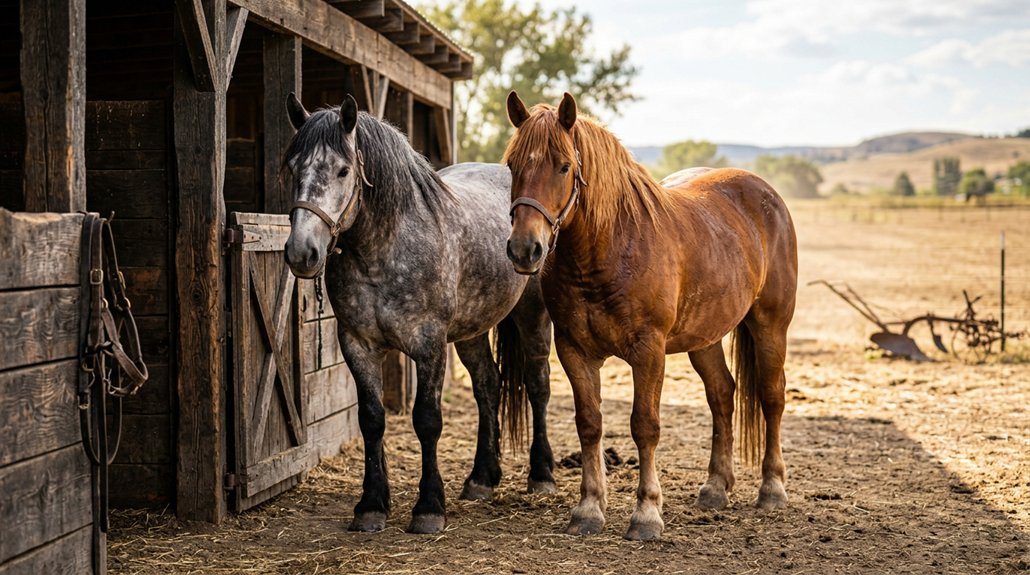
You’re exploring draft horse breeds like Clydesdales, Shires, and Belgian Drafts, known for their robust musculature and impressive draught capacity, suited for plowing and transport. The Suffolk Punch and Percheron offer versatility, efficient work ethics, and adaptability to both traditional and modern activities such as sustainable logging. With traits like calm demeanors and environmental benefits, these breeds are invaluable to farm life. There’s much more about their pivotal roles in agriculture and equine pursuits to uncover.
Key Takeaways
- Draft horse breeds, like Clydesdale and Belgian Draft, are renowned for their significant strength and robust musculature for demanding agricultural tasks.
- Shire horses excel in pulling heavy loads, with a draught capacity over twice their body weight, making them ideal for farm work.
- Suffolk Punch horses are efficient workhorses with a strong yet compact build, requiring less feed compared to other draft breeds.
- Belgian Draft horses, with their immense strength, have been historically critical in agriculture and are modern eco-friendly alternatives to mechanization.
- Percheron horses combine agility and power, excelling in both heavy farm work and various equine disciplines, reflecting their historical importance in the US.
Overview of Draft Horse Breeds and Their Vital Role
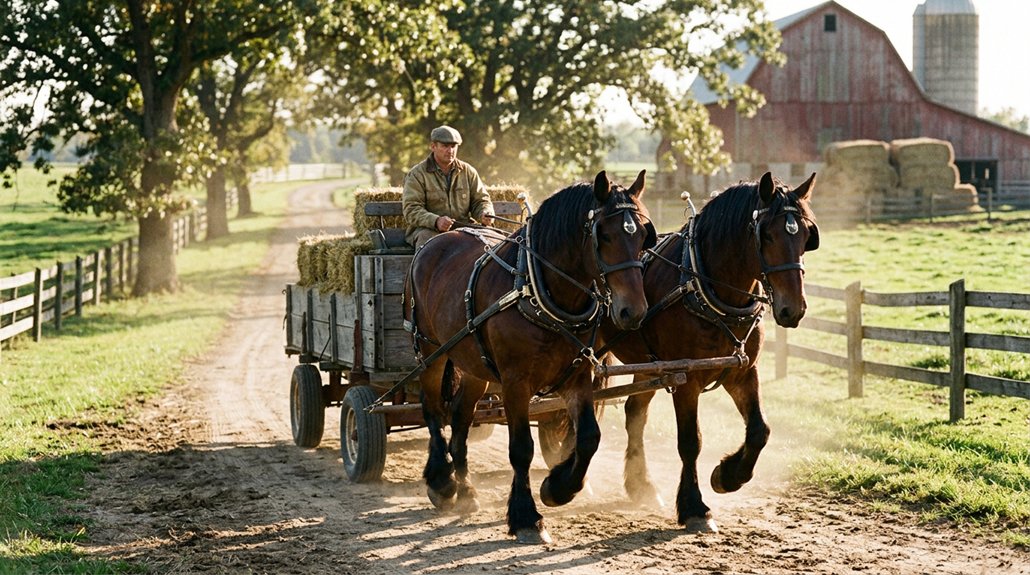
Although mechanization has revolutionized agriculture, draft horse breeds continue to hold an essential role in various sectors. These equine giants, ranging from 16 to 19 hands and weighing up to 2,000 lbs, are exemplars of draft horse characteristics—with robust musculature ideal for demanding agricultural tasks. Historical utilization in plowing and load-pulling markedly enhanced agricultural productivity, a legacy still evident in specific operations today. Key breeds like the Clydesdale, Belgian Draft, and those under conservation efforts such as Suffolk Punch and Irish Draught, embody unique traits—striking appearances and powerful, calm dispositions enable their adaptability. Their versatility extends to modern activities, like sustainable logging and equine exhibitions, affirming their indispensable contribution both past and present.
Shire Horse: Iconic Strength From England
As you explore the Shire Horse’s exceptional pulling strength, you’ll discover its pivotal role in historical farm work and transportation, embodying an unparalleled draught capacity. Anchored deeply in English cultural heritage, this breed’s resilience saw a remarkable revival since the 1970s, maintaining its status as both a functional powerhouse and a celebrated show horse with distinguished feathering. Appreciate its persistent success in modern equestrian disciplines, where the Shire’s calm demeanor and robust stature continue to underline its historical and contemporary importance.
Exceptional Pulling Strength
With roots deeply embedded in England’s agricultural and industrial heritage, the Shire Horse exemplifies exceptional pulling strength, setting a standard in the domain of draft horses. This breed’s powerful genetics come into play, enabling each horse to pull loads exceeding twice its body weight, an indication of its unparalleled force and capability. Standing at an imposing 17.2 hands (178 cm), their sheer size contributes to a formidable musculature and heavy bone structure optimized for draft applications. For the adept owner, mastering advanced pulling techniques can further harness a Shire’s capacity, maximizing efficiency in tasks like road haulage and barge towing. The breed’s versatility stems from its intrinsic strength and physical architecture, making it indispensable for intensive agricultural labor.
Historical and Cultural Significance
The Shire Horse, a paragon of strength, is deeply embedded in England’s agricultural and cultural history. With its towering stature, typically reaching 17.2 hands, and its unparalleled pulling power, the Shire Horse has been essential in farm work, road haulage, and barge towing. Historically indispensable, these equine giants contributed greatly to England’s agrarian and transport sectors, and their enduring presence is a reflection of their cultural legacy. You’ll recognize the Shire’s calm demeanor, making it a cherished participant in agricultural shows and parades, embodying rural symbolism. Despite the mechanization shift, the 1970s revival highlights their role as cultural icons, representing the enduring legacy and contributions of draft horses to England’s countryside ethos and heritage.
Revival and Modern Use
When envisioning the resurgence of the Shire Horse, you can’t overlook its shift from agrarian powerhouse to contemporary multifaceted roles. This iconic breed, once integral to traditional farming and heavy haulage, has seen a revival driven by breed conservation efforts since the 1970s. As a specialist in agricultural innovation, the Shire Horse integrates seamlessly into modern farming by offering sustainable alternatives. Their docile temperament and impressive stature—standing at roughly 17.2 hands—make them ideal for competitive exhibitions, parades, and diverse roles extending beyond traditional agriculture tasks. Significantly, Shire Horses contribute to environmentally friendly practices by minimizing soil compaction compared to machinery. They embody strength, reliability, and a tribute to England’s agricultural heritage, maintaining relevance across time.
Efficient Suffolk Punches: A Conservation Focus
Amid the resurgence of interest sparked since the 1970s, Suffolk Punch horses possess a singular efficiency that’s essential for their conservation as an integral part of England’s agricultural legacy. Known for their Suffolk characteristics, these equines boast a stocky build and a distinctive chestnut hue, measuring between 16.2 to 17.2 hands. Their efficient work ethic requires less feed than other draft breeds, making them unparalleled partners in agricultural labor.
Conservation strategies are imperative given their critically endangered status, highlighted by the UK Rare Breeds Survival Trust. Here’s why you should care:
- Only about 300 breeding females remain, stressing urgent action.
- Their good temperament makes them appealing for familial farm life.
- They’re symbolic stewards of cultural and agricultural heritage.
Clydesdale: From Fields to Parades
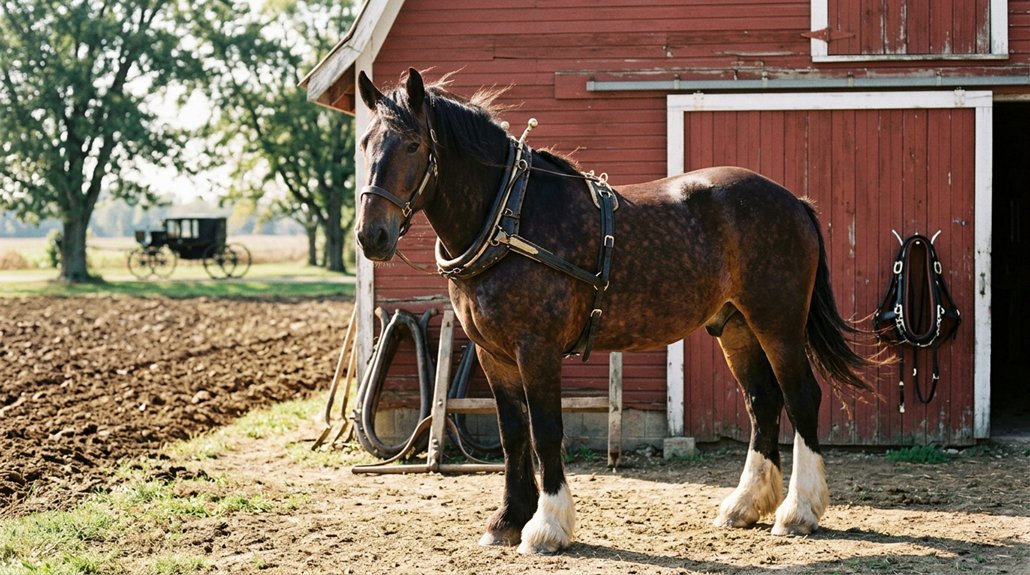
Though Suffolk Punches play a pivotal role in England’s farming heritage, Clydesdales bring a different blend of strength and grace to Scotland’s equine narrative. Standing 16 to 18 hands high, these horses are renowned for their imposing stature and distinctive markings—bay coat and signature white leg feathering. Initially bred for formidable draft work, their role encompassed agricultural duties and goods transport. However, as mechanization surged by the 1970s, Clydesdale history faced decline, prompting concerted conservation efforts. Nowadays, these majestic creatures are the pride of Anheuser-Busch’s iconic parades and campaigns, embodying both elegance and power. Clydesdale care requires attentive management to maintain their grand presence in competitions and exhibitions, spotlighting their enduring legacy in the modern equine domain.
Belgian Drafts: Robust Partners in Modern Farming
You’ll appreciate the Belgian Draft’s exceptional strength capabilities, which have roots in their genetic lineage, enabling them to stand amongst the most powerful equine breeds at a towering 16 to 18 hands. Their historical farming heritage dates back to their significant roles during World War I, setting the foundation for their modern agricultural contributions in plowing, hauling, and other heavy-duty tasks. With their tranquil temperament and steadfast work ethic, these chestnut giants are indispensable assets on both small family farms and expansive agritourism ventures.
Exceptional Strength Capabilities
Belgian Draft horses, often regarded as colossal powerhouses, showcase exceptional strength, making them invaluable assets in modern farming practices. Their formidable weight capacity allows them to pull over twice their ton-sized mass, perfect for labor-intensive agricultural tasks. This breed isn’t just muscle; it’s a balanced mix of brawn and endurance. Subjected to rigorous endurance testing, Belgian Drafts prove their reliability in sustaining prolonged exertion without faltering, an essential attribute in modern farming scenarios.
Here’s what makes them special:
- Peak Pulling Power: Capable of extraordinary draft work, they excel in tasks that demand substantial exertion.
- Steady Stamina: Their endurance testing results reveal unwavering performance over extended periods.
- Adaptability: With their calm demeanor and robust physiology, they’re ideal for sustainable farming practices, minimizing environmental impact compared to machinery.
Historical Farming Heritage
In exploring the historical farming heritage, it’s crucial to acknowledge the enduring role Belgian Draft horses have played as robust partners in agriculture. Originating from the Middle Ages, these equine powerhouses, typically measuring 16 to 18 hands and weighing a ton, have been stalwarts in tilling and plowing. Their unparalleled strength and calm demeanor allowed them to thrive in pre-mechanized farm environments, supporting heritage preservation and agricultural evolution.
During World War I, Belgian Drafts emerged as invaluable allies in transportation and labor, addressing labor shortages while maintaining productivity. Despite the dawn of modernization reducing their numbers, their capacity for handling heavy loads and working in arduous conditions keeps them relevant, safeguarding a sustainable connection to historical farming practices.
Modern Agricultural Contributions
A quintessential facet of modern agriculture is the indispensable contribution of Belgian Draft horses, a breed renowned for pulling capabilities and agronomic versatility. Their robust stature and capacity to pull over twice their weight make them ideal for sustainable practices, offering an efficient, eco-friendly alternative to mechanized equipment. Benefiting from their calm demeanor and adaptability, Belgian Drafts excel in diverse farming environments while supporting horse welfare.
Here’s how Belgian Drafts contribute to contemporary farming:
- Heavy Load Transportation: Their ability to manage substantial weight is unmatched, essential for both plowing and goods transport.
- Plowing and Tilling: Their strength provides direct tillage, reducing reliance on diesel-powered machinery.
- Soil Preservation: Their lighter footprint on farmland preserves soil structure, supporting sustainable agriculture.
Incorporating Belgian Drafts maintains tradition while promoting forward-thinking practices.
Percheron Horses: Versatility in Work and Show
Though originating from the Huisne river valley in France, Percheron horses have emerged as paragons of versatility, excelling in both work and show settings. Their formidable Percheron lineage, rooted in strength and adaptability, is evident in their sizeable frame, standing between 15.1 and 18.1 hands tall and weighing up to 2,000 lbs. Initially bred as war horses, these draft horses possess physical robustness and nimble agility, enabling them to adeptly perform heavy farm tasks and excel in equine disciplines. The versatility factors of the Percheron manifest in their capacity to thrive in pulling competitions and exhibit as show horses. Dominating the draft horse scene in the US pre-WWII, they boasted nearly 70% of the population, cementing their place as invaluable workhorses.
Frequently Asked Questions
What Is the Best Horse for Farm Work and Riding?
The Irish Draught offers unrivaled farm versatility and riding comfort. Its docile temperament supports various tasks seamlessly. If you’re seeking a breed combining strength, adaptability, and reliable performance, this horse shines in both work and riding disciplines.
What Is a Heavy Equine Used for Farm Work?
Imagine an equine Titan that embodies Herculean strength and grace—a draft horse. You’re looking at nature’s tractor, perfect for heavy farm tasks. These labor horses excel in equine strength, bred specifically to conquer the demanding rigors of agriculture.
What Is the Strongest Workhorse?
Among workhorses, the Shire stands out as the strongest due to its massive frame and historic usage in agriculture. It excels with remarkable pulling power and size, epitomizing draft horse history and workhorse characteristics effectively.
Which Horse Breed Is Most Powerful?
You’ll find that the Shire Horse, with its colossal stature and unparalleled pulling ability, tops the list of powerful drafts. However, versatile breeds like Belgians and Percherons offer exceptional strength combined with endurance, fitting varied agricultural needs effectively.
Conclusion
In the arena of agricultural efficiency, draft horse breeds like Shire, Suffolk Punch, Clydesdale, Belgian Draft, and Percheron are ironically both relics and renaissance figures. These living, breathing tractors—often more reliable than modern machinery—exemplify true horsepower. With genetic linchpins rooted in centuries, their muscular anatomy and workload tolerance make them the farmer’s quiet giants. Yet, as technology gallops ahead, it’s paradoxical that these quintessentially traditional horses might just be the sustainable future of farming efficiency.