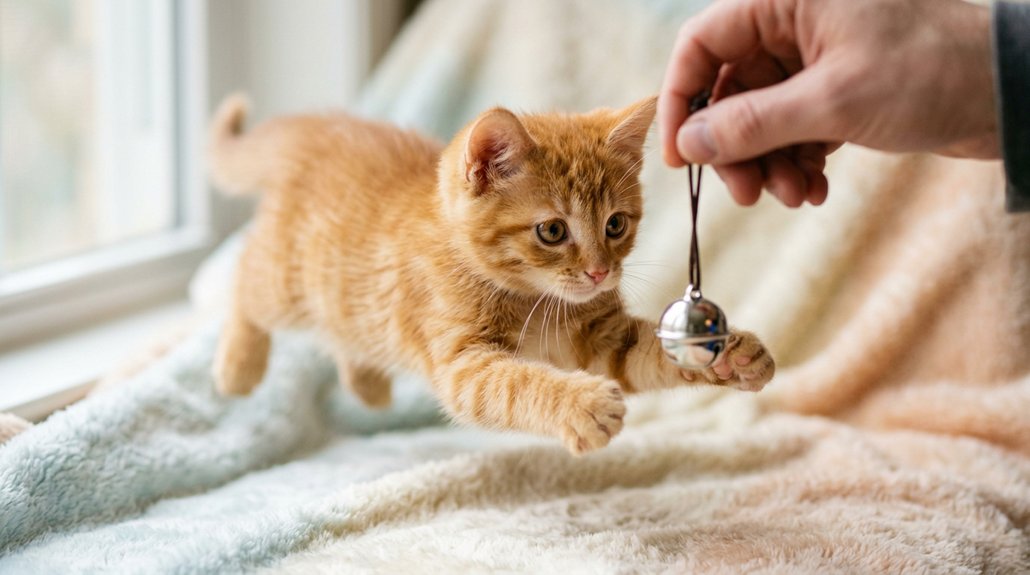
To use positive reinforcement with kittens, observe their motivations and tailor rewards like treats or play to reinforce desirable behaviors. Create a distraction-free training environment and schedule sessions before meals for maximum receptiveness. Keep training sessions brief, ideally between 5 to 15 minutes, and consistently reward achievements to strengthen the bond and promote learning. Avoid punitive measures to maintain trust. There’s much more to explore about enhancing training and fostering a supportive learning experience for your kitten.
Key Takeaways
- Observe kitten behavior to identify preferred treats and toys as positive reinforcement rewards.
- Conduct training sessions in a quiet, familiar setting with minimal distractions.
- Schedule short training sessions before mealtimes for increased focus and receptivity.
- Use treats and playtime to reward and encourage calm behaviors, building trust and confidence.
- Avoid punishments; consistently use positive reinforcement to strengthen desirable behaviors and the bond with the kitten.
Why and How to Use Positive Reinforcement for Kittens First
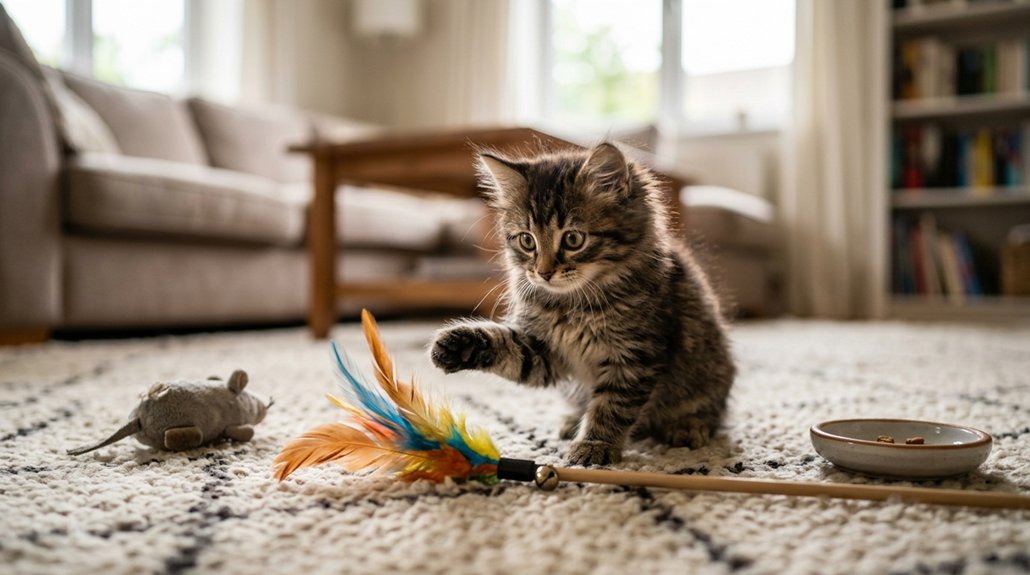
Although training a kitten might seem challenging, integrating positive reinforcement into your routine fosters beneficial behaviors and strengthens the human-feline bond. Understanding kitten behavior allows you to strategically apply rewards, ensuring they connect the dots between action and satisfaction
Identify What Motivates Your Kitten
Understanding what motivates your kitten is essential for effective positive reinforcement training. Start by observing your kitten’s interactions with different types of stimuli, including foods, toys, and social engagement, to determine which factors elicit the most enthusiasm. By identifying these preferences, you can select ideal rewards that enhance learning and strengthen the human-animal bond.
Discover Kitten Preferences
How can you uncover what truly captivates your kitten’s interest? Begin by diligently observing your kitten’s interactions with various stimuli. Noticing which activities light up their eyes is essential for identifying kitten interests effectively. Some kittens are driven by delectable treats, while others may perk up with engaging toys or gentle strokes. It’s important to gauge their affinities accurately, as specific rewards can vary in efficacy depending on their preferences. Utilize reward variety by experimenting with different incentives to enhance motivational dynamics. This strategy not only sustains your kitten’s engagement but also refines your approach to positive reinforcement. An evidence-based understanding of their inclinations guarantees successful training sessions tailored to foster the best behavioral outcomes and secure your kitten’s enthusiastic cooperation.
Determine Ideal Rewards
Pinpointing the ideal rewards for your kitten is crucial to effective training. Start by observing your kitten’s reactions to different stimuli, such as treat types, toys, and affection, with an analytical focus on what elicits a positive response. Many kittens are food-motivated, so consider small, soft treats as they enhance training reinforcement. If your feline companion exhibits low food interest, pivot to alternative rewards like interactive play with wand toys or gentle petting sessions. It’s important to experiment with reward variety to identify those most engaging; preferences are highly individualized. Regularly rotate rewards to sustain attention and motivation, optimizing the behavioral conditioning process. Implementing evidence-driven strategies will pave the way for more successful and harmonious training sessions with your kitten.
Create the Perfect Training Space
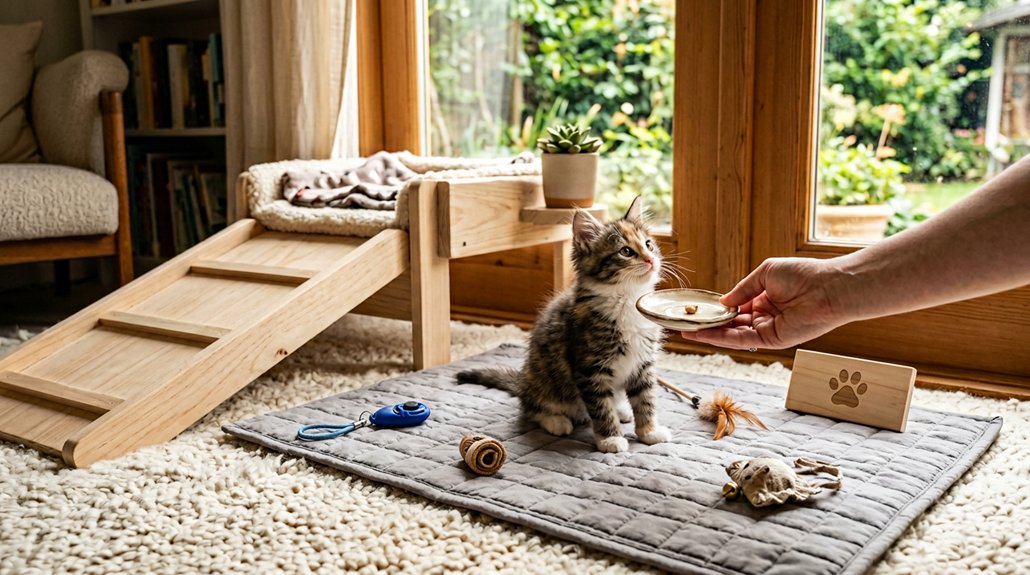
Designing an ideal training space for kittens involves creating an environment that’s both calming and engaging. Begin with a quiet, familiar training environment to promote distraction reduction and help kittens focus. Position this space in a small, contained area to control sensory exploration safely. Incorporate various textured surfaces—carpet, tile, or sisal—encouraging tactile engagement and stimulating the kitten’s curiosity. Prioritize comfort factors by ensuring soft bedding and access to water and toys, making the space inviting and motivating for participation.
Arrange the area to maintain clear visibility between you and your kitten, which is essential for timely positive reinforcement. Such a thoughtfully designed space not only minimizes stress but also optimizes the kitten’s responsiveness to training strategies, setting the stage for effective behavioral development.
Train Your Kitten at the Right Times
To effectively train your kitten, focus on sessions before mealtimes, as this is when they’re most motivated and receptive to learning. Keep sessions concise, ideally between 5 and 15 minutes, to align with their attention span and maximize engagement. Consistency is essential; multiple brief sessions per day reinforce learning and maintain your kitten’s interest.
Optimal Training Session Duration
When considering how to effectively train your kitten, it’s vital to optimize both the duration and timing of training sessions. Keeping the session length under 15 minutes caters to a kitten’s limited attention span, ensuring they remain engaged and responsive. Short, focused training sessions prevent cognitive overload, fostering a more efficient learning environment. Implement multiple brief sessions throughout the day rather than one lengthy session to reinforce behavioral retention.
A distraction-free setting is fundamental during these periods, enhancing your kitten’s ability to concentrate. Additionally, gradually escalating task complexity supports cognitive development while minimizing frustration. Allow your kitten to master basic commands before progressing to advanced skills. Such a structured approach maximizes training efficacy and sustains the kitten’s enthusiasm for learning.
Identifying Peak Motivation Times
Understanding when your kitten is most receptive to training can dramatically enhance the success of your efforts. Identifying peak motivation times involves observing your kitten’s energy levels. Typically, kittens exhibit increased activity in the early morning and late evening, making these ideal periods for training. Plan training sessions just before meal times; this capitalizes on their food motivation and bolsters positive reactions to treats. Limiting training time to 5 to 15 minutes during these intervals guarantees sustained focus and effectiveness. By consistently engaging your kitten during these high-energy moments, you create a rewarding and stimulating learning environment. This approach aids in associating training with enjoyment and promotes better learning outcomes, ultimately fostering a stronger bond between you and your kitten.
Help Your Kitten Make Friends With Rewards
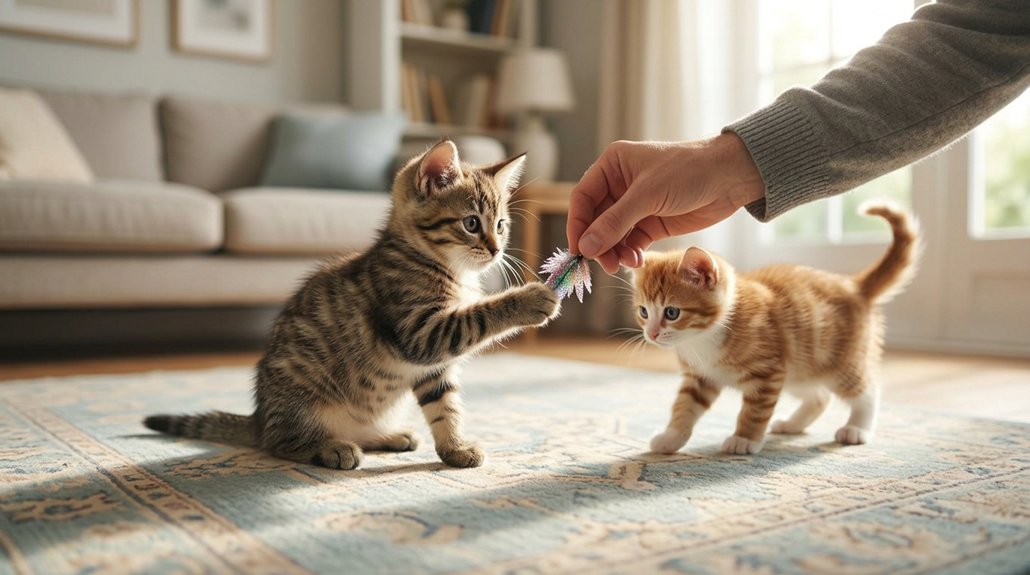
As you begin the journey to facilitate your kitten’s social development, employing positive reinforcement can greatly enhance their interactions with others. By using small, enticing treats as rewards, you create positive associations with social interaction, aiding your kitten in building confidence and reducing fear. Here are three strategies to support your kitten’s socialization:
- Introduce Gradual Experiences: Reward calm behavior with treats to promote adaptability as your kitten explores new environments.
- Facilitate Playful Engagement: Use interactive toys during short social sessions, rewarding enthusiastic participation with praise for reinforcing positive social behavior.
- Encourage Friendly Behavior: Consistently reward gentle sniffing or playfulness with affectionate reinforcement to help your kitten establish positive relationships and enhance their social skills.
These methods will promote your kitten’s adaptability and comfort around others.
Teach Basic Commands With Positive Reinforcement
Maintaining a consistent approach to positive reinforcement can extend beyond socialization into training basic commands, enhancing your kitten’s development. Start with foundational commands like “sit” and “come,” using small treats as immediate rewards to encourage correct execution. Engage in short 5-15 minute training sessions to accommodate their attention span. Employ a clicker to mark the precise moment your kitten performs the desired action, fostering a strong association between behavior and reward. Consistency across family members is critical to prevent confusion.
| Training Technique | Purpose | Duration |
|---|---|---|
| Treat Rewards | Reinforcing Behavior | Immediate |
| Short Sessions | Retaining Interest | 5-15 Minutes |
| Clicker Use | Behavior Recognition | Instantaneous |
Gradually introduce advanced commands and training games. Prioritize positive experiences to build trust and guarantee your kitten’s comfort.
How to Avoid Negative Training Effects
To effectively avoid negative training effects, it’s essential to implement consistent reward-based strategies that reinforce desired behaviors in your kitten. Avoid punitive measures, as they can induce fear and anxiety, leading to behavioral issues and eroding trust. By gradually building a partnership rooted in positive reinforcement, you’ll create a secure and trusting training environment that promotes healthy development.
Consistent Reward-Based Strategies
Successfully implementing consistent reward-based strategies with kittens hinges on the immediate reinforcement of desired behaviors. Consistent training methods are crucial to foster a secure learning environment. When practice revolves around positive behavior reinforcement, it consolidates the kitten’s understanding and encourages repeated desirable actions.
- Immediate Rewards: Once your kitten successfully performs the desired behavior, promptly reward them with a preferred treat or affection to establish a strong association.
- Diverse Motivators: Utilize varied incentives like treats, playtime, or affection to maintain engagement and motivation, guaranteeing each session captures their interest.
- Uniform Techniques: Make sure everyone in your household adheres to consistent methods, using clear, uniform cues and rewards to eliminate contradictions and enhance behavioral learning.
Consistent reinforcement without immediate negative actions cultivates a trust-based training atmosphere.
Avoid Punitive Measures
Building upon consistent reward-based strategies, it’s important to understand the impact of training methods that rely on punishment. Punitive measures like yelling, hitting, or shaking don’t simply undermine your efforts; they actively foster fear and anxiety. Instead, focus on punishment alternatives that emphasize positive reinforcement techniques. Kittens don’t understand delayed punishment, which only creates confusion and hinders effective behavioral correction.
| Approach | Effect | Outcome |
|---|---|---|
| Yelling or Hitting | Fear and Aggression | Anxiety and Mistreatment |
| Positive Reinforcement | Encouragement | Responsive Behavior |
| Delayed Punishment | Confusion | Ineffective Training |
| Redirecting Behavior | Learning Enhancement | Fear Reduction |
| Building Trust | Trusting Environment | Healthier Bond |
A trusting relationship promotes a happier, more engaged, and responsive kitten.
Build Trust Gradually
While establishing trust with kittens is essential for effective training, it’s important to introduce new experiences and stimuli gradually to mitigate fear and anxiety. Observing kitten body language, such as a tense posture or dilated pupils, can inform you when to adjust their exposure rate. Employ a supportive training method by reinforcing calm behavior immediately with treats or praise to associate positive experiences with their environment.
- Gradual Exposure: Allow kittens to explore freely and at their own pace to reduce the risk of avoidance behaviors, which can weaken the bond between you and your kitten.
- Gentle Handling: Use gentle handling to promote comfort and create a safe environment.
- Monitor Stress: Keep an eye on stress indicators and alter your approach accordingly to foster trust and effective learning.
Avoid These Common Kitten Training Pitfalls
Although kitten training is an important component of their development, several pitfalls may hinder the process if not carefully avoided. Effective socialization strategies demand steering clear of punishment-based methods, which create fear, anxiety, and damaged trust—counterproductive in fostering a cooperative learning environment. Training mistakes like forcing kittens into overwhelming situations can provoke negative associations and avoidance behaviors, undermining positive reinforcement’s intent. Additionally, rewarding undesired actions like begging or excessive meowing inadvertently reinforces these behaviors, making them persistent challenges. Keep training sessions under 15 minutes to suit kittens’ short attention spans, avoiding frustration and maximizing engagement. Consistency in cues and rewards among family members is essential; mixed signals impede learning, illustrating how nuanced understanding is critical for successful kitten training.
How to Build on Your Kitten’s Successes
To effectively build on your kitten’s successes, consider reinforcing positive behavior immediately to strengthen the association between the action and the reward. Achieving consistent success tracking allows you to monitor growth and adjust reward strategies accordingly. Confidence building is essential; by gradually increasing the complexity of tasks, you enable your kitten to thrive and learn new skills.
Reinforce positive actions instantly to build strong associations and track growth through consistent success.
Here’s how to enhance your kitten’s training regime:
- Gradual Complexity Adjustment: Incrementally increase task difficulty as your kitten masters simpler commands, ensuring a balance between challenge and ability.
- Variety of Rewards: Utilize different motivators such as treats, playtime, or praise to keep the stimulus exciting and reinforce good behavior.
- Frequent Recognition: Keep sessions short (5-15 minutes). Recognize achievements regularly to sustain interest and foster a strong bond.
Assess and Adapt Your Training Techniques
Understanding the need to assess and adapt your training techniques is essential for effective kitten development. Evaluate the kitten’s unique motivators—food, play, or affection—and tailor your training methods accordingly. Adaptation techniques are significant; gradually heighten task complexity to keep training engaging. By building on mastered skills, you prevent frustration. Keep sessions brief, under 15 minutes, respecting the kitten’s attention span. Consistency in cues and signals aids in associating behaviors with rewards.
| Aspect | Strategy |
|---|---|
| Motivation | Customize to kitten’s preference |
| Task Complexity | Increase gradually |
| Session Duration | Less than 15 minutes |
| Command Consistency | Use consistent cues and signals |
| Environment | Minimize distractions |
Regularly alter training environments to decrease distractions, enhancing learning focus. This strategic approach optimizes positive reinforcement.
Frequently Asked Questions
How to Do Positive Reinforcement for Kittens?
Enhance kitten training with clicker training and treat rewards. Use playful interactions for better engagement. Socialization tips, like exposure to diverse environments, guarantee development. Stick to evidence-based practices for effective learning. Keep sessions brief yet focused.
What Is the 3-3-3 Rule for Kittens?
The 3-3-3 rule for kittens outlines the adaptation process in three phases: initial stress and fear, progressive socialization within weeks, and established confidence and bonding by months. Employ evidence-based socialization techniques to support each phase effectively.
How Do I Say “I Love You” in Cat Language?
Communicate “I love you” by using slow blinks, mimicking feline vocalizations like purring, and responding to responsive kitten body language. Engage through gentle touch, respect their space, and offer a nurturing environment to deepen your bond.
What Age Are Cats Most Rebellious?
Cats are most rebellious during adolescence, typically between 6 months and 2 years. During this period, adolescent behavior influenced by hormonal changes and feline instincts, such as increased territoriality and energy, may challenge your management strategies.
Conclusion
In the enchanting domain of kitten training, let positive reinforcement be your guiding star. Like crafting a masterpiece, observe your kitten’s motivations, creating a seamless dance of reward-based learning. As Pavlov’s research echoes, timing is essential—catch every moment of progress. Sidestep pitfalls by ensuring consistent reinforcement and avoid the shadows of negative effects. With each small success, build a solid foundation, adapting strategies to your kitten’s growth, ensuring a rewarding journey for both trainer and feline.