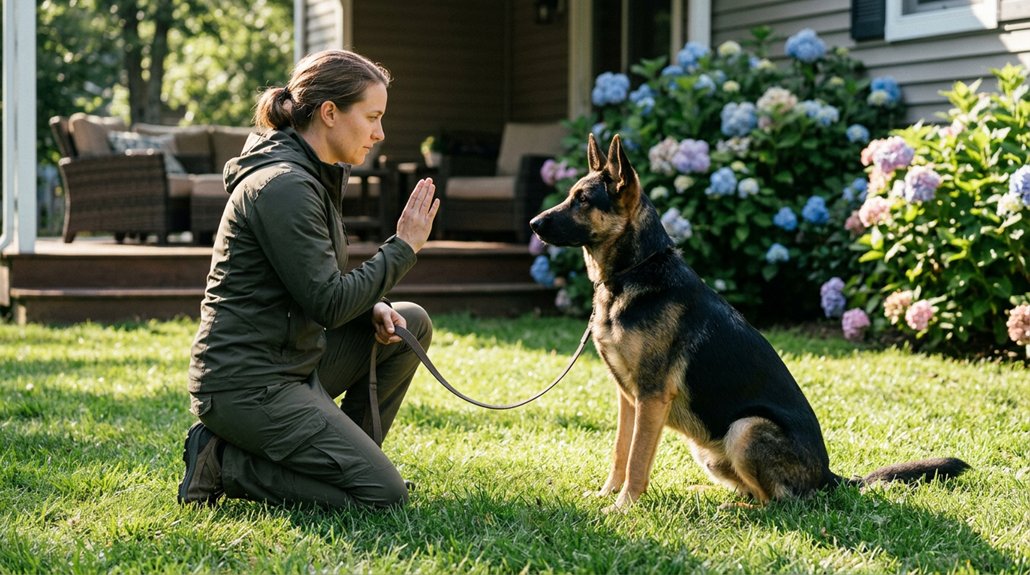
When your dog won’t listen, start by maintaining clear, consistent commands and using their name for focus. Unified command vocabulary among family members is essential. Employ positive reinforcement with immediate rewards to encourage obedience. Consider their emotional state, as fear or anxiety can impact responsiveness. Gradually expose them to identified distractions to improve focus. Ascertain training occurs in a distraction-free environment. Following these strategies will boost your dog’s listening skills and enhance your training success even further.
Key Takeaways
- Use consistent commands and clear language; ensure all family members use the same vocabulary to avoid confusion.
- Apply positive reinforcement with immediate rewards and praise to encourage listening and correct behavior.
- Identify and minimize distractions during training by creating a calm and structured environment.
- Recognize fear and anxiety triggers and provide reassurance instead of punishment to improve listening.
- Conduct frequent, brief training sessions focusing on attention and command consistency to reinforce listening.
Why Isn’t My Dog Listening? Let’s Fix It
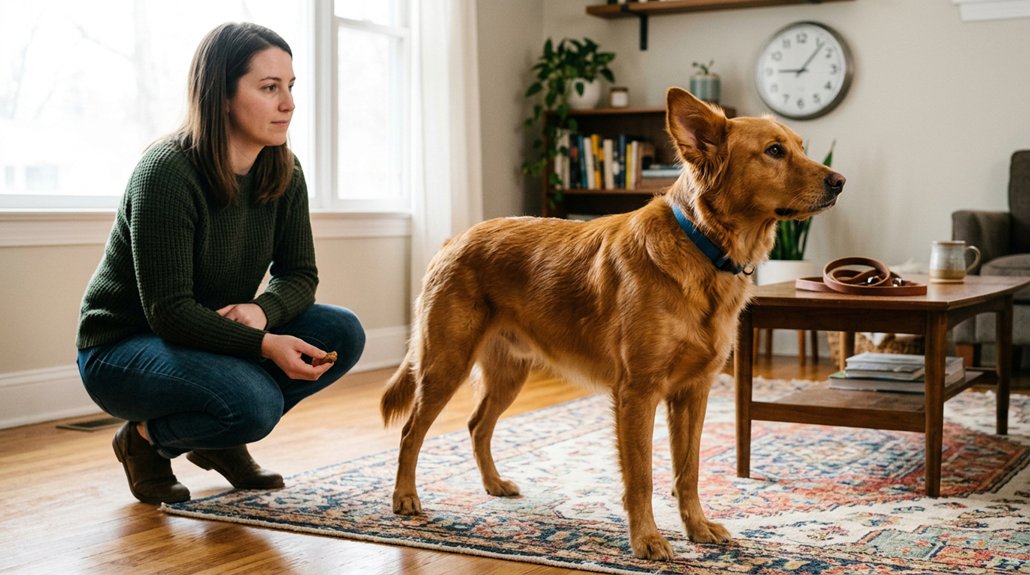
If you’re wondering why your dog isn’t listening, it’s important to contemplate several factors that might be affecting their responsiveness. In dog communication, clarity and consistency are key. Training challenges often stem from using inconsistent commands or failing to capture the dog’s attention amidst distractions. Make certain every family member uses the same signal and phrasing to avoid confusion. Before issuing commands, regain your dog’s focus by saying their name, making sure they’re attentive. Positive reinforcement is vital—reward them with high-value treats for correct responses. This approach not only validates their attempts but also strengthens the desired behavior. Monitor improvements closely; consistent, successful command execution three times in a row is a promising sign. Patience and persistence will enhance communication considerably.
Understanding Fear and Anxiety in Dogs
While you’re working on honing your dog’s listening skills, another critical element to take into account is their emotional state influenced by fear and anxiety. Fear responses can greatly impact your dog’s ability to focus on and respond to commands, often causing them to prioritize avoiding perceived threats. Understanding fear as a natural response, not defiance, encourages empathy and patience in your training approach. Identify anxiety triggers for your dog and use gradual exposure alongside positive reinforcement to help them build confidence. Avoid reprimanding fearful behavior; instead, provide reassurance to create a safe learning environment. Recognizing fear-based behaviors could stem from past traumas or inconsistent training allows you to develop a tailored strategy, optimizing your dog’s ability to listen.
Identify the Common Distractions First

To help your dog focus during training, it’s essential first to pinpoint common distractions. Environmental factors like loud noises, moving objects, or even inconsistent human interactions can all impair your dog’s responsiveness. By identifying these elements and mitigating them, you’ll greatly enhance your training sessions’ effectiveness and your dog’s ability to concentrate.
Environmental Distraction Factors
When training your dog, understanding and managing environmental distraction factors is essential for success. Start with distraction identification to enhance command response. Observe elements like traffic noise, barking dogs, or unfamiliar people in your training environment. These auditory stimuli can easily divert your dog’s attention. Visual distractions are crucial too; playful children or darting squirrels may capture their focus. Strong scents from nearby food or animals can also overwhelm your dog’s senses, leading them astray. Changes in routine, such as new visitors or varied walking routes, might unsettle them. By training in diverse environments, you help your dog generalize commands, ensuring they learn to concentrate and perform regardless of distractions. Consistent exposure builds resilience and focus in all settings.
Managing Human Interruption
Recognizing the impact of human interruption on your dog’s training is essential. Start with evaluating the common distractions your dog faces, such as unfamiliar people. Dogs often react differently; some breeds, like Border Collies, may fixate on movement, while others easily shift focus. Effective distraction management begins by training in a quiet, controlled environment, gradually introducing distractions as your dog gains confidence. Employ engagement techniques like using engaging sounds or toys to maintain attention. Positive reinforcement plays a significant role—reward your dog immediately when they successfully concentrate amidst interruptions. By understanding your dog’s level of distraction tolerance, you can better tailor your training approach, ensuring distractions from human activities are minimized, allowing your dog to focus and respond well.
Animal and Noise Diversions
Given that dogs often encounter a myriad of distractions in their environment, understanding these diversions is essential for successful training. Dogs can be particularly affected by noise sensitivity, struggling to focus amidst loud cars or energetic animals. Identifying such common distractions in your dog’s surroundings helps create effective training strategies that boost distraction tolerance. Recognize if other pets or the presence of people cause confusion or non-compliance in your dog. Consistent exposure to these stimuli in a controlled environment can gradually enhance their confidence and focus. It’s vital to adjust your training technique to minimize disruptions, ensuring your dog comprehends commands more efficiently. By mastering these elements, you’ll foster clearer communication and successful command execution during training sessions.
Ensure Command Consistency
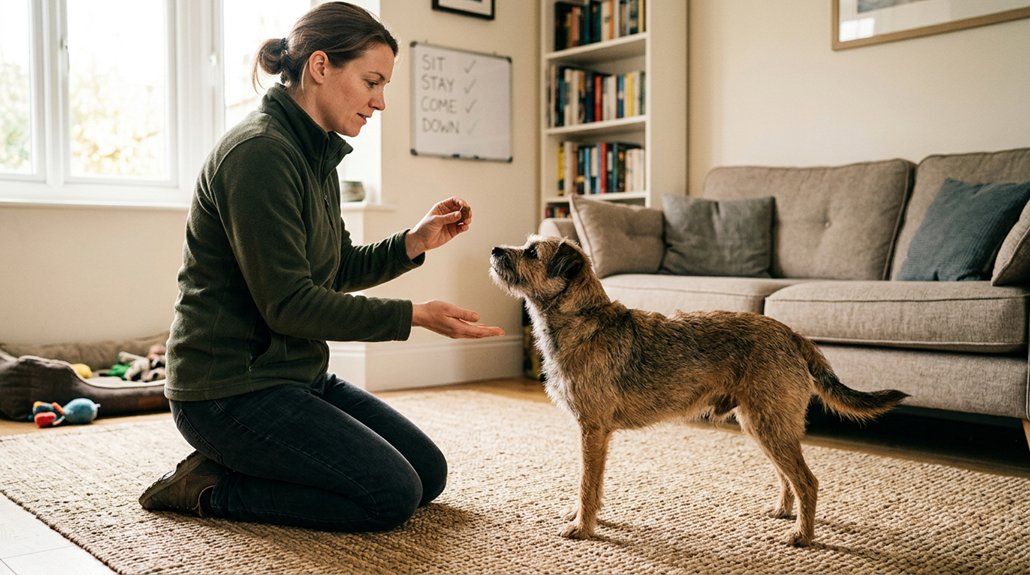
Consistency is key in effective dog training; to eliminate confusion and reinforce understanding, it’s essential that every family member uses the same commands. With unified training communication, command clarity becomes second nature to your dog, making the learning process smoother. Opt for short, direct phrases, such as “SIT” instead of “SIT DOWN”, to ensure your dog comprehends the expectation without ambiguity. Incorporate your dog’s name before issuing a command to secure their attention and focus. Aim for three successful repetitions during training sessions, guaranteeing your commands resonate. A common vocabulary across everyone interacting with your dog prevents mixed messages and solidifies training objectives, fostering an environment where your dog feels supported and capable of meeting set commands.
Employ Positive Reinforcement When Your Dog Won’t Listen
When your dog won’t listen, it’s essential to reinforce desired behaviors effectively using positive reinforcement. Start by utilizing high-value treats your dog loves to boost their motivation and increase the chances of response. Maintain a consistent training environment where you promptly reward compliance, helping your dog make the connection between their actions and the rewards.
Reinforce Desired Behaviors Effectively
Effectively reinforcing desired behaviors in your dog hinges on the strategic use of positive reinforcement. Reward timing is essential; immediately offer praise or a treat when your dog follows a command. This creates a strong link between their action and the reward, reinforcing desired behaviors. Utilize marker words to pinpoint the moment your dog performs correctly, enabling them to associate their actions with positive outcomes. Incorporate training games to maintain engagement and increase complexity gradually, boosting their confidence and focus.
- Create a distraction-free environment to help your dog concentrate.
- Employ high-value treats or enthusiastic praise for effective reinforcement.
- Structure training sessions to celebrate every effort towards compliance.
- Gradually build more complex commands to develop attention span and reliability.
These steps guarantee your dog learns all-encompassing listening skills.
Utilize High-Value Rewards
One powerful strategy to enhance your dog’s training when they won’t listen involves utilizing high-value rewards. High-value rewards like soft treats or favorite toys capture your dog’s attention far better than standard treats. To optimize effectiveness, focus on reward timing. Offer the reward immediately after your dog performs the desired behavior to solidify the association between the command and the reward. Incorporating treat variety is key—rotate different types of rewards regularly to maintain your dog’s motivation and prevent boredom. Using your dog’s name before delivering a command sharpens their focus, ensuring they’re ready to earn that reward. Establishing a consistent rewards system across all family members can help reinforce learning and eliminate potential confusion for your dog.
Maintain Consistent Training Environment
Building on the power of high-value rewards, maintaining a consistent training environment is equally important for effective dog training. Uniform command usage across all family members is vital to prevent confusion. When your dog encounters contradictory signals, their responsiveness decreases. Make sure that everyone uses the same words and gestures to solidify your dog’s understanding. Additionally, practice in the same location to enhance your dog’s ability to generalize commands.
- Use uniform command usage: All family members should use identical commands.
- Consistency in training environment: Train in similar locations to improve focus and reliability.
- Minimize distractions: A calm setting encourages your dog to concentrate on commands.
- Positive reinforcement: Reward immediately after compliance to strengthen desired behavior.
Create a Structured Training Environment
To establish a successful training routine with your dog, start by designating a specific area free from distractions; this setting will enhance your pet’s focus and response to commands. Develop a structured routine and training schedule to stay consistent. Use the same commands and cues, ensuring all family members reinforce these to prevent confusion. Sessions should be short, around one minute, with about three successful repetitions. This builds confidence and compliance.
Here’s a breakdown:
| Element | Description |
|---|---|
| Designated Area | Distraction-free zone for better focus |
| Consistent Commands | Unified cues from all family members |
| Short Sessions | 1-minute with 3 successful repetitions |
| Rewards | Immediate high-value treats after compliance |
While progressing, gradually introduce more complex commands to maintain a structured growth in skills.
Customizing Techniques for Different Distractions
When you’re working with your dog in environments full of distractions, it becomes essential to adapt your training methods to maintain their focus and responsiveness. Begin by identifying specific distraction types—such as other animals, noise, and moving objects—and gradually expose your dog to these stimuli. This process helps build their confidence and focus. Use adjustment strategies like high-value treats to lure their attention back when distractions arise. Consistently practice commands in various settings and employ techniques like altering your position or changing your tone of voice.
- Identify distraction types and expose your dog gradually to them.
- Use high-value treats for effective attention diversion.
- Adjust voice tone and positioning as needed.
- Structure training to include increasing distraction levels over time.
Pinpoint and Resolve Command Confusion
To effectively address command confusion in dog training, it’s essential that you use consistent command language. Stick with simple, clear commands like “SIT” and make sure all family members are on the same page to prevent any inconsistency in communication. Remember, your dog benefits from repetition, so aim for three successful repetitions to reinforce their understanding, and use a focused marker like “HEY” to maintain their attention without unnecessary repetition.
Consistent Command Language
Confusing a dog with inconsistent command language can diminish the effectiveness of training. It’s essential to adopt new command strategies that emphasize precision and uniformity. Guarantee family training consistency by getting everyone on board with identical commands, such as using “SIT” rather than a mixture of phrases. This prevents sending mixed signals and optimizes your dog’s learning potential.
Consider these key points:
- Use your dog’s name before giving a command to focus their attention.
- Reinforce learning with at least three successful repetitions of the same command.
- Incorporate a system of clear commands paired with positive reinforcement.
- Train the whole family to use the same terminology for consistency.
Proper terminology fosters better understanding and response, enhancing your training efforts considerably.
Clear Training Techniques
Mastering clear training techniques catapults your dog’s learning journey to new heights. First, guarantee command clarity by consistently using straightforward commands like “SIT” instead of “SIT DOWN.” This builds a seamless understanding. Involve all family members to maintain uniform command usage and reward timing. Doing so prevents command confusion and reinforces desired behaviors effectively.
Always utilize your dog’s name prior to issuing a command, capturing their full attention. Follow up with a high-value treat as immediate positive reinforcement, enhancing response accuracy. Maintain a calm yet firm tone to establish expected behavior. As your dog progresses, gradually increase command difficulty, guaranteeing you’re still rewarding compliance. With these steps, your dog will respond consistently, enhancing their learning experiences.
Help Your Dog Gain Confidence, Step by Step
Gaining confidence is an essential part of your dog’s development, and with the right approach, your furry friend can conquer fears gradually and effectively. Embrace the process of confidence building by exposing your dog to different environments. Gradual exposure to fear-inducing stimuli, like noisy settings, helps with fear recovery. Encourage a sense of security by offering reassurance instead of reprimands for fearful behavior. Use consistent and patient training techniques to minimize fear responses.
Building your dog’s confidence requires patience, reassurance, and gradual exposure to new environments.
Enhance training outcomes by incorporating positive reinforcement:
- Use high-value treats to motivate and reinforce desired behaviors.
- Create a calm and structured environment to reduce distractions.
- Allow your dog time to process commands without pressure.
- Observe reactions to adjust training practices effectively.
Following these steps will strengthen your dog’s confidence progressively.
Customize Training for Your Dog
How can you effectively tailor your dog’s training to suit their unique needs? Start by developing a plan using tailored approaches and individualized techniques. Consider your dog’s background—past trauma or inconsistent training can affect their responsiveness. Use clear, structured commands that all family members consistently apply, reducing confusion and setting clear expectations. As your dog gains confidence, gradually increase command complexity, ensuring each step is manageable. Promptly reward compliance to reinforce positive behavior. Positive reinforcement using high-value treats creates strong associations with desired actions. Monitor your dog’s responses closely and adjust the environment to minimize distractions, promoting focused learning. By customizing your training methods, you can cultivate a cooperative and attentive dog who enthusiastically listens and responds.
Frequently Asked Questions
How Do You Discipline a Dog That Won’t Listen?
Start by using consistent commands so your dog doesn’t get confused. Rather than reprimanding, focus on positive reinforcement to encourage desired behavior. Use rewards for compliance and patience to guide them toward understanding and listening consistently.
What Is the 7 7 7 Rule for Dogs?
Ah, the mythical 7 7 7 rule—because your dog obviously reads clocks! But truly, seven minutes each of positive reinforcement, training techniques, and rest can transform behaviors and relationships. Surprise: it’s an instructional not a fairy tale.
What Is the 3-3-3 Rule for Dogs?
The 3-3-3 rule helps you understand your dog’s adjustment period post-adoption: three days of stress, three weeks settling in, three months fully integrated. Use positive reinforcement and crate training to build trust and comfort efficiently.
Do Dogs Forgive You for Yelling at Them?
No, dogs don’t forgive like humans. Their behavior improves with positive communication methods. Overcome your frustration by using reinforcement techniques to rebuild trust. Dogs respond better to consistency, so patience and calm interactions make them feel secure.
Conclusion
In the world of dog training, patience and consistency are your best friends. If your pup isn’t listening, don’t fret—each woof is a chance to teach, and each moment a puzzle waiting to be solved. By understanding their fears, practicing consistency, and embracing positive reinforcement, you’re not just building obedience; you’re crafting a bond. So, step confidently into this journey, because every well-heeded command is music to a dog owner’s ears. Let’s get barking!