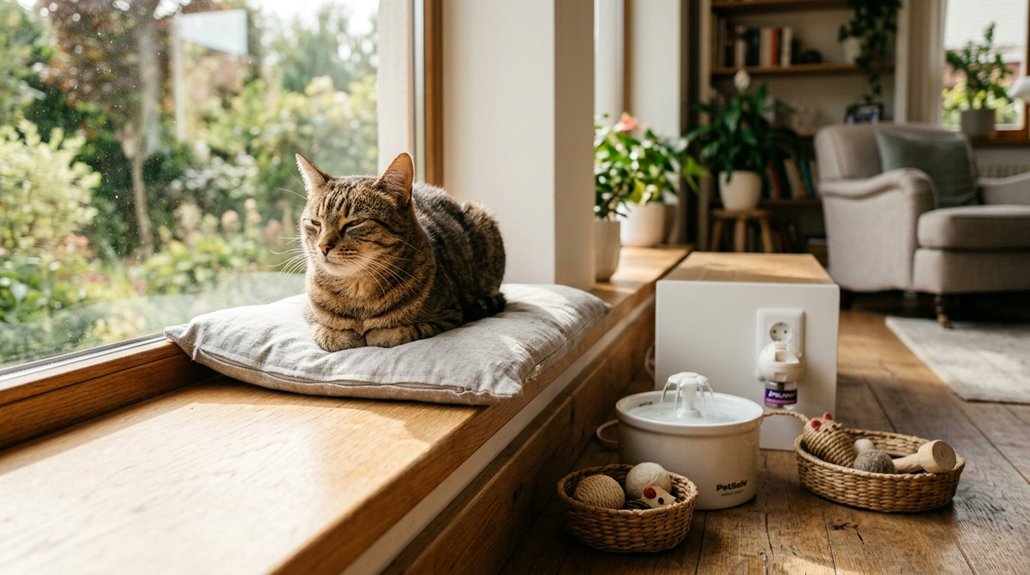
To prevent bad habits in cats, guarantee consistency in training and reward positive behaviors promptly. Understand your cat’s instincts and utilize their preferences to redirect negative actions. Create a stimulating, enriched environment with toys and scratching posts to keep boredom at bay. Maintain clean, accessible litter boxes, and use positive reinforcement to encourage good behaviors. By anticipating challenges and using these strategies, you’re well on your way to a harmonious relationship with your cat, with plenty more to discover.
Key Takeaways
- Maintain consistency in responses to establish clear behavioral boundaries and prevent the development of unwanted habits.
- Use positive reinforcement techniques to encourage repetition of desirable behaviors and diminish undesirable actions.
- Observe and redirect negative behaviors with engaging toys and activities suited to your cat’s natural instincts.
- Create a cat-friendly environment with plenty of enrichment, resources, and safe spaces to minimize stress and territorial disputes.
- Regularly monitor and adapt your environment to meet your cat’s evolving needs and encourage positive behaviors.
Start With Consistency: the Backbone of Effective Cat Training
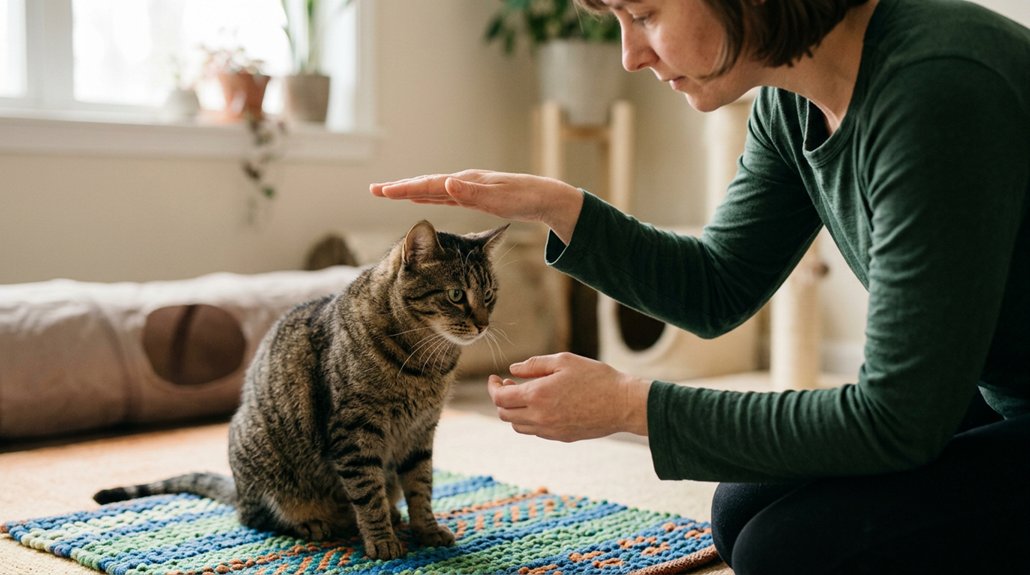
Consistency is the cornerstone of effective cat training, providing the framework within which cats can thrive behaviorally. By maintaining routine rewards and precise commands, you facilitate an environment free from confusion. Cats learn to associate positive reinforcement with desired actions, allowing them to internalize these behaviors universally, not just during specific training sessions. Scientific observations highlight that cats respond best when the stimuli and outcomes are predictable, as this alleviates anxiety typically triggered by unexpected scenarios. As a cat owner, guarantee that your responses to feline behavior remain uniform—this establishes clear boundaries and prevents the emergence of unwanted habits. A structured environment also supports this regimen, minimizing anxiety and fostering a harmonious coexistence with your feline companion.
Get to Know What Makes Your Cat Tick
Have you ever wondered what’s really going on in your cat’s mind? Understanding instincts is essential. Cats are governed by natural behaviors and environmental cues, not human logic. Observing feline communication, particularly through body language, provides insights into moods and possible triggers for undesired actions. For example, a flicking tail or flattened ears can indicate stress. Recognizing unique preferences, like favored toys, helps redirect negative behaviors constructively. In multi-cat households, comprehension of social dynamics is important to prevent territorial conflicts; make certain each cat has access to resources and individual attention. Regular playtime, interactive engagement, and mental stimulation mitigate boredom-driven habits. Cultivating this understanding promotes a harmonious existence, keeping your feline friend content and reducing behavioral issues.
Create a Cat-Friendly Home
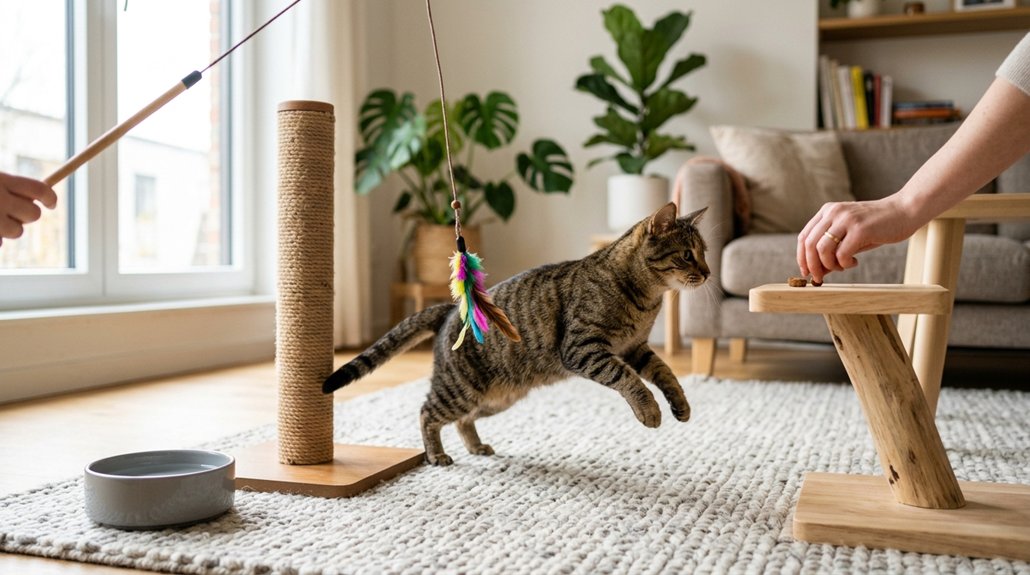
To cultivate an environment that minimizes undesirable feline behaviors, strategically enhance your cat’s ecological enrichment with an array of toys and scratching posts. Avert ideal resource accessibility by providing enough food and litter boxes to curb territorial disputes, particularly in multi-cat households. Additionally, create safe, secluded spaces for stress reduction, and use vertical structures like cat trees to encourage physical activity and decrease boredom-related actions.
Enhance Environmental Enrichment
When working to eliminate bad habits in cats, enhancing their environmental enrichment is crucial. Providing vertical structures like cat trees and climbing shelves allows your feline to engage in natural climbing activities, important for exercise and boredom reduction. Interactive toys and puzzle feeders can offer sensory stimulation and challenge their cognitive abilities, thereby minimizing the risk of frustration-induced behaviors. Establish designated play zones with hunting games, encouraging instinctual play and deterring destruction in other home areas. Frequently rotate toys to maintain a dynamic environment that captivates your cat’s attention and prevents monotony. Additionally, well-placed hiding spots provide essential security, reducing stress-related habits. A thorough environment not only keeps cats entertained but promotes their psycho-emotional well-being effectively.
Provide Safe Spaces
Creating a cat-friendly home requires thoughtful consideration of your feline’s need for safe spaces. Providing hiding spots and elevated perches is integral in fulfilling your cat’s innate desire for security and solitude, potentially mitigating stress-induced behaviors. Safe spaces, like cozy alcoves or raised platforms, allow your cat to engage in natural behaviors, such as perching and hiding, which are essential for their psychological well-being. In multi-cat households, guarantee each pet has distinct spots to reduce territorial tension and encourage peaceful coexistence. To promote healthy climbing behavior, incorporate vertical spaces like cat trees. These structures not only offer security but also deter unwanted behavior by directing activity away from furniture. Regularly reassess these spaces to align with your cat’s evolving comfort needs.
Optimize Resource Accessibility
Guaranteeing ideal resource accessibility is essential in designing a cat-friendly home that meets your feline’s environmental needs. Strategically position scratching posts in diverse locations, deterring inappropriate scratching by providing attractive alternatives. Equip your home with sufficient litter boxes—one per cat plus an extra—to avert territorial disputes and foster habitual usage.
| Resource | Suggested Placement |
|---|---|
| Scratching Posts | High-traffic and rest areas |
| Litter Boxes | Quiet, accessible corners |
| Vertical Spaces | Observational vantage points |
| Interactive Toys | Rotational play zones |
| Safe Retreats | Secluded, high-perch areas |
Promote your cat’s well-being by integrating vertical spaces like cat trees. These structures cater to climbing instincts, alleviating stress. Interactive environments with engaging toys provide mental stimulation, minimizing boredom-induced behaviors. Finally, guarantee access to quiet retreats where your cat feels secure.
Use Positive Reinforcement Techniques
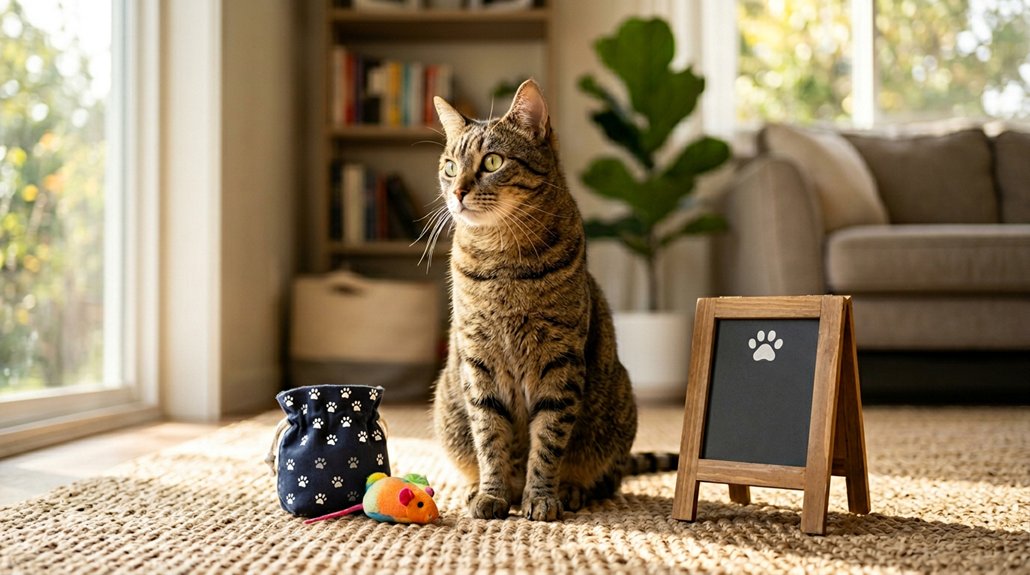
Harnessing the power of positive reinforcement can profoundly impact how effectively you train your cat. This method is based on operant conditioning, where desirable behaviors are rewarded, encouraging repetition. Using clicker training, associate the click sound with treats to reinforce this connection; precise treat timing is vital. When your cat exhibits a desired behavior, promptly reinforce it with a treat, verbal praise, or gentle petting. This immediate reward system helps them connect their actions to positive outcomes. You should apply these techniques consistently across different situations, such as during playtime or social interactions. For instance, consistently rewarding your cat for using scratching posts rather than furniture helps diminish destructive scratching habits. By regularly applying these methods, you cultivate understanding and cooperation in your feline companion.
Redirect Unwanted Behaviors Gently
To gently redirect unwanted behaviors in cats, you should provide positive alternatives that cater to their natural instincts, such as interactive toys or scratching posts. By anticipating potential misbehavior and redirecting early, you can intervene before issues escalate, reinforcing good habits with immediate rewards like treats or praise. Understanding your cat’s body language enhances your ability to preemptively guide them towards more favorable activities, reducing the likelihood of unwanted actions.
Encourage Positive Alternatives
Redirecting your cat’s unwanted behaviors often starts with the strategic introduction of engaging alternatives that align with their natural instincts. Implementing interactive play with engaging toys taps into their predatory drive and mitigates undesired actions. Here’s how you can effectively encourage positive alternatives:
- Utilize engaging toys: Introduce toys that mimic prey, such as feather wands, enticing your feline to engage in healthy, instinctual play rather than disruptive activities.
- Positive reinforcement: Immediately reward desired behavior with treats and praise when your cat uses appropriate alternatives like scratching posts, reinforcing their use.
- Restrict access wisely: Limit your cat’s access to undesirable objects, ensuring preferred items are notable and accessible, thereby guiding them towards acceptable targets for their attention.
These strategies foster a well-adjusted, content kitty.
Anticipate and Redirect Early
Understanding how to encourage positive behaviors in your cat naturally leads to anticipating and gently redirecting unwanted actions before they take root. Early intervention relies on your ability to decode body language cues, recognizing signs of impending misbehavior. For instance, observing ear twitching or tail flicking might herald furniture scratching or nipping. Interrupt these undesirable actions confidently with a loud clap or firm verbal command, and refocus your cat’s attention by immediately introducing an alternative like a toy or scratching post. Consistency is essential in solidifying your cat’s cognitive association with acceptable behaviors. Monitor their environment to minimize triggers and enhance mental and physical stimulation. Implementing these strategies guarantees your cat develops appropriate habits while reducing stress-induced anxiety or disruptive conduct.
Address Specific Behavioral Challenges
When addressing specific behavioral challenges in cats, it’s crucial to understand that these behaviors often stem from unmet needs or environmental triggers that must be identified and mitigated. For destructive scratching, equip your home with scratching alternatives like posts made of sisal, cardboard, or carpet that match your cat’s preferred materials. To redirect undesired playful aggression, such as nipping, introduce interactive toys to divert attention from behavioral triggers, providing mental stimulation and reducing stress. Litter box aversion can be addressed by maintaining cleanliness and choosing cat-friendly substrates while guaranteeing sufficient boxes to accommodate your multi-cat household.
- Scratching Alternatives: Guarantee multiple appropriate items in varied locations to prevent damage.
- Behavioral Triggers: Recognize and redirect negative behaviors promptly with suitable toys.
- Litter Box Management: Promote cleanliness and accessibility.
Frequently Asked Questions
How to Stop Bad Habits in Cats?
Stop your cat’s bad habits by using positive reinforcement to reward good behavior. Incorporate environmental enrichment to reduce stressors. Redirect undesirable actions, like scratching, consistently. Establish routines and use gentle disapproval to instill proper behavior without force.
What Is the 3-3-3 Rule for Cats?
The 3-3-3 rule outlines a cat’s typical adjustment: three days for initial stress responses, three weeks for enhanced feline communication and socialization, and three months for stable cat behavior and full integration into their new environment.
What Is “I Love You” in Cat Language?
In cat communication, “I love you” is expressed through feline body language like slow blinking, purring, head-butting, following you around, and allogrooming. Recognizing these behaviors helps strengthen your bond and enhances your mutual understanding.
How to Discourage Bad Behaviour Your Cat Is Doing?
Utilize behavior modification techniques by applying positive reinforcement strategies: reward desired behaviors to encourage repetition. Simultaneously, redirect unwanted actions to suitable alternatives. Be consistent and patient, as this scientifically-backed method yields the best long-term results for behavioral change.
Conclusion
To cultivate a purr-fect harmony with your feline companion, consistency is key. Understand your cat’s unique quirks and craft an environment that feels like an oasis. Apply positive reinforcement—praise and treats—when they exhibit desired behaviors. When mischievous antics arise, redirect with gentle nudges, rather than punitive measures. Should peculiar misbehaviors persist, consult a behaviorist to decode them. By fostering mutual respect and understanding, you’ll nurture a well-mannered cat and a blissful coexistence.