
When adding a second cat, guarantee compatibility by evaluating temperament, age, and health. Create a dedicated sanctuary for the newcomer and introduce scents to foster familiarity. Utilize gradual introduction strategies, monitoring body language and potential stress indicators. Manage conflicts with distractions and reinforce positive interactions. Regularly review progress, and seek professional advice if aggressive behavior persists. By understanding these guidelines, you’ll successfully integrate a new feline companion and create a harmonious multi-cat household. Discover more nuanced strategies ahead.
Key Takeaways
- Expect initial territorial behavior; separate zones help reduce conflicts during the adjustment phase.
- Monitor cats’ interactions closely to identify stress signals and manage any aggressive behaviors.
- Gradual scent and visual introductions promote familiarization and reduce anxiety.
- Provide separate resources like food and litter boxes to prevent competition and stress.
- Use positive reinforcement to create a harmonious environment and encourage friendly interactions.
Assessing If Your Current Cat Is Ready for a Companion
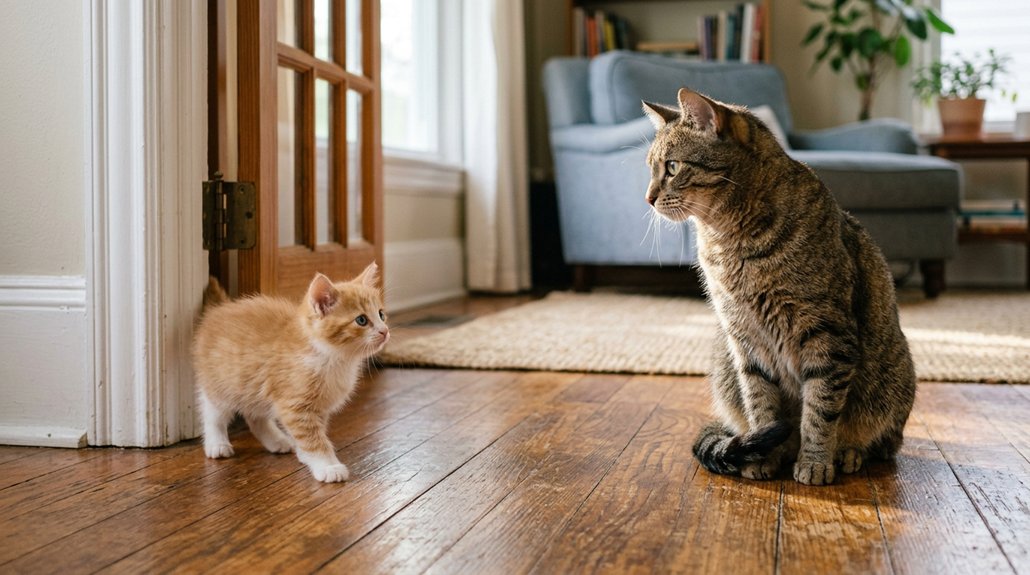
When considering adding a second cat to your household, how do you determine if your current cat is prepared for a new companion? Begin by analyzing cat communication. Notice social cues such as excessive vocalization or decreased playfulness; these may indicate loneliness. Evaluate temperament, as an easygoing and sociable feline typically adapts better to a new friend than a territorial or aggressive one. Observe interactions with neighborhood cats; positive responses imply openness to sharing space. Consider your cat’s age and health status, as young and healthy cats generally exhibit greater adaptability. Finally, guarantee you have ample resources—separate sleeping areas, litter boxes—to enable smooth cohabitation, reducing potential territorial disputes. Clinically, precise attention to these factors guarantees a harmonious integration.
Preparing Your Home for a New Roommate
Successfully preparing your home for another feline entails several structured steps to guarantee a smooth changeover for all involved. Establish a dedicated sanctuary room equipped with food, water, a litter box, and comfortable bedding. This offers the new cat a controlled environment, minimizing stress and facilitating acclimatization. Effective resource allocation is critical; assure each cat has distinct resources—three beds, multiple food and litter stations—to decrease potential territorial disputes. Rotate bedding and toys to transfer scents, promoting olfactory familiarity prior to direct introductions. Initial encounters should occur without visual barriers, using gates or screens. Maintain a calm, structured environment, scheduling interactions while offering individualized attention. These measures foster harmonious coexistence, mitigating anxiety and facilitating successful integration.
Selecting Your New Cat
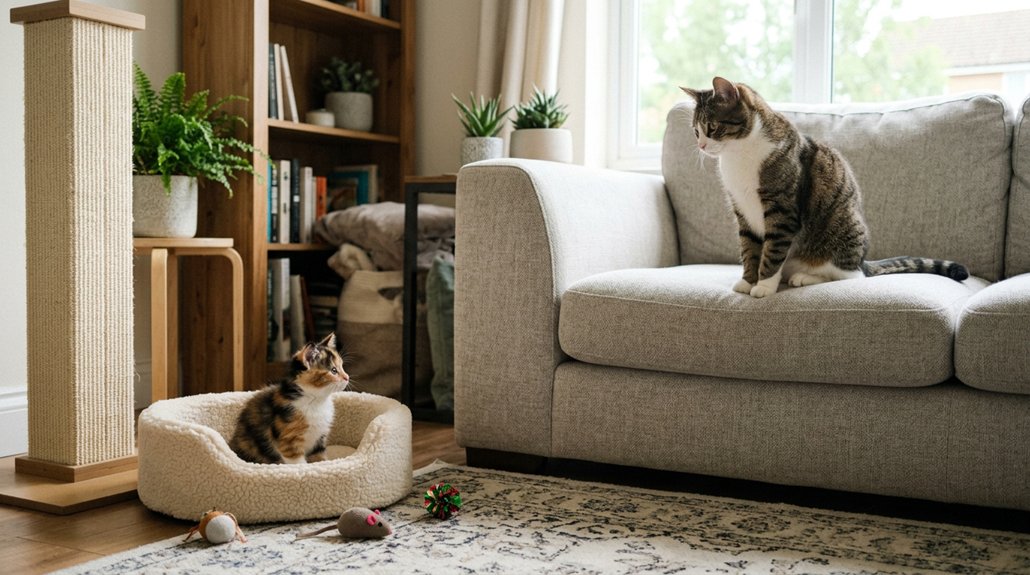
After preparing your home, the next step involves meticulously choosing your new feline companion, a process that requires careful consideration of age and temperament to guarantee an amiable integration. Prioritize age and disposition rather than gender—adult cats often more readily accommodate kittens. Opt for kittens showing friendliness and confidence; steer clear of those exhibiting aggression. When it comes to choosing breeds, consider their known temperaments that align with your resident cat. Understanding needs extends to selecting cats from the same litter, enhancing compatibility. Conduct a thorough assessment of behavior and characteristics to ascertain a harmonious home.
| Factor | Importance |
|---|---|
| Age | Adults adjust easier to kittens than other adults |
| Temperament | Prefer friendly, confident over aggressive behavior |
| Relation | Related cats exhibit better compatibility |
Guide: Introducing Your Cats Step-by-Step
Establishing a harmonious relationship between your resident and new cat demands strategic technique. Begin with scent exchange: trade scented blankets to promote familiarity and acceptance. Prepare a sanctuary for the newcomer equipped with necessities—food, water, litter box—to provide a stress-free environment. Implement gradual introduction by feeding both cats on opposite sides of a closed door. This ritual fosters positive associations without direct interaction. Move slowly to visual contact using a screen or gate, observing their body language for stress indicators. As they acclimate, coordinate structured play sessions while closely supervising. Distractions like toys can guarantee a positive atmosphere during these initial encounters. With patience and precise methodology, you’ll increase the likelihood of a successful feline friendship.
Handling Behavioral Conflicts Between Cats
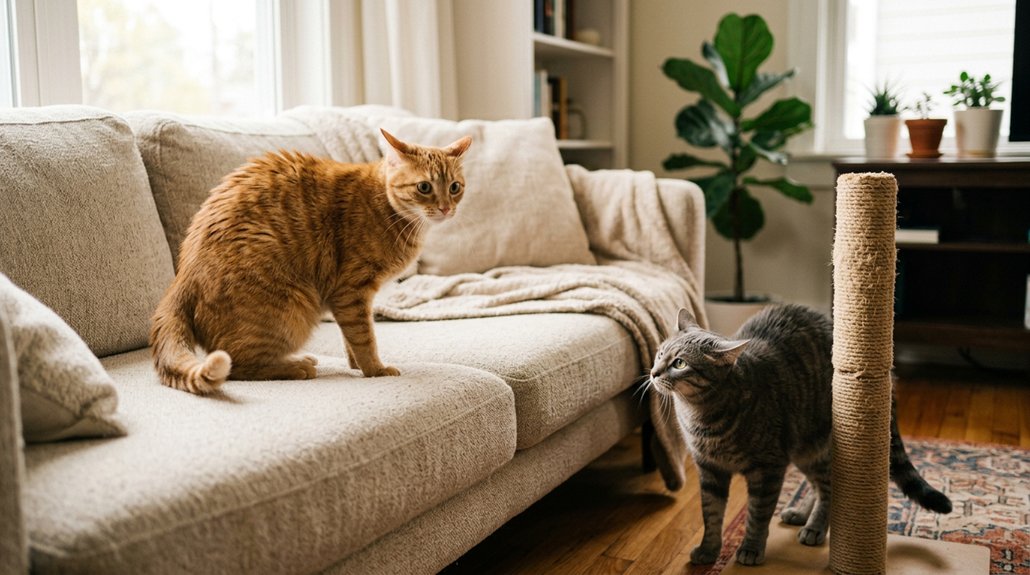
When managing aggressive behaviors between cats, employ distractions like a towel or loud noise to immediately disrupt and separate them, allowing their stress levels to diminish. Supervised encounters are essential for promoting peaceful coexistence, as gradual acclimatization reduces the likelihood of behavioral discord. Should territorial disputes persist without improvement over a month, consider rehoming or maintaining constant separation to guarantee a harmonious domestic environment.
Managing Aggressive Behaviors
Introducing a second cat to your household can sometimes lead to aggressive behaviors, necessitating a careful approach to managing such conflicts effectively. Aggression triggers often include territorial disputes or fear-driven responses. Immediate intervention strategies are essential. During initial encounters, closely monitor interactions for signs of aggression. Should a confrontation arise, employ distractions like loud noises or a towel to disrupt and separate the cats. Avoid physical intervention, as it risks injury. Always prioritize non-contact methods. Post-separation, provide positive reinforcement—treats or interactive play can shift focus, fostering calm. Allow ample time for the cats to decompress before initiating further introductions. This strategic approach mitigates tension, preventing escalation and ensuring a safer, more harmonious integration process.
Promoting Peaceful Coexistence
To foster a peaceful coexistence between your cats, it’s paramount to address potential behavioral conflicts proactively. Prioritize gradual introductions to guarantee a smoother adaptation. Monitor their interactions closely, utilizing bonding techniques like toys and treats, fostering positive associations. Implement environmental enrichment to minimize stress, providing ample resources and retreat spaces for each cat. Employ tactical distractions during encounters, like a sound or towel, to disrupt tension without harm. Patience is critical; kittens may adjust within weeks, but adult cats might require more time. Should behavioral issues persist beyond a month, reassess the situation to avert ongoing stress. Here’s a concise table to guide you:
| Strategy | Target Duration | Purpose |
|---|---|---|
| Gradual Intro | 2-4 weeks | Adaptation |
| Monitoring | Continuous | Behavior Observation |
| Distraction | Immediate | Conflict Avoidance |
| Resource Separation | Ongoing | Stress Reduction |
| Reward System | Throughout | Trust Building |
Resolving Territorial Disputes
Though cats are inherently territorial, understanding their behavioral conflicts is vital for resolving disputes effectively when adding a second feline companion. Territorial instincts can lead to aggression if gradual introductions aren’t meticulously orchestrated. Guarantee each cat has its own designated territory with ample resources to avoid competition and tension: separate feeding stations, litter boxes, and resting areas should suffice. Monitor initial encounters vigilantly, ready to disrupt any signs of aggression with distractions like a towel or loud noise. It can take weeks to resolve behavioral conflicts, so observe them closely for stress indicators. If antagonistic behavior persists beyond a month, reconsider spatial arrangements or consult a feline behaviorist. Early intervention and patience are key for fostering a harmonious multi-cat household.
Monitoring Progress and Making Adjustments
As you monitor the integration of your cats, scrutinize their social dynamics for signs of stress or harmony, which may necessitate adjustments to their living arrangements. Utilizing ethological insights, track behavioral changes meticulously, and if progress remains stagnant after consistent interventions, contemplate rehoming or segregated environments to optimize well-being. Empirical evidence underscores the importance of positive reinforcement to mitigate tension and foster affinity.
Assessing Behavioral Changes
When introducing a second cat into your home, maintaining vigilant observation is crucial to managing their behavioral changes effectively. Focus on stress indicators and behavior observations to identify potential issues timely. Here’s what to monitor:
- Behavior Variability: Observe both cats for changes in eating, grooming, and play. A decreased appetite or increased hiding may suggest distress.
- Aggression Signs: Monitor for hissing, growling, or swatting. Such behaviors can signal discomfort and require intervention.
- Scent Exchanges: Facilitate familiarity through regular scent swapping, which can reduce anxiety and promote positive interactions.
- Adjustment Duration: Assess progress over 4 to 6 weeks. While some cats may never be best friends, guarantee peaceful coexistence. If integration stalls, consult a behavior expert.
Adjusting Living Arrangements
Successfully adjusting living arrangements for your cats is essential to guaranteeing a peaceful adjustment and minimizing territorial conflicts. During the acclimatization process, optimizing space and allocating resources properly becomes paramount. Begin by creating distinct zones equipped with food, water, and litter boxes for each cat to reduce tension. Monitor their interactions before merging spaces, considering separation if aggression arises.
Incorporate a systematic observation approach:
| Action | Consideration |
|---|---|
| Initial Separation | Prevent territorial disputes |
| Resource Allocation | Guarantee comfort and stability |
| Stress Monitoring | Identify early signs |
| Gradual Introduction | Foster shared experiences |
Be patient, particularly with adult cats, who may require extended acclimation periods of 4-6 weeks. Prioritize tranquil environments to aid their adjustment, enhancing space optimization and secure resource allocation for harmonious coexistence.
Evaluating Social Dynamics
Effective management of social dynamics during the integration of a second cat involves a scientifically informed approach that emphasizes vigilant observation and adaptable strategies. Monitor interactions meticulously, as they reveal shifts in social hierarchy and potential stress signals. Here’s a concise guide to optimize the integration process:
- Observe Play Interactions: Watch for mutual, non-aggressive play, indicative of positive bonding. Unequal play may suggest dominance struggles.
- Recognize Stress Signals: Look for signs like hissing or avoiding one another, which necessitate immediate separation of the cats.
- Adjust Resources: Confirm equal access to food, litter boxes, and space to prevent territorial disputes.
- Evaluate Progress: If substantial aggression persists beyond four to six weeks, reassess the viability of cohabitation, considering possible rehoming.
Seeking Professional Help When You Need It
Have you considered the benefits of seeking professional assistance when introducing a second cat to your home? If persistent behavioral issues arise, a behavior consultation can offer customized strategies for smoother integration. Professional behaviorists, using targeted training techniques, can address complex aggression or anxiety-related concerns. Utilizing a behavior pet helpline gives you access to immediate, expert advice and resources for feline behavioral dynamics. For an extensive understanding, a behavior resource library provides insights into feline ethology, enriching your approach to introductions. Professional support proves invaluable if no progress is observed after a month of attempts, guiding you on whether to persist or explore alternatives. Expert intervention guarantees both cats’ psychological well-being throughout this critical shift.
Frequently Asked Questions
What Gender Is Best for Two Cats?
When considering male and female dynamics, same-gender compatibility often holds equal importance as temperament. Focus on the cats’ individual personalities, as easygoing temperaments generally facilitate better integration, regardless of whether they’re male or female. Prioritize harmony over gender specifics.
What Is the 3-3-3 Rule With Cats?
The 3-3-3 rule explains feline behavior adaptation through phases: initial stress response in three days, emerging social dynamics by three weeks, and established integration or social equilibrium by three months. It guides realistic expectations during cat acclimatization.
How Do I Know if Getting a Second Cat Is a Good Idea?
If your cat’s behavior is chill as a cucumber and you seek feline companionship, adding a second cat may be wise. Assess environmental enrichment, resource accessibility, and guarantee gradual introduction for a harmonious duo.
What Not to Do When Introducing Two Cats?
Don’t rush the introduction process, as it could lead to elevated cortisol levels and aggression. Avoid common mistakes like forced interactions, neglecting existing stressors, and misplacing resources to prevent territorial issues. Patience mitigates endocrine stress responses.
Conclusion
Adding a second cat is like upgrading to a bigger bandwidth in your household. You’ve assessed your current cat’s readiness, prepped your home’s environment, and chosen a feline companion. Through methodical introductions, you’ve navigated feline behavioral dynamics akin to social psychology experiments, adjusting based on interspecies interactions. If conflicts persist beyond your expertise, enlisting a behaviorist might be imperative. By methodically monitoring and adapting, you’re laying the groundwork for a multifaceted feline social structure in your home.