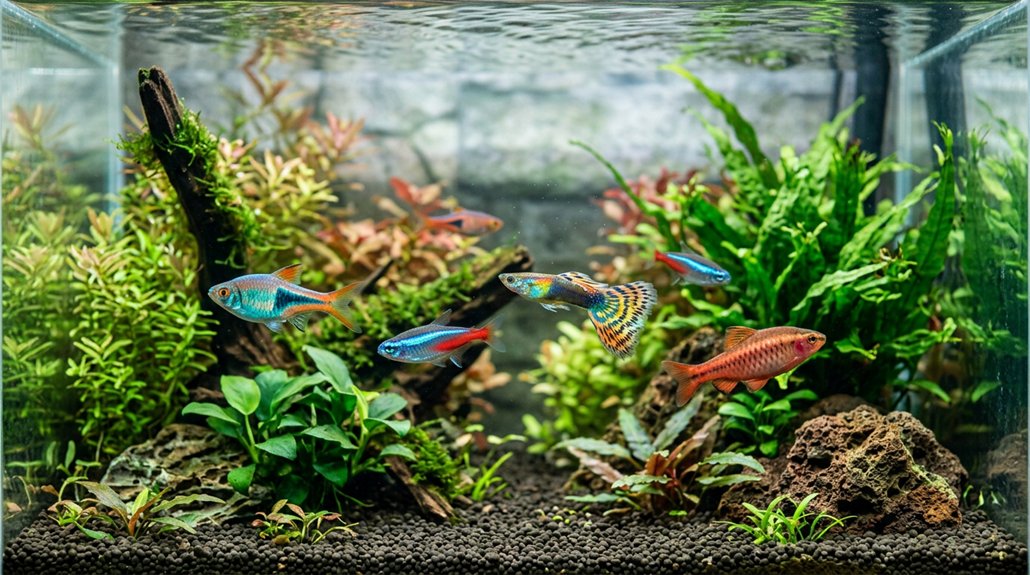
To choose compatible fish, you should match adult size, temperament, and water needs first. Keep tropical fish with tropical species, and align temperature, pH, and hardness as closely as possible. Use a tank large enough for swimming and territory, with caves and plants to break sight lines. Schooling fish need groups of six or more, while semi-aggressive or cichlid species need sturdy tankmates. Get these basics right, and the rest becomes much easier.
Key Takeaways
- Match species with similar temperature, pH, and hardness needs to avoid chronic stress and illness.
- Stock based on adult size, temperament, and tank footprint, not juvenile size or the old one-inch rule alone.
- Keep schooling fish in groups of six or more, and house territorial fish with plenty of space and hiding places.
- Use plants, rocks, caves, and driftwood to break sight-lines and reduce aggression in community tanks.
- Avoid pairing tiny fish or shrimp with predators, and quarantine new fish for 2–4 weeks before adding them.
What Makes Fish Compatible?
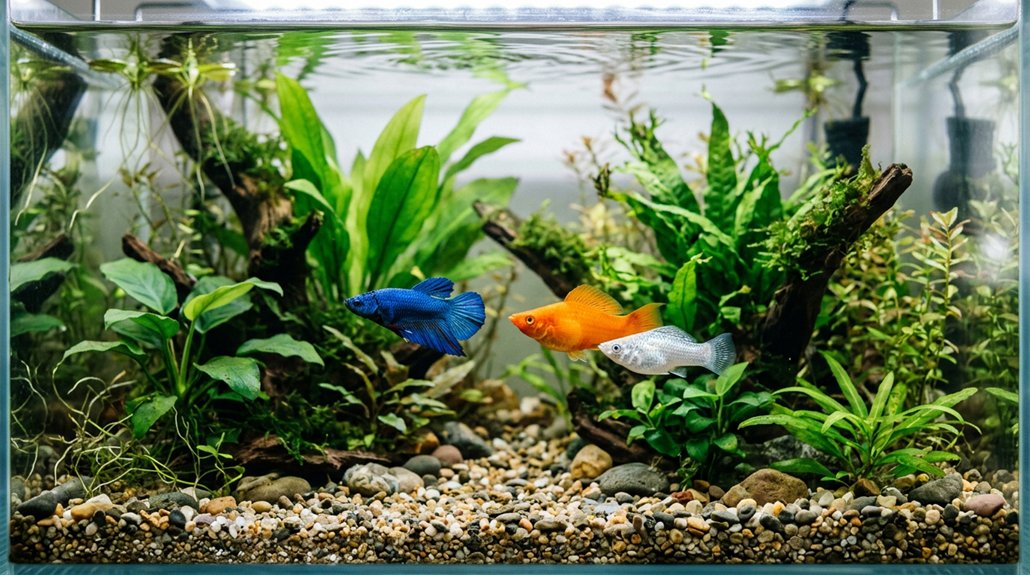
Fish are compatible when their basic needs line up, especially water temperature, pH, and hardness, so every tankmate can thrive in the same environment. You should match tropical fish with tropical ranges and coldwater species with cooler water, and keep pH differences small. Check adult size and mouth gape; if one fish can fit another in its mouth, it’s not a safe mix. You’ll also need compatible temperaments: schooling species want groups, while territorial fish may need calmer partners. Feeders must align, too, so herbivores, omnivores, and carnivores aren’t competing unfairly. Juveniles often coexist more peacefully, and livebearers do better with balanced sex ratios. Breeding compatibility and lighting preferences can also affect stress and social behavior.
How Tank Size Affects Fish Compatibility
When you stock a tank, you’ve got to account for adult size, activity level, and territory, not just the simple “one inch per gallon” rule. Small schooling fish still need enough horizontal space to form stable groups, while larger or territorial species often need much bigger aquaria to cut down on stress and aggression. Your layout matters too, because caves, plants, and broken sightlines can make the same tank function like a more open and compatible environment.
Stocking Space Needs
Even if two species seem compatible by temperament, tank size can make or break the setup, so you should treat space as a core part of compatibility. Use the one-inch-per-net-gallon guideline only as a rough start, and base it on adult size, not juveniles. Subtract substrate and décor, because they reduce usable volume. Check the tank footprint as well as total gallons: schooling fish need long, wide tanks for steady swimming, while bottom dwellers and large-bodied species need extra length and depth. For territorial fish, plan 20–30 gallons per pair or species. Keep stocking below filtration capacity, monitor ammonia and nitrite, and leave open water. If you overcrowd, waste rises, stress climbs, and compatibility drops fast.
Territory And Behavior
Territory matters just as much as temperament, because tank size can directly change how compatible your fish are. In cramped or narrow tanks, territorial species can’t establish stable boundaries, and aggression rises fast.
| Tank choice | Likely effect |
|---|---|
| Wide aquarium | More lateral space, fewer clashes |
| Tall, narrow aquarium | Stronger conflict, less separation |
| Decor-rich setup | Breaks sight lines and defines zones |
Cichlids and larger gouramis often need far more than the one-inch-per-gallon rule suggests. As fish mature, breeding territories expand, so juveniles that seemed peaceful may fight later. You should add caves, rocks, driftwood, and plants to create visual barriers. Rearranging decor can reset dominance. In some Rift Lake systems, slight overstocking may spread aggression, but only with strong filtration. Olfactory signaling also affects spacing, so stable territories help reduce stress.
Fish Temperament Basics
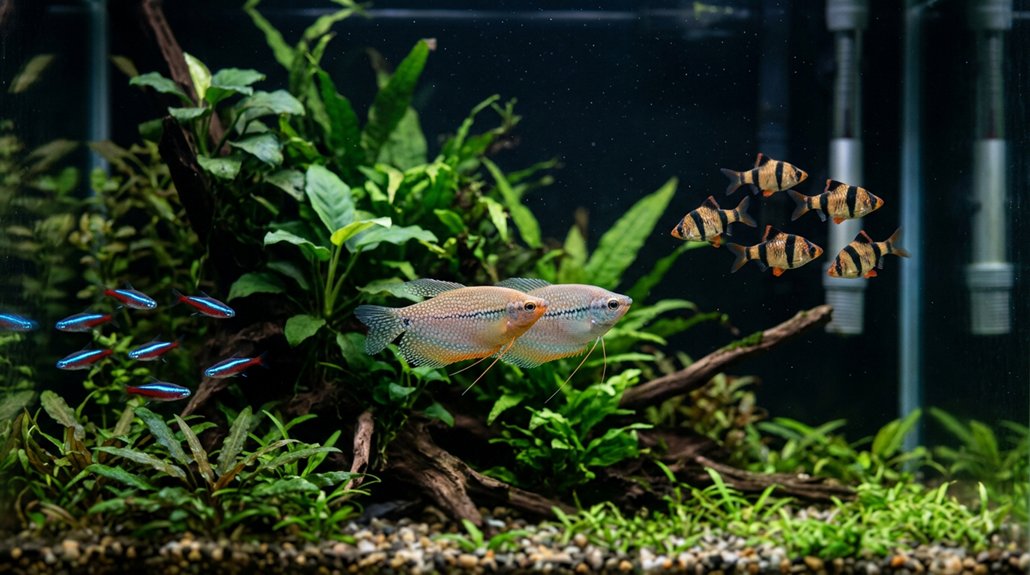
You should first sort fish by temperament: peaceful species like neon tetras and guppies are usually easier to match, while territorial or aggressive fish such as adult male bettas and many African cichlids need careful selection of tankmates. Schooling fish need groups of six or more to stay stable, but solitary territorial species will defend a set space, so you’ll want to watch for chasing, flaring, and repeated boundary patrols. Since temperament can change with size, maturity, and breeding condition, you’ll need to monitor behavior closely and remove any fish that’s being bullied or becoming overly aggressive.
Temperament Categories
Fish temperament usually falls into a few practical categories: peaceful species like schooling danios and tetras, semi-aggressive fish such as barbs and some gouramis, territorial or aggressive fish like many cichlids, and predatory species including bichirs and arowanas.
- Peaceful fish usually show fewer stress indicators in groups.
- Semi-aggressive fish may show personality shifts with age or sex.
- Territorial fish often need caves, space, and clear boundaries.
- Predatory fish can view small tankmates as food, not neighbors.
You’ll get better results by matching tank size, decor, and stocking density to the fish’s baseline temperament. Juveniles are often calmer, while larger or male fish can become more dominant. If you’re considering use-caution pairings, monitor behavior closely and be ready to separate fish if aggression rises.
Peaceful Vs Aggressive
When comparing peaceful and aggressive fish, the key difference is how they use space and whether they tolerate tankmates. You’ll usually find peaceful community species such as tetras, danios, rasboras, guppies, and platies in groups of six or more, where they show minimal conflict and fit mixed-species setups with similar-sized, non-predatory fish. Aggressive or territorial fish, including many cichlids, some barbs, large gouramis, and bichirs, need more room, cover, and often species-only stocking because they may harass, injure, or eat tankmates. Watch behavioral cues like chasing, fin-flaring, and guarded feeding hierarchies. Size matters too: if a fish fits in a predator’s mouth, it’s at risk. Temperament can shift with age, sex, breeding, and density, so plan conservatively.
Territorial Behavior Cues
Territorial behavior usually shows up as flared fins, a raised dorsal, side-to-side posturing, and repeated chasing, which can quickly escalate to nipping or cornering if the submissive fish can’t escape. You’ll also notice fin flaring signals and posterior tail pivoting when a fish is staking a claim. Watch for:
- sudden hiding or clamped fins
- loss of appetite
- visible scrapes or torn fins
- one fish targeting the same tankmate
During breeding, many males, especially cichlids and livebearers, get more defensive for days or weeks while guarding nests or fry. In crowded tanks, aggression rises because hiding spots are limited; caves and plants can soften conflicts. If harassment keeps going, rearrange decor, add space, or separate the bully.
Match Water Chemistry and Tank Zones
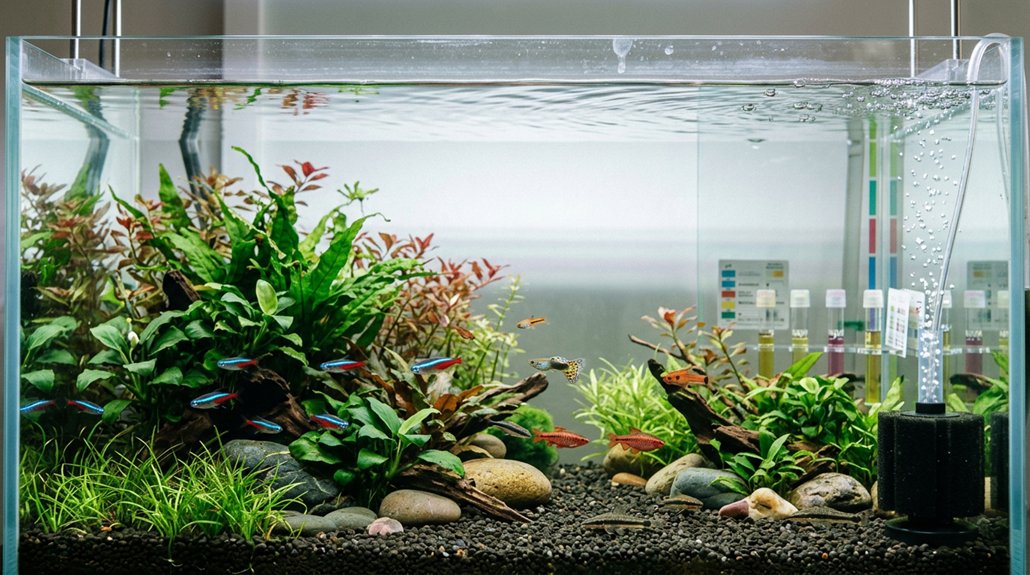
To reduce stress and aggression, you’ll want to match species by both water chemistry and tank zone: keep tropical community fish within overlapping temperature ranges, such as 24–27°C for many tetras, rasboras, and livebearers, and avoid pairing species that need more than a 5°C difference. Check pH and hardness too: Amazonian fish usually need soft, acidic water, while Rift cichlids need hard, alkaline conditions. Use water buffering only when it matches the target chemistry, not to force incompatible species together. Do microhabitat mapping before stocking: open midwater suits schooling fish, planted edges help shy species, and caves support territorial fish. Match substrate and flow to bottom dwellers, shrimp, loaches, or plecos. If needs diverge, use separate tanks or broad-tolerance species, then acclimate slowly.
Best Community Fish Compatibility
For the best community fish compatibility, you’ll get the most stable results with peaceful schooling species like danios, tetras, and rasboras, kept in groups of six or more to reduce stress and aggression. You can also pair many livebearers, such as guppies, mollies, platies, and swordtails, with small schooling fish, but you’ll need to stock them based on adult size and tank capacity. Shrimp and small snails may work in mixed setups, though larger or territorial fish can threaten them, so you’ll want to monitor tankmates closely.
Peaceful Schooling Pairs
Peaceful schooling fish make the strongest community combinations when you keep their social needs in mind: danios, tetras, and rasboras should be maintained in groups of six or more to reduce stress, limit aggression, and encourage natural shoaling behavior.
- You’ll get better schooling enrichment from larger groups.
- Their visual signals stay clearer, so the shoal moves together.
- Synchronized feeding becomes easier, and food competition drops.
- Match substrate preference for bottom species like Corydoras.
Livebearers such as guppies, mollies, platies, and swordtails can fit well if you keep male-to-female ratios near 1:2 or 1:3. Keep temperatures around 22–28°C and pH near 6.5–7.5, adjusting slightly for livebearers. Give Corydoras fine substrate and hiding spots. Avoid large cichlids, big barbs, plecos, and predators that’ll harass or eat them.
Safe Tank Mates
When you’ve got peaceful schools like danios, tetras, and rasboras set up properly, the next step is choosing tank mates that won’t upset that balance. Add livebearers like guppies, mollies, platies, or swordtails only if they’re similar in size and non-territorial. Freshwater shrimp and small snails can work too, but keep them away from predators. Corydoras and other small schooling catfish make good bottom companions when your substrate is smooth and plant decor offers cover. Match temperament, adult size, temperature, and pH before mixing species. Avoid cichlids, bichirs, goldfish, and semi-aquatic crabs. Moderate filter flow helps reduce stress and supports oxygenation, while leaving open swimming space keeps community fish comfortable.
When Shrimp Need Extra Protection
Shrimp need extra protection when their tankmates are large enough or aggressive enough to see them as food. You should keep Neocaridina with fish no bigger than 2–3 inches and skip loaches, larger cichlids, many gouramis, and bettas. Add juvenile refuges with moss, fine plants, caves, and leaf litter; aim for 1–2 hiding spots per shrimp.
- Match stable water: 20–26°C, GH 6–10 dGH, KH 1–4 dKH, pH 6.5–7.5.
- Respect the molting schedule; stressed shrimp move slower and get picked off.
- Quarantine new fish 2–4 weeks before adding them.
- Watch for nip-and-chase, missing molts, or sudden losses.
If you see trouble, add more cover or move shrimp to a shrimp-only tank.
Semi-Aggressive Fish Compatibility
Semi-aggressive fish can work in community setups, but you’ll need to give them extra room and keep tankmates carefully matched. Add 20–30% more space than you’d use for peaceful fish, and choose companions of similar size and temperament. Your tank layout should use plants and rockwork to break sight-lines and create multiple retreats.
| Tankmate | Fit |
|---|---|
| Angelfish | Similar-sized, calm fish |
| Gouramis | Cautious pairing |
| Barbs | School of 6+ |
| Loaches | Bottom-level, sturdy |
| Shrimp/snails | Avoid |
Rearrange decor when introducing new fish to reduce territory claims. Skewed ratios raise bullying, so keep groups balanced, like 2–3 females per male in livebearers. Use measured feeding strategies so no one fish monopolizes food. Avoid mixing with highly territorial cichlids, since aggression can escalate fast.
Cichlid Compatibility Rules
Cichlids follow a different set of compatibility rules than most semi-aggressive fish, and you’ll need to plan around size, territory, and species origin before mixing them. African cichlids are usually best in species- or lake-specific tanks, while South and Central American types demand case-by-case evaluation. Use these basics:
Cichlids need careful pairing, with tank size, territory, and origin guiding every stocking decision.
- Match cichlids with conspecifics or similarly sized, sturdy tankmates.
- Avoid tiny fish, shrimp, and other fragile invertebrates.
- Build a wide tank with rocks, caves, and clear territory lines.
- Research adult size, pH, hardness, temperature, breeding strategies, and coloration genetics.
In larger, structured tanks, slightly overstocking can diffuse aggression, but only when filtration is strong and space is adequate. If you’re unsure, assume the fish needs more room, not more companions.
Avoid These Fish Pairing Mistakes
Even a well-planned tank can fail if you pair fish that don’t match in size, behavior, or feeding style. You shouldn’t mix African cichlids with tetras, rasboras, or guppies; their territorial aggression can turn smaller fish into targets. Skip freshwater shrimp with angelfish, bettas, loaches, larger gouramis, or freshwater sharks, because they’re easy prey. Don’t trust overcrowding myths or the old one-inch-per-gallon rule; cichlids, plecos, and bichirs need extra room and cover. Avoid putting slow, long-finned fish with nippy barbs, since repeated fin damage raises stress. Also, never house predator-capable species with fish small enough to fit in their mouth. Ignore color clashes; focus on body size, feeding schedules, and sleep cycles when choosing tankmates.
Plan a Safe Stocking List
Start by building your stocking list around adult size, temperament, and water needs, not just how fish look in the store. Use the one-inch-per-gallon rule only as a rough starting point, then adjust for schooling activity and territorial species. During tank cycling, verify that your planned fish share temperature, pH, and hardness targets.
- Keep tetras, rasboras, and danios in groups of six or more.
- Give small schooling catfish eight to ten companions.
- Avoid mixing African cichlids with peaceful fish or shrimp.
- Match sizes, add cover, and leave room for males.
Use quarantine practices before purchase, set feeding schedules to reduce competition, and make gradual introductions so aggression stays low as the community matures.
Frequently Asked Questions
What Fish Can Live Together for Beginners?
You can keep peaceful community tank fish like tetras, rasboras, guppies, platies, danios, and endlers together if you match water parameters, feeding schedules, and temperament matching, and keep schools of six or more.
How to Know Which Fish Can Live Together?
You can tell by matching fish with similar size, temperament, water chemistry, and social needs. Watch for territorial behavior, keep schooling species in groups, quarantine newcomers, and monitor aggression before adding more.
What Fish Should Not Be Together in a Tank?
You shouldn’t mix aggressive species with peaceful fish; territorial cichlids, goldfish with tropicals, or predators with small tankmates. Think of it like a powder keg—you’ll get stress, injuries, and eaten fish if you don’t plan carefully.
What Mistakes Do Beginner Fish Owners Make?
You often make overstocking, overfeeding mistakes, and improper cycling errors; you also overlook adult size, compatibility, water parameters, and school sizes. You’ll prevent stress, aggression, and disease by planning capacity, species, and maintenance carefully.
Conclusion
In the end, good fish compatibility comes down to more than just color or size. You may hear that “peaceful” fish always get along, but that theory isn’t fully true—many species change behavior with space, water conditions, and tankmates. If you match tank size, temperament, chemistry, and swimming zones, you’ll avoid most problems. Plan your stocking list carefully, and you’ll build a healthier, more stable aquarium that’s easier to maintain.