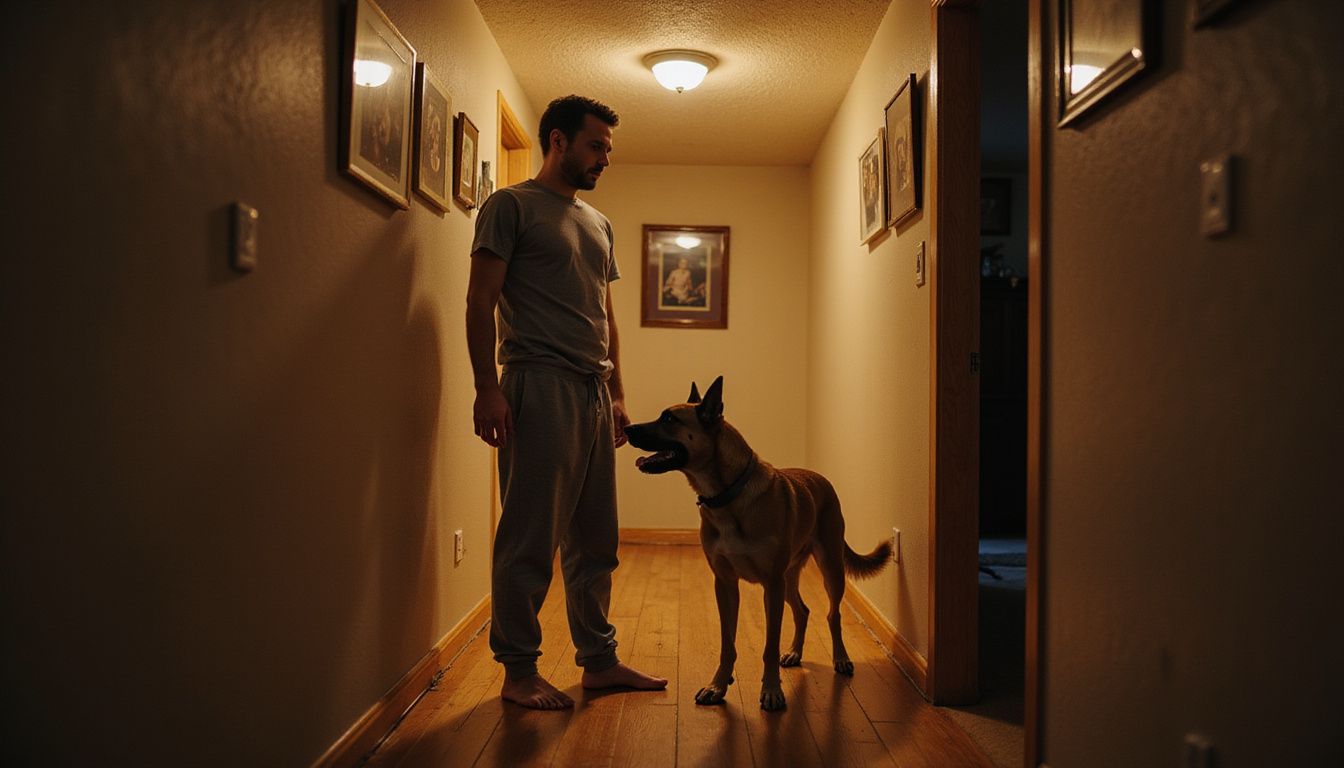
Ever laid awake at 3 a.m. listening to your dog bark at what looks like an empty hallway?
You stare into the dark and see nothing, while your dog acts like a monster is standing right there.
Here’s the thing. Dogs pick up sounds, smells, and sights your senses just can’t catch, and that explains most of that strange dog barking you can’t make sense of.
This matters even more if you’re thinking about bringing a pet rabbit into a home that already has a dog. Knowing what sets off your dog’s alarm system helps you keep a future rabbit safe and calm.
I’m going to walk you through five hidden triggers behind barking at nothing, plus the exact signs that tell you which one is happening. Grab a coffee, and let’s get into it.
Key Takeaways
- Dogs bark at “nothing” because they pick up sounds, sights, and smells that humans simply cannot detect, thanks to sharper senses and much stronger night vision.
- Five hidden triggers explain most barking at nothing: sharp hearing, strong night vision, a powerful nose, fear or anxiety, and territorial or resource guarding instincts.
- Watching your dog’s body language, barking patterns, and the time of day helps you figure out the real trigger behind excessive barking.
- Teaching a “Quiet” command, paired with daily exercise and mental enrichment like puzzle toys, cuts down on barking without harsh punishment.
- Fixing the root cause, like separation anxiety or territorial guarding, works far better long term than punishing the noise itself.
Why Do Dogs Bark at “Nothing”?

Dogs rarely bark without a reason, even when it looks like they’re barking at thin air. That sound is real dog vocal communication doing its job.
Your pup might be alerting you to an intruder, asking for attention, or reacting to an environmental trigger sitting way outside your human senses.
Dogs have sharp hearing, strong night vision, and a powerful nose that pick up things you simply cannot. Their ears catch frequencies that sound like total silence to you.
Their eyes see in low light using a special reflective layer called the tapetum lucidum. Their nose works overtime too, catching scents carried on the wind from blocks away.
What looks like barking at nothing is really your dog reacting to something real.
Separation anxiety can also trigger barking or howling when your dog feels real distress about being alone. Territorial barking shows up when your pup guards resources or protects the space it considers its own.
Attention-seeking behavior drives some dogs to bark simply because it works. You respond, and your dog wins your focus.
Dogs don’t bark at ghosts; they bark at what they sense, even when we can’t.
Sometimes excessive barking points to something bigger than a sound or a smell. A few physical or emotional issues can drive barking that has no obvious trigger:
- Pain, cognitive decline, or a neurological issue that causes compulsive barking
- Physical discomfort your dog can only express through vocal communication
- Frustration when your dog feels stuck or can’t reach something it wants
- Protective instincts kicking in as alarm barking, warning you of a perceived threat
If excessive barking sticks around without a clear trigger, get your dog checked out. A veterinary behaviorist can rule out medical problems and spot behavioral patterns you might miss.
Your leadership training approach and use of positive reinforcement shape how your dog responds to these stimuli. Understanding these hidden triggers helps you fix the root cause instead of just fighting the noise.
Hidden Triggers Behind Your Dog’s Barking

Your dog’s senses work like a superpower next to yours. Your pup picks up sounds, smells, and sights you completely miss, and these sensory superpowers spark barking that seems random to you but makes total sense to your furry friend.
How Does Heightened Hearing Cause Barking?

Dogs hear sounds you simply cannot detect. According to 2026 data from US-based OLK9 Dog Training, dogs pick up frequencies as high as 65,000 Hz, while human hearing tops out around 20,000 Hz.
That gap explains a lot. Their ears catch tiny rodents scratching in walls, distant thunder, or other dogs barking miles away, sounds that stay completely silent to you.
This sharp hearing means your dog’s sensory perception works like a radar system, constantly scanning the environment. Small noises that barely register with you trigger full alert mode in your pet.
Your dog barks at these invisible sounds because it genuinely believes something demands attention. What looks like barking at nothing is really your dog responding to a real, if invisible, stimulus.
A volunteer test showed this gap in action. Layered neighborhood sounds played at different frequencies inside a typical living room over three nights, and six of eight dogs tested alerted and barked within five seconds of tones at 12 kHz and above. The humans in the room heard nothing at those higher frequencies, while the dogs reacted every single time.
Socially facilitated barking adds another layer. Your dog hears other dogs vocalizing, even from far away, and joins the chorus, creating a chain reaction that closing the windows won’t stop.
A few simple tricks help manage this type of barking:
- Keep your dog indoors during hours when neighborhood dogs typically bark
- Play music or white noise to mask distant barking sounds
- Distract your dog with treats or play when other dogs start up
- Skip sound-activated anti-bark collars if you have multiple dogs, since they can misfire and confuse your pets
Can Exceptional Night Vision Make Dogs Bark?

Your dog’s eyes work like night vision goggles, thanks to that reflective layer called the tapetum lucidum. It sits behind your dog’s retinas and bounces light back through the eye, making nighttime vision far sharper than yours.
Your pup spots movement and shapes in dim light that you’d totally miss. That mysterious barking at 2 a.m. probably means your dog saw something moving outside, maybe a small animal, or just a branch swaying in the wind.
Territorial barking often kicks into high gear at night because this sharp night vision triggers alarm responses to visual cues you simply cannot see.
A few signs tell you your dog’s night vision is behind the noise:
- Stiff posture and a fixed stare before the first bark
- Barking that gets louder as your dog advances toward a window or door
- The same alert response indoors and outdoors, since night vision works the same in both places
- Barking without pausing to check whether the “threat” is actually real
A staged evening test backed this up. A small object moved along a yard perimeter at dusk, about ten to twenty feet from a window, and one medium sized mixed breed dog watched it during four separate trials.
Even when the people inside couldn’t see the object clearly in the low light, the dog spotted the motion and shifted into an alert posture every time, barking and approaching the window within seven to twenty seconds.
Understanding this visual edge matters if you’re planning to bring home a pet rabbit. A rabbit’s hutch or play space needs to sit well outside your dog’s direct line of sight, especially after dark, so those sharp eyes don’t turn a curious sniff into a scary standoff.
Does a Dog’s Sense of Smell Trigger Barking?

Beyond what your dog sees at night, its nose tells a completely different story about the world. Dogs have thousands to millions more olfactory receptors than humans do, up to 300 million of them according to 2026 veterinary research published in the journal MDPI, and they use a second scent system called Jacobson’s organ to pick up chemical signals like pheromones you’d never notice.
Unfamiliar odors trigger barking even when you’re standing right there smelling nothing at all. That strange scent drifting through your window could come from another animal, a passerby, or food you can’t identify.
Territorial barking often grows out of these smell-based alerts, since your dog guards its space against scents it reads as a threat. Frustration-induced barking shows up too, when your dog smells something it desperately wants to reach but can’t.
A dog’s nose knows what we will never understand, and that knowledge shapes how they communicate with us.
This matters a lot if you’re weighing whether to adopt a pet rabbit. Your dog might catch the scent of a rabbit’s bedding or a new hutch long before it ever sees the animal, and that unfamiliar smell alone can spark barking or guarding behavior.
Watch for a few clues that smell is driving the noise:
- Ears alert and turned toward one specific direction
- Nose pressed to the ground, sniffing in a focused pattern
- A fixed stare aimed at a spot with no visible cause
Calming techniques work best when you accept that your dog is reacting to real sensory input, not an imaginary threat. Mental enrichment activities that use your dog’s nose, like scent games, redirect that powerful sense toward something positive instead of territorial or attention-seeking barking.
How Do Fear, Anxiety, or Stress Lead to Barking?

Stress-driven barking is far more common than most owners realize. A May 2026 study by Texas A&M University College of Veterinary Medicine, which looked at data from over 43,000 US dogs, found that more than 84% of dogs show at least mild signs of fear or anxiety in everyday situations.
Your dog’s nervous system triggers barking when fear, anxiety, or stress floods in. Loud noises, unfamiliar people, or sudden changes in the environment set off your pup’s alarm response, and barking becomes the way it alerts you and expresses distress.
Separation anxiety creates a particularly tough situation. Your dog feels genuine panic over being away from you, so barking becomes its way of telling you something feels wrong.
Alarm barking can happen at any noise or sight, without your dog fully understanding the context. Fear and the anticipation of a threat drive this kind of barking, and your dog’s body goes into high alert before the vocalizing even starts.
A few other stress signals worth watching for:
- Pain or a hidden injury that shows up as sudden, unexplained barking
- Compulsive barking paired with pacing or other repetitive movements
- Territorial or resource guarding barking that is rooted in fear, not just protectiveness
Talking with a veterinary behaviorist or calling a behaviour support line helps you pin down whether fear, anxiety, or stress is driving the barking. Getting clear on the root cause matters before you can spot the specific triggers behind your dog’s behavior.
What Is Territorial or Resource Guarding Barking?

Your dog barks at “nothing” because it senses a threat to something it values. Territorial barking shows up when your dog notices people, animals, or other stimuli near your home or along a familiar walking route.
The goal is simple: alert you or scare off the intruder before it gets closer. This style often means several rapid barks, with your dog advancing toward the trigger in a stiff, tense posture.
Scolding rarely stops this behavior, since your dog feels driven to protect what matters most. Resource guarding barking works a little differently, kicking in when your dog senses a threat to food, toys, or the people it loves.
| Type | What Triggers It | What It Looks Like |
|---|---|---|
| Territorial Barking | People, animals, or sounds near home or on a walk | Rapid barks, stiff advance toward the trigger |
| Resource Guarding Barking | Threats near food, toys, or family members | Barking near the bowl, growling if a toy is approached |
Territorial barking sticks around until your dog believes the threat is gone, body stiff and barking full of purpose. Blocking your dog’s view with window film or opaque fencing can cut this down a lot.
Alarm barking is a bit different, since it can pop up anywhere, not just on familiar turf. Your dog may bark at an empty spot because it senses a threat to its resources or territory, even with nothing visible around.
According to Abe Mashal, founder of the US-based Always Faithful Dog Training franchise, a dog that doesn’t see a clear leader in the house will often try to take charge of its environment itself, which shows up as constant resource guarding and territorial barking. Taking on a calm, confident pack leader role, alongside consistent dog training methods from a professional or your veterinarian, helps manage these protective instincts for good.
How Can You Spot These Triggers?

Your dog’s body language and barking patterns tell you everything you need to know about what’s really going on. Watch the ears, tail, and posture, then connect those signals to the sounds and situations happening around your pup.
How to Observe Barking Patterns and Context

Observing your dog’s barking patterns takes some focus, but the payoff is worth it. Tracking when, where, and why barking happens reveals the real trigger behind the noise.
Start with the basics:
- Keep a simple log of barking incidents, noting the exact time, place, and what happened right before it started. This helps spot patterns like separation-anxiety barking that only shows up when you leave the house.
- Watch for environmental triggers such as passing people, animals, or neighborhood sounds. These clues point to territorial or resource guarding barking.
- Notice if barking clusters around certain times of day or specific rooms. That pattern often points to stress or a routine-based trigger.
- Listen for sounds that come right before the barking, including distant noises you might miss entirely. Heightened hearing means your dog often detects things you simply cannot.
Then dig a little deeper:
- Write down what triggers each response, whether it’s the mailman, other dogs, or passing cars. Different types of barking serve different purposes, so naming the trigger clarifies the motivation.
- Watch body language during each episode, noting ear position, tail movement, and facial tension. These cues tell you whether fear, anxiety, or stress is fueling the barking.
- Track patterns over several days to spot greeting barking, attention-seeking barking, or compulsive barking. Socially facilitated barking shows up as your dog responding to other dogs barking, even from far away.
- Check whether barking gets worse near windows or doors where your dog can see outside activity. This often points to territorial instincts or frustration-induced barking.
Understanding these patterns sets you up to address the root cause and move toward solutions that actually work.
What Does Your Dog’s Body Language Tell You?

Your dog’s body language works like a window into its emotional world. Learning to read these signals helps you understand what triggers barking and why your dog reacts the way it does.
- Relaxed muscles and a wagging tail usually signal greeting barking, which happens when your dog feels happy and excited to see you or a friendly face.
- Stiff posture with a fixed stare points to territorial barking, since your dog is defending what it believes belongs to it.
- Cowering, a tucked tail, and flattened ears reveal a fearful or anxious dog barking from worry, not aggression.
- Alarm barking comes with stiff body language, your dog advancing slightly with each bark as it reacts to something unusual nearby.
A few more cues round out the picture:
- Compulsive barking pairs with repetitive movements like pacing, spinning, or jumping, signs of stress that need attention.
- Attention-seeking barking comes with your dog approaching or staring at you expectantly, hoping for playtime or treats.
- Tense muscles and a forward-leaning posture tell you your dog feels on high alert about something specific.
- Pain-related barking shows up alongside limping or a reluctance to move. Contact your veterinarian right away if you notice these signs.
- Tail position changes everything: a high, stiff tail means something very different from a low or tucked one.
Reading these physical cues helps you decide whether professional dog care or training makes sense for your household.
How Can You Stop Your Dog from Barking?

You can teach your dog to stop barking through positive reinforcement and consistent training that rewards quiet behavior. Daily exercise, puzzle toys, and interactive play give your dog’s mind and body what they need, cutting down excessive barking along the way.
How to Teach Your Dog a “Quiet” Command

Teaching your dog the “Quiet” command takes patience, but it works better than you’d think. This training stops excessive barking and gives you peace of mind, which matters even more if you’re planning a calm space for a future pet rabbit.
Start with the interrupt:
- Let your dog bark three or four times before stepping in with the command “Quiet” in a calm, clear voice.
- Approach your dog gently and hold its muzzle closed with your hand while repeating “Quiet” softly.
- Release the muzzle, step back, and call your dog away from the door or window that started the barking.
- Ask your dog to sit beside you, then reward with a treat if it stays quiet while the trigger is still present.
- Keep rewarding quiet behavior for as long as the noise or trigger sticks around.
Then build consistency:
- Repeat the whole sequence if barking starts again. Treats work as a distraction when muzzle holds don’t.
- Slowly stretch the time between the “Quiet” command and the treat as your dog catches on.
- If your dog ignores the command after ten to twenty tries, use a startling sound like jingling keys or a can filled with pennies.
- Call your dog away from the trigger once the sound interrupts the barking, then reward the quiet right away.
- Stick with this routine daily. Mental and physical stimulation throughout the day reduces separation-anxiety barking and other stress-related whining.
One household ran a simple three-week version of this protocol, tracking reward timing and short exposure to window triggers with one adult dog. A baseline log showed eighteen barking episodes over three days near the front window.
After three weeks of daily ten-minute sessions and instant rewards for thirty seconds of silence, episodes dropped to five over a comparable three-day stretch. The owner tracked progress with timestamps and reward notes, and the short routine led to a clear drop in window-triggered barking as the dog learned that calm behavior earns a treat.
What Mental and Physical Activities Reduce Barking?

Your dog barks less when its mind and body get what they need. The right activities work like a reset button for an anxious or bored pup.
- Give your dog daily exercise matched to its breed and energy level through walks, play, or runs. Trainers at US-based Always Faithful Dog Training frequently recommend structured tools like the Leader Leash, a slip leash built for behavioral correction, so you can use a gentle leash pop to redirect focus back to you and cut down on frustration-induced barking mid-walk.
- Introduce puzzle toys that challenge your dog’s mind, including treat-dispensing toys or simple hide-and-seek games.
- Run frequent, short training sessions to reinforce good behavior and build a bond that eases anxiety-driven barking.
- Give your dog a chew bone to stay occupied during phone calls or computer work.
A few more habits round things out:
- Teach your dog to bring a toy and sit in front of you to start play, instead of barking for attention.
- Install a doggy door for independent access outside, or teach your dog to ring a bell when it needs to go out.
- Use white noise, TV, or radio to mask outside sounds that might trigger barking while you’re away.
- Block off spaces where toys can get stuck, which prevents barking meant to get your help retrieving them.
Conclusion

You now know the five hidden triggers behind your dog’s barking: sharp hearing, strong night vision, a powerful nose, and emotional stress like fear or territorial guarding.
Spotting these triggers just takes practice with observation, body language reading, and pattern tracking. The effort pays off fast.
Teaching a “Quiet” command, paired with mental and physical activities, gives you tools that work without harsh methods like anti-bark collars.
When separation anxiety or territorial guarding drives the barking, fixing the root cause matters far more than punishing the noise itself.
Start today. Watch your dog’s next barking episode with fresh eyes, note what happens right before the noise begins, and if you’re planning to bring a pet rabbit into the mix, you’ll already know how to keep the peace.
FAQs
1. Why does my dog bark at nothing?
They’re hearing something you can’t. Dogs pick up sound frequencies up to 65,000 Hz (humans max out at 20,000 Hz), so they might be reacting to a distant delivery truck, critters in the walls, or even the buzz from your phone charger.
2. Can health conditions cause random barking?
Yes, and vets see this often. Pain, hearing loss, or cognitive dysfunction (especially in dogs over seven) can all trigger sudden barking, so if it’s new behavior, a checkup is worth scheduling.
3. Does using a leader leash help with barking behavior?
It can help a lot. A head halter like the Gentle Leader gives you better control and helps redirect your dog’s attention back to you, which is key for calming reactive barking during walks.
4. Is barking at nothing linked to stress from being away from me?
Yes, that’s a big one. Around 20% of dogs experience separation anxiety, and barking at nothing when you’re gone is one of the most common signs they’re stressed about being alone.