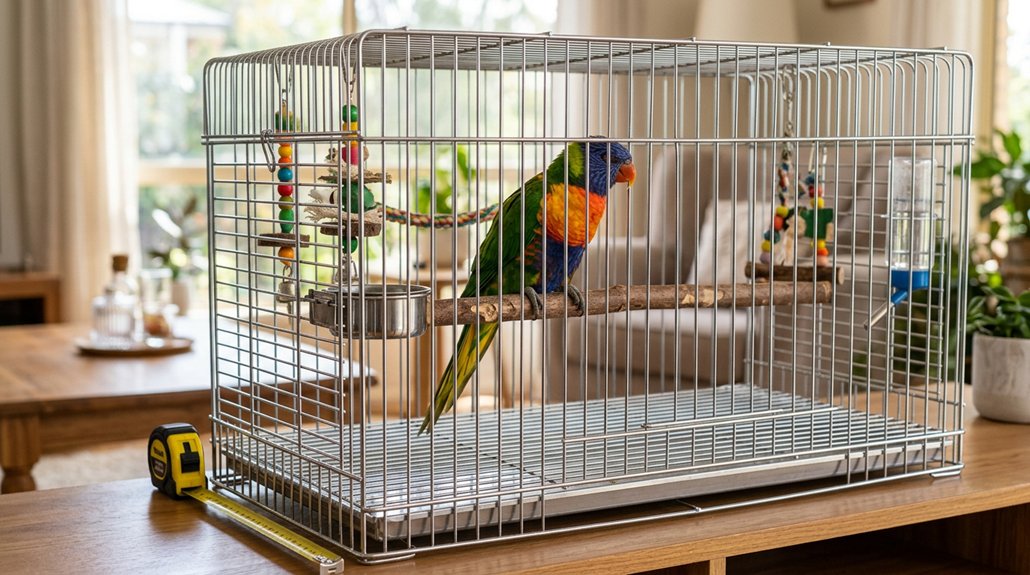
Your bird needs a cage that lets it fully extend its wings and flap without hitting perches, dishes, or toys. As a rule, width and depth should be 1.5–2 times your bird’s wingspan, with horizontal space more important than height. Budgies need about 27 × 24 × 24 inches, while cockatiels and small conures need about 28 × 18 × 22 inches. Bar spacing, materials, and interior layout matter too, and the details can change the best fit.
Key Takeaways
- Cage width and depth should be about 1.5–2 times your bird’s wingspan for full extension and flapping.
- Prioritize horizontal space over height, since usable flight and exercise matter more than tall cages.
- Choose species-appropriate minimum sizes, like 27″ × 24″ × 24″ for budgies and 28″ × 18″ × 22″ for cockatiels.
- Make sure bar spacing matches the bird’s size, preventing escapes while allowing safe climbing and movement.
- Account for perches, dishes, and toys, because they reduce clear space inside the cage.
What Size Bird Cage Does Your Pet Need?
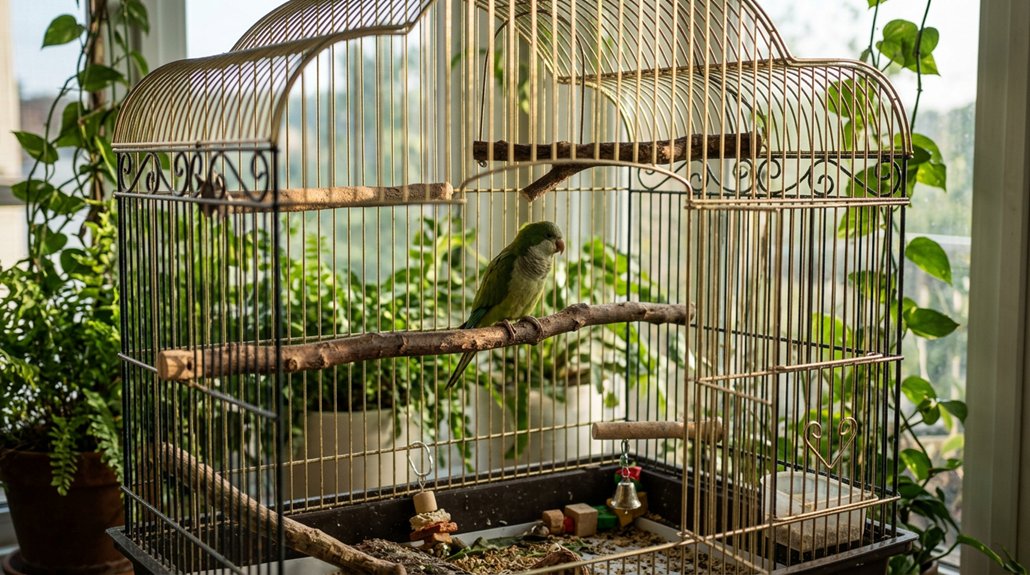
To size your bird’s cage correctly, start with the bird’s wingspan: a good rule is to choose a cage at least 1.5–2 times that width and depth so your pet can fully extend and flap without striking the bars. You should prioritize horizontal space over height, because usable flight area matters more than vertical volume. For a budgie, that usually means about 27″ wide x 24″ deep x 24″ high minimum, with a 36″ flight cage better. Don’t forget perches, dishes, and toys; they reduce clear space. Check room layout, door placement, and cleaning access before buying, and allow safe temperature control away from drafts. Use ≤1/2″ bar spacing and sturdy powder-coated or stainless steel construction. A travel carrier won’t replace proper cage dimensions, so size for daily use.
Cage Size by Bird Species
Once you’ve matched the cage to your bird’s wingspan and daily movement, the next step is to adjust those dimensions to the species itself, since activity level, body size, and beak strength vary widely. For a small parakeet or parrotlet, use at least 18″ x 18″ x 20″; a 36″ flight cage is better.
- Cockatiels and small conures need about 28″ x 18″ x 22″.
- Larger conures and caiques do better at 32″ x 23″ x 31″.
- African greys, Amazons, and small cockatoos typically require 36″ x 28″ x 46″.
- Small macaw cages are about 34″ x 24″ x 40″.
- A large macaw needs an enclosure near 80″ x 40″ with 1″–1¼” bar spacing and heavy bars.
Why Horizontal Space Matters
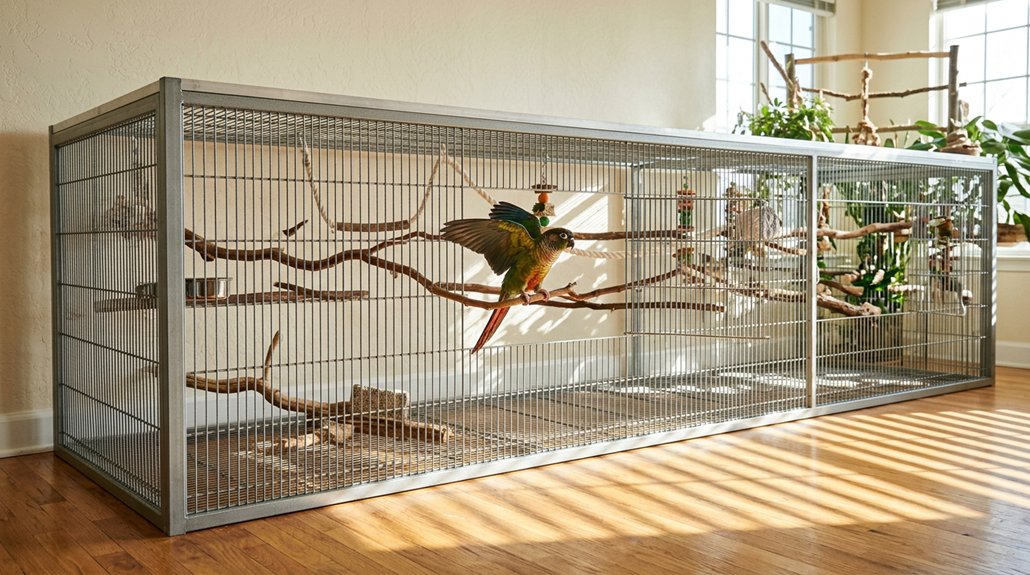
Horizontal space matters more than height because birds rely on width and length for wing-flapping, short flights, hopping, and running far more than they use vertical space. When you size a cage, prioritize horizontal dimensions so your bird can maintain natural wing extension and move along unobstructed flight paths. A practical benchmark is cage length at 1.5–2 times your bird’s wingspan; flight cages often use width and depth of 1.5–3 times wingspan to permit full flapping without contacting bars. If horizontal room’s too limited, you’re restricting exercise and increasing stress and abnormal behavior. Remember that perches, toys, and dishes consume usable floor area, so subtract their footprint when evaluating actual flight space inside the enclosure.
How to Choose Safe Bar Spacing
Safe bar spacing should be matched to your bird’s size so it can’t slip its head, wings, or feet through the bars; as a rule, small birds such as budgies, parrotlets, and finches do best with 1/2″–5/8″ spacing, medium birds like cockatiels and small conures need about 1/2″–3/4″, and large parrots usually require 3/4″–1″. Measure your bird’s maximum head width, then verify the opening is narrower for head safety.
- Check bar patterns for uniform gaps.
- Favor horizontal bars for climbers.
- Avoid scrollwork and mixed spacing.
- Choose thicker gauge wire for chewers.
- Inspect used cages for rust, bends, and loose welds.
Choose Safe Bars and Cage Materials
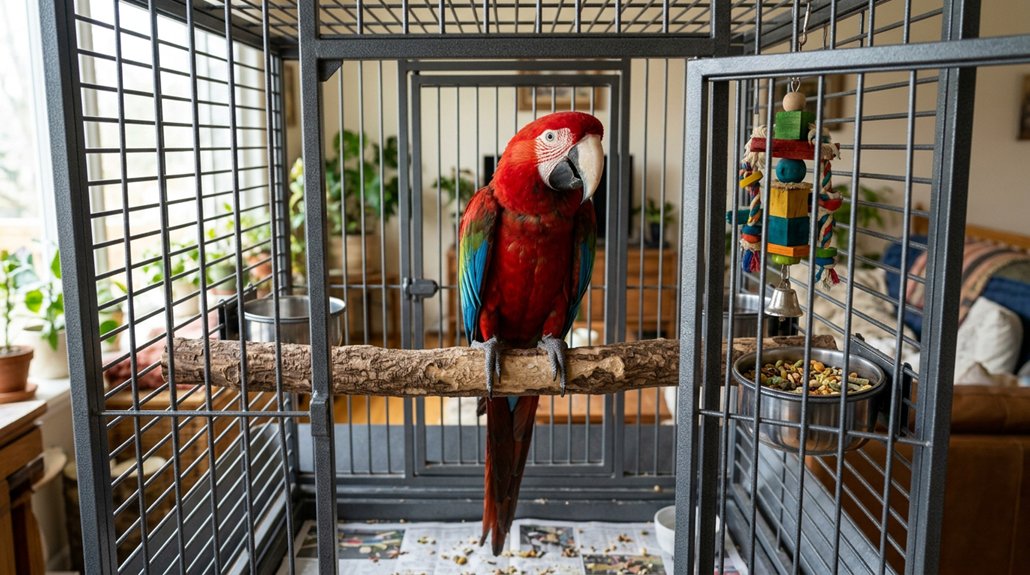
You should match bar spacing to your bird’s species—≤1/2″ for finches, parakeets, and budgies; 1/2“–3/4″ for medium parrots; and 3/4″–1” or more for large parrots—to reduce the risk of head or limb entrapment. You’ll also want the bar orientation to fit the species: horizontal bars support climbing in parakeets and other climbers, while vertical-only bars are more suitable for finches and canaries. Choose powder-coated or stainless steel cages with a sturdy wire gauge, smooth welds, and no flaking finish, rust, loose bars, or toxic metals such as lead or zinc.
Safe Bar Spacing
Bar spacing should match your bird’s size to prevent head or limb entrapment, and it often matters as much as overall cage dimensions. You need species-specific spacing: 1/2″ to 5/8″ for budgies, parrotlets, finches, and canaries; about 1/2″ to 3/4″ for cockatiels, lovebirds, and small conures; and 3/4″ to 1″ for large parrots, with 1″–1 1/4″ for bigger macaws and cockatoos.
- Use horizontal bars for climbing species.
- Avoid decorative scrollwork and uneven widths.
- Check wire gauge for bending resistance.
- Look for predator proof mesh on outdoor enclosures.
- Prioritize chew resistance in larger parrots.
Used cages should show no chipped paint, loose welds, or corroded bars, because weakened metal can fail or expose toxic surfaces.
Durable Bird-Safe Materials
Choose stainless steel or powder-coated steel with non-toxic, baked-on finishes, since stainless steel is the most durable and bird-safe option and won’t chip, rust, or leach harmful metals like zinc or lead. You’ll get better stainless longevity and fewer contamination risks than with painted or plated cages of uncertain origin. Match bar thickness to your bird’s size and chewing force: larger parrots need heavier gauge bars to resist bending, while smaller birds still need rigid construction. Verify welds, joints, and corners are smooth, with no gaps or sharp edges. Avoid flaking paint, rust, or unknown coatings, especially in used cages. Use cages with replaceable stainless-steel dishes and hardware to limit corrosion, simplify sanitation, and reduce toxic exposure over time.
What to Put Inside the Cage
You should equip the cage with at least three perches of differing diameters and materials—natural wood, a textured grooming perch, and a synthetic or rope perch—so your bird’s toes can wrap about 3/4 around each without crowding. You’ll also need multiple stainless steel or ceramic dishes, including a drinking bowl, a bathing bowl, and an extra food crock, plus rotating safe toys such as foraging puzzles, chewable blocks, and a hanging swing to support manipulation and climbing. Arrange these items to preserve clear flight space equal to your bird’s wingspan, and add a removable grate, tray liner, and a quiet sleeping box or cover for sanitation and uninterrupted rest.
Perches And Textures
- Rotate perch diameters
- Add textured grooming perches sparingly
- Use rope or cotton perches
- Replace frayed surfaces promptly
- Avoid brittle PVC perches
Toys, Dishes, And Enrichment
To set up the cage effectively, balance enrichment with open space: include at least three perch types—a natural wood perch, a textured grooming perch, and a soft rope perch—positioned so the bird’s toes wrap about three-quarters of the way around each perch to support healthy foot posture. Add 3–5 toys for a single budgie, including foraging enrichment puzzles, chewable wood or paper items, and a swing; rotate them weekly to maintain sensory stimulation and reduce boredom. Mount food and water dishes externally, or use access ports, and provide two stainless steel or ceramic food bowls plus a shallow bath. Keep a clear wingspan-sized flight lane, secure fixtures with bird-proof clips, and remove frayed ropes or loose parts immediately.
Frequently Asked Questions
What Is the 3-3-3 Rule for Birds?
It’s a sizing guideline: your bird’s cage should be at least 3 times its wingspan in width, depth, and height, supporting flight training and behavioral enrichment while reducing stress, feather damage, and stereotypic behaviors.
What Is the Best Size Cage for a Bird?
You’ll want a cage at least 1.5–2 times your bird’s adult wingspan wide; wider’s better. For budgies, aim for 36″×24″×24″. Check perch placement, door accessibility, bar spacing, and safe materials.
What Is the 60/40 Rule for Birds?
You use the 60/40 rule to size a bird cage: length should be about 60% of wingspan, depth and height about 40%, but you’ll need more space for behavior enrichment and travel safety.
Do Pet Birds Like Being in Cages?
Usually not—you’ll find most pet birds tolerate cages, but don’t prefer prolonged confinement. You’ll need behavioral enrichment and respect for social preferences, since adequate space, toys, and daily interaction reduce stress and abnormal behaviors.
Conclusion
In the end, your bird’s cage isn’t just a box—it’s its whole universe. If you skimp on space, you’re not “saving room,” you’re practically asking for stress, feather damage, and frantic pacing. Choose a cage that fits your bird’s species, gives plenty of horizontal room, and has safe bar spacing and materials. Then fill it with enrichment that truly works. When you get the size right, you’re not overdoing it—you’re meeting a biological need.