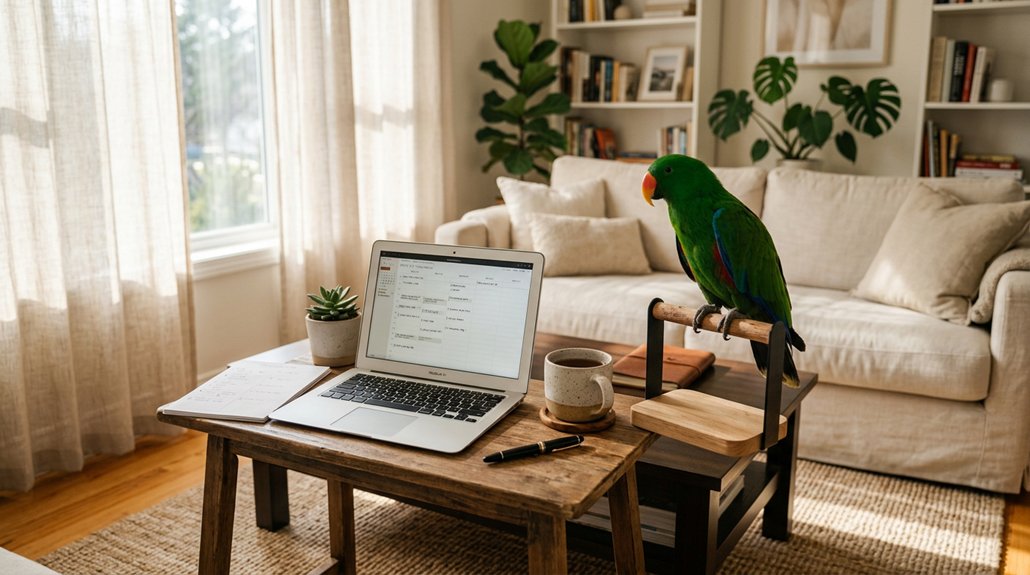
Balance work and owning a pet bird by building a predictable routine: tire your bird before work with 10–20 minutes of flight, recall, or target play, then shift to calm foraging or a toy. Set up a nearby playstand, use noise-canceling headphones, and play soft ambient sound during meetings. Check in briefly at random times, and if screaming, clinginess, or stress persists, a certified bird trainer can help refine the plan with more specific strategies.
Key Takeaways
- Give your bird a predictable morning routine with high-energy play, brief training, and a calm transition before work.
- Set up a bird-friendly workstation with a nearby playstand, foraging toys, and chew-safe enrichment to keep them occupied.
- Teach foraging gradually, rotating toys and puzzles often to prevent boredom and maintain independent engagement.
- Use calming audio, noise control, and headphones to reduce distractions for both you and your bird during work hours.
- Check in briefly at random intervals with a treat or toy so your bird feels noticed without demanding constant attention.
Set Up a Bird-Friendly Workstation
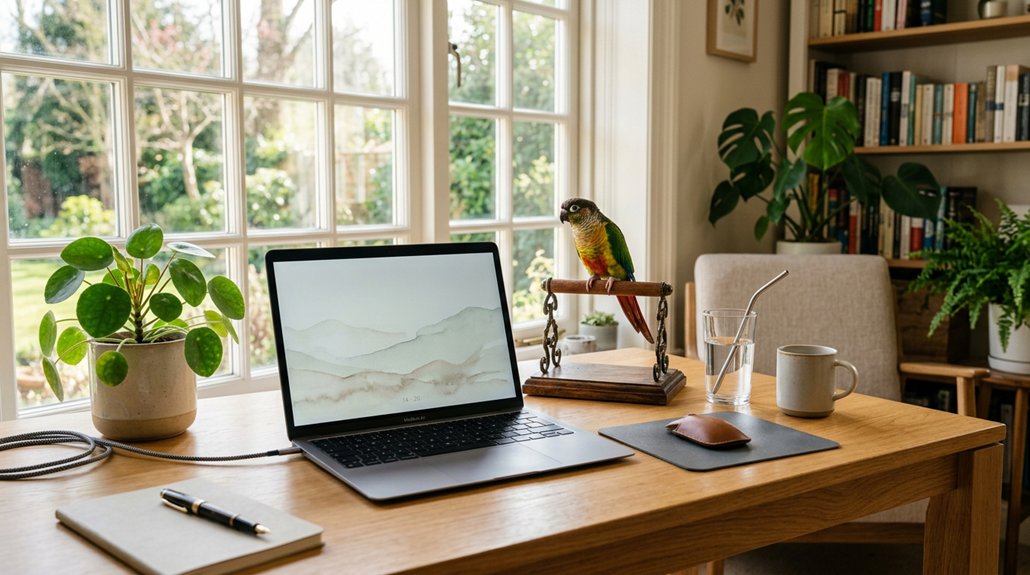
To make your workspace work for both you and your bird, set up a dedicated playstand or Java tree 4–6 feet from your desk so your bird has a visible, engaging station without landing on your keyboard. Position it where light placement supports calm observation, and, if needed, seek arborist consultation for safe wood selection and stability. Keep a foraging tray or 2–3 trained mini-foragers within arm’s reach to sustain independent engagement for 20–60 minutes. Add chew-safe toys and fresh mint, lemon balm, or lavender sprigs, then rotate them weekly. Use soft visual barriers or a slightly elevated perch to limit shoulder access, and train station behavior with high-value treats. A calibrated calming soundtrack can also reduce reactive vocalizations during focused work.
Tire Your Bird Before Work Starts
Before work, you can reduce restlessness by giving your bird a 10–20 minute high-energy play session, such as recall flights or target running. Then add 5–10 minutes of focused training to mentally tire your bird, since brief cognitive work can be as fatiguing as physical activity. Finish with a consistent calm-start routine, including a conditioning cue and quiet shift, so your bird’s activity level drops predictably before your work block begins.
Morning Training Burst
A short morning training burst can markedly improve how settled your bird is during the first work hours: wake them 15–30 minutes before you start, then spend 10–20 minutes on high-energy activity such as flying, target-running, or brief recall drills to reduce excess arousal. Use early wakeups consistently, because rushed starts undermine regulation. Begin with 3–5 reps of simple behaviors, paired with high-value treats, so you build focus without fatigue or frustration. After activity, reserve 5–10-minute cuddle windows or handling periods to give social reassurance and lower later attention-seeking. End with a foraging setup or novel toy for 10–30 minutes; this shifts trained effort into independent engagement while you begin work. This sequence creates a predictable wake-play-calm pattern that supports steadier behavior.
High-Energy Playtime
High-energy play can further stabilize your bird’s morning behavior by reducing excess physical and mental arousal before you start work. You should provide 10–20 minutes of flight or supervised out-of-cage running, adjusted to species and fitness, to discharge surplus energy. Add 5–10 minutes of recall, target work, or other active training with high-value treats to tire both body and mind. Follow with 5–15 minutes of vigorous high energy enrichment, such as dancing to music, quick fetch, or multi-perch sprints using flight safe toys. If you wake 15–30 minutes earlier, you can combine handling with this activity and often get quieter behavior for the first work hours. End with a 2–5 minute foraging challenge so your bird shifts from active play to independent engagement.
Calm Start Routine
Usually, a calm start routine works best when you tire your bird before your workday begins. You should schedule a 10–20 minute high-energy session each morning, using flying, running, or recall and station training to reduce excess arousal. After that, add 5–10 minutes of handling, feather massage, or quiet cuddling so your bird gets social contact and is less likely to demand attention later. Then offer a foraging-based breakfast, such as mini-foragers or food hidden under paper, to extend engagement while you start work. Play the same calming soundtrack, like rainforest noise, white noise, or classical music, 10–20 minutes before logging on; this conditions a settled response you can reuse during meetings. Wake 10–30 minutes earlier to complete the routine. Morning meditation can help you stay consistent.
Teach Foraging and Toy Skills
Build foraging skills in stages so your bird can succeed before the task becomes complex. Begin with free-fed treats on a tray, then hide them under crinkle paper, in flower petals, and later in covered or puzzle toys. During early sessions, use visible, easy rewards in mini-foragers for 3–5 minutes, repeating several times to strengthen behavioral conditioning. Teach toy use by modeling the action: show, partially open, or extract a treat, then reinforce successive approximations—touch, pull, full extraction. For enrichment scheduling, rotate puzzles every 3–7 days and combine food-based with non-food tasks to preserve novelty. Use short video check-ins or camera footage to measure engagement, identify preferred toy types and reinforcers, and adjust difficulty when performance plateaus.
Keep Birds Busy During Meetings
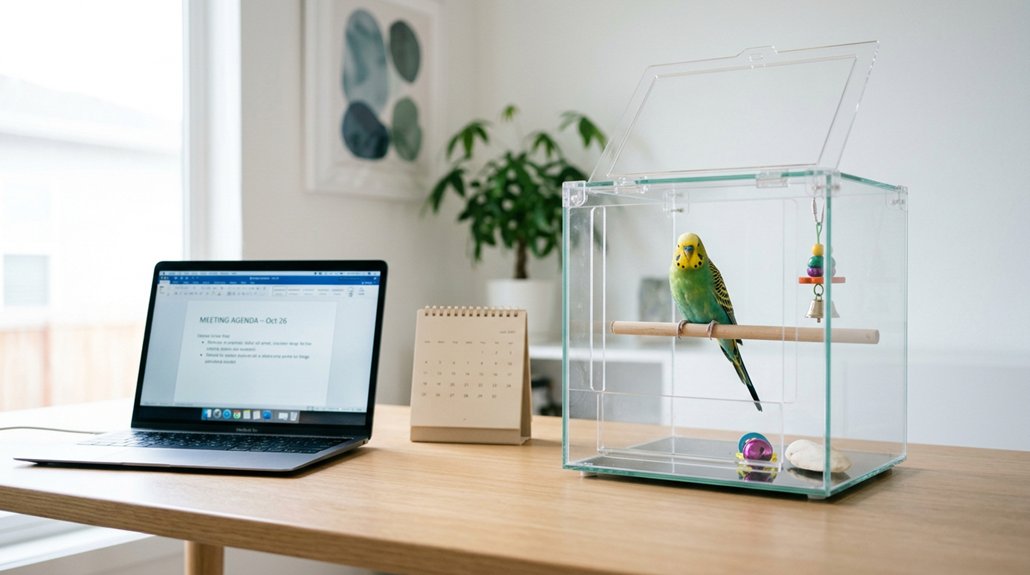
Before important meetings, you can reduce vocalization by giving your bird a 5–10 minute high-energy session and a brief handling routine 15–30 minutes beforehand, which helps expend excess energy. For the meeting itself, you can set up a playstand or Java tree 2–3 meters away with 2–3 high-value foraging toys and a mini-forager, and play a pre-conditioned calming soundtrack 10–20 minutes before and during the call. You can also use noise-cancelling headphones, provide shreddable herbs or a safe foraging snack, and keep check-ins brief and irregular to limit stress without disrupting work.
Pre-Meeting Bird Burnout
A brief high-energy session 20–30 minutes before your meeting can reduce vocalizing and restlessness by lowering arousal and redirecting excess energy. Use pre meeting stretching, then target training or recall for 10–15 minutes, followed by anticipatory feeding of a small treat to reinforce calm.
| Intervention | Timing | Expected effect |
|---|---|---|
| Flight/recall | 20–30 min pre-call | Lowered arousal |
| Calming audio | 10–20 min pre-call | Quiet cueing |
| Fresh mint/shred | Right before call | Focused attention |
| Variable check-in | Between meetings | Less separation calling |
Set a playstand nearby with 2–3 mini-foragers for 30–60-minute meetings. Choose rainforest, waves, or classical tracks; avoid bird calls. Give a mint sprig or safe shredder right before you start. Between meetings, keep check-ins brief and inconsistent.
Foraging And Toy Time
Foraging and toy time can keep your bird occupied during meetings by channeling attention into structured problem-solving rather than vocalizing or pacing. You should begin with easy treats on a tray or mini-forager, then add layers such as flowers, crinkle paper, and toy parts over several days. Provide 3–5 foraging toys and 2–3 high-value treats per session to preserve novelty, especially during long meetings. Demonstrate how to pull, flip, or slide components, since many toys need stepwise teaching. Aim for 20–40 minutes of concentrated activity using shredding items, puzzle feeders, and hidden treats. Track engagement with a pet camera for 1–2 weeks, then adjust difficulty. This sensory enrichment works best with weekly seasonal rotation.
Calm Setup For Calls
Calm, predictable cues can help your bird settle during calls: play a conditioned soundtrack such as rainforest noise, white noise, or classical music 10–20 minutes before and throughout the meeting to cue roosting behavior and reduce vocalizations. Add ambient lighting and scent cues consistently; changing them can raise arousal. Position a playstand or foraging tray 2–3 meters from your desk, stocked with layered puzzles and a high-value treat. Before calls, use a 5–10 minute high-energy session to reduce excess drive. During meetings, wear noise-cancelling headphones, then use brief, variable check-ins and quick treats to prevent attention-seeking.
- Cue calm.
- Occupy independently.
- Reinforce brief success.
Use Noise-Canceling Headphones and Calm Sounds
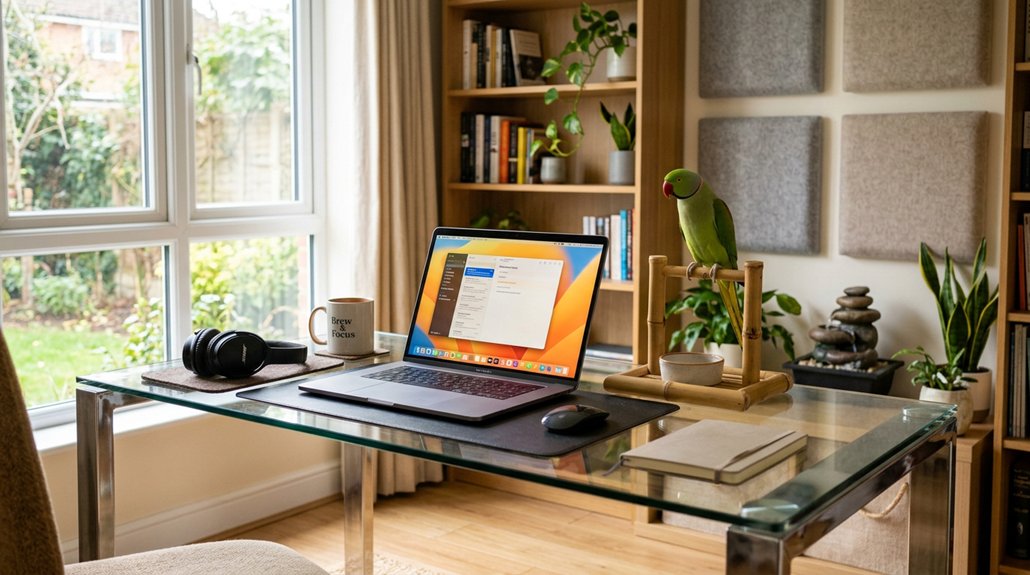
To cut through constant chatter and keep your focus intact, use over-ear noise-canceling headphones or high-NRR earplugs during work sessions. Over-ear ANC models usually suppress broadband chatter best, and soundproofing strategies in your room can amplify that effect. Maintain headphone maintenance by cleaning pads and checking battery life.
| Option | Effect |
|---|---|
| ANC headphones | Reduce steady noise |
| Earplugs | Lower peak calls |
| Calm audio | Cue roosting |
Play rain, waves, white noise, or soft classical music 10–20 minutes before work and continue it during tasks. Avoid bird vocalization tracks; they can trigger territorial calling. Complete silence isn’t realistic, so use these tools to manage, not eliminate, sound. For meetings, route the calming audio to the bird room while you keep your headphones on.
Check In at Random Times
Once you’ve reduced background noise, the next step is to reassure your bird without creating a predictable pattern. Use surprise peekins at irregular intervals, with varying duration from 30-90 seconds, 3-6 times during the workday. This lowers anticipatory anxiety better than fixed visits. During each contact, provide one brief visual or auditory cue:
- Speak softly.
- Offer a tiny treat.
- Toss a small shredding toy.
These random check-ins help maintain trust while avoiding dependence on constant presence. If you keep them exactly on the hour, your bird may learn the schedule and react with stress or vocalizing when you’re late. For a single bird, add 1-2 extra brief contacts. Pair this with one predictable 10-20 minute session before work or at lunch so reassurance stays consistent and measurable.
When to Call a Bird Trainer
If your bird’s noise, clinginess, or stress behaviors keep interrupting your work despite pre-work enrichment, foraging, and variable-time check-ins, it’s time to call a certified bird trainer. You need a behavioral assessment when screaming, feather mutilation, or appetite loss persists, or when independent foraging still fails. A trainer can build shaped routines, station training, and distance/stand coaching that fit your schedule.
| Sign | Response | Result |
|---|---|---|
| Repeated screaming | Assess triggers | Lower interruption |
| Feather damage | Modify routines | Reduce stress |
| Toy refusal | Stepwise shaping | More engagement |
| Meeting disruption | Supervised shifts | Fewer calls |
| Flock escalation | Coordinated plan | Stable behavior |
If handling problems escalate quickly, ask for an emergency referral.
Frequently Asked Questions
What Is the 3 3 3 Rule for Birds?
The 3-3-3 rule means you give your bird 3 minutes of focused interaction, 3 times daily, plus 3 longer play or flight sessions weekly. You’ll use behavior enrichment and training cues to support calm, healthy behavior.
Can You Have a Pet Bird if You Work Full Time?
Yes, you can, if you manage feather boredom with daily enrichment. You’ll need short morning and evening interaction, foraging toys, variable check-ins, and steady routine; otherwise, your bird may develop stress or separation behaviors.
What Is the 60 40 Rule for Birds?
You’re using a 60/40 split: 60% of bird time on behavioral enrichment, training, and exercise; 40% on feeding, cleaning, and basic care. It helps you maintain diet balance and reduce boredom-driven behavior.
Can I Leave My Pet Bird Alone for a Week?
No, you shouldn’t leave your pet bird alone for a week. You’ll need daily care, and ignoring illness or hazards can cause veterinary emergencies. If needed, arrange supervision and maintain flight training routines.
Conclusion
Balancing work and bird care depends on deliberate design and disciplined routines. You set up a bird-friendly workstation, tire your bird before work starts, and teach foraging and toy skills to reduce restless behavior. During meetings, you keep your bird busy and use noise-canceling headphones with calm sounds to limit stress. Random check-ins help you monitor well-being. If problems persist, you should call a bird trainer for targeted, technical intervention.