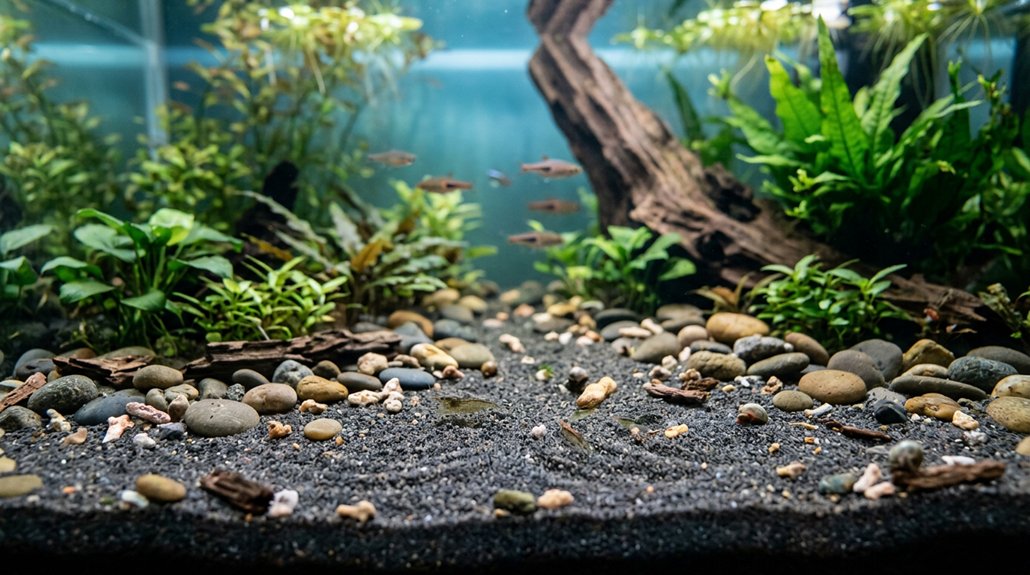
For most freshwater aquariums, you should choose inert gravel or sand because it keeps chemistry stable, is easy to clean, and works well for community fish. If you keep rooted plants, add root tabs or use an active aqua soil, which boosts growth but can lower pH and lose potency after 6–12 months. Match grain size and depth to your livestock, and maintain it gently. If you go deeper, you’ll see how to set it up right.
Key Takeaways
- Choose inert gravel or sand for stable chemistry and easy maintenance in most freshwater aquariums.
- Use active aqua soils for rooted plants needing strong growth, but monitor pH and KH because they can lower both.
- For heavy root feeders, add root tabs or use a two-layer substrate with nutrient soil capped by gravel or sand.
- Match grain size to livestock: fine sand suits Corydoras and loaches, while rounded 4–12 mm gravel suits most community tanks.
- Keep substrate depth around 2–5 cm, and vacuum gently to prevent compaction and anaerobic pockets.
Choose the Best Aquarium Substrate
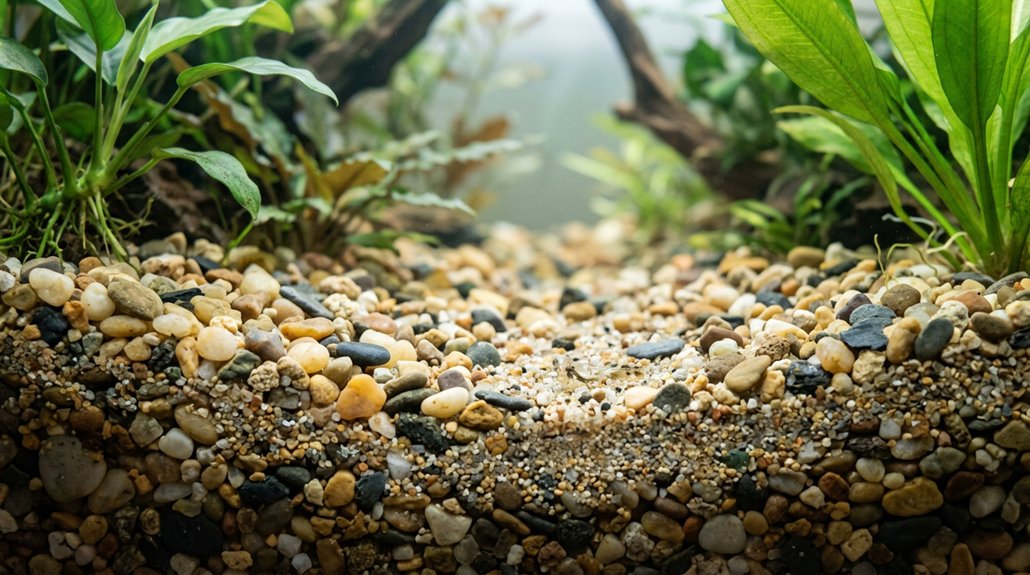
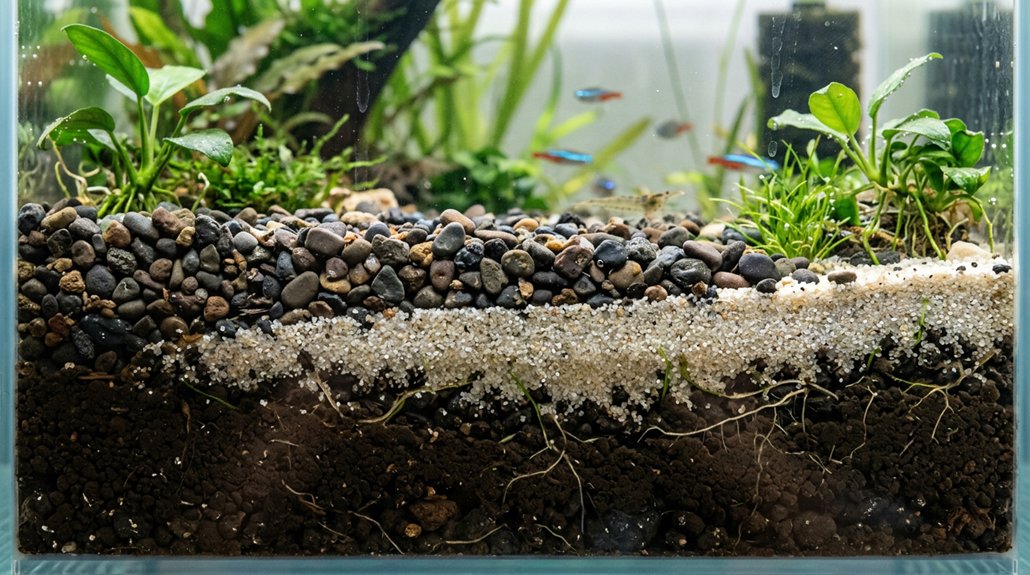
To choose the best aquarium substrate, match it to your plants’ root demands and your maintenance style: clay-based aqua soils like ADA Aqua Soil or Fluval Bio-Stratum support strong root growth and can lower pH/KH, but their nutrient reserve usually fades after about 6–12 months; if you want a longer-lasting setup, a two-layer bed with 1–2 cm of fertilizing soil under 2–5 cm of inert gravel or sand works well. For aquascape aesthetics, pick grain size and color that frame hardscape cleanly. Substrate layering also helps prevent surface compaction and dust. Inert gravel or sand is easy to keep, but medium-to-high demand plants’ll need root tabs or liquid fertilizer. Keep depth at 2–5 cm for most rooted species; use more only for heavy rooters, since fine sand can trap anaerobic pockets.
Why Aquarium Substrate Matters
Your substrate isn’t just decoration—it gives nitrifying bacteria a large surface area, so a 1–2 inch layer can improve biological filtration and ammonia conversion. It also anchors plant roots, and nutrient-rich soils can feed them directly for faster, denser growth than inert gravel or sand. If you choose the wrong depth or material, you’ll limit filtration, weaken root support, and make maintenance harder.
Biological Filtration Benefits
Substrate matters because it often houses most of the beneficial nitrifying bacteria in an aquarium, giving you far more colonization area than the filter media alone. When you choose deeper substrate—over 1 inch—you increase surface area for ammonia-oxidizing and nitrite-oxidizing bacteria, so your tank processes waste more efficiently. Nutrient-rich soils and clay-based aqua-soils can support dense colonies and speed bacterial succession, while also helping recycle waste into plant-available nutrients. For stable biofilm management, avoid overly compacted fine sand that can create anaerobic pockets and reduce nitrifier activity. Instead, match grain size and depth to your livestock and maintenance style. Gentle vacuuming or raking prevents trapped organics from overwhelming bacterial communities and keeps biological filtration working at a high, predictable level.
Plant Anchoring Support
Secure planting starts with the right substrate depth and texture, because most rooted aquarium plants anchor best in about 2–5 cm (1–2 inches) of fine sand or small gravel. You’ll get stronger root anchoring when the grains are fine enough for delicate roots to penetrate without leaving stems loose. For larger species, aim toward 4–5 cm so the root mass can spread and stabilize. Nutrient-rich aqua-soils or clay-based mixes also boost root growth and reduce your need for root tabs. Avoid very fine sand alone if it compacts; it can trap anaerobic pockets and stress roots. If you’re using inert gravel, consider hardscape attachment for Anubias or Java Fern, since they don’t need deep planting and often do better tied to driftwood or rock.
Gravel, Sand, or Soil?
Gravel’s the most common choice: it’s inert, easy to vacuum, and usually needs root tabs or a nutrient layer for heavy plant growth. Sand gives you a natural look and suits bottom-dwellers like Corydoras, but it can compact and trap waste if you don’t maintain it. Soil-based substrates fuel plant roots and bacteria, yet they can shift water chemistry, so you’ll want to match the substrate to your fish, plants, and maintenance routine.
Gravel and Sand Basics
When you’re choosing between gravel, sand, or soil, each one brings a different tradeoff: gravel is the most common and easiest to maintain, sand looks natural and suits bottom-dwellers like Corydoras, and nutrient-rich soils give plants a stronger start. For gravel, pick a grain size that’s stable and a particle shape that won’t compact too tightly. It’s affordable, easy to vacuum, and usually works best at 1–2 inches deep, though rooted plants may need root tabs because it holds little nutrition. Sand gives a softer, more natural look, but it compacts easily, so you need careful vacuuming to prevent anaerobic pockets. Both substrates also add surface area for nitrifying bacteria, so depth and porosity affect filtration, too.
Soil for Plant Growth
If your goal is lush plant growth, nutrient-rich aquarium soil usually outperforms plain gravel or sand because it supplies trace elements and organic matter that encourage faster root development and denser growth. You’ll get better root zone chemistry, especially with aqua-soils like ADA Amazonia or Fluval planted substrates, which can also soften water and lower pH. For a cleaner layout, use a 1–2 cm fertilizing soil layer under 3–5 cm of gravel or sand. That two-layer method feeds roots while limiting nutrient leakage. Inert gravel works too if you add root tabs and keep 2–5 cm depth. Sand’s fine texture plants easily, but it can compact; gravel stays stable. Avoid aggressive vacuuming of clay soils, since breaking granules shortens nutrient life and may disrupt mycorrhizal interactions.
Matching Substrate to Fish
Choosing the right substrate isn’t just about plant growth; it also needs to fit the fish you keep. For substrate compatibility, start with species behavior: community fish usually do best on 4–8 mm gravel, which anchors roots, resists compaction, and supports nitrifying bacteria at 1–2 inches deep.
- Use fine sand for Corydoras and loaches.
- Keep sand shallow, 1–2 cm, to limit anaerobic pockets.
- Choose clay or aqua soil for shrimp and planted biotopes.
- Avoid acidic soils if your fish need neutral or alkaline water.
- Add a soil layer under gravel for nutrients without disturbance.
If you keep burrowers or diggers, give them looser, deeper substrate. Match chemistry and texture to the fish first, then adjust for plants.
Best Substrate for Planted Tanks
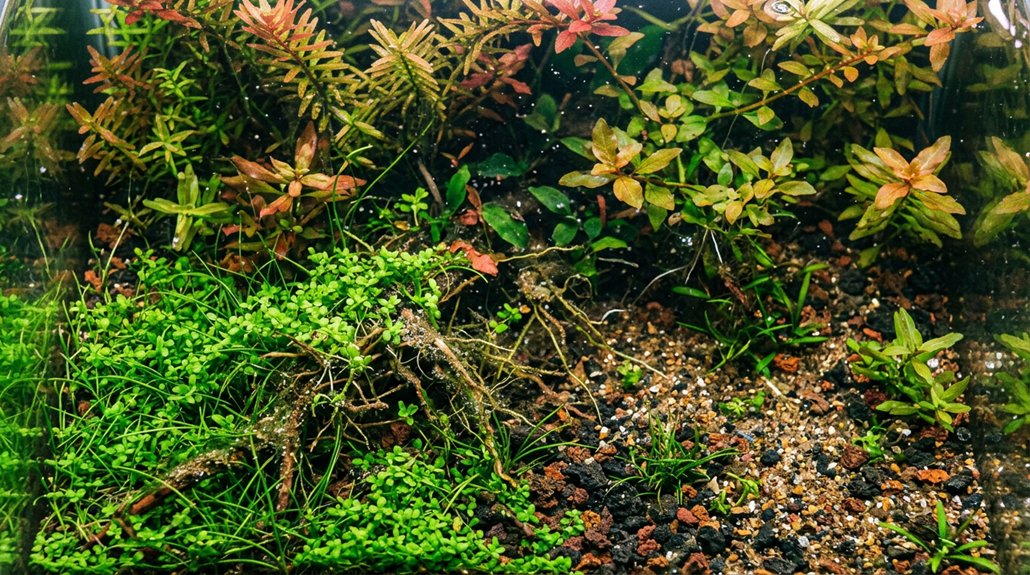
For planted tanks, the best substrate depends on how heavily you want to feed the roots and how much maintenance you’re willing to do. Clay-based aqua soils like ADA Amazonia or Fluval Bio-Stratum give you micronutrients and slowly release nitrogen, phosphorus, and potassium, often boosting growth for 6–12+ months while slightly lowering pH and KH. If you want a simpler setup, use a two-layer bed: 1–2 cm of fertilizing soil under 3–5 cm of gravel or sand. Inert sand or gravel can work, but you’ll need root tabs or liquid fertilizer for hungry plants. Keep sand at 2–5 cm depth, prevent compaction, and rely on capillary action and root competition control so roots stay oxygenated and productive.
Match Substrate to Fish and Maintenance
Once you’ve picked a substrate for plant growth, match it to the fish in your tank and the level of upkeep you can handle. Set substrate depth by function: 1–2 inches of gravel or sand suits basic rooting, while 3–5 cm of nutrient-rich aqua soil supports heavy root feeders.
- Use fine sand for Corydoras and sand-sifters.
- Choose 4–12 mm rounded gravel for most community tanks.
- Expect clay-based or volcanic media to affect pH and KH.
- Select inert gravel or sand if you want stable chemistry.
- Match maintenance tolerance to your budget and cleaning routine.
Deeper beds improve bacterial area, but they can trap waste if you don’t vacuum regularly. Plain gravel or sand is cheaper and easier to clean; planted soils cost more and need gentler handling.
How to Set Up and Maintain Substrate
To set up substrate correctly, aim for 1–3 cm of nutrient-rich plant soil for rooted plants, or about 5–10 cm total if you’re using a gravel or sand cap over an active base. Build substrate layering with 1–2 cm of aqua soil beneath 2–3 cm of decorative gravel or sand. Lightly rinse loose gravel, but don’t wash clay-based soils hard; that strips nutrients and clouds the tank. If livestock is already inside, add material slowly after pre-rinsing to reduce stress. During maintenance, vacuum gently each week, disturb sand minimally, and rake only shallowly to prevent compaction and anaerobic pockets. After 6–12 months, replenish with root tabs or liquid fertilizer. Check pH, KH, and water circulation monitoring monthly, since active soils can acidify water and lose potency over time.
Frequently Asked Questions
What Is the Best Substrate for a Freshwater Aquarium?
You’ll usually want nutrient-rich planted substrates for a planted aquarium; aquarium sand works for many setups, but you’ll need root tabs and liquid fertilizer. For heavy stocking, use sand with fast-growing plants.
What Is the Easiest Substrate to Keep Clean in a Fish Tank?
Aquarium gravel’s like a coarse sieve, so you’ll keep it clean easiest; its gaps let detritus lift out during vacuuming. Sand and planted soil compact more, trapping waste and needing gentler, frequent maintenance.
What Is the Best Thing to Put at the Bottom of a Fish Tank?
You’ll usually want inert gravel or sand, depending on livestock and plants. For planted tanks, plant soil under cap works best; for delicate bottom dwellers, live sand’s safer. Either choice should be at least 1 inch deep.
What Are the Drawbacks of Aquarium Substrate?
You’ll see compaction, waste buildup, and nutrient leaching; fine sands can create toxic pockets, while heavy substrates hinder roots and siphoning. In aquarium archaeology and substrate hydrology, they complicate maintenance and destabilize water chemistry.
Conclusion
Choosing the best substrate for your freshwater aquarium comes down to your fish, plants, and upkeep goals. If you want low maintenance, gravel may suit you; if you’re planting heavily, nutrient-rich soil can give roots a strong start. Sand works well for bottom dwellers, but you’ll need to keep it clean. Pick the substrate that matches your setup, and you’ll build a stable foundation—one that keeps your tank healthy, balanced, and thriving.