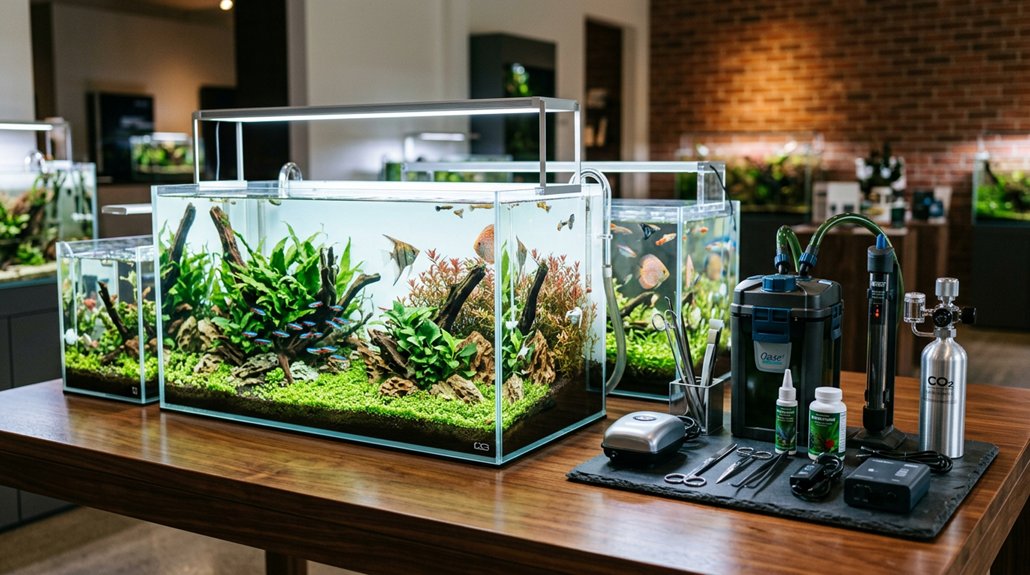
Aquarium equipment can cost about $50 to $200 for a basic small setup, but a larger or better-equipped tank can run $300 to $1,000+ before livestock. You’ll usually spend $20 to $200+ on filtration, $15 to $100 on heaters, and $20 to $200+ on lighting. Glass is often cheaper than acrylic, while saltwater gear costs more. Monthly upkeep can add $10 to $50+, and there’s more to factor in.
Key Takeaways
- Basic aquarium equipment usually costs $50–$200 for small starter tanks, depending on the included filter, heater, and lighting.
- Filtration typically costs $20–$200+, heaters $15–$100, and lighting $20–$200+ based on tank size and quality.
- Larger tanks cost much more: 50+ gallon setups often run $300–$1,000+, with custom systems reaching $50,000–$200,000+.
- Used tanks and equipment can save money, often selling for about 25%–50% of retail or roughly $1 per gallon for tanks and stands.
- Monthly operating costs are usually $10–$50, but saltwater and reef tanks cost more due to salt mix, supplements, and stronger equipment.
How Much Does Aquarium Equipment Cost?
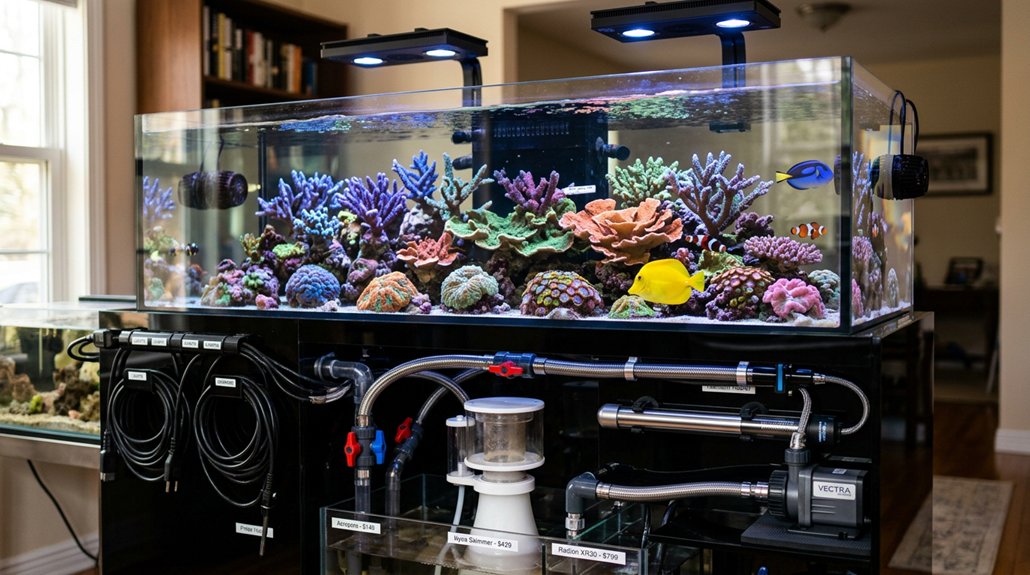
Aquarium equipment costs can vary a lot depending on tank size, system type, and whether you buy new or used. For startup budgeting, you’ll usually allocate $20-$200+ for filtration, $15-$100 for heaters, and $20-$200+ for lighting, depending on performance needs. Stands and canopies often add $50-$200 for standard setups, while custom builds can exceed $500. If you shop used, filters may sell for 25%-50% of retail, and stands often go for about $1 per gallon of capacity. You should also plan maintenance schedules around recurring expenses: media, test kits, and cleaning tools typically add $10-$20 monthly. Saltwater gear like skimmers and powerheads costs more upfront, but often retains 25%-65% resale value.
How Much Does Tank Size Affect Cost?
Tank size is one of the biggest cost drivers because the initial purchase price rises sharply as you move from 10–20 gallon tanks at about $50–$200 to 50+ gallon tanks at roughly $300–$1,000+, with custom systems reaching tens of thousands of dollars. You’ll also see material-based price differences: acrylic usually costs more than glass at the same capacity, with 10–20 gallon acrylic tanks often around $100–$300+ and large acrylic tanks commonly $500–$2,000+. For larger setups, your total cost climbs further because you’ll need stronger stands, heavier filtration, larger lighting, and more substrate, so the expense increases faster than volume alone.
Tank Size Price Jump
Even before you factor in equipment, aquarium size causes one of the sharpest cost jumps in the hobby: a 10–20 gallon glass tank typically costs about $50–$200, while 50+ gallon glass tanks often run $300–$1,000+, and very large custom systems can reach $50,000–$200,000+ once engineering and fabrication are included. As you cross volume thresholds, you’re not just buying more water capacity; you’re paying for stronger structure and higher safety costs. 1. Small tanks: low entry price. 2. Mid-size tanks: noticeable jump. 3. Large/custom tanks: exponential escalation. Used tanks follow the same pattern, since gallonage still sets value. Bigger systems also push up stands, filtration, heaters, and lighting, so your total budget rises faster than the tank price alone suggests.
Material Cost Differences
Material choice changes the price curve as much as size does, because glass and acrylic don’t scale the same way once you move beyond small systems. You’ll usually pay $50–$200 for a 10–20 gal glass tank, but $100–$300+ for acrylic, reflecting better glass clarity and impact resistance. At 50+ gal, glass often runs $300–$1,000, while acrylic commonly starts near $500 and can exceed $2,000. Taller tanks need thicker panels, and low-iron glass adds cost for improved clarity. Used tanks can cut entry costs sharply.
| Material | New Price | Used Price |
|---|---|---|
| Glass | $50–$1,000 | ~$1–$3/gal |
| Acrylic | $100–$2,000+ | ~$1–$2.50/gal |
| Specialty | Much higher | Varies |
These choices also affect maintenance costs over time.
Large Tank Examples
As tank volume climbs, costs rise steeply rather than linearly, because larger systems demand more material, stronger support, and more hardware. A 10–20 gallon glass tank may run $50–$200, while acrylic reaches $100–$300+. At 50+ gallons, glass often lands at $300–$1,000+, and acrylic at $500–$2,000+, before you add stands, filtration, and lighting. For perspective:
- Used 20-gallon glass: about $40–$60.
- New 75-gallon acrylic: often $700–$1,500.
- 5,000-gallon custom displays: roughly $50,000–$200,000+.
You’ll also face installation logistics, thicker glass or low-iron panels, custom supports, and higher livestock and reef equipment costs.
Which Costs More: Glass Or Acrylic Tanks?
You’ll usually pay more for an acrylic tank than a glass one: a 10–20 gallon acrylic can run about $100–$300+, while a similar glass tank is often $50–$200, and the gap widens on 50+ gallon builds. Acrylic’s higher price reflects its lighter weight and better impact resistance, though glass is typically cheaper up front and more scratch-resistant, which can affect long-term ownership costs. If you’re comparing used tanks, older glass and acrylic units often land near $1.00 per gallon, but newer acrylic usually holds a higher resale value at about $1.50–$2.50 per gallon.
Tank Price by Material
Glass tanks are usually the more affordable choice, while acrylic tanks cost more upfront because the material is pricier and harder to fabricate. If you’re shopping for a 10–20 gallon setup, you’ll often see glass at $50–$200 and acrylic at $100–$300+. For 50+ gallons, glass commonly lands around $300–$1,000, while acrylic often reaches $500–$2,000+.
- Small tanks: glass saves you money.
- Mid-size tanks: the gap widens as size increases.
- Custom or display builds: acrylic can support custom finishes, eco friendly materials, and complex shapes, but you’ll pay more.
Used pricing can narrow the difference, especially after a year, yet new acrylic usually stays costlier. For very large systems, costs can scale into tens of thousands quickly.
Durability Versus Clarity
When comparing aquarium materials, the price difference isn’t just about size—it also comes down to durability and optical performance. If you want stronger impact resistance, acrylic usually costs more up front, but it’s lighter and less likely to crack. Glass, however, gives you better scratch maintenance because its surface stays clearer longer and resists routine abrasion.
| Material | Typical Cost | Key Tradeoff |
|---|---|---|
| Glass | Lower | Better scratch resistance |
| Acrylic | Higher | Better impact resistance |
| Low-iron glass | Higher than standard glass | Superior clarity |
For a 20-gallon tank, acrylic can run $100–$250 versus $50–$150 for glass. On larger tanks, the gap widens. You’re paying for performance: acrylic for toughness, glass for crisp viewing.
Used Tank Value Differences
Used tank prices usually favor glass, especially in the used market where older aquariums often trade at roughly $1.00 per gallon, while newer used glass tanks can reach about $2.00–$3.00 per gallon; used acrylic tanks can be pricier when they’re relatively new, typically around $1.50–$2.50 per gallon, but they often fall back to about $1.00 per gallon after a year. You’ll usually pay more for acrylic if it’s clean and under 12 months old, yet scratches can cut resale value fast. Condition matters most: leaks, chips, and cracks justify lower offers. Specialty shapes shift pricing too, with vintage designs like hexagons and bowfronts changing the math. 1. Inspect seams. 2. Check panels. 3. Use negotiation tactics. Glass is harder and cheaper used; acrylic is lighter, but can cost more if recent.
How Much Do Filters, Heaters, And Lights Cost?
Cost adds up quickly once you move beyond the tank itself, and filters, heaters, and lights are usually the core equipment purchases. For filtration, you’ll usually spend about $20 on a small hang-on-back or sponge unit for a nano tank, while large canister filters for big freshwater or reef setups can exceed $200. Heaters for tropical systems typically run $15 to $100, with wattage and brand driving price. Basic LED lighting starts near $20, but planted or reef fixtures often reach $150 to $200+. Don’t forget filter maintenance supplies, replacement media, and lamp upgrades if your setup needs them. When comparing fixtures, check the light spectrum, not just wattage. If you buy used, expect about 25% to 50% of retail for older equipment.
How Much Do Aquarium Fish Cost?
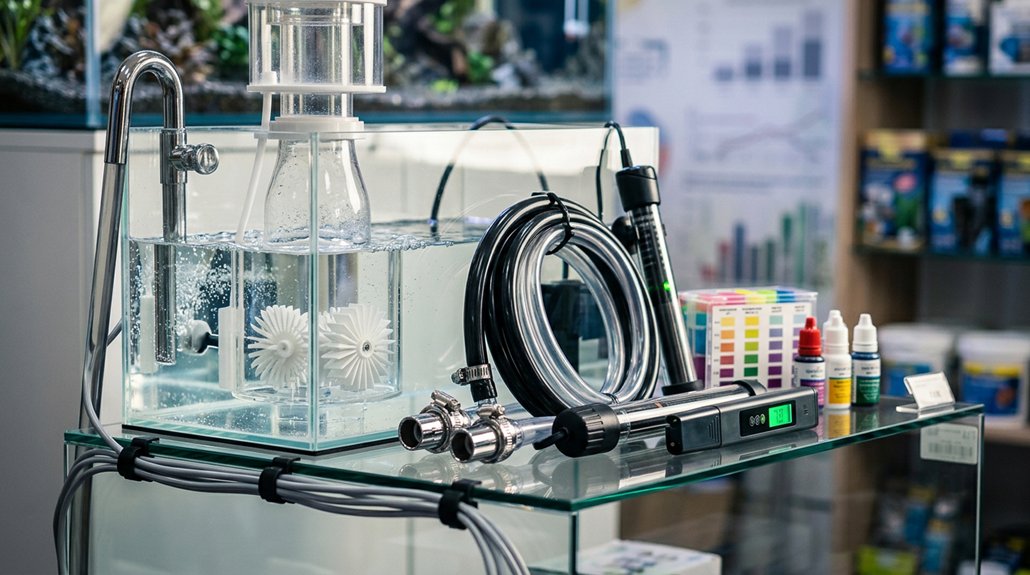
Fish prices vary widely by species, but the livestock itself is usually one of the more flexible parts of your aquarium budget. You’ll often pay under $5 for basic freshwater fish, while bettas and angelfish usually run $5–$20 each. Larger cichlids, such as discus, can cost $20–$100, and marine fish often start at $20–$200+.
- Neon tetras: $1–$3 each
- Community fish: $1–$5 each
- 20-gallon community tank: $30–$100 total
Your final total depends on stocking density, fish welfare, and feeding expenses. Higher-end species may also reflect breeding costs and selective lineage. If you’re building a stable community, choose species that match your tank size and water parameters, because overstocking can raise maintenance demands and stress the fish.
How Much Do Plants, Rocks, And Decor Add?
While livestock is often the most obvious part of an aquarium budget, plants, rocks, wood, and decor can add a meaningful amount to your total setup cost. Live plants usually run $1–$5 each, so a moderately planted 20-gallon aquarium may need $20–$60 in plant stock alone. Rocks and driftwood often cost $10–$50 per piece, and medium-tank hardscaping can total $30–$150. Artificial ornaments generally add $5–$50 each, putting a simple decor package at $15–$50. In a 20-gallon setup, you’ll commonly spend $30–$100 overall, with larger tanks scaling upward. Heavier aquascapes can also require stronger stands, more substrate at $1–$3 per pound, and closer attention to biological filtration and aquascape maintenance.
What Are The Monthly Costs Of Keeping A Tank?
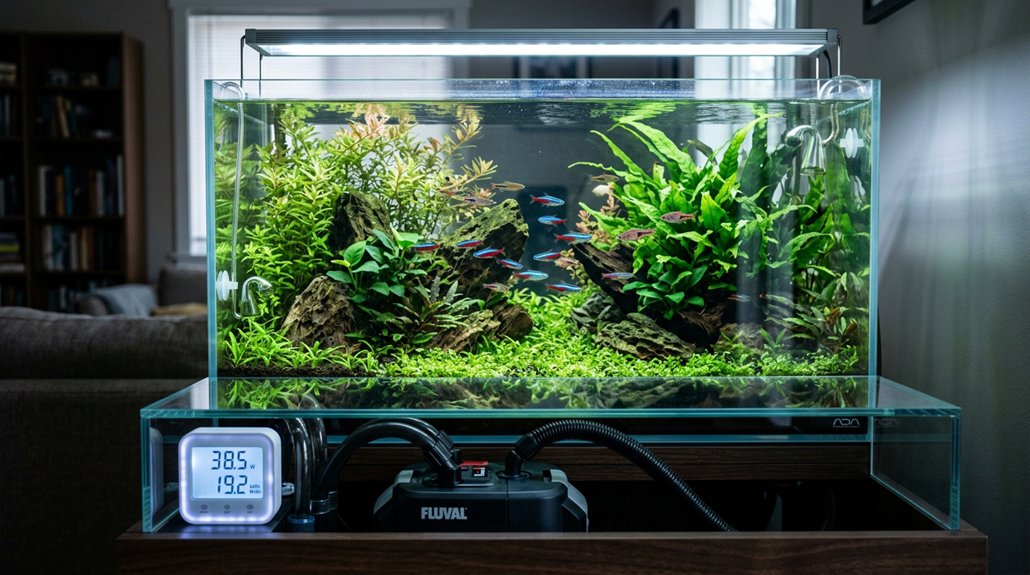
Once the tank is fully set up, the bigger question becomes what it’ll cost to keep it running month to month. Your recurring expense profile usually breaks into three parts:
- Power use: Small aquariums may add only a few dollars to your bill, while larger systems often land around $20–$50 monthly for heating, lighting, pumps, and chillers. Energy efficiency matters here.
- Consumables: Fish food commonly runs $5–$20, and water conditioner averages about $5–$15 per bottle, so budgeting $5–$15 monthly is realistic.
- Maintenance: Filter media, test kits, algae scrapers, and bulbs typically add $10–$20.
If you keep reef or saltwater tanks, recurring costs can climb to $20–$75+ because of salt mix and supplements. Plan for occasional replacements separately in hobby budgeting.
How Can You Save Money On Aquarium Equipment?
You can usually cut aquarium startup costs dramatically by buying smart rather than buying new. Start with a used glass tank and stand in good condition; older glass often runs about $1 per gallon, versus $2–3 per gallon for newer tanks. If you’re buying new, look for kits that bundle the tank, hood, lighting, and filter, since they’re usually cheaper than separate components. Glass is often the best value compared with acrylic for small setups. Match gear to your tank’s actual needs: basic filters can cost $20, while canisters and reef-specific equipment get expensive fast. Use energy-efficient LEDs and heaters, buy multi-packs, and do routine DIY maintenance to extend filter and bulb life. Community swaps can also lower costs.
Frequently Asked Questions
How Much Does an Aquarium Setup Cost?
You’ll usually spend $150–$500 for a basic setup, and $800+ for larger or planted tanks. Add aquarium maintenance supplies, filtration, lighting, substrate, and aquatic plants; ongoing costs’ll run about $10–$50 monthly.
How Expensive Is an Aquarium Hobby?
You’ll spend modestly at first, then steadily; aquarium maintenance costs usually run $10–$50 monthly for small tanks, while bigger systems can be pricier. With long term budgeting, you’re covering gear, livestock, electricity, and replacements.
How Much Does a Full Fish Tank Setup Cost?
You’ll usually spend $300–$900 for a full fish tank setup, depending on size and decorative themes. That includes tank, equipment, substrate, stock, and tests. With beginner maintenance, you can keep monthly costs around $20–$70.
How Much Does It Cost to Start an Aquarium Business?
You’ll likely need $5,000–$20,000 for a small aquarium business, but don’t stop there—market analysis and licensing requirements can push costs higher. Larger operations often demand $50,000–$200,000+ for tanks, stock, equipment, and compliance.
Conclusion
In the end, your aquarium budget depends on the choices you make: tank size, material, filtration, lighting, livestock, and decor. A 20-gallon setup might cost far less upfront than a 75-gallon system, but monthly expenses still add up in electricity, food, and water treatment. Think of it like building a house in miniatures: every piece matters. If you plan carefully, you can avoid surprise costs and keep your tank healthy without overspending.