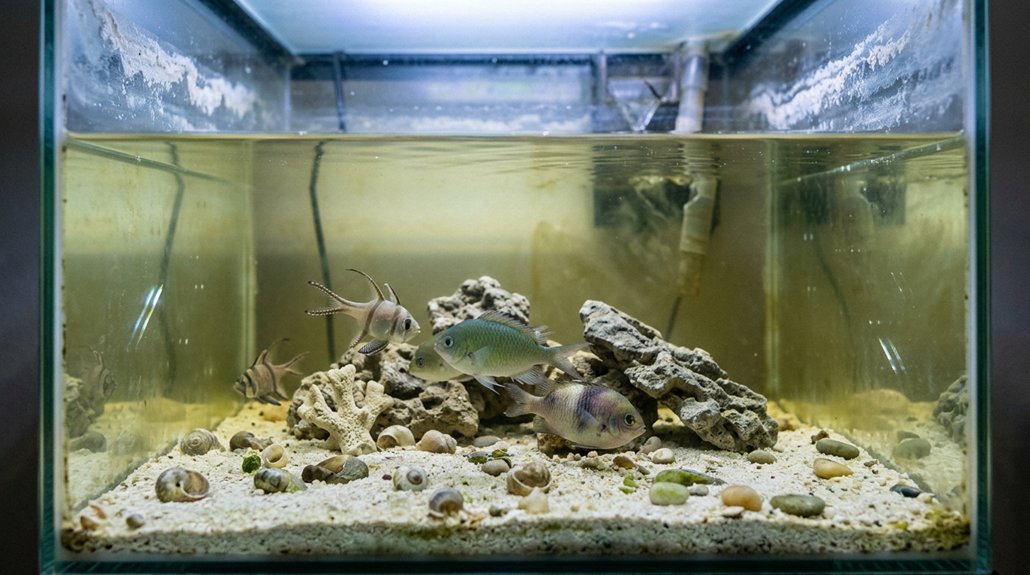
Fish die in a saltwater tank when you have ammonia or nitrite above 0 ppm, nitrate that stays high, low oxygen, unstable temperature, overcrowding, or aggressive tankmates. A new or poorly cycled tank can turn toxic fast, and overfeeding raises waste even more. Disease and parasites also spread easily without quarantine. Household sprays, fumes, soap, or lotion can contaminate the water too. If you want, the main causes are easy to sort out step by step.
Key Takeaways
- Poor water quality from ammonia, nitrite, or high nitrate can quickly stress or kill saltwater fish.
- New or underfiltered tanks often have unstable biological cycles that cause toxic ammonia spikes.
- Low oxygen, weak flow, or temperature swings can trigger gasping, stress, and rapid death.
- Overstocking, aggression, and adding unquarantined fish often lead to disease outbreaks and parasites.
- Household chemical contamination or decaying food can poison the tank and wipe out multiple fish.
Poor Water Quality in Saltwater Tanks
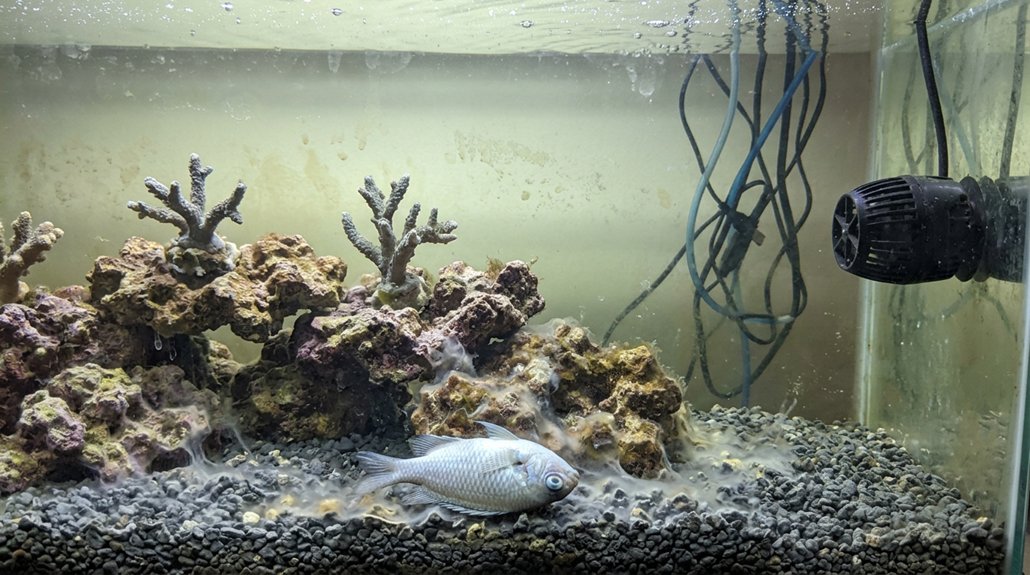
Poor water quality is one of the most common causes of fish loss in saltwater tanks, and the main threats are ammonia, nitrite, low dissolved oxygen, and toxic contaminants. You should expect ammonia and nitrite to remain at 0 ppm in a cycled system; even trace levels can damage gills, provoke gasping, and cause rapid death. In new tanks, beneficial bacteria often aren’t established for 4–8 weeks, so adding fish too early can trigger spikes. Overfeeding, excess stocking, decaying food, or dead animals can overwhelm filtration. Low oxygen from heavy bio-loads, bacterial or algae blooms, and poor surface agitation can kill fish within hours. Also, contaminants from source water, decor, aerosols, or spent carbon can poison fish even when tests look normal. Substrate compaction can trap waste and worsen conditions.
Nitrite, Nitrate, and Salinity Problems
Even when ammonia is controlled, fish can still die if nitrite, nitrate, or salinity are out of range. Nitrite toxicity is severe: even >0 ppm can impair oxygen transport, so you should test daily in new tanks and keep NO2– at 0 ppm. Elevated nitrate is less acute, but sustained levels above about 40 ppm stress fish and reduce disease resistance. Salinity near 1.025 specific gravity supports normal saltwater osmoregulation; unstable or incorrect salinity magnifies toxic effects and adds physiological stress.
- Detectable nitrite: urgent risk
- Nitrate above target: chronic stress
- Salinity drift: osmoregulatory strain
If readings rise, do a 25–50% water change, increase export, and delay new livestock until parameters stay stable.
Why Cycling Problems Kill Fish
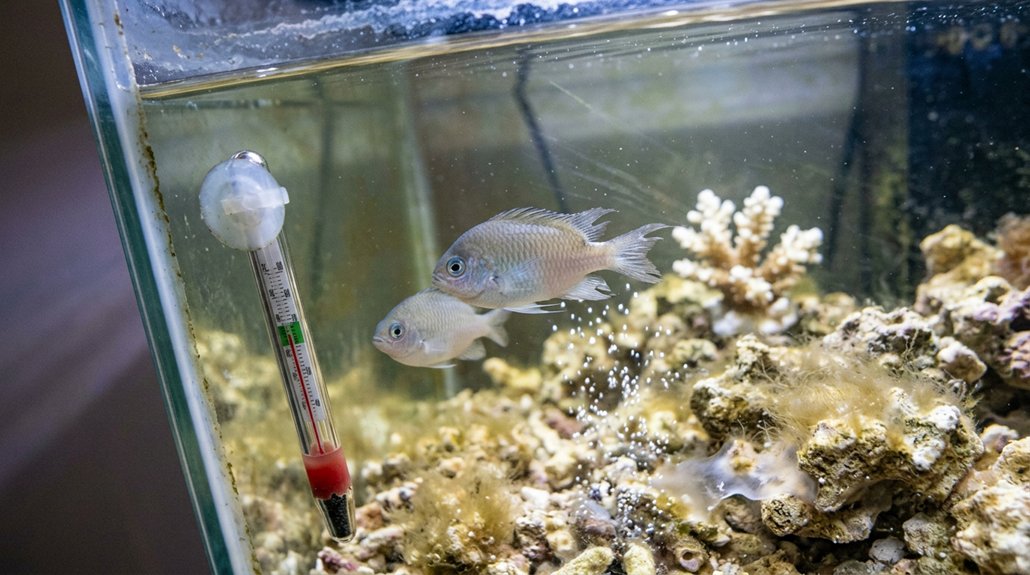
If you stock a new tank before it’s fully cycled, you can trigger New Tank Syndrome, where ammonia rises above 0 ppm and may become lethal within hours to days. During cycling, nitrite can also accumulate and impair oxygen transport, causing rapid respiratory failure and death if you don’t control it. You should cycle the tank before stocking, ideally with a fishless or seeded approach, and test ammonia, nitrite, nitrate, pH, and temperature daily.
New Tank Syndrome
New saltwater tanks often kill fish because the biological filter isn’t mature enough to process waste: ammonia from fish excretion can accumulate to toxic levels before nitrifying bacteria are established. During biofilter maturation, you’re managing a system that may need 6–8 weeks to stabilize.
- Log pH, temperature, ammonia, nitrite, and nitrate daily.
- Use bacterial inoculation or a fishless cycle to speed establishment.
- Add only a few hardy fish; don’t clean biological media early.
Heavy stocking can overwhelm developing biofiltration and trigger rapid losses. Even if fish seem normal at first, a cycling tank can shift quickly as NH3 and NO2− rise. Until tests show ammonia and nitrite at 0 ppm, you shouldn’t treat the tank as stable. Careful monitoring reduces avoidable mortality.
Ammonia And Nitrite
Ammonia and nitrite are the two most common chemical killers during a tank’s cycling phase, because a new saltwater system often can’t convert fish waste fast enough. In your tank, ammonia can rise within days and should be 0 ppm before you add more fish. Ammonia toxicity becomes worse as pH and temperature increase, because more NH3 is present. Nitrite poisoning follows when nitrite accumulates; it binds hemoglobin, reduces oxygen transport, and can cause brown gills, rapid breathing, and death above about 0.5–1 ppm. You should test ammonia, nitrite, nitrate, pH, and temperature daily, then respond to any detectable ammonia or nitrite with water changes, less feeding, and stronger aeration. A stable biological cycle usually takes weeks to establish.
Cycling Before Stocking
Before you add fish, the tank has to finish cycling, because an uncycled saltwater system can’t process waste fast enough to keep ammonia and nitrite at safe levels. In new tanks, nitrifying bacteria usually need 6–8 weeks to mature, and even low ppm readings can stress fish, damage gills, and cause gasping or rapid death.
- Use fishless cycling by dosing pure ammonia to the filter media.
- Try bacterial seeding with live rock or water from a mature system.
- Test pH, temperature, ammonia, nitrite, and nitrate daily; don’t clean biological media or add many fish at once.
If you overstock early, the sudden bioload can overwhelm biofiltration and drive toxic nitrogen spikes. Only use commercial bacterial starters as directed, because you don’t want to disrupt colonization.
Temperature and Oxygen Problems
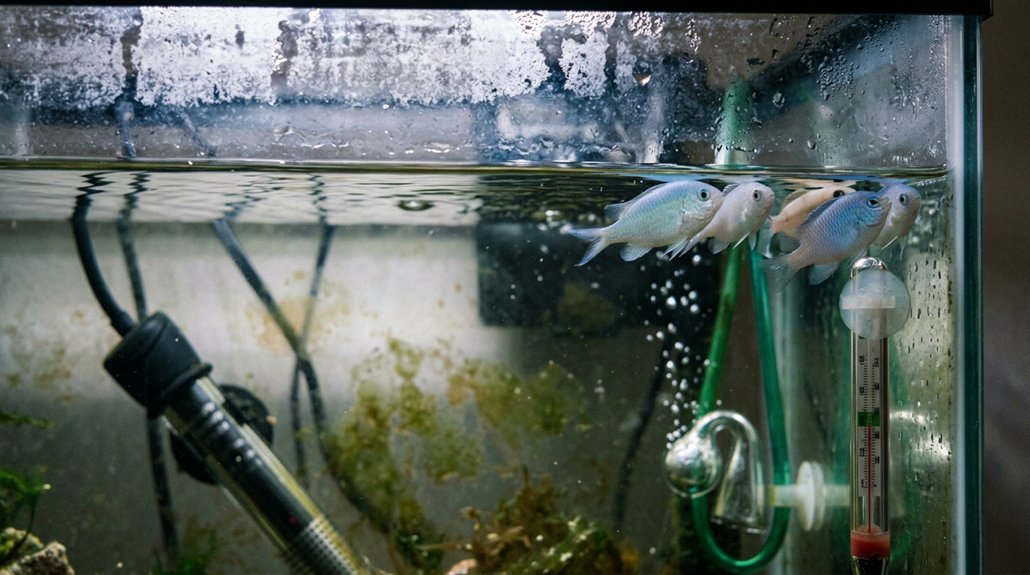
Temperature swings can quickly make your tank less safe because warmer water holds less dissolved oxygen while your fish’s oxygen demand rises. When DO drops, you may see heavy breathing, surface clustering, or lethargy, and levels below species tolerance can lead to rapid death. You’ll need to check temperature and aeration immediately, since pump failures, overfeeding, or blooms can trigger acute oxygen loss.
Temperature Swings
Even a small temperature swing of 2–3°C (4–5°F) can stress marine fish, suppress immunity, and increase susceptibility to disease. You should treat rapid fluctuations as a serious risk because heater or chiller failure can shift conditions within minutes to hours, and that’s often more lethal than gradual drift.
- A rise from 24°C to 28°C can reduce dissolved oxygen and trigger gasping.
- Stratification pockets and poor circulation can trap warm, low-oxygen water where fish linger lethargically.
- Continuous monitoring with alarms helps you keep tropical species near 24–27°C.
If you see rubbing, inactivity, or surface breathing, check temperature immediately. Backup heating and aeration reduce the chance that a brief equipment fault becomes a fatal event.
Low Dissolved Oxygen
When dissolved oxygen drops, marine fish can fail quickly because warm saltwater holds less O2, especially at 28–30°C (82–86°F), and tropical species may become hypoxic even when the tank looks otherwise normal. You should note that oxygen diffusion falls as temperature rises, so hypoxic thresholds can be crossed at night or after blooms.
| Cause | Effect | Response |
|---|---|---|
| Dense algae | Night O2 use | Aerate |
| Weak skimming | Poor gas exchange | Repair |
| High ammonia/nitrite | Less uptake | Test |
| Surface stagnation | Low diffusion | Agitate |
If you see gasping, lethargy, or rapid gill movement, act immediately. Increase surface agitation with return pumps, wavemakers, or airstones, and perform a large water change with oxygenated replacement water.
Overstocking, Aggression, and Stress
Overstocking is a common cause of mortality in saltwater tanks because it rapidly increases bioload and can overwhelm the nitrifying bacteria needed to process waste, causing dangerous ammonia and nitrite spikes. You need to respect stocking limits; a 45 L tank with 16 small fish is far beyond safe capacity. Crowding also disrupts social hierarchy, so aggressive or territorial fish may chase, bite, and injure tankmates, causing fin damage and secondary infection. Chronic bullying suppresses immunity and can reduce feeding.
Overstocking overwhelms biofiltration, spikes ammonia and nitrite, and fuels aggression, injuries, and deadly stress in saltwater tanks.
- Fish gasp when oxygen drops in dense tanks.
- New additions can introduce pathogens unless quarantined for 30 days.
- Stressed fish become vulnerable to parasites and bacterial disease.
When you add too many fish at once, stress compounds and deaths can follow quickly, even without visible water quality problems.
Overfeeding and Dirty Tank Conditions
Overfeeding is a frequent cause of mortality in saltwater tanks because excess food rapidly increases dissolved organic waste and ammonia production, which can push total ammonia to toxic levels within 24–48 hours in new or under-filtered systems. You should use strict portion control and feed only what your fish eat within 2 minutes. Any excess should be siphoned out during water changes, because uneaten food and detritus accumulation raise bacterial activity and can deplete dissolved oxygen at night, causing hypoxia, gasping, or death. Chronic overfeeding also elevates nitrate and phosphate; nitrate above 40 ppm is often problematic and can drive algae blooms and long-term stress. Regular maintenance, including 10–20% weekly water changes, substrate vacuuming, and filter cleaning, prevents the organic buildup that makes overfeeding dangerous.
Disease and Parasites in Saltwater Fish
Disease and parasites are a major cause of saltwater fish losses, especially in newly added or stressed fish. You may see flashing, rapid breathing, rubbing, lethargy, ulcers, frayed fins, cloudy eyes, or sudden death. Ich, velvet, and flukes can kill quickly; Vibrio and Aeromonas often follow injury or poor water quality and drive progressive decline. Viral diseases may cause growths or unexplained losses and usually aren’t curable.
Disease and parasites are a major cause of saltwater fish losses, especially in stressed or newly added fish.
- New fish without quarantine are common entry points.
- A 30–76 day quarantine duration can break transmission cycles.
- Diagnostic sampling helps distinguish parasites, bacteria, and systemic disease.
Use symptom review, tank history, and water tests together, because gasping and flashing can mimic one another. If you skip biosecurity, pathogens can persist in the display tank and keep reinfecting your stock.
Household Chemical Contamination
Even when disease and parasites don’t fit the pattern, fish can die quickly from household chemical contamination introduced into the room air or directly into the tank. You may see acute losses after air fresheners, plug-in scents, hairspray, scented candles, or cleaning sprays release volatile compounds that dissolve at the surface. Even low airborne exposure can be lethal when solvents and deodorizers settle on the water. Direct contamination also occurs from soap on buckets or nets and lotion transfer from hands; these residues add surfactants and antimicrobial agents that injure gills and slime coats. Fuel fumes, cigarette smoke, and exhaust can also contribute toxic gases or metals. If multiple species die and tests look normal, external contamination is likely, not a tank disease.
How to Prevent Fish Deaths
Preventing fish deaths starts with strict water-quality control and disciplined stocking. During the first 6–8 weeks, you should test and log ammonia, nitrite, nitrate, pH, salinity, and temperature daily; keep ammonia and nitrite at 0 ppm and nitrate under about 40 ppm. Cycle the tank first, then add only a few small, hardy fish, with careful fish selection and no early overstocking.
Preventing fish deaths starts with strict water-quality control, careful cycling, and disciplined stocking.
- Quarantine new fish for 2–4 weeks and treat parasites in QT.
- Run skimmer and powerheads continuously; add aeration if fish gasp.
- Use RO/DI water, dechlorinate source water, and do regular maintenance with 10–50% water changes.
If contamination is suspected, use activated carbon immediately.
Frequently Asked Questions
Why Did My Fish Die for No Reason?
Your fish likely died from unseen stressors, not “no reason”: tank cycling failure, ammonia/nitrite toxicity, temperature shock, low oxygen, or contamination. You’ll need water tests, recent handling history, and quarantine records to identify the cause.
How Does a Fish Act Before It Dies?
You’ll often see stress behaviors first; in studies, fish mortality can follow subtle signs days earlier. You may notice gasping, flashing, hiding, rapid gill movement, color fading, clamped fins, erratic swimming, and appetite loss before death.
Can a Dying Fish Recover?
Yes, you can sometimes save a dying fish if you act fast. You’ll need to correct stress signals, test water, and use targeted treatment options; after prolonged damage, recovery’s unlikely, especially with gill injury.
What Is the Most Common Cause of Fish Death?
The most common cause is dissolved oxygen depletion; you’ll see fish gasping first. In your tank, poor water quality and overcrowding stress can rapidly tip the balance, and a few hours can become fatal.
Conclusion
In your saltwater tank, most fish deaths trace back to measurable stressors: unstable salinity, toxic nitrogen compounds, low oxygen, and disease. You can reduce risk by testing water regularly, maintaining proper cycling, and avoiding overcrowding. One useful statistic: ammonia can become lethal to fish at concentrations as low as 0.02 mg/L, depending on species and pH. If you keep conditions stable and clean, you’re far more likely to keep your fish alive.