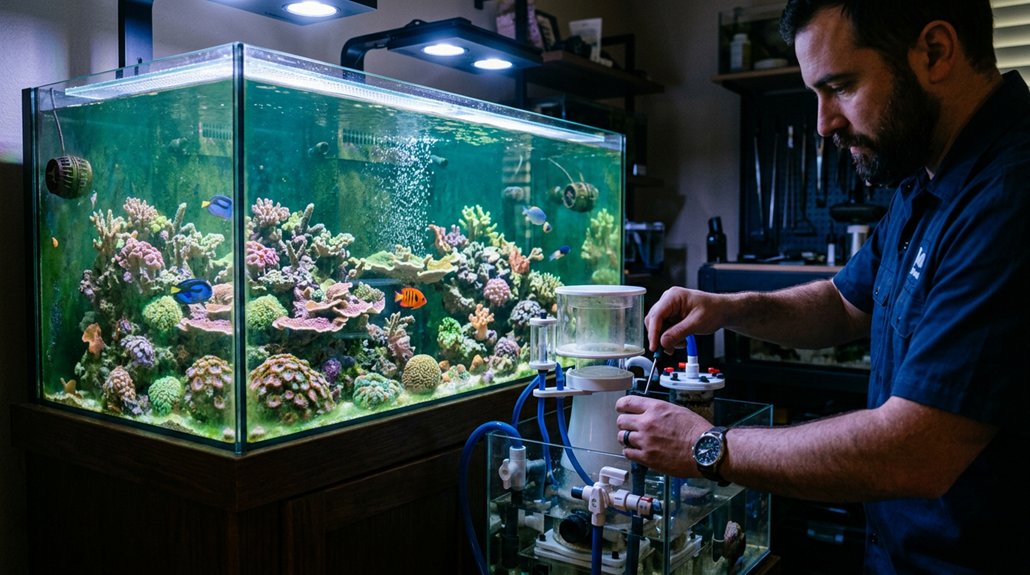
Control algae in your saltwater aquarium by reducing phosphate and nitrate, using RO/DI water, and finding hidden nutrient sources like overfeeding or detritus in the substrate. Test PO4 and NO3 weekly during outbreaks, and keep PO4 at or below 0.03 ppm and NO3 near 0–10 ppm. Manually remove growth often, boost grazing with a proper clean-up crew, and tune lighting, flow, and feeding. Skimming and a refugium can help you stay ahead of it.
Key Takeaways
- Test nitrate and phosphate regularly, aiming for NO3 0–10 ppm and PO4 ≤0.03 ppm.
- Use RO/DI water, feed sparingly, and remove detritus or decaying organics quickly.
- Manually remove algae often by scrubbing rocks, scraping glass, and siphoning loose growth.
- Increase cleanup crews, skimming, and refugium macroalgae to reduce excess nutrients.
- Improve flow and lighting, avoiding dead spots, long photoperiods, and aged bulbs.
Find the Source of Green Hair Algae
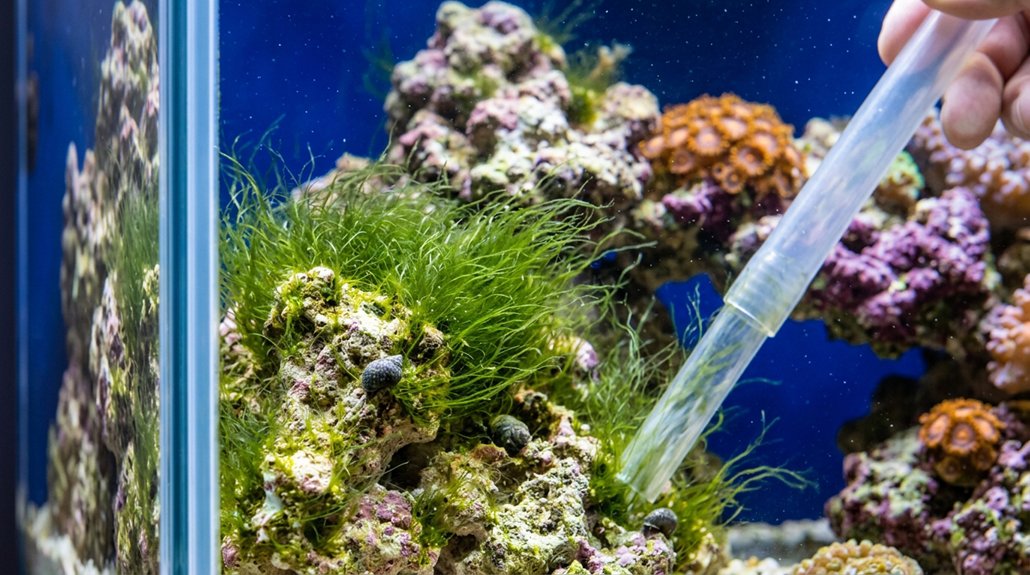
To pinpoint the source of green hair algae, start by testing phosphate (PO4) with a reliable kit and keeping it at or below 0.03 ppm, since elevated phosphate strongly fuels Derbesia growth. Next, measure nitrate regularly and keep it ≤10 ppm, ideally 0–5 ppm, because persistent nitrate also sustains outbreaks. You should inspect every likely input: source water, overfeeding, decaying organics, phosphate-leaching carbon, and supplements. Perform substrate inspection to find trapped detritus in sand, seams, and low-flow zones. Check lighting age, spectrum, and photoperiod; shifted red-heavy output can favor algae. Examine flow paths, skimmer performance, filter socks, and pump intakes for waste buildup. If algae’s embedded in porous rock, rock fragging may be needed to remove heavily colonized sections.
Test Phosphate, Nitrate, and Source Water
You should test phosphate weekly during an outbreak and keep PO4 at or below 0.03 ppm, since elevated phosphate can directly fuel nuisance algae. Keep nitrate low but not zero, with a target of 0–10 ppm, and use a reliable kit to track trends rather than isolated readings. You should also test your source water and use RO/DI for top-offs and mixes so tap-derived nitrates, phosphates, and silicates don’t keep feeding the problem.
Check Phosphate Levels
Phosphate and nitrate should be tested regularly with a reliable kit, since PO4 fuels nuisance macroalgae such as Derbesia and NO3 also supports algal growth. For routine testing, keep PO4 at or below 0.03 ppm, ideally undetectable on hobby kits, and use long term tracking to spot gradual rises before algae spreads. Test your source water periodically too, because tap water can introduce phosphate and nitrate into your system. If PO4 is elevated, you can run phosphate-removing media such as ROWAphos or PhosBan in a reactor, then retest frequently until values stabilize. Record PO4, NO3, alkalinity, and salinity over weeks; sudden shifts often point to dosing errors, source-water contamination, overfeeding, or insufficient skimming and water-change frequency.
Test Nitrate And Source Water
While phosphate remains a key driver of nuisance algae, nitrate and source water quality need equal attention, because elevated NO3 can also sustain macroalgae and green hair algae, and contaminated tap water can keep reintroducing both nutrients into the tank. You should perform nitrate testing regularly and keep NO3 at 10 ppm or less, with 0–5 ppm ideal in reef systems. Use a reliable PO4 kit too, since combined nutrient trends matter. For all top-offs and water changes, rely on RO/DI water, and make RO/DI maintenance a routine to prevent breakthrough contamination. If tap water is your only option, test it for nitrate and phosphate before use, and replace filters if measurable. Track values after feeding shifts, media changes, or dosing practices to identify the cause.
Remove Green Hair Algae by Hand
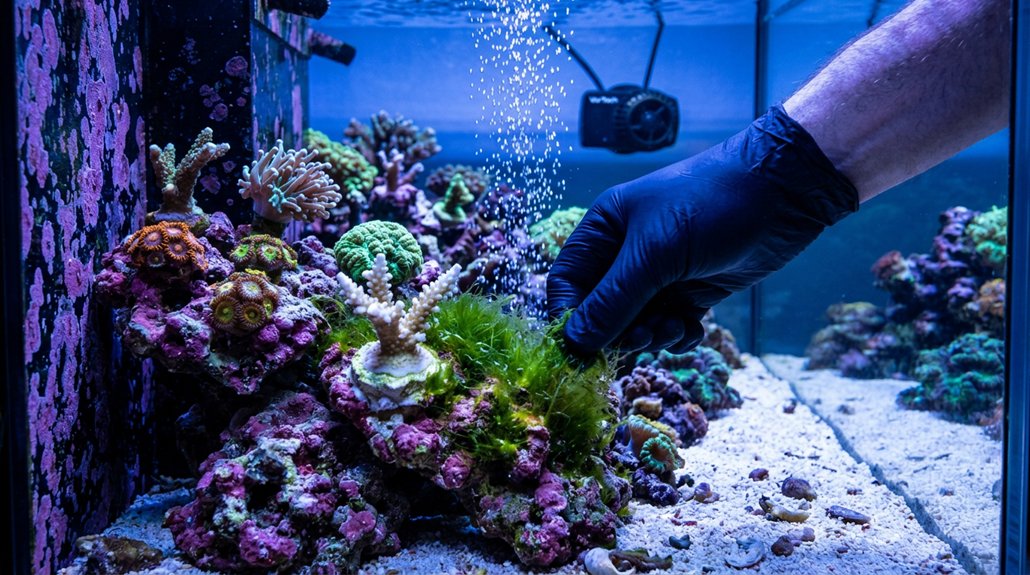
Hand-remove green hair algae as soon as it appears, pinching Derbesia into clumps and pulling it free in small sections; rinse your fingers in a container of freshwater after each pass so filaments do not reattach. This manual removal works best when you stay systematic and use targeted rinsing to isolate debris.
- Scrub rock with a stiff-bristled brush or small toilet brush.
- Scrape glass daily with a razor or algae pad.
- Blast crevices with a turkey baster weekly, then siphon loose material during water changes.
- Remove reachable growth every 1–3 days, and discard it in freshwater or an external drain.
Keep cleaned surfaces accessible; regrowth usually slows when you remove biomass before it fragments and spreads.
Add More Clean-Up Crew
Once you’ve knocked back visible green hair algae by hand, increase grazing pressure with a diverse clean-up crew matched to your tank’s size and layout. Choose compatible species and stage them in a quarantine protocol when possible. For a 15-gallon tank, 3–6 Turbo or Astrea snails plus 2–4 small hermit crabs can improve control.
| Grazers | Primary target |
|---|---|
| Trochus/Turbo snails | rock and glass scraping |
| Emerald crabs/Hermits | macroalgae and detritus |
| Small mixed CUC | sustained film-algae grazing |
Add animals gradually, then monitor weekly; replace losses promptly. Some tankmates can interfere with efficacy, so verify compatibility before introduction. Expect several weeks of continuous grazing before Derbesia declines. Even with a strong crew, you’ll still need manual removal and nutrient control; grazers alone rarely clear persistent blooms.
Adjust Light, Flow, and Feeding
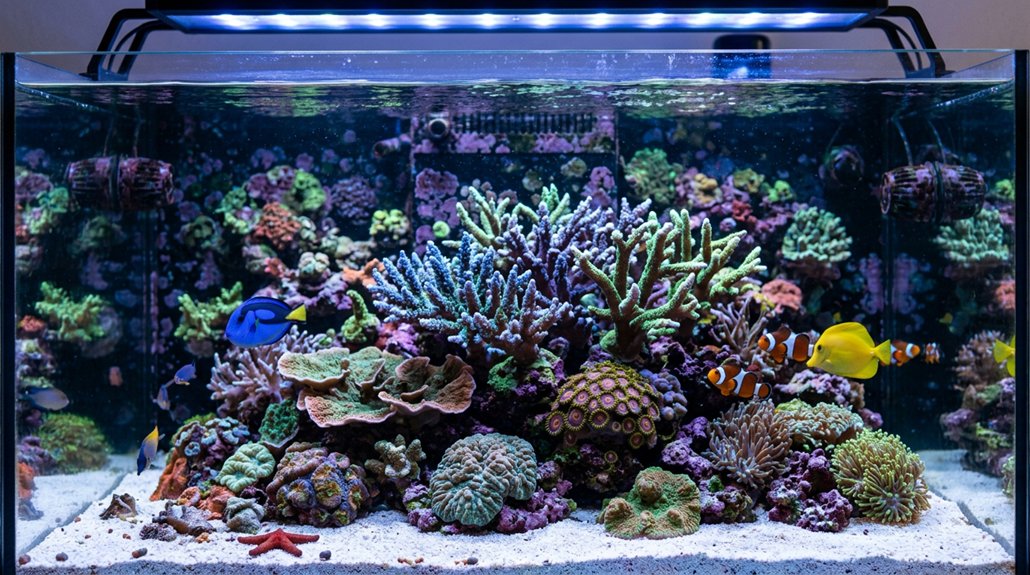
Next, tighten up light, flow, and feeding to make the tank less hospitable to algae. You should:
- Adjust photoperiods to 6–8 hours daily, and replace aged bulbs on schedule so spectral shifts don’t drive nuisance growth.
- Match intensity to your livestock, and reduce persistent red/blue peaks if hair algae keeps appearing.
- Optimize flowrates with powerheads to eliminate dead spots; target 10–20x tank volume per hour and chaotic movement around rockwork.
- Feed sparingly—only what fish eat in 2–3 minutes—and remove leftovers fast.
Keep nitrate at or below 10 ppm and phosphate at or below 0.03 ppm to limit available nutrients. Combine these adjustments with manual removal for several weeks; reduced light and stronger circulation slow regrowth, but they won’t clear established macroalgae alone.
Support Control With Skimming and a Refugium
Add a properly sized protein skimmer and a refugium to export nutrients before they can fuel algae. Your skimmer should be rated for at least your tank volume, because it removes dissolved organics and surface proteins before they decompose into nitrate and phosphate. Perform skimmer maintenance by cleaning the cup weekly and the neck monthly, and verify that pump flow stays strong. For refugium placement, use a dark sump or chamber with moderate flow and low light, then grow Chaetomorpha or another fast macroalgae. Run refugium lighting on a reverse or constant schedule to stabilize pH. Harvest macroalgae routinely, and monitor PO4 weekly; if it exceeds 0.03 ppm, add phosphate media or carbon in the sump.
Frequently Asked Questions
What Can I Put in My Saltwater Tank to Get Rid of Algae?
You can add a clean up crew—turbo or trochus snails, hermit crabs, and, if your tank allows, a lawnmower blenny or small tang—plus nutrient control with Chaetomorpha and phosphate-removing media.
What Kills Algae Immediately?
Like a flash of lightning, you can kill algae fastest with localized chemical treatments or hydrogen peroxide spot dosing; light control can also halt growth. You’ll need careful dosing, since these methods can harm corals and invertebrates.
Why Is My Saltwater Tank Growing so Much Algae?
Your tank’s algae surge usually comes from excess nitrate/phosphate, poor nutrient management, strong or aging lighting spectrum, low flow, and inadequate cleanup or grazing. You’re likely feeding, dosing, or using source water that’s adding nutrients.
What Will Kill Algae but Not Fish?
Phosphate control is your safest “algae assassin.” You can use algae grazers and chemical treatments like ROWAphos or PhosBan, plus skimming and water changes, to starve algae fast while your fish stay safe and thriving.
Conclusion
By tracing the source of green hair algae, you can correct the underlying nutrient imbalance instead of just treating symptoms. For example, if your phosphate tests high and your source water contains silicates, even aggressive manual removal will only provide temporary relief. When you verify water quality, adjust lighting and feeding, and support export with skimming or a refugium, you’ll create stable conditions that discourage regrowth and keep your saltwater aquarium healthier long term.