
Your dog’s lack of response might stem from emotional or physical discomfort, miscommunication, or distractions. To improve listening, verify consistent command language and create a conducive training environment with minimal distractions, using their name to focus attention and rewards to motivate. Gradually addressing fears and fostering trust through positive reinforcement can strengthen your bond and enhance compliance. With patience and empathy, you’ll discover how to effectively guide your dog towards better listening and long-term success.
Key Takeaways
- Inconsistent command language across family members can confuse the dog, hindering understanding and compliance.
- Emotional or physical discomfort may cause disobedience, so assess possible health issues or anxieties.
- Lack of focused, distraction-free training environments can prevent effective learning and response.
- Inadequate positive reinforcement and immediate rewards might demotivate the dog from repeating desired behaviors.
- Poorly structured training sessions, lacking gradual exposure to different settings, can affect adaptability and focus.
Why Understanding Canine Behavior Is Key

Understanding canine behavior is fundamental because it helps unravel the reasons behind your dog’s actions, which many owners mistakenly interpret as willful disobedience. Canine instincts guide your pet’s responses through behavioral cues, revealing much about their emotional signals. Recognizing these signs allows you to tailor training environments and adjust command clarity accordingly, aiding your dog in understanding directions. Diverse temporal factors and shifting social dynamics greatly impact how your dog processes information. Your reactions to these behaviors are essential; consistent and empathetic responses foster better communication. It’s critical to realize that emotional and physical discomfort can influence behavior, and empathy towards these factors enriches the learning process. Misinterpretations can easily occur, highlighting the importance of understanding rather than assuming defiance.
Identifying Fear as a Barrier to Training
When it comes to dog training, fear can be a significant obstacle that shouldn’t be overlooked. Fear triggers in dogs, particularly those who’ve experienced trauma or inconsistent training, can lead to confusion and non-compliance. It’s important to view fear as a natural response, not defiance. By understanding this, you can approach training with empathy and emotional support. Dogs need a reassuring environment where they feel safe to engage and learn. Gradually exposing them to fear-inducing stimuli, paired with comfort, can help them build confidence over time. Avoid reprimanding fear-driven reactions to create a supportive space, encouraging responsiveness to commands. With patience and understanding, you can transform fear barriers into opportunities for growth and a stronger bond with your dog.
Avoiding Miscommunication With Consistent Commands

To foster a better listening relationship with your dog, it’s essential to standardize the command language across all interactions, ensuring everyone in the household uses the same phrases. This avoids confusion and mixed signals, making it easier for your dog to understand and respond to expectations. Research shows that consistent repetition, paired with immediate positive reinforcement, not only strengthens your dog’s behavior but also enhances their trust in you.
Standardize Command Language
One of the most important aspects of dog training is establishing a standardized command language. Achieving command clarity depends on phrase uniformity. If you say “SIT” and someone else uses “SIT DOWN,” your dog may become confused. Consistent commands allow dogs to understand and respond accurately, fostering a successful learning environment. Always employ the same cues, reinforced with your dog’s name to focus their attention. A calm and firm tone enhances comprehension and processing. For better training outcomes, especially in varied environments, maintain a unified vocabulary. This approach not only aids your pet’s learning but strengthens the bond between you.
| Command Clarity | Phrase Uniformity | Tone Consistency |
|---|---|---|
| SIT | SIT DOWN | Calm |
| STAY | WAIT | Firm |
| COME | COME HERE | Gentle |
| DOWN | LIE DOWN | Clear |
| OFF | GET DOWN | Reassuring |
Unified Family Training
Effective dog training involves fully embracing the concept of unified family training. It’s vital to confirm all family members use consistent language, as differences like “SIT” versus “SIT DOWN” confuse your dog and hinder command reinforcement. Dogs thrive on repetition and clarity, so practicing commands as a family is essential. This unity means your furry friend receives uniform cues, aiding their learning process appreciably. In addition, everyone should maintain a calm, confident tone; this consistency enhances understanding and responsiveness. Establish a universally understood reward system to motivate and maintain compliance, avoiding mixed signals. Regular family discussions about training progress and strategies confirm alignment and reinforce command practices, ultimately ensuring that your dog listens and thrives within a harmonious environment.
Positive Reinforcement Consistency
Every successful dog training strategy hinges on the consistency of positive reinforcement. Your commitment to using consistent command language, like saying just “SIT” instead of varying it, markedly impacts your dog’s ability to understand what’s expected. Positive reinforcement techniques, such as using treats or praise immediately after successful commands, are essential. With precise reward timing, your dog will associate the right actions with instant gratification. It’s vital that every family member uses the same commands to prevent confusing your furry friend. Repeating commands with your dog’s name helps grab their attention and enhances learning. Aim for three successful repetitions to solidify the command. A clear rewards system reinforces compliance and speeds up recognition of desired behaviors.
Strategies to Minimize Distractions During Dog Training
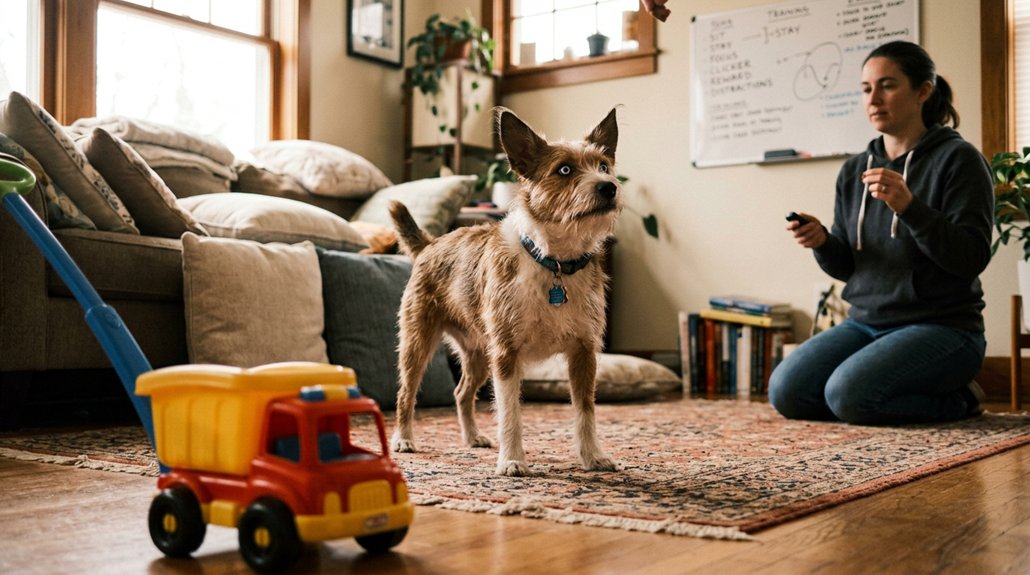
To effectively train your dog, it’s essential to manage environmental stimuli by starting in a quiet, controlled space that helps reduce distractions. Enhance your dog’s focus with high-value treats and keep sessions short to maintain their interest without overwhelming them. As they progress, gradually introduce more distractions and guarantee consistent command usage among all family members to foster their listening skills amidst varied environments.
Manage Environmental Stimuli
Creating an ideal training environment is essential for helping your dog focus and learn. Start in a controlled area, minimizing distractions to reinforce commands. As your dog becomes more proficient, gradually increase distraction exposure. This helps your dog generalize obedience in varied settings. Use high-value treats or toys to capture their attention, especially when distractions seem unavoidable. Keep training sessions short, around 5-10 minutes, to prevent overwhelming your dog and promote better compliance. Remember, patience is key. Implement gradual desensitization techniques by introducing distractions from a distance and slowly decreasing this buffer. This methodical approach allows your dog to become comfortable with their surroundings, building the confidence needed to maintain focus in increasingly stimulating environments.
Enhance Focus Techniques
Attract your dog’s focus by strategically using their name before issuing a command; this serves as a cue to direct their attention amidst distractions. Focus enhancement starts with practicing in a quiet, familiar space to build concentration. Keep sessions brief, roughly 5-10 minutes, to avoid overwhelming your dog and optimize distraction reduction. As your dog improves, gradually expose them to more distracting environments to strengthen their focus.
Enhance your sessions with:
- High-value treats: Use tasty rewards to motivate focus and reinforce desired behaviors.
- Favorite toys: Incorporate beloved toys as incentives to keep your dog engaged.
- Gradual challenges: Slowly increase environmental distractions to help focus translate beyond training.
These science-based strategies nurture a lasting bond, making listening second nature.
Utilize Controlled Training Spaces
Engaging your dog in a controlled training space is a foundational strategy in minimizing distractions. The design of your training area plays an essential role in distraction reduction, allowing your dog to focus better on commands and cues. Begin in a quiet room or enclosed yard, familiar yet devoid of disruptions. Use lightweight barriers to define this space, systematically cutting out noise and movement that might divert your dog’s attention. Short, focused sessions in such controlled environments will be most effective, preventing your pet from becoming overwhelmed and keeping them engaged. Gradually introduce new environments to reinforce learned behaviors, helping your dog become more responsive in varied contexts. Regular practice in different locations strengthens command generalization, boosting their adaptability and attention.
Guiding Your Dog’s Choice Toward Compliance
Although it might seem like your dog isn’t listening, it’s important to guide their choice toward compliance by establishing a foundation of structured boundaries. Dogs often resist commands if they perceive freedom choices without clear boundary setting. You can prevent confusion by consistently using the same commands across all family members, which helps your dog understand and cooperate.
Reinforce compliance by associating positive experiences with each command:
Associate commands with positive experiences to foster obedience and emotional bonding with your dog.
- High-value treats make obedience rewarding and encourage them to repeat behaviors.
- Enthusiastic praise creates an emotional bond, reinforcing their willingness to listen.
- Frequent practice in varied settings aids in understanding commands, mitigating distractions.
Addressing underlying fears or anxieties nurtures a confident, secure canine, making them more likely to embrace compliance and listen effectively.
Ensuring Command Generalization Across Settings
To guarantee your dog’s commands are understood universally, it’s vital to incorporate contextual learning strategies and practice in varied environments. By training in different settings, you’re not only helping your dog associate commands with different surroundings but also augmenting their ability to focus amidst distractions. Remember, consistency is key; by steadily repeating commands across settings, you build your dog’s confidence and adaptability, fostering a strong bond of communication between you and your pet.
Contextual Learning Strategies
When you’re training your dog, it’s essential to implement contextual learning strategies to guarantee command generalization across various settings. Dogs exhibit behavioral flexibility and environmental adaptability when their training encompasses diverse environments. Repeated exposure to different contexts guarantees your dog won’t only obey commands at home but in new places too.
Here’s how to enhance their training:
- Practice in multiple environments: Train in the park, at home, and on busy streets to boost adaptability.
- Include distractions: Introduce distractions like toys or other pets to strengthen focus and compliance under pressure.
- Gradual exposure: Increase complexity gradually to build confidence and command mastery.
Environment Variability Impact
Understanding the impact of environment variability is vital for effectively training your dog to generalize commands across different settings. Dogs often struggle with situational responses because they rely heavily on environmental cues. What works at home might not in a crowded park, and that’s where training across various contexts becomes critical. Gradually exposing your dog to diverse environments helps them associate commands with expected behaviors, beyond just the lure of treats or physical prompts. This exposure enhances their decision-making skills and guarantees they aren’t confused by new surroundings. Repeated practice in these varied scenarios strengthens their ability to follow commands despite distractions, leading to greater compliance and confidence wherever they are. Ultimately, this erases location-based inconsistencies and boosts their training’s overall effectiveness.
Consistency in Training Methods
Although training a dog requires patience and dedication, ensuring consistency in your methods is essential for command generalization across various settings. Using the same command language reinforces your dog’s understanding. For example, always use “sit” and avoid synonyms like “down.” Consistency is key in various training environments to help your dog reliably perform commands despite distractions. Training in different locations solidifies their command reinforcement ability. Gradual exposure is crucial—build confidence by slowly introducing new settings.
- Picture a bustling park where commands are seamlessly obeyed amidst noise.
- Imagine each family member using identical commands, fostering a clear understanding.
- Visualize your dog confidently responding, despite unfamiliar surroundings.
Adopt a unified approach—everyone in the household should use consistent language and methods.
Effective Use of Training Pressure Without Harm
In dog training, the use of pressure, when applied carefully, can effectively guide your pet towards desirable behavior without causing harm. Proper pressure application involves gradual exposure and precise behavior shaping, ensuring your dog understands the link between their actions and outcomes. Use energetic cues softly, guiding them without confusion or fear while focusing on trust building. It’s essential to avoid continuous pressure, which may lead to learned helplessness, where the dog disengages entirely. Instead, pair gentle pressure with reward integration to encourage and reinforce the desired behaviors. Maintain a calm and assertive energy, so your dog recognizes the influence of its actions rather than seeing pressure as punishment. This balanced approach fosters a confident, attentive canine companion.
Building Genuine Motivation Beyond Treats
Ever wondered how you can build motivation that goes beyond the lure of treats? It starts with strengthening the emotional connection and trust between you and your dog, ensuring positive engagement in each interaction. Dogs thrive on intrinsic motivation, especially when they feel secure. By focusing on relationship strengthening, you’re enhancing their comfort and emotional well-being, which naturally increases their willingness to listen.
Strengthen trust and emotional connection to enhance your dog’s intrinsic motivation and willingness to listen.
Utilize:
- Play interaction to boost training enjoyment and deepen the bond.
- Consistent command understanding, making your expectations clear and reducing reliance on treats.
- Praise and encouragement to foster trust building and positive emotional responses.
Addressing fear and anxiety is vital. When your dog feels at ease, their intrinsic motivation flourishes, making obedience less about treats and more about shared experiences.
Setting Realistic Dog Training Expectations for Success
Understanding how to set realistic expectations in dog training can greatly enhance the progress and satisfaction for both you and your furry friend. Recognize that your dog’s compliance may vary, particularly in puppies or anxious dogs influenced by emotion and environment. Establish clear training milestones, acknowledging that dogs’ emotional readiness and maturity are vital for their progress. Consistent, unified commands from family members are important to prevent confusion, allowing your dog to generalize behaviors confidently. Also, consider age and individual growth pace; puppies might need more time to reach those milestones. By observing your dog’s progress, you’ll notice improvements can take weeks—stay patient. Adopting a structured approach guarantees your expectations align with your dog’s capabilities, leading to successful training outcomes.
Laying a Strong Training Foundation for Long-Term Results
As you begin laying a strong training foundation for your dog, the key is implementing clear, consistent commands to establish expectations and minimize confusion. With command clarity and timing cues, you’ll foster an environment where your dog feels confident responding to your directions. Effective training blends calm, assertive communication with structured sessions tailored to your dog’s unique needs.
- Positive Reinforcement: Reward your dog promptly after compliance to reinforce desired behaviors and strengthen your bond.
- Patience and Repetition: Regular practice helps dogs to assimilate commands, gradually generalizing them across varied settings.
- Trust Building: By maintaining a consistent approach, you build trust, increasing your dog’s likelihood of obedience and comfort in exploring new skills.
Through compassionate guidance, patience, and science-backed methods, your dog will flourish.
Frequently Asked Questions
How Do You Discipline a Dog That Won’t Listen?
Focus on positive reinforcement and training consistency. Make certain commands are clear and consistent among all family members. Reward good behavior promptly, avoid physical punishment, and gradually introduce distractions to help your dog generalize commands effectively.
What Is the 3-3-3 Rule With Dogs?
The 3-3-3 rule outlines a dog’s adaptation period: three days to settle, three weeks to open up, three months to fully adjust. Understanding this supports effective dog behavior observation and compassionate training methods. Be patient.
What Are the 4 Signs Your Dog Thinks of You as a Parent?
Your dog views you as a parent if they engage in bonding activities like eye contact, show submission in canine communication, protect you instinctively, and seem secure when near, symbolizing their trust and attachment to you.
What Is a Silent Killer in Dogs?
A silent killer in dogs is often a condition like bloat or pancreatitis. Understanding canine communication and watching for behavioral signals like lethargy or discomfort can be essential. Stay vigilant, proactive, and consult your vet for expert guidance.
Conclusion
In the exhilarating world of dog training, understanding your canine’s behavior is like wielding a magic wand. By transforming fear into confidence and using consistent commands, you unveil the secret code to your dog’s mind! Mastering the art of minimizing distractions and guiding your dog’s decisions can make you the dog whisperer of your neighborhood. Remember, genuine motivation extends beyond treats—it’s a journey of shared experiences. Harness these strategies, and your training success will be legendary!