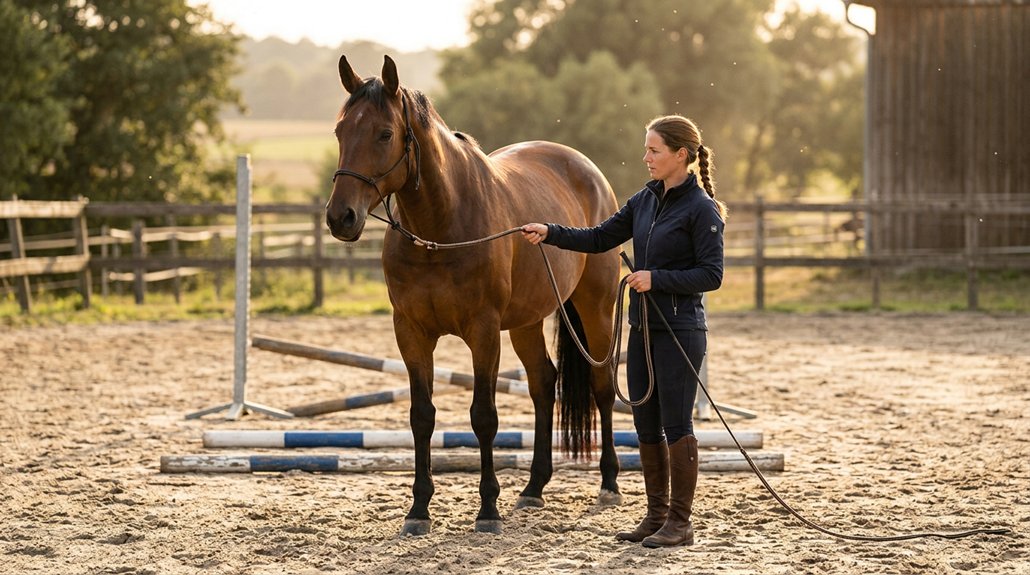
To effectively train your horse, you must understand their psychology and communication. Use positive reinforcement—quick rewards reinforce desired behaviors. Keep a stress-free environment by minimizing distractions and establishing routines. Consistent cues and body language are essential for clarity. Desensitize gradually to build confidence and address unique needs. Starting with groundwork and respecting personal space lays important foundations. Patience is key for addressing common training challenges, and mastering these basics opens further training insights.
Key Takeaways
- Understand horse behavior and communicate with clear, consistent commands to build trust.
- Use positive reinforcement techniques like treats or praise to encourage desired behaviors.
- Create a stress-free training environment by minimizing distractions and maintaining consistent routines.
- Gradually introduce new objects and situations to build horse confidence and adapt to individual needs.
- Begin with groundwork exercises to establish boundaries and ensure respect for authority.
Understand Horse Psychology for Training
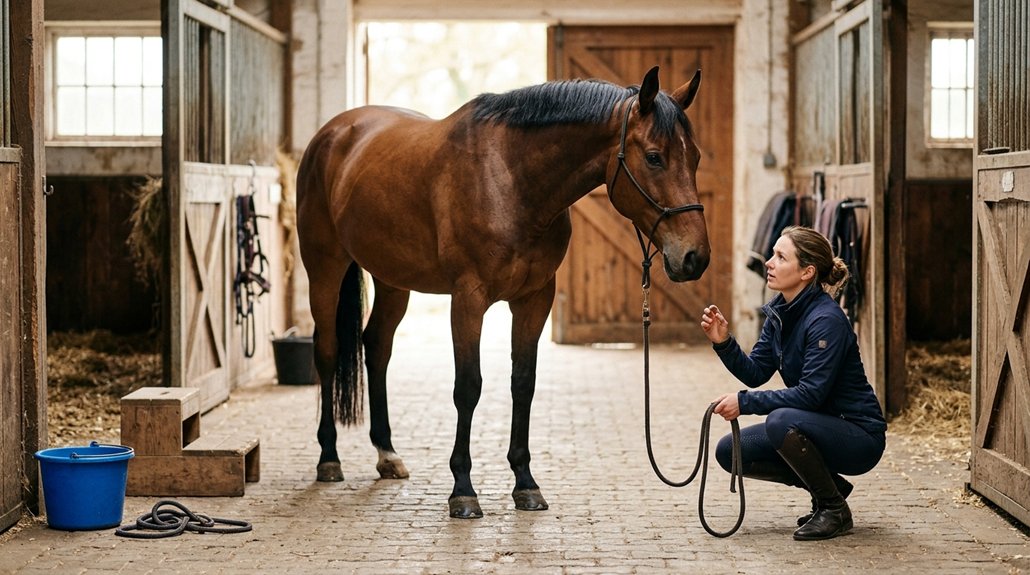
To effectively train a horse, understanding its psychology is essential. You need to comprehend horse behavior and the role of emotional intelligence in shaping learning patterns. Horses don’t inherently know how to navigate human settings, which is why tailored training considering their unique experiences is key. Building trust is imperative through consistent handling, considering their social interactions and environmental influences.
Recognize their instinctual responses and anxiety triggers. Non-verbal cues are important, as horses thrive on observational learning. Identifying stereotypic behaviors helps adjust training to address underlying issues. By establishing clear communication and a consistent reward system, you facilitate a stress-free environment that fosters learning, ensuring effective behavior modification while enhancing your bond with the horse.
Implement Positive Reinforcement Techniques
To effectively employ positive reinforcement in horse training, reward desired behaviors with treats, praise, or release of pressure to motivate your horse. Make certain the reward is given immediately after the desired action to reinforce the connection between behavior and positive outcome. Consistent application of these techniques guarantees clarity and helps build a strong, trusting relationship between you and your horse.
Reward Desired Behaviors
Mastering positive reinforcement techniques can transform your horse training by making it more effective and enjoyable for both you and your horse. Utilizing reward types, such as treats, praise, and playtime, aligns with reinforcement techniques that can reinforce desired behaviors. By offering a reward immediately after your horse exhibits a desirable action, you strengthen the behavior through clear association. Consistency is key to solidifying these outcomes, ensuring your horse understands which actions are appreciated. Incorporating a variety of rewards keeps your horse engaged and motivated, as different individuals may respond better to certain types. Balancing reinforcement with clear guidelines prevents confusion, helping your horse distinguish rewarded behaviors from those needing adjustment, and thereby fortifying training results in the long term.
Timing of Reinforcement
In addition to using rewards effectively, accurately timing your reinforcement is fundamental for successful horse training. Immediate behavior reinforcement creates a clear link in your horse’s mind, promoting positive responses during sessions. To establish effective training intervals, there are key strategies you must follow:
- Quick Reward: Deliver rewards right after the desired action to cement the connection.
- Use a Clicker: This expedites marking the precise behavior, improving comprehension.
- Reward Efforts: Encourage attempts, not just successes, fostering your horse’s willingness to learn.
- Gradually Fade Rewards: Help your horse perform with less reliance on instant rewards over time.
These techniques guarantee your training is consistent and compassionate, supporting your horse’s learning journey.
Consistent Training Practices
When you integrate consistent training practices with positive reinforcement techniques, you’re crafting a learning environment where your horse thrives. Begin with simple habituation techniques, reinforcing basic behaviors until they’re second nature. Use clear communication and consistent cues so your horse understands which actions lead to rewards. Timing is key—deliver treats, praise, or affection within seconds of the desired behavior to solidify the connection.
Adjust reinforcement schedules by gradually increasing the task complexity. This keeps your horse engaged and builds confidence without causing frustration. Mix up rewards, using verbal praise, grooming, or play, to maintain interest and strengthen your bond. By steadily raising criteria, you foster a proactive and responsive partner who looks forward to training sessions.
Ensure Consistent Communicative Signals
Although horses are highly perceptive animals, they require consistent communication to truly understand what you expect from them. Using clear signals and attentive body language is key. Trainers need to confidently convey consistent cues, allowing horses to link specific signals to actions. To guarantee efficient learning, follow this crucial approach:
- Consistent Commands: Use the same signals for specific actions. This avoids confusion and reinforces understanding.
- Body Language Awareness: Your posture and movement are interpreted by the horse, impacting their responsiveness.
- Positive Reinforcement: Reward desired behaviors promptly, helping horses associate actions with positive outcomes.
- Regular Practice: Reinforce key signals through daily groundwork, allowing for smoother riding shifts.
Demonstrate calm leadership, providing a stable foundation for your horse’s development.
Create a Stress-Free Training Environment
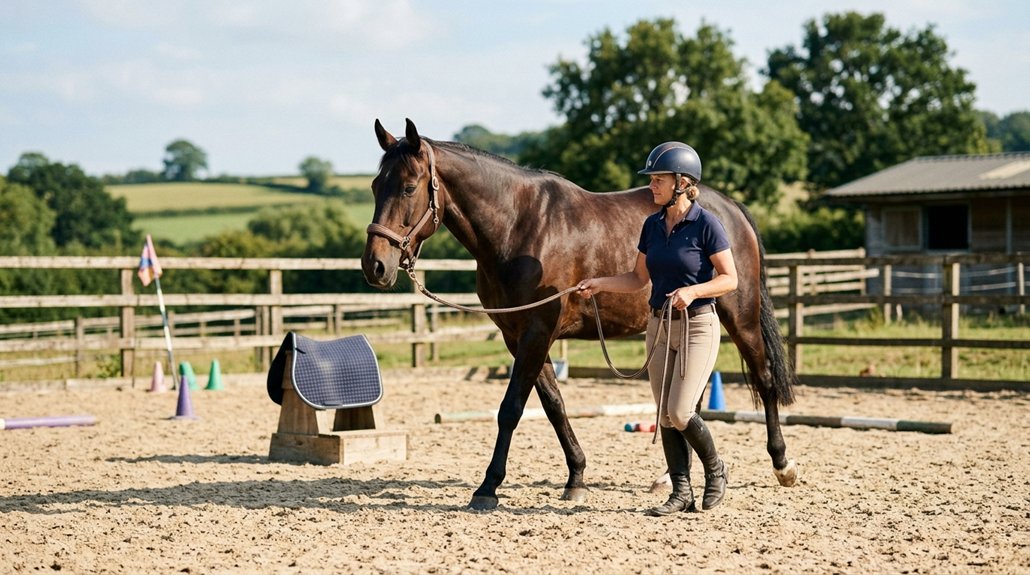
To create a stress-free training environment, minimize external distractions by ensuring the space is quiet and devoid of disruptive stimuli. Establish clear boundaries and consistent routines to provide predictability that alleviates anxiety and enhances learning. By implementing these strategies, you’ll foster a secure and trusting atmosphere conducive to effective horse training.
Minimize External Distractions
Creating a stress-free training environment is essential for a horse’s learning process. You’ll enhance your horse’s focus by employing noise reduction and visual simplicity in the training area. A calm setting minimizes anxiety, aiding effective learning. Consistent cues coupled with controlled surroundings prevent sensory overload, allowing gradual introduction of new concepts. To cultivate such an environment, consider the following:
- Quiet Familiar Spaces: Train in areas your horse knows well and maintain minimal noise.
- Avoid Distractions: Keep other animals and people away during sessions.
- Routine Training: Establish a consistent routine to reinforce security.
- Hazard-Free Zone: Guarantee the area is safe from potential hazards.
These steps foster a focused atmosphere, essential for a horse’s successful training.
Establish Clear Boundaries
When training a horse, establishing clear boundaries is fundamental to creating a stress-free learning environment. Boundary training is essential because it teaches your horse to respect your personal space, reducing unwanted behaviors during sessions. Start by using distinct physical cues, like outstretched arms, to signal the limits of your space. This method allows your horse to quickly recognize and respect these boundaries, making sessions safer for both of you. Make certain that you consistently enforce these limits—any invasion of your space should be met with immediate corrective action to reinforce respect and your leadership. The principle “Don’t move your feet unless told to do so” sets a strong foundation for behavioral expectations, making sure your horse responds accurately to your cues.
Implement Consistent Routines
A structured routine is a powerful tool in establishing a stress-free training environment for your horse. Implementing a daily schedule fosters training predictability, which can considerably reduce the horse’s anxiety. Here’s how to guarantee success:
- Daily Schedule: Establish and adhere to a daily training schedule to create a predictable environment, helping your horse feel secure and less anxious.
- Consistent Signals: Use reliable cues and signals, allowing your horse to anticipate your commands, thereby reinforcing their confidence and learning process.
- Gradual Desensitization: Incorporate slow exposure to new stimuli within your routines, aiding in your horse’s comfort with unfamiliar situations.
- Reward Relaxation: Encourage calm behavior by rewarding your horse when it’s relaxed, promoting a stress-free atmosphere during transitions.
These steps will enhance your horse’s demeanor and willingness to learn.
Use Desensitization to Build Confidence
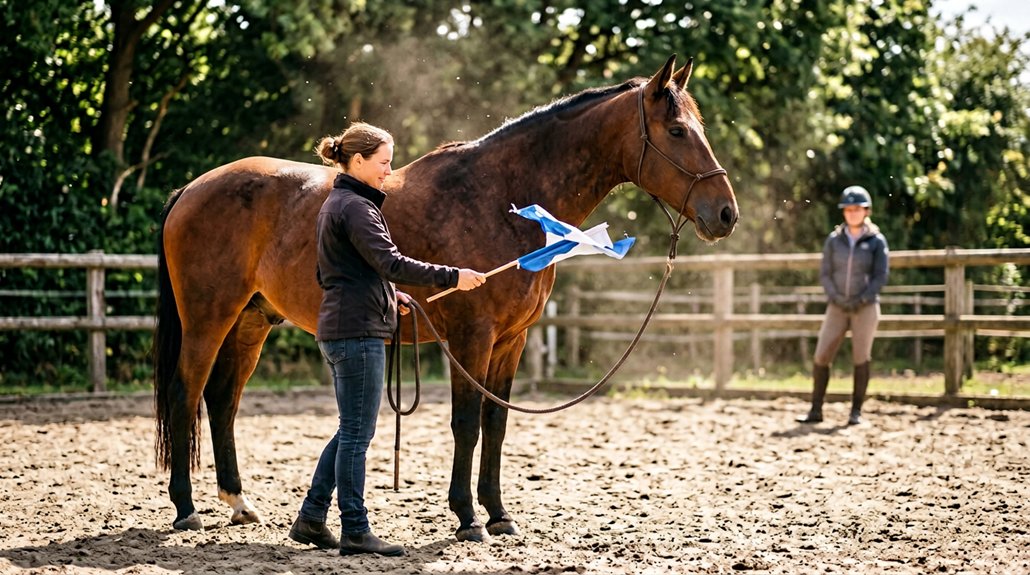
To build a horse’s confidence through desensitization, begin by gradually introducing them to new and potentially frightening objects or situations. This includes the careful saddle introduction. Start by letting your horse see and sniff the saddle. Utilize gradual exposure—slowly drape it over their back without securing it. This method helps familiarize and comfort your horse without overwhelming them.
Horses learn effectively through repeated exposure to stimuli, provided their comfort levels are respected. Patience and timing are key—reward calm behavior to reinforce positive associations. Incremental exposure prevents stress or fear. Consistent desensitization strengthens your bond with your horse, building trust and improving communication. Over time, this strategy encourages a calm, confident horse, ready to tackle whatever challenges arise in training.
Read Your Horse’s Cues for Better Communication
How can you effectively communicate with a creature that doesn’t speak your language? By developing emotional awareness and refining your behavior observation skills, you can identify and respond to your horse’s cues. Horses express themselves mainly through body language:
- Ear position and movement: Forward ears indicate interest, while pinned back ears signal stress.
- Tail movement: A calm, gentle tail suggests relaxation; excessive swishing may mean discomfort.
- Eye expression: Soft eyes show receptiveness, while wide eyes can indicate fear or anxiety.
- Stance and facial muscles: A relaxed posture and softened facial muscles denote a positive mood.
Recognizing these signs enables you to adjust your training techniques, ensuring your horse’s comfort and fostering a strong, communicative bond.
Establish Essential Training Foundations
Building a strong foundation in horse training is essential for developing a respectful and harmonious relationship. Start with foundation exercises that establish clear boundaries and personal space, ensuring your horse recognizes and respects your authority. Groundwork principles like haltering and leading lay the groundwork for more advanced tasks. Teaching your horse to wait and maintain position fosters patience and reinforces respect for your commands. Consistent and compassionate methods are key; horses thrive when they understand what’s expected. Use positive reinforcement—like treats or praise—to reinforce good behaviors, enhancing learning outcomes and strengthening your bond. Focus on clarity and patience during these early stages to cultivate a well-mannered horse, forming the bedrock of successful training.
Adapt Training for Individual Horse Needs
While a solid foundation sets the stage for training success, it’s equally important to tailor your approach to each horse’s unique needs. Recognize that equine adaptability is shaped by factors like maturity, past experiences, and breed characteristics. Different horses demand individualized strategies:
- Thoroughbred Training: Opt for structured guidance and frequent input. They thrive on precise instructions.
- Colder-Blooded Breeds: Use gentle, patient techniques. They’re more responsive to a calm, steady approach.
- Temperament Awareness: Understand each horse’s past to design effective, tailored techniques.
- Innate Desire to Please: Harness their enthusiasm to learn with positive reinforcement.
Adaptability as a trainer means reflecting on each session. Adjust strategies to support your horse’s unique learning pace and behavior, ensuring effective training outcomes.
Solve Common Horse Training Problems With Patience
Patience stands as a cornerstone in resolving common horse training problems, preventing anxiety and resistance from taking root. When you rush the process, frustration can build for both you and your horse. To overcome this, manage your expectations carefully. Remember that horses learn effectively through gradual exposure and desensitization. Introduce new environments or stimuli slowly to build their confidence without overwhelming them. Consistent use of rewards and positive reinforcement helps make training sessions more enjoyable, fostering a cooperative relationship. Clear, consistent cues improve communication, allowing you to address behavioral issues efficiently. Reflect on your horse’s responses and adapt your techniques accordingly. With patience, you not only solve problems more effectively, but you also nurture your horse’s growth and comfort.
Frequently Asked Questions
What Is the 1/2/3 Rule for Horses?
The 1/2/3 rule suggests dedicating one hour to groundwork exercises, two to riding, and three to horse care and bonding. It’s rooted in natural horsemanship, ensuring a balanced approach to training and building trust.
What Is “I Love You” in Horse Language?
“I love you” in horse language is shown through equine communication involving relaxed body language, soft eyes, and gentle nipping. When a horse mirrors your movements, it indicates trust and a genuine bond between you both.
What Does It Mean When a Horse Stomps His Front Foot?
Sometimes foot stomping’s like a telegram from your horse, signaling discomfort, impatience, or health concern. Pay attention to your horse’s communication, address their needs, and consult a vet for persistent stomping to guarantee their wellbeing.
What Are the 3 F’s for Horses?
The 3 F’s for horses are Food, Freedom, and Friends. Ensuring these is essential for groundwork exercises and understanding horse behavior, leading to a balanced diet, space to roam, and social interaction for ideal well-being.
Conclusion
You’ve got the reins now, so take these techniques and become the maestro every horse owner should be. Remember, in training horses, an ounce of patience is worth a pound of skill. By understanding their psychology, using positive reinforcement, and maintaining consistent communication, you’re setting the stage for success. Create a stress-free environment, adapt to individual needs, and solve problems patiently. Read their cues, build confidence, and establish strong foundations to create a harmonious partnership with your equine companion.