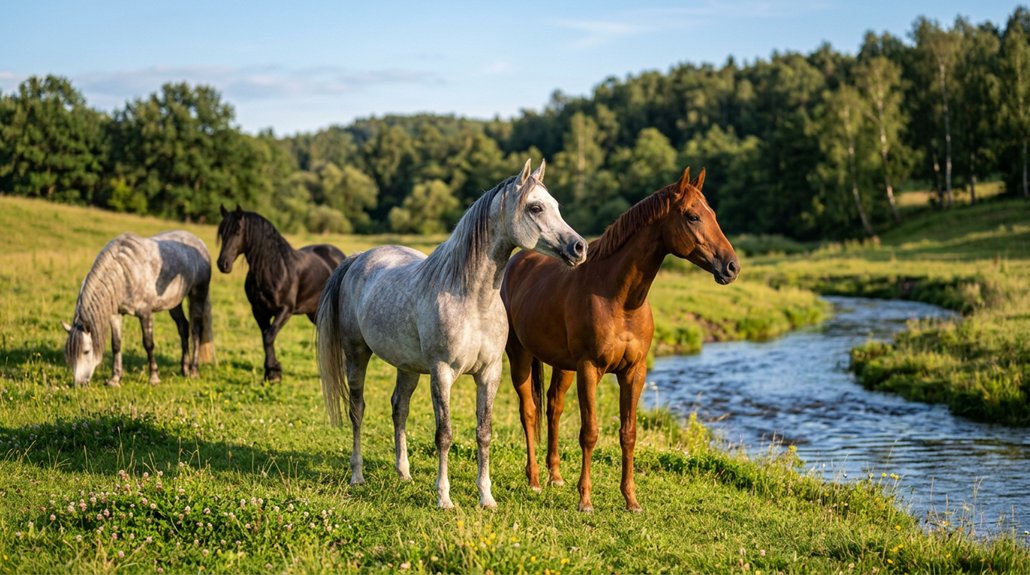
When exploring the most popular horse breeds, you’ll find each has unique attributes. American Quarter Horses excel in versatility and calm temperament, ideal for family and competition. Arabian Horses, with historic endurance, offer remarkable stamina. Thoroughbreds are renowned for speed, a hallmark of racing. Miniature Horses are prized for therapy, while Draft Horses, with immense strength, suit heavy tasks. Tennessee Walking Horses provide unparalleled comfort. Unpacking these traits further reveals the profound impact on equestrian disciplines.
Key Takeaways
- American Quarter Horses, comprising 42.1% of the North American population, are versatile in multiple disciplines and have calm temperaments.
- Arabian Horses, with a history of over 2,000 years, excel in endurance, featuring stamina, agility, and distinctive dished faces.
- Thoroughbreds, known for speeds up to 40 mph, are popular in racing, jumping, and dressage due to their athletic build and history.
- American Paint Horses are depicted by unique coat patterns, showcasing adaptability and versatility in various equestrian disciplines.
- Miniature Horses, averaging 34 inches in height, are used in driving and therapy roles, known for their gentle nature.
Introduction to Horse Breeds and Their Characters
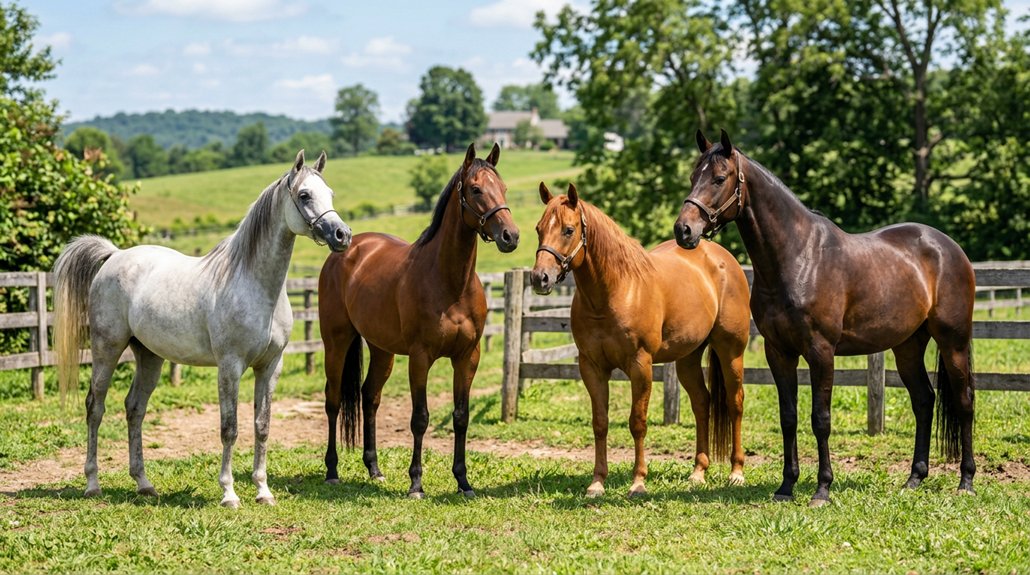
While delving into the diverse world of horse breeds, it is essential to understand that distinct characteristics emerge from selective breeding, meticulously designed to enhance specific traits in conformation and temperament. Breed evolution reflects cultural significance, with approximately 786 recognized breeds representing a rich tapestry of equine history. In North America, prominent breeds such as the Thoroughbred and Arabian exemplify specialized capabilities. Thoroughbreds excel in speed and racing, while Arabians are known for endurance and elegance. Registration protocols with breed organizations prevent genetic anomalies and safeguard lineage authenticity, maintaining cultural heritage and practical functionality across generations. Such stringent breed standards guarantee horses are well-suited for various allied activities, from competitive racing to leisure riding, highlighting their invaluable roles within human societies.
American Quarter Horse: A Versatile Champion
Building upon the extensive tapestry of horse breed characteristics, the American Quarter Horse stands out as a paragon of versatility and performance. Domestically prevalent, it constitutes 42.1% of the equine demographic, thanks to approximately 2.1 million registered individuals. Originally optimized for quarter-mile sprints, this breed exhibits unparalleled speed, reaching this distance in merely 21 seconds. Their adaptability is scientifically acknowledged across disciplines: cutting, reining, barrel racing, and Western pleasure riding. The voracious utility of American Quarter Horses extends to ranch work, ideally suited given their temperamental stability. Notoriously calm and amenable, they’re prized as family companions, accommodating both novice riders and experienced equestrians. This characteristic inclusivity underpins the American Quarter Horse Association’s (AQHA) global prominence, registering over 6 million horses.
Arabian Horses: Stamina and Historic Influence
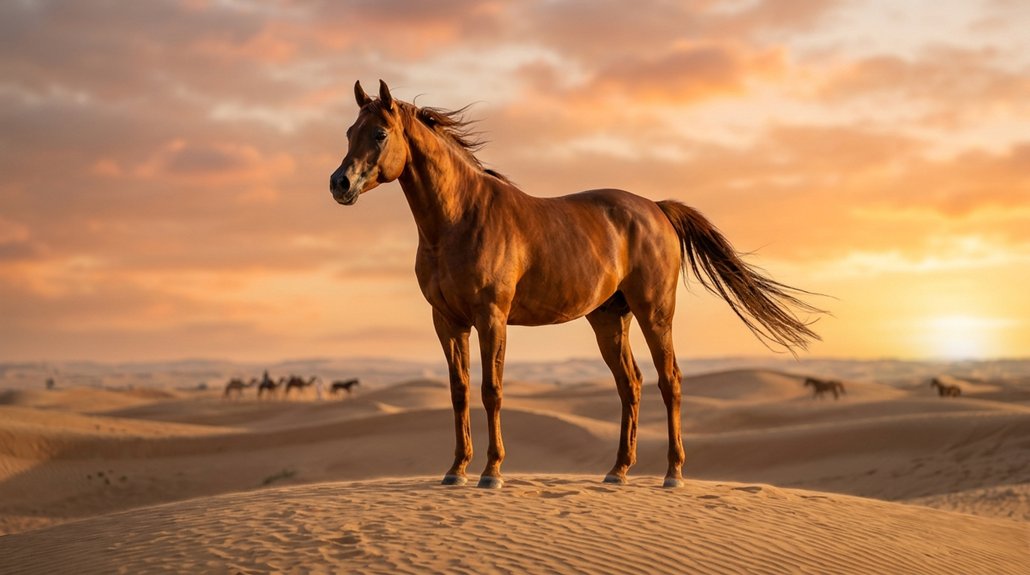
Renowned for their ancient lineage and unparalleled stamina, Arabian horses possess a rich history spanning over 2,000 years, originating from nomadic tribes in the Middle East. This breed’s origins contribute to its unique capabilities in endurance training, with Arabians excelling in long-distance equestrian sports due to their remarkable stamina and agility. Their genetic makeup, marked by distinctive phenotypic traits such as a dished face and high tail carriage, reflects centuries of selective breeding. Arabians steadily maintain influence by enhancing the genetic pool of numerous equestrian breeds.
Ancient lineage and stamina define Arabian horses, vital to endurance sports with unique traits enhancing many breeds.
Their strong rider bond and intelligence make Arabians indispensable in various disciplines. From show jumping to competitive dressage, their cultural and practical contributions remain significant.
- Admire their historical prestige and endurance.
- Celebrate their refined beauty and strength.
- Cherish their relationship with riders.
Thoroughbreds: Icons of Speed and Racing
Thoroughbreds are paramount in the racing industry due to their notable speeds of up to 40 mph, a proof of their meticulously cultivated lineage since the 17th century. You’re likely to appreciate their athletic build, typically ranging from 15.2 to 17 hands, a factor that enhances their performance not only in racing but also in jumping disciplines. Post-racing, their shift to equestrian sports such as show jumping and dressage demonstrates their versatility and continued functional utility in the equine domain.
Racing Excellence and History
Although Thoroughbreds are celebrated for their unrivaled speed, they didn’t emerge by chance but through meticulous breeding practices in England during the 17th and 18th centuries. The Thoroughbred history is grounded in racing innovations, originating from crossing Arabians with local British breeds. This selective pairing enhanced attributes like speed and stamina, accelerating the breed’s prominence. Today, they’re pivotal in the U.S. racing industry, with numerous registered annually. They reach top speeds of around 40 mph, showcasing their superiority on the track.
- Feel the adrenaline as these horses reach astonishing speeds.
- Witness history as you explore their storied bloodlines.
- Embrace legacy, knowing each racehorse carries centuries of evolution.
The Thoroughbred’s racing excellence remains a reflection of centuries of dedication.
Athletic Build and Versatility
Building upon their rich history in racing, these horses exemplify athletic excellence beyond the track. Thoroughbreds rank as the second most popular breed in North America, renowned for achieving speeds up to 40 mph. This makes them formidable contenders over middle distances such as the 1.5-mile tracks commonly utilized in racing. Their athletic design is complemented by targeted performance conditioning, allowing them to excel in various equestrian disciplines. However, their energetic and sensitive temperament necessitates experienced handling for superior Thoroughbred training outcomes. Beyond racing, they adapt adeptly into jumping, dressage, and eventing, showcasing their inherent versatility. Their lineage and unique traits are meticulously preserved by breed organizations, ensuring the perpetuation of their competitive edge and multifaceted capabilities.
American Paint Horse and Miniature Horses: Unique and Versatile
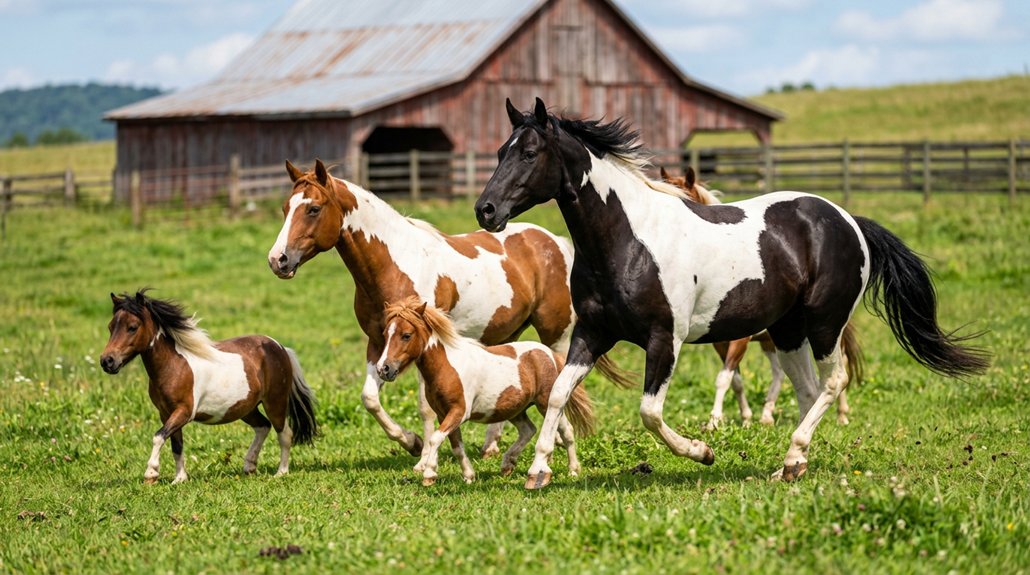
When considering the American Paint Horse, you’ll notice its distinctive coat patterns, resulting from intricate genetic expressions, which contribute to its popularity across equestrian disciplines like showing and ranch work. With origins tracing back to Thoroughbreds and native horses, this breed officially gained recognition in 1962 and now boasts over 1.1 million registrations, underscoring its versatility and adaptability. Similarly, Miniature Horses, averaging 34 inches in height, demonstrate exceptional versatility despite their size, engaging in driving events and therapy work, making them ideal candidates for both competitive and companionship roles.
Distinctive Color Patterns
Renowned for their striking coloration, the American Paint Horse exhibits large, irregular patches of white contrasted with any other equine color, contributing to its recognition in various equestrian disciplines. Such distinctive color patterns are not mere accidents but the result of meticulous breeding techniques, blending Thoroughbred and Spanish stock. This genetic strategy guarantees not only visual allure but also desirable traits like agility and placid temperament.
Miniature Horses, distinguished by their compact stature, embrace a wide spectrum of coat patterns—from solid hues to intricate spotting. The American Miniature Horse Association acknowledges these variations, which enhance their suitability as companion and therapy animals.
Adopting these breeds invites you to experience:
- Unique heritage and visual splendor
- Adaptable and gentle companions
- A commitment to preservation and pedigree
Versatile Equestrian Roles
Although equine enthusiasts may be drawn to horses primarily for aesthetic appeal, both the American Paint Horse and Miniature Horse demonstrate significant versatility in equestrian roles that transcend appearance alone. The American Paint Horse blends Thoroughbred and Quarter Horse genetics, excelling in western riding, jumping, and barrel racing. It’s not just about show; its calm temperament and adaptability lend well to performance and recreational participation. Comprising 6.8% of the U.S. horse population, they play crucial roles in competitive sports and ranch operations.
Meanwhile, Miniature Horses make impactful contributions in therapeutic roles, particularly in therapeutic settings due to their friendly disposition. Accounting for 5.1% of the U.S. population, these compact equines excel in small-scale driving events, showcasing agility and obedience. Their versatile engagements promote well-being.
Draft Horses: Powerful and Gentle Giants
Draft horses, such as Clydesdales and Percherons, are recognized for their formidable size and strength, often tipping the scales at approximately 2,000 pounds. Their draft horse temperament is especially calm and docile, ideal for heavy work tasks like pulling plows and carriages. In the U.S., they constitute about 4.7% of the equine population, underscoring their utility and value in agriculture and exhibitions. Their distinctive features, including feathered legs and muscular physiques, enhance their imposing yet gentle appearance.
Their working capabilities extend beyond traditional roles. They excel in recreational activities such as parades and competitive driving events, thanks to their gentle disposition.
- Majestic Brilliance: Their sheer size inspires awe.
- Reliable Allies: Trusted for critical agricultural tasks.
- Endearing Giants: Calm, docile nature offers companionship.
Tennessee Walking Horse: Ideal for Comfort and Trails
With its distinctive running walk gait, the Tennessee Walking Horse offers an exceptionally smooth and comfortable experience, making it an ideal choice for long-distance trail riding. This breed is engineered for comfort, thanks to its unique four-beat gait, which minimizes vertical movement and thereby reduces rider fatigue over extended distances. Possessing a calm temperament, these horses facilitate a relaxed environment essential for novice riders and seasoned equestrians alike. Accounting for approximately 4.5% of the U.S. horse population, the Tennessee Walking Horse demonstrates versatility in multiple equestrian activities such as trail riding, show, and pleasure riding, proving its adaptability beyond trails. Originally developed in the 18th century for plantation work, this breed’s popularity is bolstered by a dedicated community that endeavors to preserve its heritage.
Utilizing Horse Breeds in Modern Equestrian Sports
In modern equestrian sports, selecting the right horse breed can greatly enhance performance across various disciplines, thanks to each breed’s specialized attributes. Training techniques are tailored to exploit breed adaptations, optimizing performance. American Quarter Horses are exemplary in barrel racing, benefiting from their innate speed and agility. Thoroughbreds, with superior athleticism, excel in speed-centric sports like horse racing and show jumping. Their training regimens focus on maximizing these capabilities. Arabians dominate endurance competitions, where their stamina is unmatched. Conditioning programs prioritize aerobic capacity, perfectly aligning with their physiology. Appaloosas, noted for versatility, engage in multiple disciplines, with training emphasizing adaptability. Standardbreds lead in harness racing, with techniques aimed to enhance unique pacing abilities.
Choosing the ideal horse breed enhances performance by leveraging specialized attributes in modern equestrian sports.
- Feel the adrenaline surge in competitive races
- Witness profound endurance during grueling rides
- Experience unity between rider and horse across different events
Trends in Breeding and Equestrian Practices
Recognizing breed-specific advantages in equestrian sports naturally leads to an exploration of breeding and equestrian practices shaping these remarkable animals. Selective breeding aims to amplify desirable attributes like speed and temperament in breeds such as the Thoroughbred and American Quarter Horse. However, breeding ethics necessitate an emphasis on genetic diversity to prevent health issues. The prevalence of versatile breeds like the Arabian and American Paint signals a shift towards multi-discipline capabilities, catering to diverse equestrian interests. Historically, economic forces, evident in the Arabian boom, impact breeding decisions, occasionally resulting in overbreeding and market volatility. Present-day trends prioritize equine welfare, advocating for responsible breeding practices that focus on health and adaptability, rather than mere aesthetic traits, fostering long-term equine suitability.
Frequently Asked Questions
What Is the Most Popular Breed of Horse?
You’re asking about horse breeds and the American Quarter Horse ranks highest, constituting 42.1% of North America’s horse population. This breed is celebrated for adaptability and a calm demeanor, traits essential when evaluating top horse breed characteristics.
What Are the 3 F’s for Horses?
The 3 F’s in equine care are Feeding, Fitness, and Feet. Ideal nutrition supports equine behavior and communication, while fitness guarantees physical readiness. Proper foot care prevents disorders, essential for maintaining effective equine performance and interaction.
What Is “I Love You” in Horse?
In horse communication, “I love you” translates to nuzzling, relaxed postures, and grooming behaviors. Remarkably, about 68% of horses exhibit these equine affection signals with owners, fostering mutual trust and strengthening their bond through consistent positive interactions.
What Is the Most Unique Horse Breed?
You’ve got a range of options for the most unique horse breed. Consider the Akhal-Teke’s metallic sheen or the Icelandic’s tölt gait, each showcasing distinct breed adaptations and unique characteristics, exemplifying evolutionary ingenuity and genetic divergence.
Conclusion
In your exploration of equine excellence, you’ve encountered diverse breeds, each boasting distinct attributes. From the Arabian’s ageless endurance to the Quarter Horse’s quintessential versatility, these creatures captivate with compelling characteristics. Selection and stewardship are paramount; prioritize potential, pairing personalities with purpose. Equestrian sports evolve, embracing environmental ethics while enhancing genetic genealogy. Whether for racing, recreation, or rehabilitation, recognizing refined qualities guarantees efficient equine engagement. Your informed investment in these incredible animals promises both practical performance and profound partnerships.