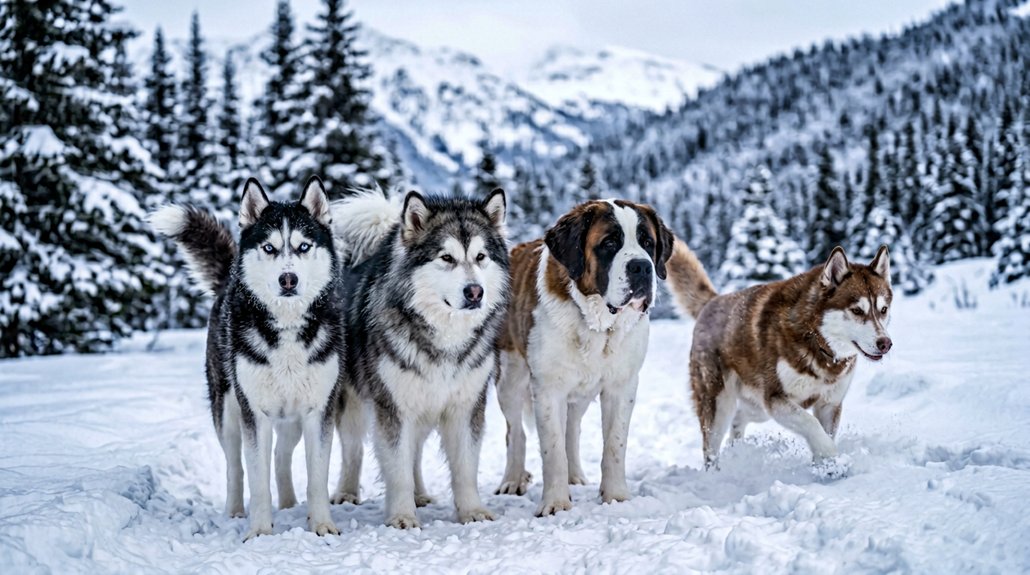
For cold weather, choose dog breeds with thick double coats and robust energy levels for thermal efficiency and endurance. Consider Siberian Huskies and Alaskan Malamutes for their superior insulation and historic sled roles. Saint Bernards offer strength and family-friendly temperaments, while Newfoundland’s water-resistant coats excel in aquatic cold. The Finnish Lapphund is suited for active family life. Evaluating these breeds guarantees health and compatibility in low temperatures. Discover more about each breed’s unique adaptation and care needs ahead.
Key Takeaways
- Siberian Huskies have dense double coats, offering superior insulation and cold tolerance, suited for snowy environments.
- Alaskan Malamutes boast extraordinary strength and endurance, ideal for traversing snow-laden terrains with exceptional cold resistance.
- Saint Bernards feature thick insulating coats and gentle temperaments, making them excellent family companions in cold climates.
- Great Pyrenees possess a thick double coat and protective instincts, serving as effective cold-weather and family-friendly guardians.
- Newfoundlands have water-resistant double coats and robust adaptations, perfect for cold-water and snow-laden environments.
Choosing the Right Cold-Weather Dog Breed
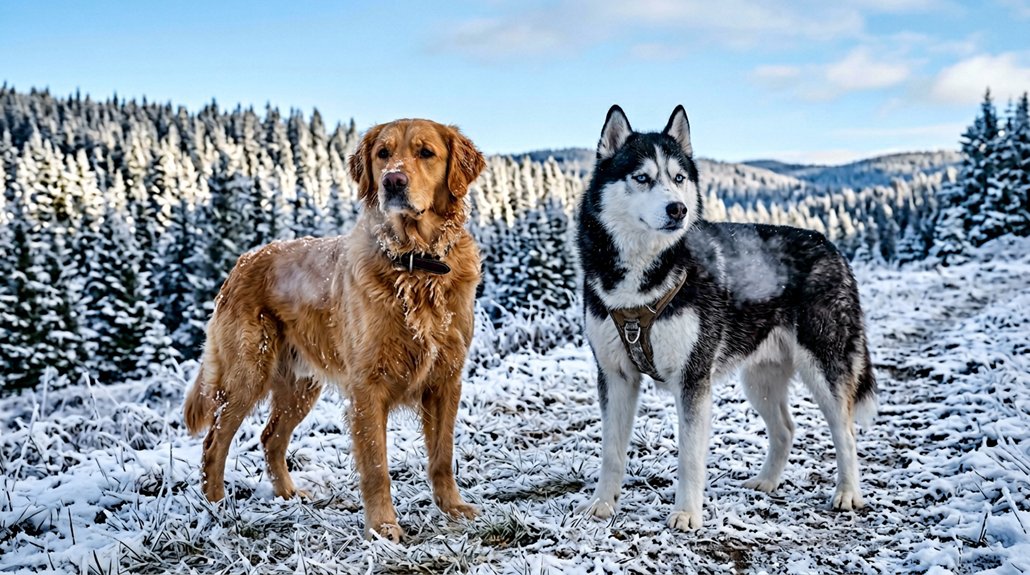
When you’re selecting a cold-weather dog breed, it’s vital to take into account several physiological and behavioral traits that enhance their ability to thrive in frigid environments. Proper grooming techniques are fundamental for maintaining the insulating properties of thick double coats found in breeds like the Samoyed and Keeshond, requiring frequent brushing to minimize shedding. You should perform a temperament evaluation to determine if a dog’s behavioral characteristics align with your experience level and lifestyle. Breeds such as the Akita and Tibetan Mastiff display independent natures needing experienced handlers. Additionally, factors like size and historical adaptability to cold, as seen in Newfoundland dogs, influence their efficacy in low temperatures. Carefully considering these aspects guarantees your chosen companion’s health and well-being in cold climates.
Cold Climate Champions: Essential Traits
Selecting a breed with ideal cold resilience involves understanding the hallmark traits that enable dogs to flourish in freezing temperatures. These cold-climate champions generally have high cold tolerance due to thick double coats that reduce heat loss by up to 60%. Their ancestral roles—ranging from sledding to guarding—demanded robust energy levels and keen protective instincts, vital for surviving harsh environments. Maintaining these traits requires regular attention to grooming needs, ensuring their insulating coat remains effective.
Key features of cold-weather breeds include:
- Thick double coats: Insulate and provide significant heat retention.
- High energy levels: Essential for performing in frigid conditions.
- Loyalty and protection: Developed for roles like sledding and rescue.
Understanding these traits helps in selecting the best companion for cold climates.
Siberian Husky: The Energetic Arctic Explorer
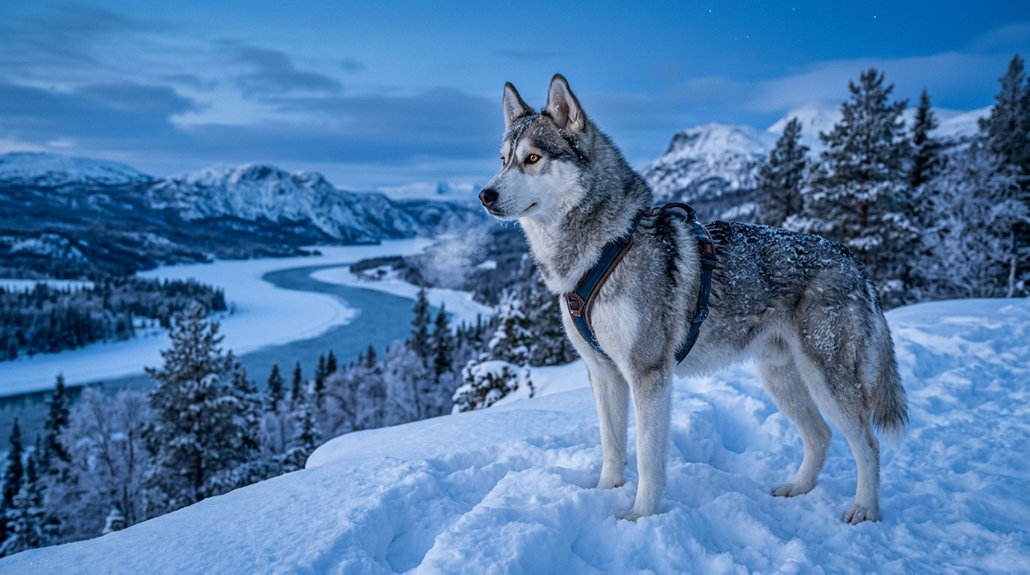
Despite their majestic image, Siberian Huskies are scientifically engineered for frigid environments due to their dense double coats and exceptional endurance. Their thick fur provides superior insulation, vital for thermoregulation in subzero temperatures. Understanding Husky behavior is important as they’re inherently energetic, requiring regular physical and cognitive stimulation to mitigate stress-related issues. Ideal training strategies focus on maintaining their sled-pulling lineage by emphasizing exercise and structured play, which supports cardiovascular health and mental agility.
With an average lifespan of 12 to 15 years, health maintenance is paramount. You’re advised to implement robust training strategies to counteract their strong pack instinct and escape tendencies. Moreover, biannual shedding necessitates grooming interventions to preserve coat functionality and prevent dermatological complications.
Alaskan Malamute: Godfather of Snow Trails
When selecting a canine for extreme winter climates, you might consider the Alaskan Malamute, noted for its unparalleled strength and endurance, essential for traversing snow-laden terrains. Its double-layered coat functions as an exceptional insulator, safeguarding against cold-induced health risks while optimizing energy efficiency in frigid conditions. Additionally, the Malamute’s amicable disposition guarantees it’s not only a robust working dog but also an ideal addition to active households that prioritize rigorous daily exercise regimens.
Strength and Endurance
Renowned as the godfather of snow trails, the Alaskan Malamute exemplifies extraordinary strength and endurance, making it a quintessential companion for cold-weather adventurers. This breed’s Alaskan heritage highlights its robust constitution, suitable for hauling heavy loads through icy landscapes. Built for endurance training, their powerful musculoskeletal structure supports ideal force exertion, crucial for sledding and freight duties. Their dense double coat, with its highly insulative properties, is physiologically adapted to withstand subzero conditions, facilitating prolonged outdoor activities. It’s essential to integrate ample exercise into their routines to enhance health and muscular stamina.
- Biophysical Adaptation: Dense, waterproof fur for insulation.
- Heritage Significance: Critical during Klondike Gold Rush.
- Physiological Demand: Requires substantial physical activity.
This scientifically grounded insight guarantees your Alaskan Malamute thrives in frigid environments.
Snowy Terrain Mastery
From strength and endurance to mastery of snowy terrain, the Alaskan Malamute remains unmatched among cold-weather breeds. As the Godfather of Snow Trails, it was meticulously bred by the Inuit to transport heavy sled loads across icy expanses. This breed’s anatomical structure, including substantial snowshoe paws, guarantees ideal weight distribution. It allows the Malamute to traverse deep snow with minimal exertion and maximal stability. Their double coat provides thermal insulation, vital for maintaining thermoregulation in frigid conditions. You’ll find that Alaskan Malamutes require regular winter exercise due to their high metabolic rates and energy demands. Engaging them in outdoor activities not only satisfies their physiological needs but also mitigates potential health issues related to obesity and cardiovascular diseases.
Family-Friendly Temperament
While the Alaskan Malamute’s prowess in snowy terrains is well-documented, its family-friendly temperament offers equally compelling attributes. Known for its friendly disposition, this breed bonds closely with owners, thriving in family dynamics. Engaging in structured training techniques is essential for maintaining their high intelligence and mental stimulation. Regular outdoor exercises paired with diverse indoor activities guarantee peak physical health and emotional well-being. Significantly, the Malamute’s gentle nature makes it adept at interacting with children, often showcasing protective instincts.
- Affectionate and Loyal: Close bonding with family members.
- Active Lifestyle Advocates: Needs regular exercise to maintain health.
- Gentle and Protective: Harmonizes well with children, assuring safety.
It’s the Malamute’s intelligent and adaptable personality that makes it a cherished addition to any family.
Saint Bernard: A Family-Friendly Avalanche Expert
Saint Bernards embody a remarkable blend of strength and gentleness, making them exceptional companions in both family settings and avalanche rescue operations. Their historical prominence in these roles is due to their adept avalanche training, leveraging their acute olfactory abilities and significant physical strength. These gentle giants create strong familial attachments, particularly with children, due to their calm temperament and adaptability.
From a health perspective, their double coat insulates against severe cold, aiding their functionality in frigid environments. Despite their calm indoor demeanor, maintaining ideal health necessitates consistent exercise to prevent obesity, a common issue in larger breeds. Their large head, droopy ears, and friendly expression not only define their iconic appearance but also contribute to their valued role as affectionate family members and responsive working dogs.
Samoyed: An Affectionate Snow Companion
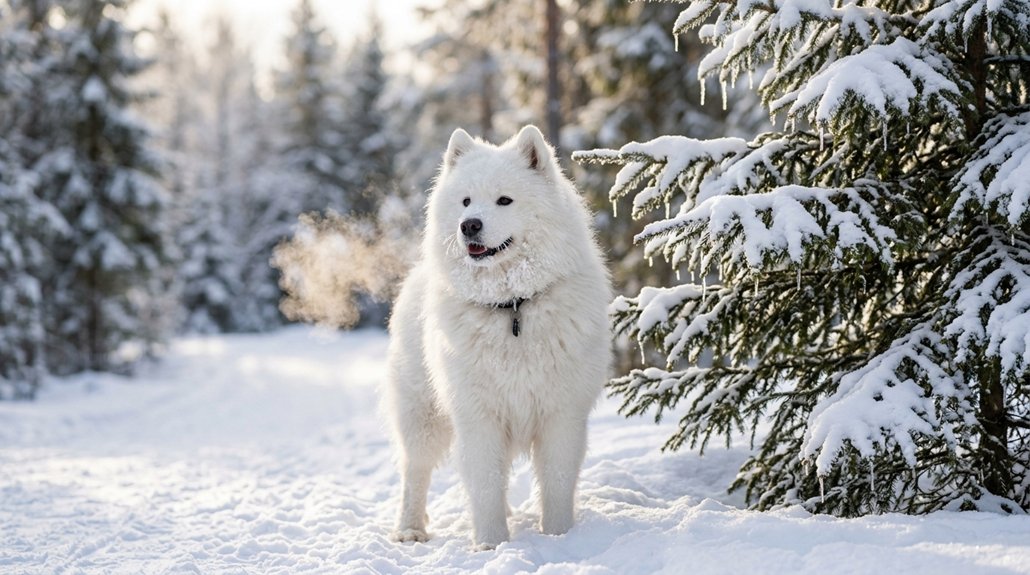
Samoyeds possess a dense, fluffy white coat that not only defines their appearance but also serves as an essential thermal barrier in frigid conditions, allowing them to flourish in cold climates. Historically, Samoyeds were bred by the Samoyed people of Siberia, primarily for herding reindeer and sled-pulling, showcasing their remarkable endurance and adaptability in snowy environments. You’ll find their friendly demeanor and “smiling” expression irresistibly endearing.
Their grooming needs are considerable due to the dense undercoat, requiring meticulous care, especially during seasonal shedding. Regular maintenance mitigates matting, enhances coat insulation, and promotes dermatological health.
- High energy levels necessitate daily physical activity for overall wellness.
- Life expectancy ranges between 12 to 14 years with excellent care.
- Known for their affable personality, ideal for families.
Great Pyrenees: A Gentle Snow Guardian
The Great Pyrenees exhibits an imposing stature, often weighing between 80 to 100 pounds, and is uniquely equipped for cold environments with a thick double coat that minimizes heat loss. This breed’s historical role as a livestock guardian showcases its protective instincts and intelligence, ideal for guarding livestock against predators. The calming demeanor of a Great Pyrenees makes it a reliable companion, especially for families with children, providing both protection and affection.
| Attribute | Description |
|---|---|
| Weight Range | 80-100 pounds |
| Coat | Thick double coat |
| Origin | Pyrenees mountains |
| Life Expectancy | 12-15 years |
| Exercise Needs | Moderate, enjoys outdoor time |
With a lifespan of 12 to 15 years, the Great Pyrenees needs moderate exercise and thrives in snowy conditions. Their minimal grooming requirement, beyond seasonal shedding, complements their robust health profile.
Tibetan Mastiff: Majestic in the Cold
When considering canine adaptations to frigid environments, the Tibetan Mastiff’s dense, woolly coat is an evolutionary marvel, providing superior thermal insulation that supports its survival in subzero temperatures. It’s essential to acknowledge that this breed exhibits an aloof demeanor towards unfamiliar individuals, necessitating regular socialization to enhance its loyalty and amiability. Because of this dual nature, health-conscious owners should prioritize environmental enrichment and structured interaction to balance the Mastiff’s protective instincts and social adaptability.
Thick Fur Insulation
A pivotal example of effective thermal regulation is seen in the Tibetan Mastiff, whose ultra-thick, wooly mane offers exceptional insulation against frigid temperatures. This ancient breed’s temperature adaptation strategies utilize their dense fur to trap body heat, creating a barrier against harsh winter environments. For peak health, these dogs benefit from structured winter exercise tips to maintain muscle tone without overexerting in icy conditions. Their anatomy and physiology are fine-tuned for low-temperature climate adaptation.
To enhance understanding of their cold-weather prowess, consider the following:
- Thermal Insulation: Their thick fur acts as a thermal blanket, maximizing warmth.
- Guarding Instincts: Their expansive build aids in protecting livestock from harsh elements.
- Cold Adaptation: Well-suited for snowy conditions, they prefer ample space and cold climates.
Aloof Yet Loyal
Tibetan Mastiffs exemplify a majestic blend of independence and loyalty, traits finely honed by their heritage in the cold Himalayas. Their thick, woolly coat acts as a thermal barrier against frigid temperatures. Yet, their lion-like demeanor signifies more than just beauty; it cues an innate aloofness, critical when crafting socialization strategies. Introduce them to a variety of experiences early, making sure they view strangers positively. Training challenges arise from their inherent stubbornness, necessitating structured, consistent conditioning protocols to harness their allegiance effectively. These assertive canines demand robust leadership to form positive social interactions, as well as a commitment to regular physical activity to support their mental and physiological well-being. You’ll need patience, but their loyalty is unparalleled.
Newfoundland and Cold Waters: Nature’s Lifeguard
Despite their gentle demeanor, Newfoundlands exhibit a robust physiological adaptation that makes them exemplary in cold-water environments. Possessing fantastic attributes like webbed feet and a water-resistant double coat, these gentle giants are naturally equipped for water rescue operations. Their buoyant bodies facilitate ease in aquatic movement, enhancing their effectiveness in lifesaving endeavors. Biomechanically, their muscular build supports remarkable stamina, essential during long-duration swims.
Examine these Newfoundland attributes:
- Hydrotherapy-Mimicking Coat: The thick double coat insulates against freezing temperatures, maintaining core body stability.
- Environment-Specific Behavior: Bred for water rescues, their instinctual urgency in aquatic scenarios makes them proficient at assisting humans.
- Psychological Profile: With a calm and patient temperament, they coexist harmoniously with children and other animals, enhancing social health.
Invest in Newfoundland activity for ideal well-being.
Finnish Lapphunds: From Reindeer to Family Herding
When you consider the Finnish Lapphund, renowned for its origin in Finland as a reindeer herder, its resilience to frigid environments stands out. This breed demonstrates remarkable adaptability attributed to its thick, weatherproof coat, serving as a biological insulator against cold stressors. Finnish Lapphunds possess inherent herding instincts, supported by their historical role in reindeer herding. These medium-sized canines are skilled in cognitive conditioning, enhancing their receptivity to scientifically-backed training techniques. You’ll find their friendly disposition ideal for active family dynamics demanding physical and mental engagement. Regular exercise optimizes physiological health, necessitating outdoor activities which stimulate their instinctual behaviors.
| Trait | Description |
|---|---|
| Origin | Reindeer herding |
| Coat | Weatherproof and insulating |
| Temperament | Friendly and enthusiastic to please |
| Exercise needs | Requires regular physical and mental activity |
Frequently Asked Questions
What Is the Most Cold Tolerant Dog Breed?
You’ll find the Siberian Husky excels in cold climate adaptability. Its thick fur insulation provides exceptional protection against frigid temperatures, ensuring health and survival in harsh environments. They’re a scientific marvel in the domain of canine cold tolerance.
What Annoys Dogs the Most?
Picture a dog’s stress as a ticking clock when loud noises fill the air. Unfamiliar environments amp up cortisol levels, triggering anxiety. It’s essential to guarantee consistency to maintain their psychological well-being and emotional homeostasis.
Do Dogs Have a Favorite Person?
Yes, dogs can exhibit loyalty towards their favorite person by forming strong bonds influenced by social interactions and trust. Their emotional attachment is typically rooted in consistent caregiving, positive reinforcement, and calm assertive energy from humans.
What Words Do Dogs Hear Best?
Dogs’ ears are like finely-tuned radars, excelling in sound recognition with auditory cues featuring hard consonants, like “sit” or “stay.” Consistent, upbeat vocal tones enhance comprehension, maximizing their cognitive processing for effective command learning.
Conclusion
Choosing the right cold-weather dog breed can be akin to natural selection in evolutionary biology. Imagine a Tibetan Mastiff, majestic amid snow, akin to an apex predator perfectly tailored to its environment. Their double-layered coat acts like the insulation in thermoregulation, vital for maintaining homeostasis in frigid climates. Each breed thrives due to unique anatomical adaptations, teaching us the importance of physiological resilience. Selecting one for your family guarantees an enduring bond in life’s wintry landscapes.