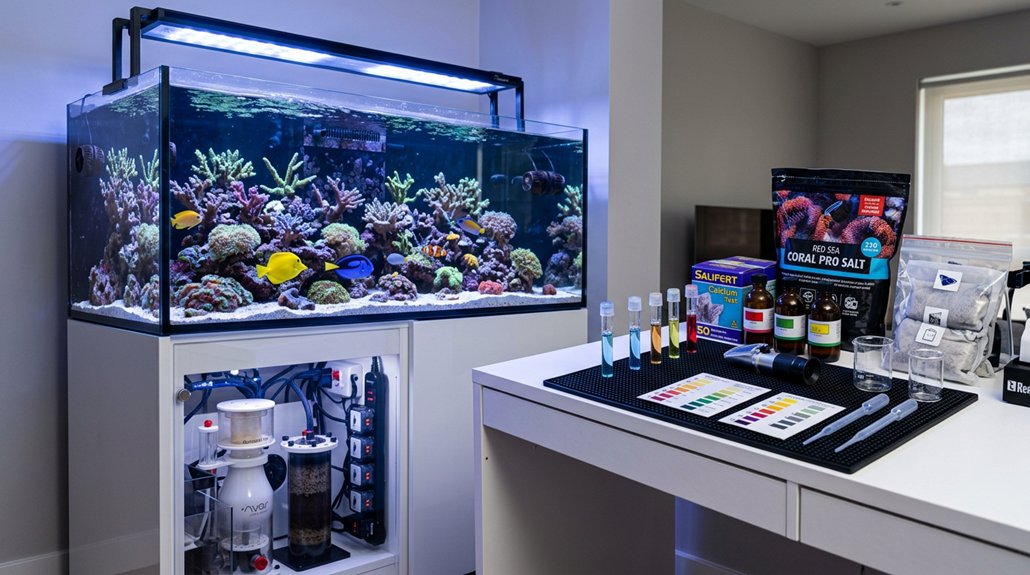
A saltwater aquarium usually costs you $700 to $2,000 to set up, though a modest build can start around $500 and larger, heavily stocked reefs can run much higher. You’ll need to budget for the tank, stand, heater, lighting, filtration, circulation, rock, sand, and initial fish or corals. Ongoing costs often add $50 to $100 per month for salt, testing, food, electricity, and maintenance, with upgrades and replacements increasing over time.
Key Takeaways
- A modest first-year saltwater aquarium setup usually costs about $500–$1,000.
- A new mid-range system often costs $1,000–$2,000, while a 30-gallon reef can reach $700–$2,000.
- Core equipment includes the tank, stand, heater, lighting, filtration, return pump, and often a protein skimmer.
- Rock, sand, and lighting typically add about $250–$750, depending on tank size and equipment quality.
- Expect ongoing monthly costs of about $50–$100 for salt, testing, food, electricity, and maintenance supplies.
How Much Does a Saltwater Aquarium Cost?
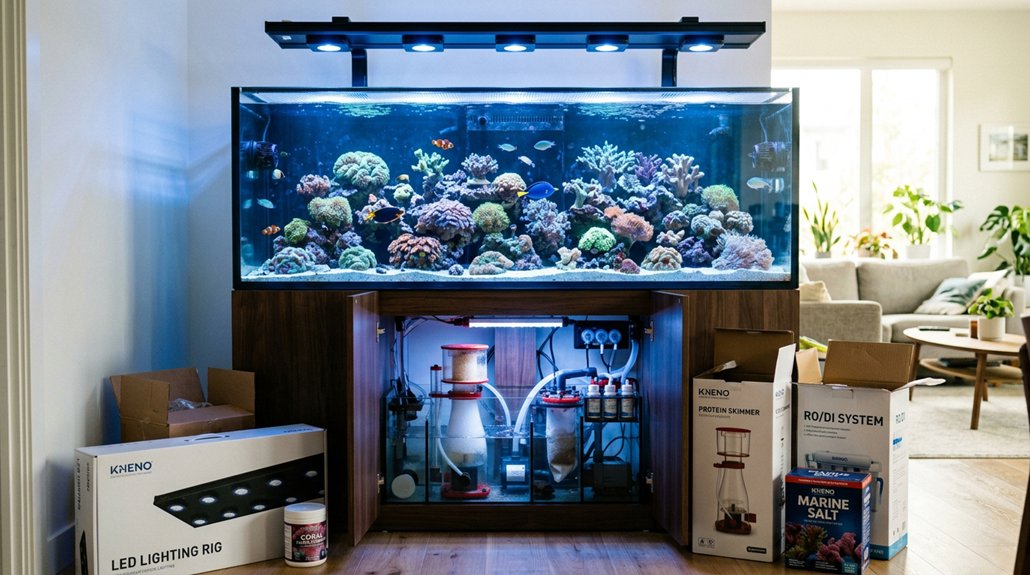
A saltwater aquarium usually costs more than a freshwater setup, and you should plan for $500–$1,000 in the first year for a modest budget build, or $1,000–$2,000 for a new mid-range system. In practice, you’ll often spend about $25–$100 per gallon, depending on component quality. A 30-gallon beginner reef-ready tank can land between $700 and $2,000 once you include the stand, filtration, lighting, circulation, rock, sand, and initial livestock. Core line items commonly include a tank, sump, return pump, protein skimmer, circulation pumps, and lighting. You’ll also need about $50 per month for salt, test kits, food, and routine maintenance. Careful maintenance schedules and advice from hobby communities can help you control upgrades and avoid overspending over the first 12–24 months.
What You Need to Start a Saltwater Tank
To start a saltwater tank, you’ll need core equipment: an aquarium, stand, heater, thermometer, and appropriate lighting matched to your livestock plan. You’ll also need filtration and flow components, including a sump, return pump, and often a protein skimmer, plus circulation pumps sized to move at least 5× your tank volume per hour. Add substrate, live or dry rock for biological filtration and aquascaping, then budget for salt mix, test kits, and basic tools to complete the setup.
Core Tank Equipment
Building a saltwater tank starts with the core equipment that keeps water chemistry stable and livestock healthy. You’ll typically begin with a 30-gallon reef-ready glass or acrylic aquarium, which balances stability and equipment cost. Choose a stand that matches the tank material and supports full contact for acrylic to preserve tank aesthetics and maintenance access.
| Item | Typical Cost |
|---|---|
| 30-gallon tank | $135–$400 |
| Stand | $75–$300 |
| Lighting, rock, sand | $450–$1,500 |
A glass tank usually runs about $135–$300, while acrylic is about $200–$400. A sturdy stand adds $75–$300, and DIY can reduce that. For reef setups, quality LED lighting, live or dry rock, and sand add substantial cost, so your initial budget should account for the display first and the aquascape next.
Filtration And Flow
Once the tank and stand are in place, filtration and flow become the next major budget item because they determine how clean, oxygen-rich, and stable the system stays. You’ll want a return pump that moves 4–6× your tank volume each hour, so a 40-gallon tank needs roughly 160–240 GPH through the system. A protein skimmer sized to your aquarium, usually $200–$500, strips dissolved waste before it becomes nitrate and phosphate. For circulation, aim for about 5× tank volume in randomized flow, using one wavemaker or powerhead per 3 feet of tank length to prevent dead spots. A sump, often $40–$200, adds equipment space and power-outage capacity. If you prefer simplicity, an AIO can reduce upfront cost, while separate gear may run $300–$800+. Flow optimization and skimmer maintenance matter.
Rock, Sand, And Lighting
Rock, sand, and lighting round out the core startup costs because they shape both the biological stability and the long-term livestock options of your tank. You’ll typically budget 0.5–1.5 lb of live rock per gallon; for a 30-gal system, that’s 30–45 lb. New rock runs about $5–$12/lb, while used rock is cheaper. 1. A shallow 1″ sandbed usually fits mixed reef tanks; plan roughly 1 lb per gallon. 2. Deeper substrate depth needs 2–3× more sand and can alter nutrient processing. 3. Lighting should match livestock: modest LEDs suit fish-only tanks, but coral systems need higher-output fixtures with proper PAR and spectrum. Reef rubble can help fill gaps. Expect about $100–$420 total for lighting and roughly $100–$330 for rock and sand.
Choose the Right Tank, Stand, and Sump
Choose a tank, stand, and sump that fit both your livestock plan and your budget, because these core components drive a large share of startup costs. Glass reef-ready tanks usually begin near $135 for small sizes and can exceed $300 as capacity and features increase; acrylic tanks often start around $200 and run past $400, with better clarity but more scratch risk. For tank placement, you’ll need a stand in the $75–$300+ range, with MDF or plywood cheapest and metal or finished cabinets pricier. Acrylic tanks need full-length, flat support. A sump typically costs $40–$200 and should hold drainback volume from a power outage. Plan sump plumbing carefully, because the sump also houses media and supports future equipment. An initial tank, stand, sump, and pump package often totals several hundred to low thousands.
Budget for Skimmer, Pump, and Flow
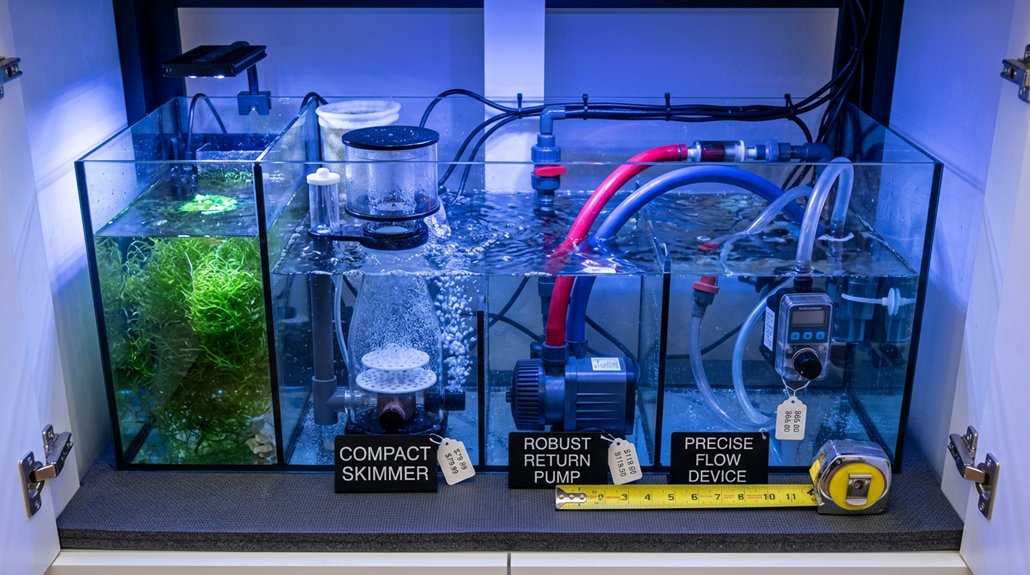
After the tank, stand, and sump are accounted for, the next major cost is the equipment that keeps water moving and oxygenated. You’ll usually budget $200–$700 for a starter reef setup.
- A protein skimmer for a 30–40 gallon system typically costs $120–$300; nano skimmers start around $80–$150.
- Your return pump should deliver 4–6× tank volume per hour through the sump, so a 30-gallon tank needs about 120–180 GPH; expect $60–$300, plus attention to pump noise.
- For display circulation, target at least 5× total flow; wavemakers often add $30–$300 each, and $30–$100 more covers fittings, unions, and silencing parts.
Plan flow optimization early, then tie cleaning into your maintenance scheduling.
Plan Your Lighting, Rock, and Sand
Lighting, rock, and sand are the next major budget drivers, and they’ll determine both the look and biological function of your reef. For a 30-gallon starter tank, you’ll usually spend $150–$400 on LED lighting, with quality app-enabled fixtures around $300, or $100–$560 on T5 systems depending on bulbs and channels. Match output to your livestock goals: moderate LEDs suit fish-only or soft coral setups, while higher-intensity LEDs or premium T5s fit SPS requirements. Pay attention to lighting placement so coverage is even and shadowing stays controlled. Plan 15–45 lb of live rock and about 30 lb of sand for a 1-inch bed, more for deeper beds. Consider substrate chemistry, plus delivery, curing, and pest risk before buying.
Estimate Livestock Costs for Fish and Corals
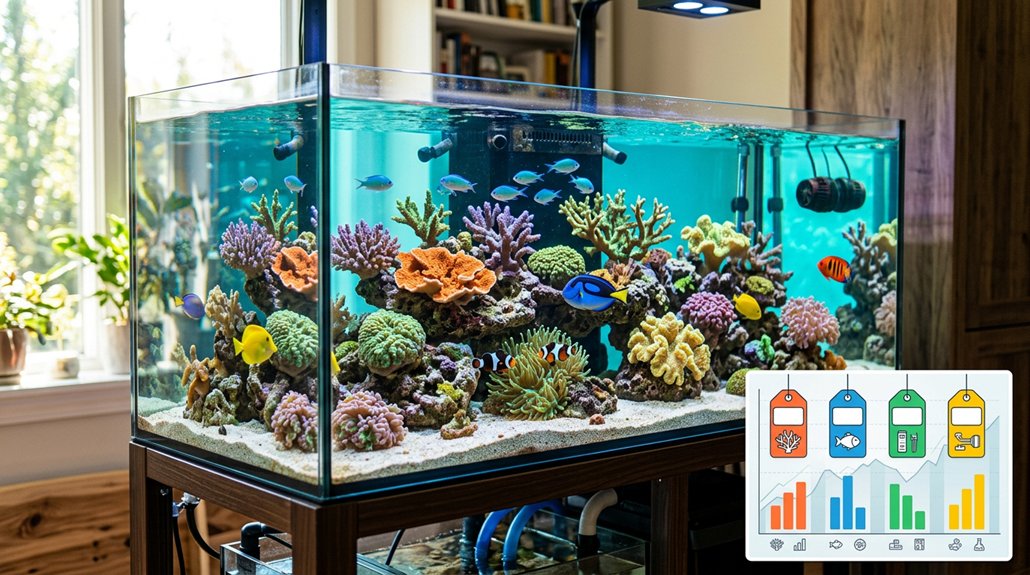
Once you’ve budgeted for the tank, equipment, and aquascape, livestock will usually be the next cost to add up. For a beginner reef, you’ll typically spend $12–$40 per small fish, with common starter species averaging about $20. Colorful tangs, angelfish, or rarer wrasses often cost $40–$200, and specialty specimens can reach $500–$1,500. Corals add another layer: soft coral and common LPS or SPS frags often start at $10–$50, while premium colonies may exceed $100–$500.
Livestock is often the next big reef cost, with fish and corals ranging from budget frags to premium specimens.
- Fish: budget by species and size.
- Corals: price rises with rarity and colony size.
- Inverts: include them in your livestock total.
A stocked 30-gallon reef often needs $300–$800 initially. Prioritize breeding programs and quarantine procedures to reduce losses.
Track Ongoing Saltwater Tank Costs
You’ll need to budget recurring monthly supply costs of about $30–$100 for salt mix, test kits, supplements, and food, with the total rising as tank size and coral stocking increase. Power use for pumps, lights, heaters, and controllers can add roughly $10–$60 per month, while consumables and small equipment like carbon, filter socks, bulbs, and impellers typically need replacement every 3–12 months at $20–$150 per event. You should also plan for larger livestock, salt, and upgrade expenses, since occasional replacements or emergencies can add $100–$1,000+ in a single incident.
Monthly Supply Costs
Monthly supply costs for a saltwater aquarium are usually manageable, but they add up steadily, so it’s important to budget for them from the start. For a typical 30–50 gallon tank, you’ll spend about $20–$50 monthly on salt mix, water testing supplies, and food. Add $10–$30 for replacement filter media, activated carbon, and alkalinity or calcium additives if you keep corals.
- Consumables: salt, test kits, food.
- Maintenance media: carbon, pads, chemical supplements.
- Ongoing reserves: lighting wear, RO/DI cartridges, top-off water, and emergency savings.
You should also expect $5–$15 per month for light replacement amortized, or more if you’re upgrading LEDs. Set aside $10–$40 monthly as a spare-parts reserve for equipment failures or unexpected treatment needs.
Livestock And Replacement
Beyond routine consumables, livestock and equipment replacement are the other major ongoing saltwater aquarium costs to track. You’ll usually spend $12–$80 per fish and $10–$200+ per coral or invertebrate, so a phased 30-gallon reef can total $500–$800 over months.
| Item | Typical Cost | Notes |
|---|---|---|
| Fish | $12–$80 | Popular species often near $20 |
| Corals/Inverts | $10–$200+ | Price rises with rarity and size |
| Replacements | Several hundred/year | Disease or transport losses |
Frag swaps and used livestock can cut stocking costs by 50% or more, but quarantine protocols still matter to protect your system. For equipment, plan replacement cycles every 3–7 years; pumps and skimmers may cost $30 to $500 each. Heavily stocked reefs can push first-year livestock spending into the thousands.
Power, Salt, And Upgrades
Power and consumables are the next big ongoing saltwater tank costs to track. Your monthly salt mix, test kit replacements, and food usually run $30–$60, while RO/DI water, buffer, carbon, and phosphate removers can add $5–$40 more. Electricity for pumps, heaters, and lighting often costs $10–$50 monthly, so energy budgeting matters, especially if you run multiple powerheads or a skimmer.
- Salt and supplies: expect bulk 20–50 lb salt bags to cost $30–$60.
- Utilities: LED lighting reduces draw, but equipment quality changes usage.
- Upgrade scheduling: plan $100–$500 yearly for pumps, skimmers, controllers, and lighting as you move toward reef-level demands.
Over two years, total upgrades can add $1,000–$2,000.
Frequently Asked Questions
Is It Expensive to Start a Saltwater Tank?
Yes, it can be expensive: you’ll likely spend $500–$1,000 initially, and more with livestock. Your equipment choices and maintenance schedule strongly affect total cost, especially if you replace undersized gear or skip essentials.
Is a Saltwater Aquarium Worth It?
Yes, it’s worth it if you value marine biodiversity and can handle the hobby commitment. You’ll get striking livestock and pride of ownership, but you’ll also need steady maintenance, testing, and ongoing monthly expenses.
Is It Hard to Start a Saltwater Aquarium?
Yes, you’ll find it harder than freshwater: like balancing a tide in glass, you must manage salinity, alkalinity, calcium, and magnesium. With beginner equipment and maintenance learning, you can start successfully, but mistakes hit fast.
Conclusion
Setting up a saltwater aquarium can cost more than a freshwater system, but careful planning helps you control expenses. You’ll need to budget for the tank, stand, sump, skimmer, pump, lighting, rock, sand, and livestock, plus ongoing salt, food, and maintenance. If you choose equipment wisely and stock gradually, you can avoid costly mistakes. As the adage goes, “You get what you pay for,” so investing in quality upfront often saves you money later.